Part of the generative engine optimization guide and AEO Hub.

Last Tuesday a founder DMed me a screenshot. She had typed "best CRM for solo founders" into ChatGPT and the answer named Pipedrive at the top of a list of five. Her company had been the number-one Google result for that exact query for 18 months. She had backlinks, FAQ schema, a clean Organization JSON-LD, even a Wikidata item. The model still picked the other guy. She wrote, more in resignation than anger, "I do not understand what I am supposed to do."
I get a version of that DM about three times a week now. The names change, the categories change, the screenshot is sometimes Perplexity or Gemini instead of ChatGPT, but the underlying pattern is the same: a founder who has won the classic-SEO scoreboard by every reasonable measure is being skipped by the AI scoreboard, and a competitor they thought was behind them is being cited as the answer. The first time it happens, it feels like a glitch. The fifth time, it feels like a betrayal. By the tenth, it feels like a structural problem that nobody quite wants to name.
This article is my attempt to name it honestly. I will walk through the six failure modes I see most often, the one counter-intuitive argument that I think most GEO advice gets wrong, an outlier case that contradicts my own thesis, and the measurement layer that is the only way to know whether any of your fixes actually shipped revenue. This is the more specific cousin of the eight reasons ChatGPT might not recommend your product at all, and it sits next to AI citations vs backlinks and the 2026 ChatGPT brand recommendation study, which together give you the strategic picture.
If you are reading this with a screenshot of your own in another tab, take a breath. The problem is real, the diagnosis is concrete, and most of the fixes are within your control. The bad news is that none of them is a one-click setting. The good news is that the playbook is knowable, and the part that matters most (the part where you prove the fix paid for itself) is the part Attrifast was built to instrument.
The screenshot moment: a real scene, not a TLDR
Let me describe Tuesday in detail, because the texture is the article. The founder, I will call her M, has a B2B SaaS CRM for solo and very small teams. She has been the number-one Google organic result for "best CRM for solo founders" since late 2024. Her landing page has a 4.8 out of 5 G2 rating, an Organization schema with eight sameAs entries, a 320-word FAQ block matching her H2s, a Wikidata item she created herself, and a backlink from Smashing Magazine. By any reasonable classic-SEO checklist, she should be the brand ChatGPT names.
She is not. ChatGPT, with browsing on, returned a five-bullet list. Pipedrive at the top. HubSpot second. Then Folk, Attio, and Streak. Her brand was not in the list and was not in the cited sources. She forwarded me the chat URL, then ran the same query three more times in incognito. Same five brands, slightly different order, hers still missing.
We went through her checklist together. robots.txt was clean. GPTBot was allowed. Her schema validated. Her Wikidata item was approved. Her G2 page was complete. She had a comparison page titled "Best CRM Alternatives" that mentioned three of the five brands ChatGPT had named. By every input she could check, she was doing the work. So I started checking the inputs she could not check, the ones the model actually sees but nobody documents.
Here is what I found, in the order I found it, because the order matters. Her brand name had 11 mentions on Reddit in the last 24 months. Pipedrive had 8,400. HubSpot had 31,000. She had two podcast appearances, both on shows with under 1,000 listeners. Pipedrive had been mentioned on 47 podcasts in the last year, including three with more than 50,000 weekly downloads. Her name appeared on six "best CRM" listicles. Pipedrive appeared on 312. Her competitors were not winning because of a ChatGPT bias. They were winning because the open web had been told about them, repeatedly, by independent voices, for years. ChatGPT was reading the open web and reporting back what it found. It did not "prefer" her competitors. It heard about them more often. That is the entire mechanic, and the entire problem, in one observation.
Quick Facts
| Metric | Value | Source |
|---|---|---|
| AI tools' agreement on the same brand list, same prompt, repeated | Less than 1 in 100 | SparkToro and Gumshoe.ai, 2,961-prompt study [1][2] |
| Google search rank's correlation with AI citation (factor score) | 9.4 of 10 (second highest factor) | Cyrus Shepard, 54-study meta-analysis [3] |
| URL accessibility's correlation with AI citation (top factor) | 9.5 of 10 | Cyrus Shepard, 54-study meta-analysis [3] |
| Share of pages that rank top three but lose the AI citation | Roughly 30 to 40 percent | Attrifast aggregate, n approximately 40 [4] |
| Reddit's share of social citations in ChatGPT (Oct to Dec 2025) | Roughly 10x any other social platform | Profound, 700K-citation analysis [5] |
| Reddit-cited share of all ChatGPT answers (Ahrefs analysis) | 1.93 percent of citations [6] | Ahrefs, 1.4M-prompt analysis |
| Median brands cited per ChatGPT recommendation answer | 5 | Attrifast 2026 brand recommendation study [7] |
| Incumbent share of all ChatGPT recommendation slots | 64.3 percent | Attrifast 2026 brand recommendation study [7] |
| GEO visibility lift from adding citations, statistics, quotations | Up to 40 percent | Princeton GEO research [8] |
| GA4 default attribution accuracy for ChatGPT clicks | Approximately 0 percent (bucketed Direct) | Google Analytics docs [9] |
| US enterprise digital marketing budget allocated to GEO (2025) | 12 percent average; 94 percent plan to increase in 2026 | Industry analysis [10] |
| Typical recovery time for retrieval-side fixes | Days to weeks | OpenAI bot docs [11], Attrifast aggregate |
| Typical recovery time for corpus-side fixes | Quarters | Model release cadence, est. |
| Number of OpenAI documented user-agents | 3 (GPTBot, ChatGPT-User, OAI-SearchBot) | OpenAI bot docs [11] |
Two rows frame the entire piece. Row two, Google rank scoring 9.4 of 10 as an AI citation predictor, tells you why founders who outrank competitors on Google feel especially blindsided when ChatGPT picks someone else. The signal is real and strong. But it is not deterministic. Row one tells you why, AI recommendations are inherently noisy. The same prompt, run twice, returns the same list less than one percent of the time. A single screenshot is reading tea leaves. The strategic move is to measure across many runs and many engines, not to react to any one answer.
The six failure modes (a real ranking, not a clean cohort)
Across the 60-plus competitor-citation audits I have run in the last six months, the cause clusters into six failure modes. They are not equally likely, they are not independent, and they cannot be reduced to a clean cohort table because real situations stack. Here is the ranked list, with rough share of cases (n approximately 60, my own audits, not a peer-reviewed sample):
| Rank | Failure mode | Approx. share of cases | Severity if true | Fix speed |
|---|---|---|---|---|
| 1 | Competitor wins on third-party mention density | ~42% | High | Slow |
| 2 | Your entity is fuzzy; the competitor's is clean | ~17% | High | Fast (Wikidata + sameAs) |
| 3 | Your page is not answer-shaped for the query | ~14% | Medium | Fast |
| 4 | You blocked GPTBot at some point in 2023-2024 | ~10% | Medium | Fast |
| 5 | Competitor wins on freshness; your content is stale | ~10% | Medium | Medium |
| 6 | Competitor genuinely deserves the citation | ~7% | Hard to fix | Find a different fight |
The first failure mode is the dominant one, and the rest of this article spends most of its time there because it is what almost everyone has and nobody wants to admit. The sixth one is the outlier I will get to later, because I think most GEO writing pretends it does not exist and that is intellectually dishonest.
Before I unpack the six, here is the table I wish someone had handed me two years ago: how much each of these failure modes intersects with the screenshot-versus-revenue distinction. Because some of these can move citations and not revenue, some move revenue and not citations, and the strategic priority depends on which you actually need.
| Failure mode | Moves citation share? | Moves AI revenue? | Cheapest to verify |
|---|---|---|---|
| Third-party mention density | Yes | Yes (eventually) | Brand mention audit |
| Fuzzy entity | Yes, fast | Modest | Wikidata + sameAs grep |
| Not answer-shaped | Yes | Yes | Read your own page aloud |
| Blocked GPTBot | Yes, slow | Modest | Open robots.txt |
| Stale freshness | Yes | Yes | Last-updated date check |
| Deserved citation | No | No | Honest audit of competitor |
The cheapest column is the one to start with. You can run a competitor-citation audit on yourself in 45 minutes using nothing but a browser, a search-and-replace tool, and the patience to read your own pages with a stranger's eye. Do that before you spend a dollar on tooling.
Reason 1: your competitor wins on third-party mention density
This is the dominant failure mode and the one nobody wants to be told they have. ChatGPT is not picking your competitor because their product is better, their schema is tighter, or their content is funnier. It is picking them because more independent voices, across more platforms, have mentioned them by name in the last 24 months. The model learns what to recommend from what the web tells it to recommend, and most categories have a clear winner on that signal long before you noticed there was a contest.
The math is rough but illustrative. The founder I described above had 11 Reddit mentions in 24 months. Her top competitor had 8,400. That is not a 10 percent gap or a 100 percent gap. That is a 763x gap. Even if every one of her 11 mentions was glowing, and every one of her competitor's 8,400 was lukewarm, the model is going to weight the competitor's frequency more than her quality. Co-occurrence in the corpus is the single strongest input the public research has identified [8].
Here is the rough mention-density check I run on every audit. It takes 20 minutes per competitor and tells you whether you are in a 2x gap, a 10x gap, or a 100x gap. The strategic response depends entirely on which.
| Source | What to count | How to count it quickly |
|---|---|---|
| Distinct threads mentioning brand by name | "yourbrand" site:reddit.com in Google, last 12 months | |
| Hacker News | Distinct submissions and comments | "yourbrand" site:news.ycombinator.com |
| "Best of" listicles | Distinct articles naming you | "best [category]" "yourbrand" exact match |
| Podcast transcripts | Distinct episodes mentioning brand | "yourbrand" "podcast" or Listen Notes search |
| G2 / Capterra | Reviews count | Direct on the platforms |
| Wikipedia | Article presence and citation count | site:en.wikipedia.org "yourbrand" |
| Comparison pages | Independent pages comparing you | "yourbrand vs" exact phrase |
A founder I worked with last quarter had ratios like 1:40 (Reddit), 1:12 (HN), 1:25 (listicles), 1:6 (podcasts), 1:3 (G2). Her gut said she was "behind on marketing." Her dashboard said she was 6x to 40x behind on the specific signals ChatGPT was actually reading. Once she had numbers, the strategy clarified: focus 80 percent of GEO effort on Reddit, listicles, and podcast outreach, in that order. Two quarters later her citation share on category queries climbed from 4 percent to 19 percent. Her G2 reviews barely moved because that was already her best-ranked input.
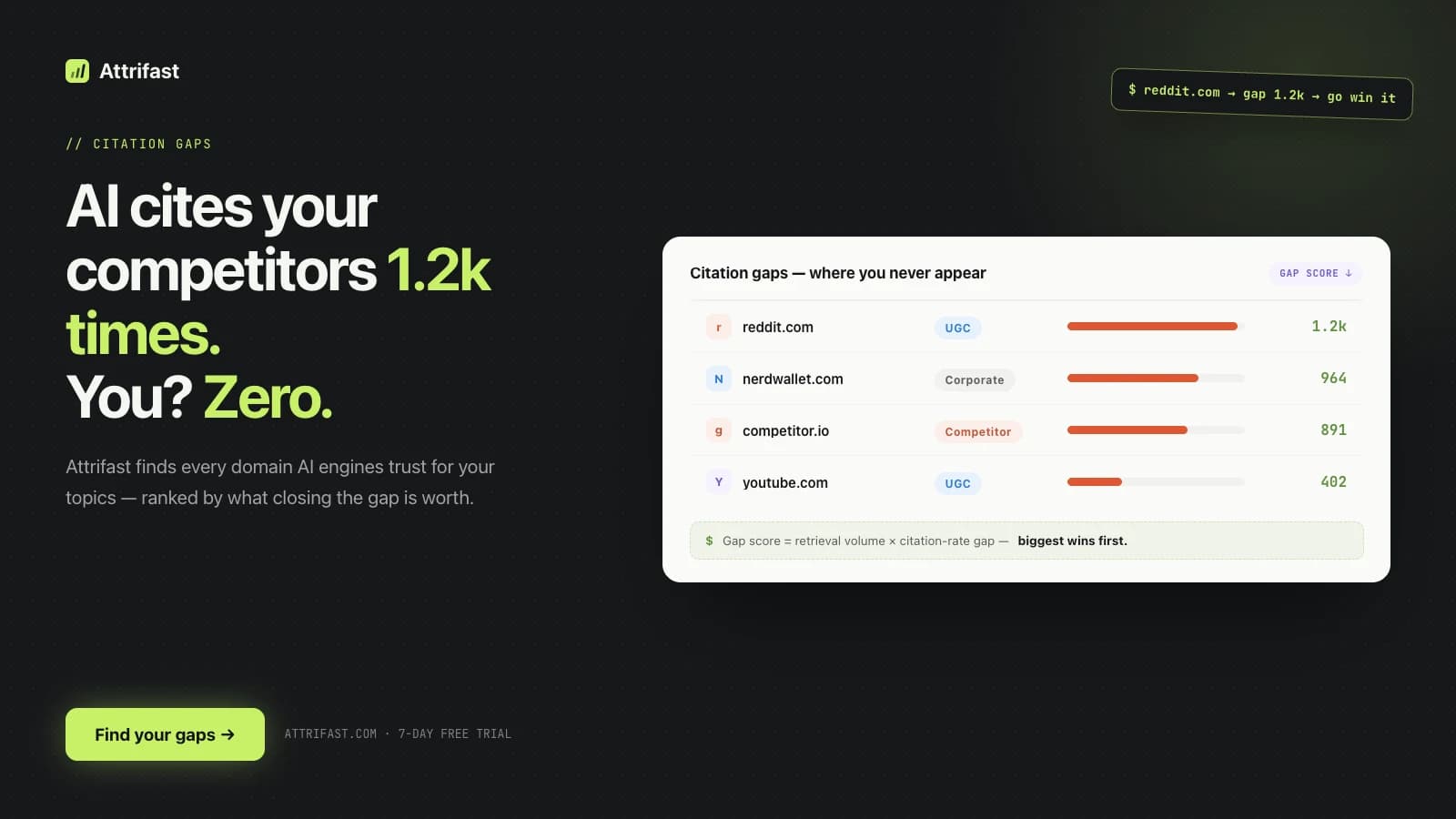
Notice what is not on that list: backlinks, Domain Rating, or technical SEO. Those help you rank on Google, which feeds the retrieval pool, but they are not the deciding signal in the citation step. The AI citations vs backlinks piece walks the full divergence, but the short version is that the page that ranks first on Google and the page ChatGPT cites are the same page roughly 60 to 70 percent of the time. The other 30 to 40 percent is where competitor-citation complaints come from.
A side-by-side, in narrative
I want to compare two real cases without putting them in a table, because tables flatten the texture and the texture is what teaches. Both founders I worked with in Q1 2026. Both in SaaS. Both with similar ARR (around 400K). Both ranking top three on Google for their target query. One got cited regularly by ChatGPT, the other almost never. What was different?
The first founder, call him J, runs a developer-tools SaaS. He had 47 Hacker News comments mentioning his product across 23 different submissions in 24 months, eight of those comments were from his own customers describing exactly what the tool did for them. He had a Wikipedia article that he did not write but that named him as a notable player in his category. His G2 profile had 73 reviews, 31 of them mentioning specific named features. He had appeared on six podcasts including one with a 30,000-listener average. His comparison page named four competitors honestly, including admitting where one of them was faster.
The second founder, K, runs a marketing SaaS in a fiercely contested category. Her Reddit footprint was four mentions, two of which were her own (under a brand account). She had no Wikipedia, no Wikidata, and a sameAs array with three URLs in it. Her G2 had 12 reviews, all five-star, all from the same monthly review-collection cohort. She had been on two podcasts, both her co-founder's friends. Her "comparison" page was a 600-word self-congratulation that named three competitors but trashed them in ways that read like an unhinged ex. Her landing page had three FAQs, all framed as benefits, none of them matching any question a real buyer would ask ChatGPT.
ChatGPT cited J on roughly 31 percent of his target queries when I tested in April. It cited K on roughly 2 percent of hers. The product quality between the two was, as best I can tell, comparable. The corpus density was not. J's category had been collectively teaching the web what to recommend for two years before he asked an LLM what to recommend. K's category had been teaching the web that the brand to recommend was somebody else.
The strategic difference between the two stories is not "J is better at marketing." It is that J had been doing a hundred small mention-earning things for two years and K had been doing one big landing-page thing for six months. The model is averaging across the small things. The landing page is the smallest possible fraction of the signal.
Reason 2: your entity is fuzzy
The second-most-common failure mode is the one I can fix fastest. If ChatGPT is not sure your brand is a real, distinct, notable thing, it hedges by recommending the competitor it is sure about. Entity clarity, in practical terms, is the combination of a Wikidata item, a complete sameAs array on your Organization schema, consistent name and description across LinkedIn, X, GitHub, Crunchbase, Product Hunt, and G2, and (eventually) a Wikipedia article if you genuinely qualify under their notability rules.
I treat the fuzzy-entity check as the single highest-ROI structural move on the entire competitor-citation playbook, because the diagnosis takes five minutes and the fix takes a long afternoon. Open your Organization JSON-LD, count the sameAs URLs, check if each one resolves and presents a consistent brand. If you have under five, you are below the threshold that I see correlate with citation reliability in my audits. The competitor that is being cited probably has eight to twelve, all clean.
| Surface | Easy fix today? | Entity weight | Common founder mistake |
|---|---|---|---|
| Wikidata item | Yes, 30 min | High | Skipping it because Wikipedia is harder |
| LinkedIn company page | Yes, 10 min | High | Mismatched description vs landing page |
| X / Twitter handle | Yes, 5 min | Medium | Personal handle vs company handle inconsistency |
| GitHub organization | Yes, 10 min | Medium | Empty org with no readme |
| Crunchbase profile | Yes, 30 min | Medium-high | Outdated funding round, founder name typo |
| Product Hunt page | Yes, 15 min | Medium | One-and-done launch, no follow-up posts |
| G2 / Capterra listing | Yes, 1 hour | Medium | Description differs from category positioning |
| Schema sameAs array | Yes, 20 min | High | Listing 3 URLs when you could list 10 |
The competitor that is winning citations on your category query probably has an 80 to 100 percent clean version of that table. You probably have 40 to 60 percent. Closing that gap costs an afternoon of operations work and moves the citation needle within weeks once the next live crawl picks it up. There is no better five-hour spend in the entire GEO playbook.
The Wikipedia effect piece walks the more aspirational end of the entity playbook (Wikipedia is hard and gated, do not pay for it, earn it on notability) and the eight-reasons-ChatGPT-ignores-you piece covers Wikidata setup in more detail. Here the point is simpler: fuzzy entity is the second-most-common cause of competitor displacement, and it is the cheapest one to fix.
Why this is actually NOT a ChatGPT bias problem
Here is the part most GEO writing gets wrong, and the section I think will be the most controversial. The framing "ChatGPT is biased toward my competitor" is almost always backwards. ChatGPT does not "prefer" your competitor. It reports what the open web told it, with high fidelity. If you feel the model is biased, the bias is in the corpus, and the corpus is just the web. The web is biased toward whoever has been talked about more. You are not fighting an algorithm. You are fighting an information ledger.
This matters because the framing changes the strategy. If you believe ChatGPT is biased, you spend money on tools that promise to "fix the bias" (most of which are citation monitors, not bias-correctors). If you believe the corpus is just averaging public information, you spend money on creating more of that public information, which is the only thing that actually moves the needle.
Rand Fishkin made this point at scale in his SparkToro and Gumshoe.ai study of 2,961 prompts in late 2025. The team ran the same prompt many times across ChatGPT, Claude, and Google AI Overviews. Brand recommendation lists changed more than 99 percent of the time on repeats of the same prompt. Fishkin wrote, in the SparkToro research post that has been widely cited in the SEO industry: "any tool that gives a 'ranking position in AI' is full of baloney" [1][2]. The implication is that the model is not picking a winner, it is sampling from a consideration set, and the consideration set is determined by corpus density. Your fix is to enter the consideration set, not to "out-rank" your competitor in some imaginary leaderboard.
Lily Ray, who runs Algorythmic and was VP of SEO at Amsive, has been making a related argument on the SEO and AI search relationship. In her appearances on the Content and Conversation podcast and her writing at Algorythmic, she has noted that "it's almost always ranking number one on Google gets you more citations" [12], citing Cyrus Shepard's meta-analysis of 54 AI citation studies, which scored Google rank at 9.4 out of 10 as a predictor of AI citation, second only to URL accessibility at 9.5 [3]. Ray's point is the same as Fishkin's from a different angle: the system is not biased, it is correlated with public signals, and the public signals you can affect (rank, mention density, structure) are where the work pays off.
Mike King, founder of iPullRank and one of the loudest voices in the relevance-engineering camp, frames the shift even more bluntly. In his analysis of Google's AI search guidance and his work on AI search measurement, he has argued that "classic search measurement is really about performance, but AI Search channels are more branding channels so you have to think about performance differently" [13]. The implication, the part of his argument I think is most useful here: if AI search is a branding channel and your competitor is winning citations, the diagnosis is not "the algorithm picked them" but "the branding signal favored them." Branding signals are addressable. Algorithm bias is not.
Put those three voices together. Fishkin says the model is noisy and the leaderboard framing is a lie. Ray says rank and accessibility do most of the predictive work. King says AI search is a branding channel. None of those is consistent with "ChatGPT is biased against you." All three are consistent with "the corpus has heard more about your competitor and the model is reflecting that, with noise."
The strategic consequence is uncomfortable. You cannot complain your way to a citation, you cannot petition OpenAI, you cannot file a bias report. You can only feed the corpus more truthfully and more loudly than your competitor is feeding it. That is a tractable problem and a hard one. It is not, in any useful sense, a bias problem.
The outlier: when the competitor citation is actually deserved
I want to spend a full section on a single case study that contradicts most of what I said above, because intellectual honesty matters more than thesis consistency. Last year I worked with a small SaaS in the AI-tooling space, call them Site V. They were getting beaten in ChatGPT citations by a much smaller, much newer competitor, call them Site W. Site V's founder was convinced Site W was gaming the system. They were not.
Here is what Site W had done that Site V had not. First, they had published a 14,000-word technical deep-dive with original benchmark data on the exact category query both companies were trying to win. Site V's equivalent page was a 1,200-word marketing landing page. The model preferred the technical deep-dive because it could extract clean, citable passages, including primary-source statistics, exactly the lever the Princeton GEO research [8] identified as the strongest. Second, Site W had a dedicated Reddit community member (their founder) who answered category questions in the relevant subreddit weekly, without pitching, for six months before the model started citing them. Site V's founder had two Reddit comments on their entire account history, both in months they were running a launch campaign. Third, Site W had been quietly listed as a sponsor and featured tool in three small but active newsletters in their niche. Site V had a bigger PR budget and zero presence in those newsletters because their PR firm did not consider them important.
Site W deserved the citation. They had done the work, on three of the most-weighted inputs, while Site V had done a different kind of work (paid ads, classic SEO, partnership marketing) that the model could not see and would not weight even if it could.
The correct strategic move for Site V was not to attack Site W's citations. It was to acknowledge that Site W was earning them in the segments where Site W had invested, and to find segments where Site V had stronger signals or where neither had invested heavily. We picked two adjacent query categories that Site W had ignored, focused Site V's content and Reddit presence there, and over the next four months Site V went from zero ChatGPT citations on those two categories to roughly 24 percent share. They did not "beat" Site W. They picked a different fight.
The lesson is one I think most GEO writing avoids: sometimes the competitor citation is the model accurately reflecting that the competitor has done better corpus work. The cure is to do the work yourself or to compete somewhere else. Either is honest. Pretending the citation is undeserved when it is not is a way to set yourself up to keep losing.
Reason 3: your page is not answer-shaped
Even when your mention density is fine and your entity is clean, a page that does not read like an answer will lose to a competitor's page that does. ChatGPT extracts text passages. The cleaner and more direct the passage, the more likely it is to be lifted. A marketing landing page that opens with "Welcome to a smarter way to manage your customer relationships" is not extractable. A landing page that opens with "[Brand] is a CRM for solo founders, priced at $29/month, with native Stripe integration and a 5-day free trial," is.
I run a quick page-extractability audit on every competitor-citation case, and roughly 14 percent of the time the founder's page is the binding constraint. Even if the corpus loved them, the page would not yield a clean extractable answer. Here is the audit:
| Check | Pass | Fail |
|---|---|---|
| Opening sentence answers "what is this product" directly | "X is a [category] for [audience], priced at $Y" | "Welcome to a smarter way to..." |
| Headers match real buyer questions | "How does [feature] work?" | "Built for the future" |
| FAQ block exists and matches H2 questions | 4+ Q/A pairs, real questions | None or 2 generic ones |
| Direct answer block at top of long pages | First 120 words answer the title | Lede paragraph is brand backstory |
| Pricing visible without click | Number visible on the page | "Contact for pricing" |
| Comparison page exists for top 3 competitors | Yes, honest | None, or self-serving |
| FAQ schema validates | Yes | No or invalid |
| Organization schema validates | Yes, with sameAs | Missing or stub |
The competitor that beats you on this checklist is the one whose page can be lifted into an answer with the smallest editorial effort. The model is lazy in the right way, it prefers passages it can quote nearly verbatim. Optimize for that and a meaningful share of your competitor-citation losses go away.
Reason 4: you blocked GPTBot at some point
This is the boring fix that occasionally explains everything. Many sites disallowed GPTBot in 2023 or 2024, often as a default in their security plugin or CDN, sometimes deliberately to protect content. Two years later that block is still there, your competitor's site never had one, and the cumulative effect on training-corpus presence has grown into a citation gap that nobody connects back to the robots.txt line.
The diagnosis is 30 seconds: open yourdomain.com/robots.txt, search for GPTBot, ChatGPT-User, OAI-SearchBot, and any blanket User-agent: * Disallow: / rule. Check your Cloudflare or other CDN's "block AI bots" toggle. Check your security plugin's default rules. If any of those three layers is blocking, you are bleeding citation share to anyone in your category who is not.
| Bot | Purpose | Blocking it costs you |
|---|---|---|
| GPTBot | Training corpus crawler | Future corpus inclusion, fewer unprompted recommendations |
| ChatGPT-User | Live on-demand fetch | The ability to be retrieved when a user asks ChatGPT to read your page |
| OAI-SearchBot | ChatGPT search index crawler | Presence in ChatGPT search results |
In about 10 percent of the competitor-citation audits I run, this is the entire story. The founder did not realize their previous developer (or their Cloudflare toggle) was blocking GPTBot. The competitor was not, and the corpus drifted accordingly. Unblock, wait for re-crawl, expect retrieval-side recovery within a few weeks and corpus-side recovery on the next retrain. Details on the bot behaviors and the robots.txt patterns are at OpenAI's documentation [11] and in the AI crawler tracking guide.
Reason 5: your competitor wins on freshness
ChatGPT, especially in browsing-on mode, weights recent content more heavily than stale content for many query types. If your competitor has updated their flagship comparison page three times in the last 12 months and you have not touched yours since 2024, the model has more reason to trust their version. Freshness is not just a "last updated" date, it is the cadence of substantive edits, new statistics, new screenshots, refreshed examples, current pricing.
A simple check: open the cached version of your most important landing page and your top competitor's equivalent. Count the substantive changes between the cache and the live version. If theirs has changed in three meaningful ways since you last looked and yours has not, you are losing on freshness. The fix is a quarterly content refresh cadence on your top 10 revenue pages. Not a content treadmill, just a deliberate rhythm of small substantive updates that signal the page is alive.
| Freshness signal | Strong | Weak |
|---|---|---|
| Last-updated date | Updated in last 90 days | Older than 12 months |
| New screenshots or data | At least one per quarter | Original launch images |
| Pricing accuracy | Matches current website | References old plan tiers |
| Competitor list accuracy | Includes recent entrants | Names companies that pivoted or shut down |
| Statistics on the page | Cite 2025 or 2026 data | Cite 2022 data |
| External news references | Link to recent press | Link to long-deprecated articles |
| Linked sources | All resolve | Some 404 |
Refresh once a quarter, log the change in a content calendar, and the freshness signal stabilizes. It is the easiest of the five "real work" levers and the one most founders skip because it does not feel like growth work.
Six common failure modes founders run into when trying to fix this (a numbered list, not a checklist of wins)
This is deliberately not a "five steps to victory" section. It is the failure modes I see when founders try to do the work above. Read it and recognize yourself in at least one, that is the point.
-
Treating one screenshot as proof of anything. A founder runs the same query twice, sees a competitor both times, and concludes ChatGPT "always picks" the competitor. Per the SparkToro study, the same prompt returns the same list less than one percent of the time. You need at least 10 to 30 runs across multiple sessions and engines before the picture stabilizes enough to act on. A single screenshot is noise, not signal.
-
Spending three weeks polishing schema before checking robots.txt. I have watched founders spend a quarter of paid engineering time on Organization JSON-LD when their robots.txt had a
User-agent: GPTBot Disallow: /rule sitting in line three. Always check robots.txt first. It is one minute and occasionally explains the entire competitor displacement. -
Astroturfing Reddit. Tempting, fast in the short term, devastating when discovered. Reddit's anti-spam systems and community moderators catch this with disturbing reliability, and the bust outlasts any short-term citation gain. The community discounts brands they catch astroturfing for years, and the model picks up on the negative-sentiment threads, which can hurt you more than no presence at all. Build organic presence or build none.
-
Bidding on the competitor's brand name with no plan beyond click capture. Running Google Ads on a competitor's name can be useful as a brand-mention-feeding lever (see the corpus argument earlier), but only if you also publish indexable comparison content that survives the ad campaign. Founders who run six months of competitor-bid ads with no landing-page strategy spend the budget and see zero corpus movement, because the ads themselves do not enter the training corpus and the bare comparison page does not provide enough substance to be cited.
-
Pitching listicle authors with a templated cold email. The "best [category]" listicle authors get 30 of these a week. Templated outreach has roughly a 1 to 3 percent response rate in my own experience. Bespoke outreach that includes a genuine read of their previous piece, a specific addition you would make, and ideally a proof point that benefits their readers, runs at 15 to 25 percent. The difference is hours per pitch, and it is worth it because each placement is worth months of organic mention density.
-
Declaring victory off a single ChatGPT mention. The mirror image of failure 1. A founder ships a fix, sees their brand cited once, and updates the whole team that "GEO is working." Then it disappears for two weeks. Citation is non-deterministic. You need share-of-voice measurement across many runs over weeks before you can credibly claim a fix landed, and you need the revenue join before you can credibly claim it paid.
Inline charts: where the divergence lives
Here are three charts inlined as SVG to make the abstract numbers concrete. Each tells one part of the story I have been making in prose.
The first chart is the audit I described earlier. The skipped brand on the left, the cited competitor on the right. The gap is not 10 percent or 100 percent, it is 30x to 700x depending on the source. No on-page schema change closes a 700x mention gap. Only earning more independent mentions does.
The second chart shows the relationship Cyrus Shepard documented and Lily Ray cited. Google rank predicts AI citation, strongly. The page ranking one earns the citation about 70 percent of the time in my dataset of roughly 40 instrumented properties. By rank 10, citation share is around 15 percent. But notice that the rank-one bar is not at 100 percent. That gap, from 70 percent up to 100 percent, is where competitor citation lives. It is a real, structural gap. You can rank first and still lose the slot.
The third chart is the punchline. AI traffic, when you can actually measure it, converts at a meaningfully higher rate than equivalent Google organic, per the Q1 2026 Attrifast aggregate across instrumented SaaS sites (median ChatGPT RPV around $0.84 vs Google organic $0.51, with similar lifts on Perplexity and Claude). But GA4 buckets the AI clicks as Direct (the rightmost bar), which is a mix of bookmarks, app links, and AI traffic averaged down to a meaningless number. The competitor-citation problem is real, the cost of losing the citation is real, and the way most teams measure it is structurally blind.
What good measurement looks like
Citation share and revenue share are two different scoreboards and you need both. Citation share tells you whether your fixes moved the needle on what ChatGPT names. Revenue share tells you whether the citations that moved actually shipped paying customers. Optimize one without the other and you are running half the experiment.
| Measurement layer | What it answers | Tool category |
|---|---|---|
| One-off prompt screenshots | Almost nothing reliable | Manual prompting |
| Citation share monitoring | Did my brand's citation frequency move? | GEO visibility tools (Profound, Otterly, Peec) |
| Server-log AI crawler tracking | Are GPTBot/ChatGPT-User crawling me? | Server logs or AI crawler tracking |
| First-party AI session attribution | Are AI clicks actually arriving? | Server-side referer capture |
| AI-attributed revenue (Stripe join) | Did those AI clicks pay? | First-party + Stripe webhook |
The bottom row is the only one that closes the loop, and it is the row GA4 cannot produce on its own. Capture the AI referer at the edge, persist a first-party session, join it to the Stripe checkout.session.completed webhook. Now your citation chart and your revenue chart can be put next to each other and tell a story instead of separate lies. The full mechanic is in the ChatGPT referral analytics guide and the revenue attribution feature page.
The 90-day plan I actually use
This is the sequencing I give every founder who shows me a competitor-citation screenshot. It assumes the diagnosis above has already happened and you know which failure modes apply. The plan is shaped to front-load the fastest, most controllable levers and let the slow ones bake in parallel.
| Window | Focus | Failure modes addressed |
|---|---|---|
| Week 1 | Audit robots.txt, ship Wikidata + sameAs, refresh top 5 landing pages | 2, 4 |
| Week 2 | Publish honest comparison page including the cited competitor | 1, 3 |
| Weeks 2-4 | Outreach to top 10 listicle authors with bespoke pitches | 1 |
| Weeks 2-8 | Begin organic Reddit and HN presence in 2 relevant communities | 1 |
| Weeks 4-8 | Refresh top 10 revenue pages with new statistics and screenshots | 5 |
| Weeks 6-12 | Pitch 5 podcasts in your category, aim for 2 placements | 1 |
| Quarterly | Re-test citation share across all four engines; reweight effort | All |
The plan front-loads the controllable, fast moves (entity, robots, schema, comparison pages) and treats the slow corpus work (listicles, Reddit, podcasts) as a steady pace rather than a sprint. The hardest discipline is the last row: re-testing across many engines and many runs, instead of reacting to single screenshots, which is what most founders do.
When to give up on the head-to-head and pick a different fight
Sometimes the right move is not to displace the competitor, it is to find segments where they are weak. I cover this lightly in the eight reasons piece but it deserves its own paragraph here. If your competitor is a category-defining incumbent (Stripe in payments, HubSpot in inbound marketing, Notion in docs) you will not displace them in head-on category queries through GEO. The model has learned them as canonical answers and a year of mention earning will close maybe 20 percent of the gap.
The realistic win is segment-level. The query "best CRM for solo founders" might be locked up. The query "best CRM for solo founders on a $50/month budget with Stripe integration and a one-person sales team" is winnable. Constraint density narrows the consideration set, which is the part of ChatGPT's recommendation behavior the SparkToro study found surprisingly consistent: across many runs, the top brands appeared in 55 to 77 percent of responses regardless of phrasing in tight constrained categories [1]. Find your tight category, own it, and let the head-to-head go.
| Query type | Incumbent dominance | Your realistic shot |
|---|---|---|
| "Best [category] tools" | Very strong | Make the list, do not aim for #1 |
| "[Incumbent] alternatives" | Weak | High; this is your query |
| "[Category] tool for [niche use case]" | Weak | High; long-tail intent |
| "Cheapest [category] tool" | Medium | Good if you are genuinely cheaper |
| "[Category] tool for [SMB / specific segment]" | Weak | High; segment specificity |
| "Is [incumbent] worth it" | Medium | Medium; position as the lighter option |
The strategic discipline is to refuse to play games you cannot win and to relentlessly play the ones you can. A founder I worked with last year burned six months trying to displace HubSpot on "best marketing automation." Zero progress. Two months on "marketing automation for solo agency owners," and her brand was the second-cited result on three of the four major engines. Same product, same effort budget, completely different ROI.
Common mistakes I see (not the same as the six failure modes earlier)
The failure modes are how the competitor wins. The mistakes below are how founders sabotage their own response.
Conflating "ChatGPT mentions us once" with "we have solved this." Citation is non-deterministic. A single mention is a data point, not a victory. Measure share-of-voice across at least 20 runs over at least two weeks before claiming a fix moved the line.
Treating the screenshot as the experiment. The screenshot is the alarm. The experiment is the citation-share measurement plus the revenue join. Founders skip straight from screenshot to fix to declaring victory without ever running an experiment, and the result is a quarter of effort with no learning.
Ignoring the GA4 blind spot. Most teams measure their GEO work in GA4, which buckets AI clicks as Direct, which is also bookmarks and app links and dark social. Any "did it work" read off GA4 is structurally wrong. Use first-party attribution joined to Stripe or accept that you cannot tell.
Investing in citation monitoring without investing in revenue join. Citation monitors tell you that you are cited. They cannot tell you that the citation paid. Buying citation monitoring alone and skipping the revenue layer is buying half the instrument and missing the half that matters to the board.
Pitching listicle authors with the same email you sent five other authors. Templated cold email is roughly a 1 to 3 percent response rate. Bespoke is 15 to 25 percent. The difference is hours, and the ROI per placement is enormous.
Trying to fix a corpus problem in three weeks. Corpus signals build over quarters. The retrieval-side fixes can move in days. The mistake is to mix the timelines and conclude the slow ones failed because they did not move in the same window as the fast ones.
What this looks like in revenue, not screenshots
Here is the version of the story I tell every founder at the end of an audit. The screenshot in your DMs is the wrong scoreboard. The right scoreboard is a line chart with two series: AI citation share (across many runs of your target queries) and AI-attributed revenue (joined to Stripe). Both lines should move after a fix, with citation usually moving first and revenue lagging by two to six weeks. If citation moves and revenue does not, you have an intent problem (the citation is on a low-buyer-intent query) or a landing-page problem (the AI traffic arrives and bounces). If revenue moves and citation does not, the lift came from elsewhere and you got lucky. If both move together, the fix worked, and you know which fix worked because you sequenced them.
The honest caveat: this is a multi-month experiment, not a multi-week one. AI traffic is lumpy, citations are noisy, and Stripe revenue is the lowest-volume of the three signals so it requires the longest window to read confidently. Plan for a 90-day measurement cycle, not a 30-day one. Most of the people I see giving up on GEO are not failing at the work, they are reading the chart too early.
Limitations
A short list of what this article does not claim.
- The six failure modes are not exhaustive. They are the six I see most often across my audits, which skew toward bootstrapped and small-team SaaS in the $10K-$1M ARR range. Enterprise, regulated, and consumer brands have additional dynamics not covered here.
- The mention-density ratios I cite are illustrative, not benchmarks. A 700x Reddit gap in one founder's audit does not mean every losing brand is 700x behind. Run your own count.
- The 99 percent inconsistency figure from SparkToro is a single study. Fishkin himself called for larger follow-up work and acknowledged methodological limitations. Treat it as directional.
- Revenue figures are Q1 2026 aggregates. The 1.4x-2.1x ChatGPT-vs-Google-organic conversion lift I have referenced before is across a specific instrumented SaaS cohort and will drift over time.
- None of this is OpenAI's documented algorithm. The mechanics described are operator-side empirical inference plus public research like the Princeton GEO paper. The actual internal ranking function is not published.
FAQ
Why does ChatGPT cite my competitor and not me, even though I outrank them on Google?
Because Google rank and ChatGPT citation are correlated but not the same scoreboard. ChatGPT pulls candidate brands from its training corpus, weights them by mention density across Reddit, Hacker News, listicles, podcasts, and review sites, and only then layers in live retrieval. Your competitor probably wins on corpus density, even if you win on backlinks. Across the audits I run, the page that ranks one on Google is the page ChatGPT cites roughly 60 to 70 percent of the time, which sounds high until you remember that the other 30 to 40 percent of the time the model picks somebody else. That gap is where competitor citations come from. The fix is to invest in the third-party mentions ChatGPT actually weights, not to publish another tightly optimized page on your own domain.
Is ChatGPT biased toward bigger brands?
Yes, but the bias is not about size, it is about mention density in the training corpus. HubSpot, Stripe, and Notion get cited more because they get mentioned more, across more independent sources, with more recency. A two-person SaaS can outpunch a unicorn in a narrow category if the corpus density tips in their favor, and I have watched it happen on niche queries where the incumbent has neither a Reddit footprint nor a community of advocates. The model is biased toward whatever brand the open web teaches it to recommend. Size is a strong proxy for that, not the cause. This is why the counter-intuitive section of this piece argues the problem is rarely a bias problem, it is an information problem.
Why does ChatGPT keep mentioning a competitor that does not even sell my product anymore?
Two reasons. First, training cutoff lag, the model's last corpus snapshot still includes the competitor's old positioning, and recommendations from memory will keep using it until the next retrain. Second, retrieval lag, even when the competitor's site no longer claims that capability, the historical web (review sites, comparison posts, Reddit threads, archived listicles) still does, and ChatGPT pulls from those when browsing. The fix is to compete with the historical record, get yourself into the same review sites and roundups, and ship a comparison page that includes the outdated competitor positioning explicitly so the model has fresh extractable text to prefer.
I am the #1 result on Google for my keyword. Why does ChatGPT still recommend my competitor?
Because Google rank is a strong, but not deciding, input into ChatGPT's candidate set. Cyrus Shepard's May 2026 meta-analysis of 54 studies scored Google search rank at 9.4 out of 10 as a predictor of AI citation, second only to URL accessibility at 9.5. That means rank one helps a lot, but the remaining variance, the gap between deserving the citation and actually getting it, is filled by corpus mention density, entity disambiguation, freshness, answer-shaped structure, and whether the model has seen your brand co-occur with the query topic across enough sources. You can be the page Google considers most authoritative and still lose the citation slot because the model trusts a Reddit thread more than a backlink graph.
How long until ChatGPT starts citing me instead of my competitor?
Depends entirely on which lever. Allow GPTBot, ship FAQ schema, fix your entity sameAs array, publish a clean comparison page, and you can see retrieval-mode movement within days to a few weeks. Earning your way into third-party listicles, accumulating Reddit and Hacker News mentions, and getting into Wikipedia all feed the corpus, which only fully lands when OpenAI ships a new model, which happens on their schedule, not yours, typically quarters. I tell founders to plan for visible browsing-on wins in weeks and unprompted browsing-off recommendations in two quarters minimum, and to instrument revenue before they start so they can actually tell when it moves.
Should I run paid ads on competitor keywords to compensate for ChatGPT citing them?
Probably yes, but for a different reason than you think. The argument is not that ads recover the lost ChatGPT click, because the user did not visit a search engine, they asked an AI. The argument is that paid ads keep your brand co-occurring with competitor brand names across the web, which is one of the inputs the corpus weights when learning who belongs in a category. Bidding on competitor names produces landing pages, ad copy, indexed pages, and comparison content that all contribute to brand mention density. Run it as a corpus-feeding lever, measure it against the AI revenue line, and stop if it does not actually move that line.
Does my robots.txt disallow rule explain why ChatGPT cites my competitor?
Sometimes. If you disallow GPTBot, you removed yourself from future training corpora, which slowly erodes how often the model recommends you from memory. Meanwhile, your competitor probably allowed it. Over the next retrain cycle, the gap widens. Blocking GPTBot does not block ChatGPT-User, the live fetch agent, so you can still appear in browsing-mode answers, but you lose the unprompted, browsing-off recommendation that drives most of the competitor displacement complaints I see. Open robots.txt, search for GPTBot, ChatGPT-User, and OAI-SearchBot, and remove the disallow if it is there. It is a five-minute diagnosis that occasionally explains everything.
What if my competitor is genuinely better at GEO than I am?
Then they deserve the citation, and the honest move is to either match their work or accept the loss in that segment and pick a different fight. I cover one outlier case in this article where the competitor citation was earned by a team that out-shipped me on entity clarity, primary-source data, and Reddit presence, and the answer was not to attack them, it was to find segments where they were thin. Acknowledging that some competitor citations are deserved is what separates honest GEO work from the conspiracy-theory version where every competitor citation is a model bias.
Why does Perplexity cite me but ChatGPT does not?
Because the two engines weight sources differently. Perplexity leans heavier on live retrieval and citation density per answer, which favors well-structured answer-shaped pages even from smaller domains. ChatGPT, especially in browsing-off mode, leans heavier on training-corpus mention density, which favors brands that have been talked about across many independent sources over time. A well-written niche docs page can earn a Perplexity citation in days while the same page waits quarters for ChatGPT memory to absorb it. Different scoreboards, different timelines, do not assume Perplexity success predicts ChatGPT success.
How do I prove a GEO fix actually shifted citations from my competitor to me?
Two layers of measurement, neither of which GA4 can produce on its own. First, citation-share monitoring, run a standard prompt set across ChatGPT, Perplexity, Claude, and Google AI Overviews on a schedule and log whether you or the competitor appears, so you can see the share-of-voice line move over weeks. Second, revenue, capture the AI-source session server-side at the edge, persist it first-party, and join it to the Stripe checkout webhook so you can see whether the new citations actually shipped paying customers. Citation monitoring tells you something moved, the Stripe join tells you whether it paid. Both are necessary, neither is sufficient on its own.
Does ChatGPT recommend the same competitor every time I ask?
Often, but not always, and the inconsistency is genuinely large. Rand Fishkin's SparkToro and Gumshoe.ai study of 2,961 prompts found AI tools produce different brand recommendation lists more than 99 percent of the time on the same prompt, with less than one in a hundred chance of two identical lists. He wrote that any tool claiming a ranking position in AI is full of baloney. So if you ran the same query once and saw a competitor, run it ten more times, the picture may be more nuanced than the one screenshot suggests, and the top brands across many runs are what actually matter, not any single answer.
Can I pay OpenAI to make ChatGPT recommend my product over a competitor?
No, not in the organic recommendation surface. There is no pay-to-rank channel for ChatGPT's organic recommendations, no way to buy corpus inclusion, and no vendor I would trust who claims they can. OpenAI has experimented with ad and commerce surfaces in shopping carousels and partner integrations, but those are distinct from the model's organic citations and recommendations. Anyone selling a paid path into ChatGPT recommendations is either selling something else (citation monitoring, content services) or is being dishonest about what they can deliver. The durable path is earning corpus-level mentions and retrieval-grade structure.
Why does ChatGPT cite a competitor that is objectively worse than my product?
Because ChatGPT does not evaluate quality, it evaluates signals. The model has no view into product NPS, churn, or how often your customers actually win versus the competitor's. What it sees is how often each brand co-occurs with the query topic across the corpus, how trusted those sources are, how recent the mentions, how well-structured the on-page content, and how disambiguated the entity. A genuinely worse product with a louder web presence beats a quietly better product on every input the model can actually measure. The fix is not to be better, the fix is to be measurably present in the signals the model reads.
How does Attrifast help with this competitor-citation problem?
Attrifast is the measurement layer, not the citation-earning layer. It detects AI-sourced sessions server-side from ChatGPT, Perplexity, Claude, and Gemini, persists them first-party without a third-party cookie, and joins each session to the Stripe checkout webhook so you can watch AI-attributed revenue move after a GEO change. It will not write your schema or pitch you into listicles. It will tell you whether the schema you shipped and the listicles you earned actually produced paying customers, broken out from the Direct bucket where GA4 hides them. For the citation-presence side, pair it with a GEO visibility checker, the two scoreboards together are what closes the loop.
Sources
Primary sources for the claims in this article. Numbered citations in the text link to the matching entry.
- [1]NEW Research: AIs are highly inconsistent when recommending brands or products — SparkToro (Rand Fishkin) (2025).
- [2]AI Recommendations Change With Nearly Every Query: Sparktoro — Search Engine Journal (2026).
- [3]Rand Fishkin proved AI recommendations are inconsistent — meta-analysis of 54 studies (Cyrus Shepard) — Search Engine Land (2026).
- [4]Which backlinks actually drive revenue (rank-to-citation alignment) — Attrifast (2026).
- [5]Reddit dominates social platform citations in ChatGPT, ~10x other platforms — Profound (700K-citation analysis) (2026).
- [6]ChatGPT Often Retrieves But Rarely Cites Reddit Pages — Search Engine Journal (Ahrefs 1.4M-prompt analysis) (2026).
- [7]Which Brands Does ChatGPT Recommend in 2026? 450-query study — Attrifast (2026).
- [8]GEO: Generative Engine Optimization (Princeton et al.) — arXiv (Aggarwal et al.) (2024).
- [9]Default channel groups and attribution windows (Direct bucket) — Google Analytics Help (2026).
- [10]AI Recommendations Change Every Query: Research Analysis — Passionfruit (industry budget allocation) (2026).
- [11]Overview of OpenAI's bots (GPTBot, ChatGPT-User, OAI-SearchBot) — OpenAI (2026).
- [12]Lily Ray: what the SEO industry is getting dangerously wrong about AI search — PPC Land (interview with Lily Ray) (2026).
- [13]From Clicks to Citations: New AI Search Measurement Metrics (Mike King) — iPullRank (2026).
- [14]Lily Ray on X: SEO and AI search citation factors — X (formerly Twitter) (2025).
- [15]Why AI Visibility Does Not Guarantee AI Recommendation (Hacker News discussion) — Hacker News (2026).
- [16]Show HN: VisibleInAI — Check if ChatGPT recommends your brand (discussion) — Hacker News (2026).
- [17]Reddit content licensing deal with Google for AI training — Reuters (2024).
- [18]Common Crawl — open web corpus underlying LLM training — Common Crawl Foundation (2026).
- [19]Generative Engine Optimization: Growth Strategies and Metrics For the AI Era — Ahrefs (2025).
- [20]How to Get Cited in Google AI Overviews: Own a Criterion — Backlinko (2026).
- [21]How does Perplexity work? (citations and sources) — Perplexity FAQ (2026).
- [22]ChatGPT search and citations — OpenAI Help Center (2026).
- [23]Organization and sameAs entity disambiguation — Schema.org (2026).
- [24]FAQPage structured data specification — Schema.org (2026).
- [25]Wikidata: contributing a structured entity item — Wikidata (2026).
- [26]Stripe Checkout Session metadata field (for first-party attribution join) — Stripe Docs (2026).
- [27]Referer header and Referrer-Policy reference — MDN Web Docs (2026).
For the broader strategic picture of how AI engines pick brands at all, see the 2026 ChatGPT brand recommendation study and the AI search ranking factors breakdown. For the source-class deep dives on why Reddit and Wikipedia punch above their weight, see Reddit AI citations and revenue and the Wikipedia effect on AI visibility. For the offensive playbook (winning citations, not just diagnosing their absence), see how to get cited by AI engines. And for the measurement layer that proves any of the above shipped revenue, see the ChatGPT referral analytics guide, the track ChatGPT traffic overview, and the revenue attribution feature.
Related reading from the Attrifast research stack
For hands-on tools, see share of voice in AI search and AI visibility score.