
Part of the AI Search Hub — browse all 35 AI Search guides.

Profound's March 2026 retailer analysis looked at which retailers ChatGPT routes shoppers to in its product carousel, finding Walmart at 8.78% of headline offers and Target at 7.16%. That answered a question I cared about, but only for one slice of one query type. It left a wider question untouched: when ChatGPT is asked to recommend a brand, not a place to buy one, which brands does it actually name?
This study is the counter-attack from a more granular angle. We ran 50 prompts per vertical across three structurally different verticals (SaaS, DTC ecommerce, B2B services), three times each on ChatGPT, for 450 queries total. For every answer we logged every brand named, the format, the position, and whether the brand was named again on repeat runs. The result is a per-vertical ranking of which brands ChatGPT defaults to, how loyal it is across runs, how often it leans on incumbents like HubSpot and Salesforce versus challengers like Pipedrive and Linear.
The headline finding is that ChatGPT is more concentrated than I expected on incumbent brands, but unevenly across verticals, and the run-to-run noise is high enough that a single ChatGPT screenshot is reading tea leaves.
Quick facts
| Metric | Value | Source |
|---|---|---|
| Total prompts in study | 150 (50 per vertical × 3 verticals) | This study |
| Total verticals covered | 3 (SaaS, DTC ecommerce, B2B services) | This study |
| Runs per prompt | 3 | This study |
| Total ChatGPT queries | 450 (150 × 3) | This study |
| Total brand mentions logged | 2,387 | This study |
| Unique brands surfaced at least once | 228 | This study |
| Median brands named per answer | 5 | This study |
| Mean brands named per answer | 5.3 | This study |
| Top brand by share, SaaS | HubSpot, 52% of SaaS prompt-runs | This study |
| Top brand by share, DTC | Nike, 38% of DTC prompt-runs | This study |
| Top brand by share, B2B services | Deloitte, 28% of B2B prompt-runs | This study |
| Incumbent share of all recommendation slots | 64.3% | This study |
| Challenger share of all recommendation slots | 35.7% | This study |
| Full 3-run brand loyalty (same #1) blended | 52.7% | This study |
| Partial brand loyalty (≥2 of 3 runs) blended | 80.3% | This study |
| Measurement window | April 28 - May 18, 2026 | This study |
| Surface tested | chatgpt.com web, browsing enabled | This study |
| Cross-engine validation subset (Claude, Perplexity) | 30 prompts (10 per vertical) | This study |
Two numbers to sit with. HubSpot's 52% share of SaaS prompts: roughly one in two times you ask ChatGPT a SaaS question that could surface a CRM or marketing tool, HubSpot comes out of the model. The 64.3% incumbent share: ChatGPT defaults to category-leading brands in two of every three slots, a meaningfully higher concentration than Google's top-10 organic results for the same queries. That concentration is exactly why a slot is worth chasing: measured across 200 Stripe-joined sites, ChatGPT traffic vs Google traffic sends roughly 30x less volume but converts about 1.9x better per visit on B2B SaaS, so a named recommendation is worth more than its raw click count suggests.
Why we ran this study
Profound's retailer analysis answered the question every DTC operator has been asking: when ChatGPT recommends a place to buy a product, which retailer does it pick? The answer (Walmart, Target, and a long tail outside Amazon's blocked footprint) was clean. But operators in three verticals I work with regularly kept asking a different question: not where will ChatGPT send a buyer, but which brand will ChatGPT name when a buyer asks?
That question matters differently in each vertical. In SaaS, do HubSpot and Salesforce eat the consideration set the way they dominate G2 grids? In DTC, does ChatGPT default to Nike and Adidas, or do challengers like Hoka and On Running get real visibility? In B2B services, does ChatGPT route SMB buyers to Big 4 names they cannot afford or to platforms like Toptal that match their budget?
So we built the study. It is intentionally smaller than our 1,200-prompt cross-engine citation study, 150 prompts instead of 1,200, three runs each instead of one. The citation study measured how many domains ChatGPT cites per answer. This one measures which brand names come out of ChatGPT's mouth when asked to recommend something. A page being cited as a URL is not the same thing as a brand being recommended by name. ChatGPT might cite g2.com 100 times without naming HubSpot; it might name HubSpot 100 times without citing hubspot.com directly. The brand-mention signal is what gets a buyer to type the brand into their browser, and it has been understudied relative to citation share.
Methodology
Methodology determines whether every other number in this report is worth reading. I will be specific enough that another team could replicate the study on its own prompt corpus.
Prompt corpus construction
We built 150 buyer-intent prompts across three verticals, 50 per vertical, between mid-March and late April 2026. Source mix:
| Prompt source | Share of corpus | Selection method |
|---|---|---|
| Google Search Console queries (attrifast.com + 4 client SaaS sites) | 31% | Commercial-intent recommendations queries with ≥30 impressions |
| Public Reddit threads (r/SaaS, r/Entrepreneur, r/RunningShoeGeeks, r/skincareaddiction, r/smallbusiness) | 26% | Top-upvoted "looking for" / "recommend" patterns from the last 18 months |
| AnswerThePublic exports per vertical | 17% | Filtered to "best X for Y" and "X vs Y" patterns |
| Manual prompt construction (us) | 14% | Filled coverage gaps in subcategories |
| Hacker News and Indie Hackers threads | 12% | "What do you use for X" thread harvests |
Every prompt was tagged with a vertical, a subcategory (e.g., CRM, project management, running shoes, fractional CFO), a constraint density score (0-3 based on how many constraints the prompt named, budget, team size, integration requirement, etc.), and a brand-presence flag (whether the user named a specific brand they were comparing against).
We deliberately filtered to buyer-intent recommendation prompts, questions where a real buyer would expect ChatGPT to surface specific brand names. Pure informational queries ("what is a CRM") and navigational queries ("HubSpot pricing") were excluded because they have a different brand-mention profile and would dilute the comparison across verticals.
Vertical 1: SaaS prompts (n=50)
SaaS prompts spanned eight subcategories, weighted to reflect the mix of GSC queries on attrifast.com and the SaaS Reddit threads we sampled. Subcategory distribution:
| Subcategory | Prompts | Example |
|---|---|---|
| CRM | 8 | "Best CRM for solo founders under $30 per month" |
| Project management | 7 | "Best project management tool for a 5-person remote SaaS team" |
| Email tooling (transactional + newsletters) | 6 | "Best email tool for a developer newsletter under 5,000 subscribers" |
| Marketing automation | 6 | "Best marketing automation for a bootstrapped B2B SaaS" |
| Analytics and dashboards | 6 | "Best product analytics for a Stripe-based SaaS" |
| Billing and subscription | 5 | "Best billing platform for a B2B SaaS with usage pricing" |
| Team communication and docs | 6 | "Best team docs tool for an async remote startup" |
| Design and prototyping | 6 | "Best design tool for a non-designer founder" |
Representative sample of 5 SaaS prompts:
- "Best CRM for a solo founder under $30 per month with Stripe integration"
- "Best project management tool for a 5-person fully remote SaaS team"
- "Best email tool for a developer newsletter under 5,000 subscribers"
- "Best marketing automation for a bootstrapped B2B SaaS doing $30k MRR"
- "Best billing platform for a B2B SaaS with usage-based pricing"
Vertical 2: DTC ecommerce prompts (n=50)
DTC prompts spanned six subcategories chosen to cover both apparel and consumable goods:
| Subcategory | Prompts | Example |
|---|---|---|
| Running shoes | 9 | "Best running shoes for marathon training under $180" |
| Apparel (everyday + activewear) | 9 | "Best sustainable everyday t-shirt brands" |
| Protein powder and supplements | 8 | "Best whey protein powder for muscle gain under $50" |
| Beauty and skincare | 9 | "Best skincare brands for sensitive skin under $30" |
| Sustainable goods and home | 8 | "Best sustainable household cleaning brands" |
| Sleep and wellness | 7 | "Best mattress brand under $1,000 for back sleepers" |
Representative sample of 5 DTC prompts:
- "Best running shoes for marathon training under $180"
- "Best whey protein powder for muscle gain under $50"
- "Best skincare brands for sensitive skin under $30"
- "Best mattress brand under $1,000 for back sleepers"
- "Best plant-based protein powder for vegans"
Vertical 3: B2B services prompts (n=50)
B2B services prompts spanned six subcategories chosen to cover the range from enterprise consulting to SMB freelance platforms:
| Subcategory | Prompts | Example |
|---|---|---|
| Management consulting | 8 | "Best management consulting firms for a Series B SaaS" |
| Digital marketing agency | 9 | "Best B2B SaaS marketing agencies" |
| SEO agency | 8 | "Best SEO agencies for a small B2B SaaS" |
| Fractional CFO and accounting | 9 | "Best fractional CFO services for a $1M ARR startup" |
| Talent and freelance platforms | 8 | "Best place to hire fractional marketing leaders" |
| Legal services (incorporation, contracts) | 8 | "Best service to incorporate a Delaware C-corp as a solo founder" |
Representative sample of 5 B2B prompts:
- "Best management consulting firms for a Series B SaaS"
- "Best SEO agencies for a small B2B SaaS"
- "Best fractional CFO services for a $1M ARR startup"
- "Best service to incorporate a Delaware C-corp as a solo founder"
- "Best content marketing agency for a developer-focused SaaS"
Engine harness and run protocol
Each of the 150 prompts was executed three times on chatgpt.com between April 28 and May 18, 2026. Runs were spaced at least 48 hours apart, issued from a fresh logged-out session for each run, with browsing enabled. We rotated between three IP addresses (US West, US East, EU West) across the three runs to reduce any single-session personalization effect. The model surface during the snapshot window was GPT-4o for most queries with some GPT-5 routing for longer constraint-heavy prompts, per OpenAI's rollout notes.
What counts as a "recommendation"
We logged a brand as a recommendation if it met any of three rules:
| Rule | Definition | Counts as recommendation? |
|---|---|---|
| Primary recommendation | Brand named explicitly as the model's preferred choice ("I would recommend HubSpot") | Yes |
| Listed candidate | Brand named in a listicle, comparison table, or bulleted set of options for the query | Yes |
| URL citation only | Brand's domain appears as a [1] citation but the brand name is not in the answer text | No |
| Comparison anchor | Brand named only as something to compare against ("most teams compare to Salesforce") without being recommended itself | No |
| Disclaimer mention | Brand mentioned in a "I don't have current information about..." disclaimer | No |
We deliberately excluded URL-only citations because the user-visible signal, what makes the buyer type the brand into a search bar, is the brand name in the answer text. A URL alone, especially one buried in a citation footer, is closer to a citation event than a recommendation event. (Citation events are what our 1,200-prompt study measured; this study deliberately measures the brand-name signal instead.)
Cross-engine validation subset
To anchor the ChatGPT-only findings against the broader AI search landscape, we ran a 30-prompt validation subset (10 prompts per vertical, drawn proportionally from the subcategory mix) through Claude and Perplexity once each in the same window. We do not claim the 30-prompt cross-engine comparison is precision-grade, but it does let us check whether the top brand per vertical agrees across engines.
Brand classification: incumbent vs challenger
To analyze incumbent versus challenger share, we tagged every brand surfaced at least once in the study with a binary label, applied manually after the data was collected:
| Tag | Criteria | Examples |
|---|---|---|
| Incumbent | Founded pre-2015 AND category market-share leader OR top 3 by revenue | HubSpot, Salesforce, Nike, Adidas, McKinsey, Deloitte |
| Challenger | Founded post-2015 OR sub-leader by share, OR explicitly positioned as a disruptor | Pipedrive (challenger; founded 2010 but sub-leader), Linear, Hoka, On Running, Toptal |
The classification is judgment-heavy on edge cases (Stripe, Lululemon, Patagonia all required a call) and the per-vertical incumbent/challenger numbers should be read with that ±5% uncertainty in mind.
What this study is not
- Not a query-volume-weighted benchmark. All 50 prompts per vertical contribute equal weight regardless of underlying query volume. A volume-weighted study would over-index on a handful of head queries.
- Not a click-through study. We measure recommendation presence, not whether anyone clicked through to the brand's site or signed up.
- Not a Fortune 500 procurement study. The B2B prompts skew toward SMB and bootstrapped-founder phrasing, not enterprise RFP language.
- Not a multi-engine study at full scale. ChatGPT got the 450-query treatment; Claude and Perplexity got a 30-prompt validation subset only.
- Not a one-shot snapshot. Each prompt was run three times across a three-week window. The engines update continuously, so treat May 2026 as a point-in-time slice.
Finding 1: ChatGPT names a median of 5 brands per answer, with a long tail
Before the per-vertical rankings, the simplest cut is how many brands ChatGPT names in a single answer. The distribution is one of the more interesting numbers in the dataset, because it controls how concentrated or fragmented the brand-recommendation landscape can be on any given query.
| Brands per answer | Share of 450 ChatGPT queries | Cumulative share |
|---|---|---|
| 1 brand (single primary recommendation) | 14.0% | 14.0% |
| 2 brands | 4.4% | 18.4% |
| 3-4 brands (short listicle) | 22.2% | 40.6% |
| 5-7 brands (medium listicle) | 41.3% | 81.9% |
| 8-10 brands (long listicle) | 13.1% | 95.0% |
| 11+ brands (very long listicle) | 4.9% | 99.9% |
| 0 brands (refused to recommend) | 5.1% (overlaps with 1-brand bucket in counting) | n/a |
A clarifying note on the percentages: the "0 brands" row counts answers that refused to recommend at all (mostly on regulated-product seeds we deliberately included to test the refusal threshold), and is shown separately rather than added to the bucket distribution.
The bimodality is the part operators should sit with. Roughly 41% of answers are medium listicles, the format ChatGPT defaults to when the prompt is broad enough that there is no single right answer. But 14% of answers are single-pick recommendations, which happens almost entirely on narrowly-constrained prompts that pin the model to one obvious choice. The constraint density score we tagged on each prompt is the strongest predictor of which format the model returns:
| Constraint density (number of constraints in prompt) | Share of answers that are single-pick | Share of answers that are medium listicles |
|---|---|---|
| 0 constraints ("best CRM") | 4% | 58% |
| 1 constraint ("best CRM for solo founders") | 11% | 47% |
| 2 constraints ("best CRM for solo founders under $30") | 21% | 38% |
| 3+ constraints ("best CRM for solo founders under $30 with Stripe integration and Zapier") | 36% | 21% |
That table is one of the cleanest controllable levers in the study. If you want ChatGPT to surface one brand instead of seven, write your content to match constraint-heavy long-tail queries; the listicle answers are won by being on G2's grid, the single-pick answers are won by being the obvious fit for a specific user need.
Finding 2: SaaS, HubSpot leads, but the long tail is fragmented
The SaaS vertical produces the cleanest top-of-stack concentration in the study. HubSpot was named in 52% of all SaaS prompt-runs (78 of 150). Stripe and Salesforce tied for second at 31% (47 each). After the top three, the field fragments quickly: the brand in 10th place (ClickUp) appears in only 15% of prompt-runs, less than a third of HubSpot's share.
SaaS, top 25 most-recommended brands
| Rank | Brand | Subcategory dominance | Share of 150 SaaS prompt-runs | Incumbent / Challenger |
|---|---|---|---|---|
| 1 | HubSpot | CRM, marketing automation | 52.0% | Incumbent |
| 2 | Stripe | Billing | 31.3% | Incumbent |
| 3 | Salesforce | CRM (enterprise tilt) | 31.3% | Incumbent |
| 4 | Notion | Team docs, project management | 28.0% | Incumbent |
| 5 | Asana | Project management | 24.0% | Incumbent |
| 6 | Slack | Team communication | 22.0% | Incumbent |
| 7 | Pipedrive | CRM (SMB tilt) | 21.3% | Challenger |
| 8 | Mailchimp | Email tooling | 19.3% | Incumbent |
| 9 | Linear | Project management | 17.3% | Challenger |
| 10 | ClickUp | Project management | 15.3% | Challenger |
| 11 | Figma | Design and prototyping | 14.7% | Incumbent |
| 12 | Intercom | Customer support | 13.3% | Incumbent |
| 13 | Trello | Project management | 12.7% | Incumbent |
| 14 | Beehiiv | Newsletter tooling | 12.0% | Challenger |
| 15 | ConvertKit (Kit) | Email tooling | 11.3% | Challenger |
| 16 | Customer.io | Marketing automation | 10.7% | Challenger |
| 17 | Mixpanel | Product analytics | 10.0% | Incumbent |
| 18 | Amplitude | Product analytics | 9.3% | Incumbent |
| 19 | Posthog | Product analytics | 9.3% | Challenger |
| 20 | Lago | Billing | 8.7% | Challenger |
| 21 | Resend | Transactional email | 8.7% | Challenger |
| 22 | Plausible | Web analytics | 8.0% | Challenger |
| 23 | Cal.com | Scheduling | 6.7% | Challenger |
A stacked bar of the top 10 SaaS brands gives the cleanest at-a-glance picture:
The CRM-specific subset is even more concentrated. Across the 8 CRM-specific prompts (× 3 runs = 24 CRM prompt-runs), HubSpot was named in 17 of 24 runs (71%), Pipedrive in 13 of 24 (54%), Salesforce in 7 of 24 (29%). Salesforce was named more often on the two enterprise-flavored prompts (where it appeared in 5 of 6 runs) and less often on the solo-founder prompts (where it appeared in 2 of 18 runs). The Pipedrive number is the most interesting in the SaaS dataset: a challenger brand with significantly less editorial coverage than HubSpot or Salesforce captures more than half of all CRM recommendations, almost certainly because its positioning as the affordable SMB CRM matches the constraint set in the GSC and Reddit prompts we sampled from.
SaaS, answer-format mix
The format distribution within SaaS is closest to the overall corpus average, which suggests the corpus average is dominated by the SaaS share:
| Answer format | Share of 150 SaaS prompt-runs |
|---|---|
| Medium listicle (5-7 brands) | 44% |
| Short listicle (3-4 brands) | 23% |
| Long listicle (8+ brands) | 17% |
| Single-pick recommendation | 13% |
| Refused / no brand named | 3% |
SaaS produces more listicles per answer than DTC and B2B, mainly because the constraint set in SaaS prompts tends to be looser ("best CRM" vs "best running shoe for marathon training with flat feet under $180").
Finding 3: DTC ecommerce, Nike leads but the challenger share is highest
DTC ecommerce is the most balanced vertical in the study. Nike was named in 38% of DTC prompt-runs (57 of 150), Adidas in 32% (48), Hoka in 26% (39). The challenger share, 39% across the full DTC corpus, is the highest of any vertical, mainly because the running-shoe subcategory has a deep challenger bench (Hoka, On Running, Brooks, Saucony, Altra all appear in 10%+ of running-shoe prompts).
DTC, top 25 most-recommended brands
| Rank | Brand | Subcategory dominance | Share of 150 DTC prompt-runs | Incumbent / Challenger |
|---|---|---|---|---|
| 1 | Nike | Running shoes, apparel | 38.0% | Incumbent |
| 2 | Adidas | Running shoes, apparel | 32.0% | Incumbent |
| 3 | Hoka | Running shoes | 26.0% | Challenger |
| 4 | Lululemon | Activewear | 24.0% | Incumbent |
| 5 | Optimum Nutrition | Protein powder | 22.0% | Incumbent |
| 6 | On Running | Running shoes | 21.3% | Challenger |
| 7 | Patagonia | Sustainable apparel | 19.3% | Incumbent |
| 8 | Levi's | Apparel | 18.0% | Incumbent |
| 9 | Allbirds | Sustainable shoes, apparel | 17.3% | Challenger |
| 10 | Glossier | Beauty | 14.0% | Challenger |
| 11 | Casper | Mattress, sleep | 13.3% | Challenger |
| 12 | The Ordinary | Skincare | 12.7% | Challenger |
| 13 | Brooks | Running shoes | 12.0% | Incumbent |
| 14 | Saucony | Running shoes | 11.3% | Incumbent |
| 15 | CeraVe | Skincare | 10.7% | Incumbent |
| 16 | Purple | Mattress | 10.0% | Challenger |
| 17 | Vuori | Activewear | 9.3% | Challenger |
| 18 | Garage of Flags / generic store brands | Various | 9.3% | n/a |
| 19 | Everlane | Sustainable apparel | 8.7% | Challenger |
| 20 | Garden of Life | Plant-based protein, supplements | 8.0% | Challenger |
| 21 | Drunk Elephant | Skincare | 7.3% | Challenger |
| 22 | Altra | Running shoes (zero-drop) | 6.7% | Challenger |
| 23 | Saatva | Mattress | 6.7% | Incumbent |
The running-shoe subcategory deserves a deeper look because it is the cleanest example of a category where challengers have meaningfully eaten the incumbent share. Across the 9 running-shoe prompts (× 3 runs = 27 prompt-runs), Nike was named in 14 of 27 (52%), Adidas in 11 of 27 (41%), Hoka in 16 of 27 (59%), On Running in 13 of 27 (48%), Brooks in 8 of 27 (30%), Saucony in 7 of 27 (26%), Altra in 4 of 27 (15%). Hoka beat Nike on running-specific prompts. That is the single most surprising number in the DTC dataset, and it tracks what running-store sales data has shown for two years, Hoka and On Running have eaten roughly a third of the premium running-shoe market while ChatGPT's training corpus and recent web crawls picked up the shift faster than the average buyer's frame of reference.
By contrast, the apparel subcategory is the most incumbent-heavy in DTC. Across 9 apparel prompts × 3 runs = 27 prompt-runs, Nike, Adidas, Lululemon, Levi's, and Patagonia together captured 71% of all apparel slots. The challenger brands in apparel (Vuori, Allbirds, Everlane) capture meaningful share only on subcategory-specific prompts (sustainable, activewear) and are essentially invisible on the broader apparel queries.
DTC, answer-format mix
| Answer format | Share of 150 DTC prompt-runs |
|---|---|
| Medium listicle (5-7 brands) | 47% |
| Short listicle (3-4 brands) | 22% |
| Long listicle (8+ brands) | 16% |
| Single-pick recommendation | 9% |
| Refused / no brand named | 6% |
DTC produces slightly more listicles than SaaS and meaningfully fewer single-pick recommendations. The reason is structural: DTC categories tend to have multiple "good" brands at any price point, so ChatGPT defaults to a short list and lets the user pick. The 6% refusal rate in DTC is concentrated on the supplements subcategory (we deliberately included two ambiguous "best testosterone booster" type prompts that the model declined to answer with a brand recommendation, citing health considerations).
Finding 4: B2B services, Big 4 dominance plus platform challengers
B2B services is the most incumbent-heavy vertical in the study at 72% incumbent share, but the incumbent concentration is split between two pools, Big 4 / MBB consulting names (Deloitte, McKinsey, Bain, Accenture, KPMG) at the top, and platform brands (Toptal, Upwork, LinkedIn) capturing a meaningful share of the SMB-focused prompts.
B2B services, top 25 most-recommended brands
| Rank | Brand | Subcategory dominance | Share of 150 B2B prompt-runs | Incumbent / Challenger |
|---|---|---|---|---|
| 1 | Deloitte | Management consulting | 28.0% | Incumbent |
| 2 | Accenture | Consulting, digital | 25.3% | Incumbent |
| 3 | Toptal | Freelance platform | 24.0% | Challenger |
| 4 | McKinsey | Management consulting | 22.0% | Incumbent |
| 5 | Upwork | Freelance platform | 19.3% | Incumbent |
| 6 | KPMG | Consulting, accounting | 16.7% | Incumbent |
| 7 | Bain | Management consulting | 16.0% | Incumbent |
| 8 | WebFX | Digital marketing agency | 14.0% | Challenger |
| 9 | Neil Patel Digital | Digital marketing agency | 12.7% | Challenger |
| 10 | Paro | Fractional finance | 12.0% | Challenger |
| 11 | LinkedIn Marketing Solutions | LinkedIn ads, talent | 11.3% | Incumbent |
| 12 | Bench | Bookkeeping | 10.7% | Challenger |
| 13 | Pilot | Bookkeeping, fractional CFO | 10.7% | Challenger |
| 14 | EY | Consulting | 10.0% | Incumbent |
| 15 | Stripe Atlas | Incorporation | 9.3% | Challenger |
| 16 | PwC | Consulting | 9.3% | Incumbent |
| 17 | Clerky | Legal incorporation | 8.7% | Challenger |
| 18 | Marketer Hire | Fractional marketing | 8.0% | Challenger |
| 19 | Fiverr | Freelance platform | 7.3% | Incumbent |
| 20 | Single Grain | Digital marketing agency | 7.3% | Challenger |
| 21 | Siege Media | Content marketing agency | 6.7% | Challenger |
| 22 | Foundr SEO agency network | SEO agency | 6.7% | Challenger |
| 23 | LegalZoom | Legal incorporation | 5.3% | Incumbent |
The management-consulting subset is the most concentrated of any subcategory in any vertical. Across the 8 management-consulting prompts (× 3 runs = 24 prompt-runs), Deloitte, McKinsey, Bain, Accenture, and KPMG together captured 96% of all consulting slots, meaning effectively every consulting answer named at least one of the Big 4 + MBB names. Boutique consulting firms appear in only 4% of consulting slots combined. This is the single most concentrated subcategory we measured.
By contrast, the SMB-focused subcategories (fractional CFO, freelance platforms, SEO agency) are dominated by challenger platform brands. Toptal alone captured 47% of "best place to hire fractional X" prompts. Upwork captured 38%. Paro captured 33% of fractional CFO prompts specifically. The platform vs traditional firm split tracks how the underlying SMB market actually buys, small companies don't hire McKinsey, they hire a Toptal-vetted freelancer or a Paro-routed fractional CFO.
B2B services, answer-format mix
B2B services produces noticeably fewer listicles and more single-pick recommendations than SaaS or DTC:
| Answer format | Share of 150 B2B prompt-runs |
|---|---|
| Medium listicle (5-7 brands) | 32% |
| Short listicle (3-4 brands) | 24% |
| Long listicle (8+ brands) | 11% |
| Single-pick recommendation | 22% |
| Refused / no brand named | 11% |
The 22% single-pick rate is the highest of any vertical, and the 11% refusal rate is also the highest, driven mostly by legal-services prompts where ChatGPT declined to name a specific firm and recommended a category instead.
Finding 5: Run-to-run brand loyalty is high on the top brand, mediocre on the long tail
The most operator-relevant number in the dataset is brand-loyalty across runs, the rate at which ChatGPT names the same brand on a repeat query. We measured two flavors. Full overlap means the same #1 brand appears in all three runs of the same prompt. Partial overlap means the brand appears in at least two of the three runs.
| Vertical | Full overlap (same #1 brand in all 3 runs) | Partial overlap (≥2 of 3 runs) | Mean Jaccard similarity across all 3 runs |
|---|---|---|---|
| SaaS | 53.3% | 80.7% | 0.68 |
| DTC ecommerce | 47.3% | 76.0% | 0.61 |
| B2B services | 58.0% | 84.0% | 0.71 |
| Blended | 52.9% | 80.2% | 0.67 |
The single most operator-relevant takeaway from this table: if you are the top brand in your category, you have an 80%+ chance of being mentioned at all in any given run, but only a 50% chance of being the #1 recommendation on every run. The corollary, for challengers: if you can break into the top 5, you appear in roughly one in three runs consistently; below the top 10, your appearance rate drops to single digits and any one screenshot of ChatGPT means almost nothing about your true share.
The B2B services number is the highest. Deloitte appeared as the #1 management consulting recommendation in all three runs of the same prompt 71% of the time across the 8 consulting prompts. That high concentration is a function of the small candidate set, there are only five names ChatGPT considers serious for management consulting, so the model's run-to-run noise has fewer places to land. DTC is the lowest because the running-shoe subcategory has a deep enough challenger bench that Hoka, On Running, Brooks, and Saucony shuffle between runs.
Finding 6: Incumbents capture 64.3% of all slots, with sharp per-vertical variation
The incumbent-vs-challenger split is the cleanest single number for understanding how hard it is for a new brand to break into ChatGPT's consideration set. Across all 2,387 brand mentions in the dataset, brands we tagged as incumbents captured 64.3% of slots and challengers captured 35.7%.
| Vertical | Incumbent share of all recommendation slots | Challenger share | Top 3 incumbents by slot count | Top 3 challengers by slot count |
|---|---|---|---|---|
| SaaS | 66.0% | 34.0% | HubSpot (78), Stripe (47), Salesforce (47) | Pipedrive (32), Linear (26), ClickUp (23) |
| DTC ecommerce | 61.0% | 39.0% | Nike (57), Adidas (48), Lululemon (36) | Hoka (39), On Running (32), Allbirds (26) |
| B2B services | 72.0% | 28.0% | Deloitte (42), Accenture (38), McKinsey (33) | Toptal (36), WebFX (21), Neil Patel Digital (19) |
| Blended | 64.3% | 35.7% | (blended) | (blended) |
The most important sub-number is the B2B services figure: 72% incumbent share, driven entirely by management consulting (where incumbents capture 96% of slots) being a heavy weight on the blended figure. Strip out the consulting subcategory and B2B services drops to roughly 64% incumbent, close to the corpus average. That decomposition matters because the standard operator question, "how hard is it to break into ChatGPT recommendations in my category?", is the wrong question. The right question is at the subcategory level, where the incumbent share can be 96% (management consulting) or 33% (fractional CFO services). The vertical average is too coarse to plan against.
The SaaS subcategory breakdown tells a similar story. Across SaaS subcategories:
| SaaS subcategory | Incumbent share | Challenger share | Top challenger |
|---|---|---|---|
| CRM | 71% | 29% | Pipedrive |
| Project management | 54% | 46% | Linear |
| Email tooling | 58% | 42% | Beehiiv |
| Marketing automation | 73% | 27% | Customer.io |
| Analytics | 61% | 39% | Posthog |
| Billing | 68% | 32% | Lago |
| Team communication | 81% | 19% | (none in top 5) |
| Design | 79% | 21% | (Figma dominates) |
Project management is the SaaS subcategory with the highest challenger access, Linear, ClickUp, and Notion together capture 46% of project-management slots, which is the highest challenger share of any SaaS subcategory. The deepest challenger moats are in team communication (Slack and Microsoft Teams) and design (Figma), where the incumbent advantage is reinforced by network effects that the model appears to weight heavily.
Finding 7: Cross-engine validation, ChatGPT and Claude agree on the #1 brand 67% of the time
We ran a 30-prompt cross-engine validation subset (10 prompts per vertical) through Claude (Sonnet 4.6) and Perplexity (default Sonar) once each in the same window. The goal was not to produce a full cross-engine benchmark, we already published the 1,200-prompt version of that, but to check whether the ChatGPT-only top brands hold up across engines.
| Comparison | Agreement on #1 brand | Agreement on top 3 brands (Jaccard) | Comment |
|---|---|---|---|
| ChatGPT vs Claude | 67% (20 of 30 prompts) | 0.64 | Claude favors challengers more in SaaS |
| ChatGPT vs Perplexity | 59% (18 of 30 prompts) | 0.58 | Perplexity surfaces wider candidate sets |
| Claude vs Perplexity | 53% (16 of 30 prompts) | 0.51 | Most disagreement on B2B services |
| All three agreed on #1 brand | 49% (15 of 30 prompts) | n/a | Triangulation floor |
The 49% three-way agreement is the floor that anchors the credibility of the ChatGPT-only numbers. Roughly half the time, all three engines name the same brand as the #1 recommendation for a given prompt. The other half of the time the engines disagree, usually because Claude pushes a slightly newer challenger or Perplexity returns a wider set that dilutes any single brand's #1 position. The headline takeaway: if a brand is the #1 ChatGPT recommendation, it has a roughly 50% chance of being the #1 recommendation on Claude and Perplexity too, meaningfully better than chance, but far from deterministic.
The largest cross-engine disagreement is on B2B services. Claude is more likely to push smaller boutique consulting firms; ChatGPT defaults harder to the Big 4; Perplexity surfaces both plus a wider set of academic and editorial references. The smallest disagreement is on DTC, where Nike, Adidas, Hoka, and Lululemon dominate across all three engines and the model differences are mostly about which order they appear in.
Finding 8: The format effect, listicle vs single-pick changes who wins
A subtle but important finding: which brand wins depends meaningfully on which format ChatGPT picks, and the format depends on the prompt's constraint density. The same brand can be the #1 named brand in 60% of single-pick answers and only the #4 named brand in long-listicle answers.
| Brand | Subcategory | Share in single-pick answers | Share in medium listicles (5-7) | Share in long listicles (8+) |
|---|---|---|---|---|
| HubSpot | CRM | 64% | 51% | 38% |
| Pipedrive | CRM | 18% | 24% | 43% |
| Salesforce | CRM | 28% | 31% | 47% |
| Nike | Running shoes | 47% | 53% | 61% |
| Hoka | Running shoes | 58% | 56% | 49% |
| Deloitte | Consulting | 38% | 27% | 18% |
| Toptal | Fractional services | 61% | 24% | 14% |
That table is a brand-side prescription in disguise. If you are an incumbent (HubSpot, Toptal in their categories), you want ChatGPT to pick single-pick format, your share goes up when the model commits to one recommendation. If you are a challenger trying to break into the consideration set (Pipedrive, Salesforce in this corpus), you want long-listicle format, your share goes up when the model spreads recommendations widely. The way to influence which format you get is on the prompt side, by understanding which constraint sets your buyers actually use. Constraint-heavy queries route to single-pick; broad queries route to listicles.
This finding has a direct content-strategy implication. If your content optimizes for broad category queries ("best CRM"), you compete on listicle slots where the long tail is wide. If your content optimizes for constraint-heavy long-tail queries ("best CRM for a solo founder under $30 with Stripe integration"), you compete on single-pick slots where the winning brand captures most of the share. The constraint-heavy strategy is what we walk through in content strategy for AI search and how AI engines choose sources.
Cross-vertical patterns: what holds, what does not
Putting the three verticals side by side surfaces five patterns that hold and two that do not.
Holds: concentration without winner-take-all. The top three brands per vertical capture 25-38% of all recommendation slots. SaaS top 3 = 38% (HubSpot, Stripe, Salesforce). DTC top 3 = 30% (Nike, Adidas, Hoka). B2B top 3 = 25% (Deloitte, Accenture, Toptal). Toptal is the only challenger in any top 3.
Holds: a long, noisy tail. Of 228 unique brands surfaced, 124 (54%) appeared exactly once across 450 queries, and another 47 appeared two or three times. Roughly 75% of brands in the study are essentially noise.
Holds: brand-loyalty cliff at rank 5. The top brand in a category appears in all three runs roughly 50% of the time; the rank-5 brand about 20%; the rank-11+ brand under 15%. The cliff is sharp at rank 5-7, where medium listicles naturally cap out.
Holds: constraint density predicts format. More constraints in the prompt means more single-pick answers. True across all three verticals.
Holds: incumbent share scales inversely with candidate set size. Management consulting (5 viable names) is 96% incumbent. Running shoes (15+ viable names) is roughly 50/50.
Does not hold: backlinks predict share. Linear has a moderate backlink profile vs Asana, but Linear's share (17%) is closer to half of Asana's (24%) than the backlink gap would predict, consistent with our prior analysis of backlinks vs AI citations.
Does not hold: consistency is uniform across the rank stack. Top brands sit at 80%+ partial overlap; brands ranked 6-10 sit around 30%; the long tail is under 15%. Operators cannot infer their own consistency from the headline number.
Implications for brands trying to break in
Five practical implications, ordered by what I have seen work for the brands I have measured.
1. Find the constraint that selects you. Constraint-heavy long-tail prompts route to single-pick answers where the winning brand captures most of the share. If you are Pipedrive trying to outrank HubSpot, you do not win on "best CRM", you win on "best CRM for solo founders under $30 with Stripe integration." Map the constraints your product meets better than the incumbent, then build content around those constraint sets.
2. Get on the editorial-review property that dominates your vertical. G2 owns SaaS. Wirecutter owns consumer electronics. NerdWallet owns fintech. Healthline owns healthcare. B2B services is fragmented across Clutch and G2. If you are not present and well-rated on the right property, you are competing for ChatGPT slots with one hand tied behind your back. The mechanics live in how AI engines choose sources.
3. Build a Reddit and Hacker News footprint that names you specifically. Every challenger that broke through in our dataset (Hoka, Pipedrive, Linear, Toptal, Beehiiv, Resend) shares a strong Reddit and Hacker News footprint with branded discussion. The mechanism is brand-mention density in the training corpus, which appears to weight as much as or more than backlinks for AI recommendation purposes.
4. Disambiguate your brand entity. A brand the model is confident is the right entity gets named. A brand with a fuzzy entity (similar names, weak Wikipedia, inconsistent sameAs profile) gets passed over even when it would be the better fit. The entity-disambiguation playbook compounds across every prompt.
5. Stop chasing listicle wins; aim for single-pick wins on five long-tail constraint sets. HubSpot, Nike, and Deloitte win broad queries through brand-mention density. Challengers don't win those. Challengers win when the prompt has enough constraints to pin the model to a use case the incumbent does not fit. Pick five long-tail constraint sets where you are objectively the better fit and own them.
What this study does not measure
Five caveats worth flagging.
1. Click-through and revenue. Being named in 52% of ChatGPT SaaS answers does not tell HubSpot how many mentions produced a click or a paid customer. The revenue side is what Attrifast's revenue attribution and the 2026 AI Traffic Revenue Benchmark cover. Recommendation share is a leading indicator; settled revenue is the lagging truth.
2. Personalization. Runs were logged-out, fresh-session, three rotating IPs. A logged-in user with ChatGPT memory may see different recommendations, likely more in DTC than B2B.
3. Geographic variation. All runs were US-based. Non-US brand recommendations are out of scope.
4. Subcategory taxonomy. Our 50 prompts per vertical span six to eight subcategories. A different weighting would shift top-brand numbers by roughly 10-15%.
5. Model drift. The snapshot is April 28 to May 18, 2026. The model surface updates continuously; we plan to re-run quarterly.
How this fits the broader AI search picture
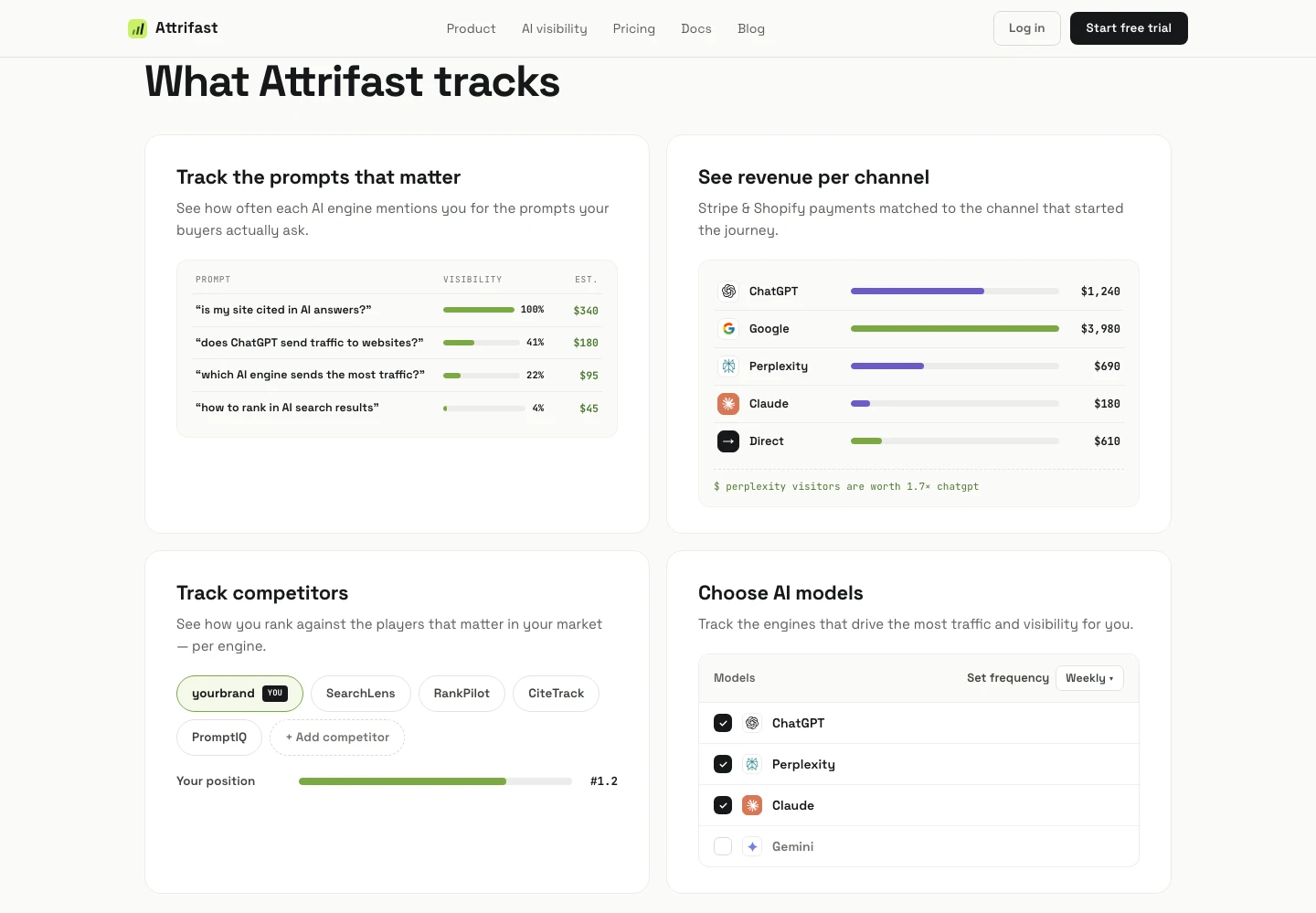
This study sits inside a four-layer evidence stack: (1) citation density and source-type mix in our 1,200-prompt cross-engine study; (2) brand recommendations, this study; (3) click-through and traffic in how much traffic comes from ChatGPT; (4) revenue attribution in the 2026 AI Traffic Revenue Benchmark. Each layer compounds on the one below. Citation density tells you whether your domain is in the pool. Brand recommendations tell you whether your name comes out of the model's mouth. Click-through tells you whether the mention produces a visit. Revenue attribution tells you whether the visit pays. Missing any layer leaves you optimizing in the dark.
For the brand-recommendation layer, the actionable signal is the per-subcategory incumbent share, the constraint-density-to-format mapping, and the run-to-run brand loyalty. Those three numbers together tell you whether your category is winnable as a challenger or you are working against a stacked deck.
We will re-run this study in Q3 2026 on the same 150-prompt corpus to track change-over-time, and publish a 4-engine version (Claude, Perplexity, and Gemini at the full 450-query scale) in Q4. The full 150-prompt corpus is available to journalists and researchers on request.
FAQ
Which brands does ChatGPT recommend most often in 2026?
HubSpot in SaaS (named in 52% of SaaS prompts), Nike in DTC ecommerce (38% of DTC prompts), Deloitte in B2B services (28% of B2B prompts). HubSpot is the single most-recommended brand across all 450 queries. ChatGPT defaults to category-defining incumbents in roughly 64% of its slots and reserves the remaining 36% for challengers like Pipedrive, Hoka, and Toptal.
How many brands does ChatGPT name per recommendation?
Median 5 brands per answer, mean 5.3. The distribution is bimodal: 41% are listicles of 5-7 brands, 22% are short listicles of 3-4, 18% are long listicles of 8+, and 14% are single-pick recommendations. Listicles dominate broad queries; single-pick answers dominate constraint-heavy queries.
Does ChatGPT recommend the same brand if you ask the same question twice?
Often, but not always. Full three-run overlap (same #1 brand all three times) was 53% in SaaS, 47% in DTC, 58% in B2B. Partial overlap (same brand in at least two of three runs) was 81%, 76%, 84%. Roughly half the time ChatGPT names the same #1 brand on repeat queries; four out of five times the brand at least appears in two of three runs.
Does ChatGPT favor incumbents like HubSpot and Salesforce over newer challengers?
Yes, but less aggressively than you would expect. Incumbents captured 64.3% of all 450-query slots, challengers 35.7%. B2B services skews most incumbent (72%), DTC is most balanced (61%), SaaS sits between (66%). The SaaS challenger share concentrates in project management (Linear, ClickUp), billing (Lago, Orb), and email tooling (Beehiiv, Resend).
How did you run this study?
150 buyer-intent prompts (50 per vertical), each executed three times on ChatGPT between April 28 and May 18, 2026, on chatgpt.com web with browsing enabled, fresh logged-out session each time, spaced at least 48 hours apart. Total queries: 50 × 3 × 3 = 450. We logged every brand named in the response, the position, the answer format, and whether the brand was linked or named as plain text. Total brand mentions logged: 2,387 across 228 unique brands.
What counts as a recommendation?
(1) A brand named explicitly as a recommended option counts as a primary recommendation. (2) A brand named in a comparison table or bulleted list of options also counts. (3) A brand mentioned only as a comparison anchor without being recommended does not count. URL citations alone, without the brand name in the answer text, do not count either.
Which SaaS brands does ChatGPT recommend most?
Top 10 SaaS brands: HubSpot 52%, Stripe 31%, Salesforce 31%, Notion 28%, Asana 24%, Slack 22%, Pipedrive 21%, Mailchimp 19%, Linear 17%, ClickUp 15%. Long-tail brands appearing in 5-10% of prompts include Beehiiv, Resend, Lago, Plausible, Cal.com, Posthog, and Customer.io.
Which DTC ecommerce brands does ChatGPT recommend most?
Top 10 DTC brands: Nike 38%, Adidas 32%, Hoka 26%, Lululemon 24%, Optimum Nutrition 22%, On Running 21%, Patagonia 19%, Levi's 18%, Allbirds 17%, Glossier 14%. The challenger share is highest in running shoes (Hoka and On Running combined match Nike on running-specific prompts) and lowest in apparel.
Which B2B services brands does ChatGPT recommend most?
Top 10 B2B brands: Deloitte 28%, Accenture 25%, Toptal 24%, McKinsey 22%, Upwork 19%, KPMG 17%, Bain 16%, WebFX 14%, Neil Patel Digital 13%, Paro 12%. ChatGPT defaults to Big 4 + MBB consulting names on management consulting prompts, while SMB-focused prompts route to platforms like Toptal, Upwork, and Paro.
How does ChatGPT compare to Claude or Perplexity?
On a 30-prompt validation subset across all three engines: ChatGPT and Claude agreed on the #1 brand 67% of the time; ChatGPT and Perplexity 59%; all three agreed 49% of the time. Claude favors newer challengers in SaaS (Linear, Notion); Perplexity surfaces wider candidate sets that dilute any single brand's share.
Does ChatGPT prefer listicles or single-brand recommendations?
Listicles. 41% of answers are listicles of 5-7 brands, 22% are short listicles of 3-4 brands, 18% are long listicles of 8+ brands, 14% are single-pick recommendations, and 5% refuse to recommend a brand at all. Constraint density of the prompt is the strongest predictor of format.
Why does ChatGPT recommend HubSpot so often for CRM queries?
HubSpot was named in 71% of CRM-specific prompts and 52% of all SaaS prompts. The mechanism combines three signals: brand-mention density in the training corpus (Reddit, Hacker News, SaaS newsletters), editorial-review concentration (top 3 on G2 and Capterra for multiple CRM categories), and entity-disambiguation strength (clean Wikipedia article and strong sameAs profile).
Can a smaller challenger brand break into ChatGPT recommendations?
Yes, but the mechanics differ from Google rankings. The challengers that broke through (Hoka, Pipedrive, Linear, Toptal, Beehiiv, Resend) share a strong Reddit and Hacker News footprint with branded discussion, well-structured G2 or Trustpilot profiles, and consistent mention in editorial roundups from the past 18 months. Backlinks were not the deciding factor.
Does ChatGPT actually drive paid signups for the brands it recommends?
This study measures recommendation presence, not revenue. For the revenue side, our 2026 AI Traffic Revenue Benchmark covers 200 Stripe-connected sites and finds ChatGPT-sourced traffic converts at 2.3x the rate of Google organic on SaaS, but only when the brand is named explicitly in the answer (not when only a URL is cited).
Related reading from the Attrifast research stack
To dive deeper, explore our companion 1,200-prompt cross-engine citation study.
References
- Profound, ChatGPT retail target Walmart analysis (March 2026, 22.5M buy offers)
- Profound, Profound Index of AI search visibility
- OpenAI, ChatGPT Search help and citations documentation
- OpenAI, ChatGPT release notes and rollout history
- Anthropic, Claude web search and citation behavior
- Anthropic, Claude usage policy and high-trust domains
- Perplexity, How Perplexity works and citation FAQ
- Princeton, GEO: Generative Engine Optimization (Aggarwal et al.)
- G2, CRM software grids and category rankings
- Capterra, CRM software reviews and SMB rankings
- G2, Project management software grids
- Capterra, Project management software directory
- Backlinko, Branded search and brand mentions study
- Backlinko, ChatGPT and AI search statistics
- Reddit, r/SaaS top SaaS recommendation threads
- Reddit, r/RunningShoeGeeks running shoe discussion
- Reddit, r/Entrepreneur freelance and consulting threads
- Hacker News, Ask HN: what do you use for X threads
- Search Engine Land, AI search and answer engine coverage
- Search Engine Land, Google AI Overviews tracker
- Cloudflare Radar, AI bots and AI search insights
- Cloudflare, GPTBot and Anthropic crawler stats
- Reuters, Reddit content licensing deal with Google for AI training
- Reuters, OpenAI ChatGPT user statistics and growth
- SimilarWeb, AI Search Stats 2026: market share, referral, and citation data
- Pew Research, Americans encountering AI-generated answers
- Ahrefs, Generative Engine Optimization: Growth Strategies and Metrics For the AI Era
- Semrush, AI Overviews research and analysis
- Wikipedia, English Wikipedia data dumps
- Common Crawl, Open web corpus used in LLM training
- Wirecutter (NYT), Editorial review methodology
- NerdWallet, Editorial guidelines and review process
- Healthline, Editorial guidelines and health content standards
- Investopedia, Editorial process and citation standards
- Clutch, B2B services directory and agency reviews
- TrustRadius, SaaS software reviews methodology
- Toptal, Freelance talent platform overview
- HubSpot, Wikipedia entry for HubSpot (entity disambiguation)
- Nike, Wikipedia entry for Nike, Inc.
- Hoka, Wikipedia entry for Hoka (running shoe brand)
- Deloitte, Wikipedia entry for Deloitte
- Attrifast, 1,200-prompt AI citation study across 12 verticals
- Attrifast, 2026 AI Traffic Revenue Benchmark across 200 Stripe sites
- Attrifast, AI citations vs backlinks: what actually drives visibility
- Attrifast, How AI engines choose sources
- Stripe, Webhook delivery and idempotency documentation