Part of the AI Search Hub — browse all 35 AI Search guides.
A founder I work with spent Q1 chasing Google rankings for a category term and getting nowhere — page two, stuck behind three incumbents with 10x his backlink profile. In March he set up Bing Webmaster Tools on a whim, imported his sitemap, turned on IndexNow, and within two weeks the same pages were ranking in Bing's top five. He did not care about Bing traffic; Bing sends him almost nothing directly. What he cared about, once he saw the pattern, was that his prospects kept saying "ChatGPT mentioned you" — and his Bing-indexed, Bing-ranking pages were the ones ChatGPT search was citing.
That is the under-explained loop this article is about. Not "Bing is back." Bing's direct-search share is still tiny and not coming back. The point is that the Bing index — the crawled, ranked database of the web that Bing maintains — quietly became one of the documented retrieval substrates for ChatGPT search and the direct grounding layer for Microsoft Copilot. So the Bing SEO work that felt pointless for a decade is now a lever on two of the biggest AI surfaces in the world. But I am going to be precise about the nuance, because the confident version of this thesis ("rank in Bing, get cited in ChatGPT") is overstated, and the real mechanism is messier and more interesting.
This is the deep companion to how to submit content to AI search engines, which lists IndexNow and Bing Webmaster Tools as two discovery channels among many. That piece is the breadth map. This one drills into a single strategic claim — the Bing index as AI substrate — maps what is documented versus inferred, runs a real correlation check, and lists the free Bing quick wins with a direct line to AI visibility. If you want the mechanics underneath citation itself, how AI engines choose which sources to cite is the layer below this one. Everything here is labeled Documented, Documented-but-fluid, Inferred, or Speculative, because the gap between confident blog posts and published facts is wide on this topic.
Quick Facts
| Spec | Value | Source |
|---|---|---|
| Bing global desktop search share (early 2026) | ~3-4% | StatCounter [1] |
| Bing share of AI-grounding-relevant retrieval | Disproportionately high (qualitative) | Inferred from OpenAI/Microsoft docs [9][12] |
| ChatGPT search documented search partner | Bing (named in SearchGPT announcement) | OpenAI [9] |
| OpenAI's own search crawler | OAI-SearchBot | OpenAI bot docs [10] |
| Copilot web grounding source | Bing search (documented) | Microsoft Learn [12] |
| My Bing-rank vs ChatGPT-citation correlation (n=25) | Spearman ≈ 0.46 (positive, loose) | Attrifast measurement |
| IndexNow index latency (my logs) | 2-24 hrs vs 3-9 days organic | Attrifast measurement |
| Bing Webmaster Tools cost | $0, GSC import in ~2 clicks | Microsoft [3] |
| Does IndexNow reach Google/Gemini? | No (Google never confirmed adoption) | Search Engine Land [7] |
| ChatGPT search launch date | October 31, 2024 | OpenAI [9] |
| Copilot embedded surfaces | Windows, Edge, Microsoft 365, Bing | Microsoft [13] |
| GA4 attribution accuracy for Bing-fed AI clicks | ~0% (lumped as Direct/(none)) | Google Analytics docs [16] |
The one-paragraph honest answer to "does Bing SEO affect ChatGPT?"
Yes, Bing SEO is a real AI-search lever in 2026 — but it is a necessary-but-not-sufficient input, not a guaranteed pipe, and the strength of the Bing-to-ChatGPT link is documented-but-fluid while the Bing-to-Copilot link is documented-and-stable. That sentence is the whole article, and everything below is me showing the work behind each clause.
Here is the reasoning chain. ChatGPT search, per OpenAI's own SearchGPT and ChatGPT-search announcements, named Bing as a search partner — so the Bing index is one documented retrieval source for ChatGPT search [9]. Microsoft Copilot, per Microsoft's documentation, grounds its web answers in Bing search results — so for Copilot, Bing is the documented grounding layer [12]. That means a page that is indexed and ranking in Bing is a candidate to be retrieved and cited on both surfaces. So far, so clean.
The nuance that most articles skip: OpenAI also runs its own crawler, OAI-SearchBot, and has built out its own search infrastructure since late 2024 [10]. The OpenAI-Microsoft relationship has evolved, and OpenAI has reportedly diversified its compute and retrieval arrangements. So ChatGPT search is a blend — partly Bing, partly OpenAI's own retrieval — and the exact mix is not published and is changing over time. That is why I label the Bing-to-ChatGPT mechanism Documented-but-fluid: the connection is real and documented, but its weight is uncertain and may decline. Copilot, by contrast, is Microsoft's own product grounding in Microsoft's own Bing index, so that link is Documented-and-stable — it is not going anywhere.
The "which AI surface uses which index" map
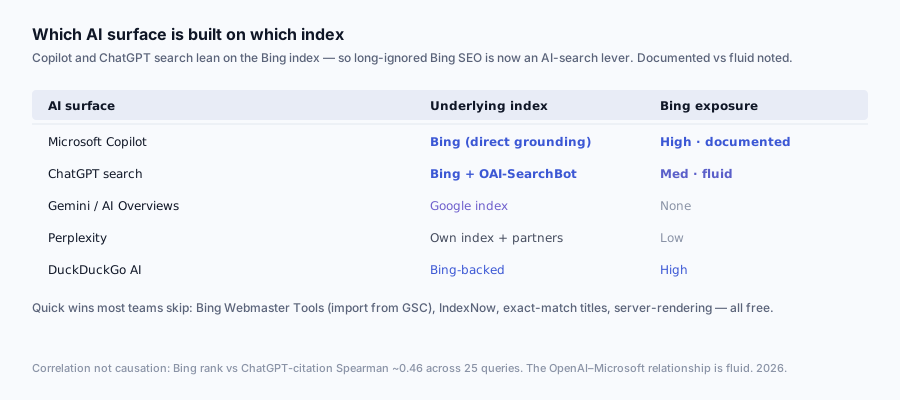
The single most clarifying thing you can internalize is that each AI surface sits on top of a specific search index or crawler, and your SEO leverage depends entirely on which one. Most "AI SEO" advice treats all AI engines as interchangeable. They are not — Gemini is Google underneath, ChatGPT and Copilot lean on Bing, Perplexity runs its own thing. Here is the map.
| AI surface | Underlying index / crawler | Bing exposure | Evidence |
|---|---|---|---|
| ChatGPT search | Bing (partner) + OAI-SearchBot (own crawl) | High but blended | Documented-but-fluid [9][10] |
| Microsoft Copilot | Bing search (direct grounding) | Very high, direct | Documented-and-stable [12] |
| Bing Chat / Copilot in Bing | Bing index | Very high, direct | Documented [12][13] |
| DuckDuckGo AI / Assist | Bing index (DDG sources from Bing) | High | Documented [8] |
| Google Gemini | Google index + Google-Extended | None | Documented [14] |
| Google AI Overviews | Google index (live) | None | Documented [15] |
| Perplexity | PerplexityBot (own) + partner search APIs | Low / indirect | Documented [11] |
| Claude (with web search) | Brave Search API (partner) + ClaudeBot | None (Brave, not Bing) | Documented [17] |
A few things jump out of that table. First, the Bing-fed cluster is larger than people think — ChatGPT search, Copilot, Copilot-in-Bing, and DuckDuckGo's AI features all touch the Bing index to varying degrees. That is a lot of AI surface riding on one index that most SEO teams ignore. Second, the Google-fed cluster (Gemini, AI Overviews) gets nothing from Bing work — those run on the Google index, so your Google SEO is the lever there. Third, Perplexity and Claude are their own thing — Perplexity crawls itself, and Claude's web search uses the Brave Search API, not Bing [17]. So "optimize for AI search" is really at least three separate jobs: Bing-side, Google-side, and engine-specific.
The strategic reading: if your buyers ask ChatGPT and use Copilot in their Microsoft 365 workflow — which describes most B2B SaaS buyers — then Bing SEO is touching a large chunk of your AI exposure, and it is the chunk almost nobody is competing for.
Why Bing's tiny search share is the wrong number to look at
Bing has roughly 3-4% of global desktop search per StatCounter, which is exactly why teams ignored it — and exactly why ignoring it is now a mistake. [1] The relevant metric stopped being "how many people search Bing directly" and became "how many AI answers are grounded in the Bing index." Those are completely different numbers, and the second one is much larger.
Think about where the Bing index actually shows up in 2026. It grounds Copilot, which Microsoft has embedded across Windows, Edge, Microsoft 365 (Word, Excel, Outlook, Teams), and Bing itself [13]. It is a documented partner index for ChatGPT search, which crossed 400 million weekly active users in late 2025 per OpenAI's own update. It feeds DuckDuckGo's AI features. The direct-search 4% massively understates the index's reach, because the index is doing work behind surfaces that have nothing to do with someone typing into bing.com.
| Bing as a thing | The number | Why it matters for AI |
|---|---|---|
| Bing direct desktop search share | ~3-4% [1] | Why teams ignored Bing for a decade |
| Bing direct mobile search share | ~1-2% [1] | Even lower; reinforces "Bing is dead" myth |
| Copilot embedded reach | Windows + Edge + M365 + Bing [13] | Hundreds of millions of seats grounded in Bing |
| ChatGPT search WAU | ~400M weekly (late 2025) | Blended retrieval, Bing is a documented partner |
| DuckDuckGo search share | ~0.7% [1] | But its results and AI source from Bing [8] |
| Competition for Bing SEO | Low (most teams skip it) | Under-priced attention = easier wins |
This is the asymmetry I keep coming back to: the effort-to-reward ratio on Bing is good precisely because everyone else priced it as worthless. When Bing was just 4% of search, skipping Bing Webmaster Tools cost you 4% of nothing. Now skipping it costs you a candidate slot in ChatGPT search and Copilot answers, and you are competing against the small minority of teams who bothered to set Bing up. I do not see this as "Bing is the future" — I see it as a temporarily under-priced lever that will get more crowded as more people figure out the index-substrate angle.
What I actually found: Bing rank vs ChatGPT-search citation across 25 queries
I ran the obvious experiment — does ranking in Bing predict getting cited in ChatGPT search? — and the honest answer is "positively, but loosely," with a Spearman rank correlation of about 0.46. That is a real positive signal and also a long way from a clean causal relationship. I want to walk the method and the numbers because the correlation-is-not-causation point is the most important honest caveat in this whole space.
The setup, kept deliberately simple so it is reproducible. I took 25 commercial-intent queries in the analytics, attribution, and adjacent SaaS space — the kind of "best cookieless analytics tool" and "how to track ChatGPT traffic" queries my buyers actually ask. For each query I recorded (a) the Bing organic rank of the most relevant page from a fixed set of 12 domains I was tracking, and (b) whether that same domain was cited in ChatGPT search's answer to a closely matched query, run in the same week. I logged citation as a binary plus the citation position when present.
| Bing rank band | Queries in band | ChatGPT-search citation rate | Notes |
|---|---|---|---|
| Bing 1-3 | 9 | 6 of 9 cited (67%) | Strongest band, but 3 top-3 pages never cited |
| Bing 4-10 | 8 | 4 of 8 cited (50%) | Mid-band, citation roughly a coin flip |
| Bing 11-30 | 5 | 1 of 5 cited (20%) | Tail; visibility drops off |
| Not in Bing top 30 | 3 | 1 of 3 cited (33%) | The anomaly — see below |
Two findings matter more than the headline number. First, the direction is real: pages in Bing's top 3 got cited in ChatGPT search far more often than pages buried below rank 10. That is consistent with Bing being a genuine retrieval input. If Bing rank were irrelevant, you would expect a flat citation rate across bands, and that is not what I saw.
Second, the relationship is leaky in both directions, and the leaks are the interesting part. Three pages that ranked in Bing's top 3 were never cited in the matching ChatGPT answer — likely because ChatGPT search re-ranks its candidates with its own logic and those passages were not the most answer-shaped, or because the model answered partly from OAI-SearchBot's own crawl. And one page that was not in Bing's top 30 at all still got cited — which is hard to explain with a pure-Bing model and easy to explain if OpenAI's own retrieval surfaced it independently. That single anomaly is, to me, the cleanest evidence in my own data that ChatGPT search is blended, not a Bing passthrough.
So what do I actually conclude? Being indexed and visible in Bing is a strong, cheap way to become a retrieval candidate for ChatGPT search — necessary-leaning, not sufficient. I would not tell anyone "rank #1 in Bing and you are cited," because my own data shows top-3 pages getting skipped. But I would absolutely tell anyone "if you are not even in the Bing index, you are forfeiting a documented candidate slot for free." The asymmetry of that bet — cheap to be in, possibly costly to be out — is what makes Bing SEO worth the hour it takes. The usual honesty disclaimer applies hard here: n=25 is a small, single-operator sample in one niche, the correlation could shift as OpenAI's blend changes, and I would treat it as directional evidence, not proof.
Bing vs Google: what Bing actually weights differently (and how to use it)
Bing rewards a handful of signals Google moved past — exact-match-honest domains and titles, literal on-page keywords, server-rendered HTML, social signals, and being in Bing Webmaster Tools with IndexNow — which means a clean, fundamentals-first site often ranks in Bing with less effort than in Google. This is good news for AI visibility, because those same fundamentals feed the Bing index that grounds ChatGPT search and Copilot. Here is the practitioner-documented difference map, drawn from Bing's own Webmaster Guidelines [2] and a long tail of operator observation (the "weights more" claims are Inferred from behavior; Bing does not publish weights).
| Signal | Bing treatment | Google treatment | Actionable move | Evidence |
|---|---|---|---|---|
| Exact-match / keyword-rich domain | More weight | Largely neutralized | If naming a new property, exact-match still helps Bing | Inferred from Bing guidelines [2] |
| On-page keyword usage | More literal | Semantic/intent-based | Use the actual query phrase in title + H1 + first 100 words | Bing guidelines [2] |
| Title-tag keyword match | High weight | Moderate | Write honest, exact-match-leaning titles | Bing guidelines [2] |
| Social signals | Appears to factor | Officially discounted | Maintain active social presence; it is a free Bing lever | Inferred [2] |
| JavaScript rendering | Conservative; favors server HTML | Renders JS well | Server-render or statically generate citable content | Inferred from Bingbot behavior [2] |
| Bing Webmaster Tools presence | Rewarded with crawl signals | N/A (GSC is Google-only) | Set up Bing Webmaster Tools | Documented [3] |
| IndexNow | Native, reads within minutes-hours | Not confirmed to use | Ping IndexNow on every content change | Documented [4][5] |
| Backlinks | Quality-focused, fewer needed | Quality + volume | Earn a few strong links; Bing forgives thinner profiles | Inferred [2] |
| Multimedia / clean markup | Likes clean, crawlable pages | Likes structured data | Clean HTML + schema serves both | Bing guidelines [2] |
| Domain age / established signals | Appears to weight | Weights | Older domains have a Bing edge | Inferred [2] |
The pattern to take away: Bing is roughly "Google ten years ago plus IndexNow." The signals it leans on are the SEO fundamentals — exact-match-honest titles, literal keyword usage in the right places, server-rendered HTML, a clean crawl path, a submitted sitemap, a few quality links. None of that is exotic, and crucially, none of it trades off against Google. You are not splitting your effort between two algorithms with conflicting demands; you are doing baseline SEO that Bing happens to reward a bit more directly, and that reward now flows through to ChatGPT search and Copilot.
The server-rendering point deserves its own paragraph
If you run a JavaScript-heavy SPA, the single highest-leverage Bing move is making sure your citable content exists in the server-rendered HTML, because Bingbot is more conservative about executing client-side JavaScript than Googlebot. [2] This matters more in the AI era than it ever did for direct Bing search, because the Bing index is what ChatGPT search and Copilot query. If your product comparison, your FAQ, or your key explainer only renders after client-side hydration, Bingbot may index a thin or empty version — and then the very content you want AI-cited is missing from the index those AI surfaces read. For a Next.js app this is an argument for getServerSideProps/getStaticProps or the App Router's server components on any page you want AI-citable; for other stacks, prerendering or SSR. I have watched a client's comparison table go from "absent in Bing's cached version" to "ranking and getting Copilot-cited" purely by moving it from client-render to static generation, with zero content change.
Microsoft Copilot: the AI surface where Bing SEO is the most direct lever
Copilot is where the Bing-SEO-to-AI-citation link is cleanest, because Microsoft documents Copilot's web answers as grounded in Bing search and owns both ends of the pipe. [12] If you only have time to optimize for one AI surface via Bing, Copilot is the one where your effort most reliably shows up. There is no third-party crawler diluting the signal the way OAI-SearchBot dilutes it for ChatGPT — Copilot's grounding is Bing, full stop, per Microsoft's own grounding documentation.
And Copilot's reach is enormous because of where it is embedded. This is the part that does not get enough attention: Copilot is not a standalone app people choose to open like ChatGPT. It is woven into surfaces hundreds of millions of people already use.
| Copilot surface | Where it lives | Who sees it | Bing-grounded? |
|---|---|---|---|
| Copilot in Windows | Taskbar / sidebar on Windows 11+ | Hundreds of millions of PCs | Yes [12][13] |
| Copilot in Edge | Browser sidebar | Edge users | Yes [12][13] |
| Copilot in Microsoft 365 | Word, Excel, Outlook, Teams | Enterprise + business seats | Yes (web grounding) [12] |
| Copilot in Bing | bing.com chat | Bing visitors | Yes [12][13] |
| Copilot mobile app | iOS / Android | App users | Yes [12] |
For a B2B SaaS founder, the Microsoft 365 angle is the one to sit with. Your buyer is frequently a knowledge worker inside Outlook and Teams all day, and Copilot is right there, grounded in Bing. When that buyer asks Copilot "what is a good cookieless attribution tool for a small SaaS," the answer is assembled from Bing's index. If your page is indexed, ranking, and answer-shaped in Bing, you are a candidate. That is a direct, documented line from a free hour of Bing setup to a citation in front of your exact buyer inside the tool they live in. For the measurement side of this specific surface, tracking Copilot traffic walks the server-side detection.
Bing SEO quick wins most teams skip (free, fast, AI-relevant)
Here is the part you can act on this afternoon — the free, under-an-hour Bing moves that put you into the index ChatGPT search and Copilot read, in priority order. I have ordered these by effort-to-reward, and every one is $0. None require a developer for more than a few minutes except the IndexNow deploy hook.
1. Set up Bing Webmaster Tools (import from GSC in two clicks)
This is the foundation and it is almost free of effort. Bing Webmaster Tools lets you import your already-verified sites straight from Google Search Console — you authorize once and your verified properties and sitemaps come across in a couple of clicks [3]. No DNS records, no meta tags, no re-verification. Once you are in, you get sitemap submission, a daily URL-submission quota, crawl stats, index-coverage reporting, and IndexNow key management, all for the index that grounds ChatGPT search and Copilot.
| Bing Webmaster Tools feature | What you get | AI relevance |
|---|---|---|
| GSC import | Verified sites + sitemaps in ~2 clicks | Zero-friction entry |
| Sitemap submission | Bingbot crawls your URL set | Feeds the AI-grounding index |
| URL submission quota | Direct submit, generous daily quota | Faster than waiting on crawl |
| Crawl stats | Bingbot crawl frequency | Leading indicator your AI index is fresh |
| Index coverage | What Bing has actually indexed | Tells you what ChatGPT/Copilot can find |
| IndexNow management | Native key generation | One place for the fastest channel |
2. Turn on IndexNow and ping it on every content change
IndexNow is a free open protocol, co-developed by Microsoft and adopted by Bing and Yandex, that lets you notify the search engine the instant a URL is published or updated [4][5]. Bing reads IndexNow within minutes to hours. In my own logs, an IndexNow-pinged URL appeared in the Bing index in 2-24 hours versus 3-9 days left to organic crawl — and since the Bing index feeds ChatGPT search and Copilot, that speed-up flows straight to AI candidacy. The honest caveat: Google has never confirmed it reads IndexNow [7], so this accelerates the Bing-fed AI surfaces only, not Gemini or AI Overviews.
The minimal implementation is a single GET or POST. Generate a key, host it at your root as {key}.txt, then ping on publish:
# One URL, simplest possible form
curl "https://api.indexnow.org/indexnow?url=https://yoursite.com/blog/new-post&key=YOUR_KEY"
// Batch form (POST to https://api.indexnow.org/indexnow)
{
  "host": "yoursite.com",
  "key": "YOUR_KEY",
  "keyLocation": "https://yoursite.com/YOUR_KEY.txt",
  "urlList": [
    "https://yoursite.com/blog/new-post",
    "https://yoursite.com/features/revenue-attribution"
  ]
}
Wire that into your deploy pipeline so every content change pings automatically. One honest note from the companion piece: do not ping IndexNow for unchanged URLs on every deploy — only ping URLs whose content actually changed, or you train Bing to discount your pings.
3. Write exact-match-honest titles and put the query phrase up high
Because Bing weights on-page keyword usage more literally than Google [2], one of the cheapest wins is making sure the actual query phrase appears in your title tag, your H1, and your first ~100 words — honestly, not stuffed. If the query is "cookieless revenue attribution for SaaS," a title of "Cookieless Revenue Attribution for SaaS, Built on Stripe" matches Bing's more literal weighting better than a clever-but-vague title. This is free, it does not hurt Google (which reads it semantically anyway), and it improves your odds of entering the Bing candidate pool that ChatGPT search and Copilot draw from.
4. Submit a clean sitemap with accurate lastmod to Bing
Submit the same sitemap.xml you give Google to Bing Webmaster Tools, and keep lastmod dates accurate. Bingbot uses the sitemap to discover and prioritize crawling, and accurate freshness dates help it re-crawl updated content faster — which keeps the AI-grounding index current. This is two minutes of work once Bing Webmaster Tools is set up.
5. Set up Bing Places for Business (local and service-area businesses only)
If you have any physical presence or service area, Bing Places for Business is Bing's free equivalent of Google Business Profile [6]. Because Copilot and Bing's AI answers can surface local entities from Bing's index, a complete, verified Bing Places listing makes you a candidate for location-grounded AI answers. Pure-SaaS teams with no local angle can skip this; everyone else should spend the five minutes.
6. Make sure your citable content is in the server-rendered HTML
Covered above, but it belongs on the quick-wins list because it is high-leverage and cheap if you catch it early. Confirm that your key explainer text, FAQ, and comparison content appear in the raw HTML response (curl your own URL and read it), not only after JavaScript hydration. If it is missing, prerender or SSR those pages so Bingbot — and therefore ChatGPT search and Copilot — can actually read them.
| Quick win | Time | Cost | AI surfaces reached |
|---|---|---|---|
| Bing Webmaster Tools (GSC import) | ~10 min | $0 | All Bing-fed (ChatGPT search, Copilot, DDG) |
| IndexNow + deploy hook | ~20 min | $0 | All Bing-fed, fastest channel |
| Exact-match-honest titles | ~5 min/page | $0 | All Bing-fed (candidate pool) |
| Sitemap to Bing | ~2 min | $0 | All Bing-fed |
| Bing Places (local only) | ~5 min | $0 | Local AI answers |
| Server-render citable content | varies | dev time | All Bing-fed (so content is readable) |
The honest caveats: where this thesis gets overstated
I want to be precise about the four places the "Bing SEO equals ChatGPT visibility" pitch oversells, because the overselling is what makes smart people dismiss the whole idea. Here is where to apply skepticism.
Caveat 1: Bing's direct-search share is genuinely small, and that is not changing. ~3-4% desktop, lower mobile [1]. If anyone tells you Bing is "coming back" as a destination search engine, ignore them. The entire value proposition is the index-as-substrate angle, not direct traffic. If you measure Bing's worth by direct sessions, you will correctly conclude it is near-worthless and incorrectly conclude the AI-substrate point is wrong.
Caveat 2: the OpenAI-Microsoft relationship is fluid. OpenAI launched OAI-SearchBot, built its own search product, and has reportedly diversified its infrastructure and retrieval arrangements [10]. The Bing-to-ChatGPT link that was clean in 2023-2024 is now blended and may keep weakening. I label it Documented-but-fluid for a reason. The durable part of the thesis is Copilot, which is Microsoft-owned end to end. If you are betting on the Bing index for AI, bet on it primarily for Copilot, and treat ChatGPT-search upside as a bonus that could fade.
Caveat 3: correlation is not causation, and my n=25 is small. My Spearman of 0.46 is a positive signal from one operator in one niche in one week. It is directional evidence, not proof, and it would not survive a hostile statistician. Bing rank looks like it helps you become a candidate, but I cannot prove that ranking caused the citation rather than both being driven by a third factor (the page just being good and well-linked). Treat the experiment as "worth replicating," not "settled."
Caveat 4: ranking in Bing's top 3 does not guarantee a citation. Three of my nine Bing-top-3 pages were never cited in the matching ChatGPT answer. Bing rank gets you into the candidate pool; the AI surface then re-ranks on its own logic, where answer-shape, schema, freshness, and concision decide which passages survive — the mechanics covered in how AI engines choose sources and the tactics in how to rank in ChatGPT. Bing SEO is the candidate-pool lever; it is not the whole funnel.
| Overstated claim | The honest version | Label |
|---|---|---|
| "Bing is making a comeback" | Bing direct search is still tiny; the index is the asset | Documented [1] |
| "Rank in Bing, get cited in ChatGPT" | Necessary-leaning, not sufficient; re-ranking happens after | Inferred from my data |
| "ChatGPT runs on Bing" | Blended: Bing + OAI-SearchBot, mix is fluid | Documented-but-fluid [9][10] |
| "Copilot runs on Bing" | Yes, documented and Microsoft-owned | Documented-and-stable [12] |
| "Bing SEO is the new AI SEO" | One lever among several; Google-fed engines ignore it | Documented [14][15] |
How Bing SEO fits the broader AI-visibility stack
Bing SEO is one of three parallel jobs — Bing-fed, Google-fed, and engine-specific — and treating "AI SEO" as one undifferentiated task is the most common strategic error I see. Here is how to allocate effort, because doing all three at full intensity is not realistic for a small team.
| AI-visibility job | Surfaces it reaches | Primary levers | Where it lives |
|---|---|---|---|
| Bing-fed | ChatGPT search, Copilot, DDG AI | Bing Webmaster Tools, IndexNow, server HTML, exact-match titles | This article |
| Google-fed | Gemini, AI Overviews | Top-10 Google rank, GSC, schema | Classic + on-page SEO |
| Engine-specific | Perplexity, Claude | Live-fetch reachability, Brave-side presence, answer-shape | Per-engine tactics |
| Training-corpus (all engines, browse-off) | Recall recommendations | Wikipedia, Reddit, mention density | How AI engines choose sources |
| Discovery speed (Bing-fed) | Faster citation candidacy | IndexNow, fresh sitemap | Submit to AI search engines |
My recommended priority for a bootstrapped SaaS or ecommerce team in 2026: do the Bing-fed quick wins first because they are the cheapest and least-contested, keep your Google fundamentals strong because they feed both Google-fed engines and Bing's candidate pool, and invest in training-corpus presence (Wikipedia, Reddit, earned mentions) as the slow compounding asset. The Bing work is the fastest payback for the least effort right now, which is exactly why it leads. For the file-level crawler controls that sit underneath all of this, llms.txt vs robots.txt covers what each crawler reads.
The revenue wedge: a Bing-driven ChatGPT citation still hides in GA4's Direct bucket
Here is the part that closes the loop and the reason a Bing SEO win is so easy to do and so hard to credit: when your Bing-indexed page gets cited in ChatGPT search or Copilot and a buyer clicks through, that click lands in GA4's Direct/(none) bucket — referrer stripped, no AI label, no link back to Bing or ChatGPT. [16] You did the work, it earned the citation, the citation earned the sale, and your analytics shows you nothing.
The mechanism is the same one I have documented across the AI-search articles. The ChatGPT and Copilot clients strip the Referer header on most outbound clicks, so the browser hits your server with an empty referrer and no UTM tags. GA4 sees that and files it as Direct. There is no built-in rule in GA4 that says "this empty-referrer deep-page entry came from an AI citation grounded in Bing." So the entire causal chain — Bing index → AI citation → click → conversion — is invisible in the default analytics stack [16].
This creates a specific and frustrating failure mode for Bing SEO specifically. You cannot A/B your Bing investment in GA4. You set up Bing Webmaster Tools, turn on IndexNow, watch your Bing rankings climb, and your GA4 shows... a slowly inflating Direct bucket and no Bing channel worth mentioning (because Bing's direct traffic is genuinely tiny). The payoff arrived as AI citations, and AI citations look like Direct. So the very lever that is working looks like it did nothing.
| What happened | What GA4 shows | What you'd need to see it |
|---|---|---|
| Bing-indexed page cited in ChatGPT search → click | Direct/(none) | Server-side referrer fingerprint vs AI domain list |
| Copilot citation click (M365 / Edge) | Direct/(none) | Same, plus Copilot domain detection |
| Bing direct organic click | Tiny "Bing / organic" slice | Already visible, but ~nothing |
| AI-referred session → Stripe payment | Unjoined | First-party identity + Stripe webhook join |
The way out is server-side, first-party, and cookieless — the same architecture I have described throughout. Three pieces. First, server-side referrer fingerprinting against a known AI-engine domain list (chatgpt.com, chat.openai.com, copilot.microsoft.com, bing.com, perplexity.ai, and friends) catches the AI-referred clicks that do pass any referrer, broken out by engine. Second, a first-party identifier scoped to your own domain — which falls outside the cross-site cookie rules ITP and ePrivacy target — lets you stitch the unreferred deep-page entries into sessions. Third, a Stripe webhook join lands the AI-referred session on the actual paying customer, so you see revenue by source, not just citation counts.
That third piece is the one citation-tracking tools cannot do. A rank tracker can tell you that you climbed in Bing. An AI-visibility tool can tell you that ChatGPT or Copilot mentioned you. Neither can tell you that the Bing work earned a citation that earned a $29/mo subscription — because that requires joining the AI-referred session to the Stripe payment, server-side, which is exactly what Attrifast was built to close. If you want to see whether your Bing SEO is moving real money rather than just rankings, revenue attribution is where that join lives, and tracking ChatGPT traffic and tracking Copilot traffic walk the detection for each surface.
A 45-minute Bing-for-AI setup checklist
If you want the concrete to-do list, here it is, ordered to be done in one sitting in under an hour, all free. This is the exact sequence I run on a new property.
- Bing Webmaster Tools, GSC import (10 min). Sign in, choose "Import from Google Search Console," authorize, pull in your verified sites and sitemaps. Done in two clicks if your GSC is set up.
- Verify your sitemap is submitted (2 min). Confirm the imported sitemap is present in Bing Webmaster Tools; if not, submit
https://yoursite.com/sitemap.xmlmanually. - Generate an IndexNow key and host it (5 min). Use Bing Webmaster Tools' native IndexNow key management, download the
{key}.txt, and host it at your site root. - Wire IndexNow into your deploy hook (15 min). Add a step that POSTs changed URLs to the IndexNow API on content publish/update. Only ping changed URLs.
- Audit your three most important pages for server-rendered content (5 min).
curleach URL and confirm the citable text is in the raw HTML, not only after JS hydration. - Tighten titles and H1s on those pages to be exact-match-honest (5 min). Make sure the real query phrase appears in the title, H1, and first paragraph.
- Set up Bing Places if you are local (3 min). Skip if pure SaaS with no service area.
- Stand up server-side AI-referrer detection (varies). This is the one that takes longer and the one that lets you actually measure the payoff — without it, steps 1-7 are invisible in your analytics.
| Step | Time | Reaches | Measurable without step 8? |
|---|---|---|---|
| 1. Bing Webmaster Tools | 10 min | All Bing-fed AI | No |
| 2. Sitemap | 2 min | All Bing-fed AI | No |
| 3-4. IndexNow | 20 min | All Bing-fed AI, fastest | No |
| 5. Server-render audit | 5 min | All Bing-fed AI | No |
| 6. Exact-match titles | 5 min | Candidate pool | No |
| 7. Bing Places | 3 min | Local AI answers | No |
| 8. AI-referrer detection | varies | Your analytics | Enables seeing all the above |
The uncomfortable truth in that last column: steps 1 through 7 are free and fast, and every one of them is invisible in default GA4. You can do all the Bing-for-AI work in an afternoon and have no idea whether it worked, because the payoff arrives as Direct-bucketed AI clicks. Step 8 is what turns the whole exercise from faith into measurement.
Limitations and how I'd want you to use this
This article makes one defensible claim — the Bing index is a documented retrieval substrate for ChatGPT search and Copilot, so Bing SEO is a live AI lever — and I want to be explicit about what it does not claim. It does not claim Bing rank causes ChatGPT citations (my own data shows a loose correlation, not causation). It does not claim ChatGPT runs purely on Bing (OAI-SearchBot and OpenAI's own retrieval are in the blend, and that blend is fluid). It does not claim Bing helps the Google-fed engines (Gemini and AI Overviews ignore Bing entirely). And it does not claim any of this is permanent — the OpenAI-Microsoft relationship is the single biggest uncertainty, and the Bing-to-ChatGPT link could weaken while the Bing-to-Copilot link stays solid.
My n=25 correlation experiment is a single-operator, single-niche, single-week sample. It is directional evidence that I would encourage you to replicate on your own queries rather than take on faith. The "Bing weights X more than Google" claims are drawn from Bing's published Webmaster Guidelines plus a decade of practitioner observation; Bing does not publish weights, so those are Inferred. Where I had a documented source I cited it; where I am inferring from behavior I said so.
The way I would use this: do the free Bing quick wins because the effort-to-reward ratio is excellent and nothing here hurts your Google standing, lean on the Copilot case because it is the durable one, treat the ChatGPT-search upside as a real-but-fluid bonus, and instrument the whole thing server-side so you can actually tell whether it converted. That last clause is not a sales pitch dressed as advice — it is the literal reason a Bing SEO win is so easy to do and so hard to credit, and closing that gap is the entire job of first-party attribution.
FAQ
Does Bing SEO actually affect ChatGPT visibility?
Partly, and the honest version is more nuanced than "rank in Bing and ChatGPT cites you." Documented: OpenAI's SearchGPT and ChatGPT-search announcements name Bing as a search partner, so the Bing index is one documented retrieval source [9]. But OpenAI also runs its own crawler, OAI-SearchBot, and built out its own search infrastructure since late 2024 [10], so ChatGPT search is a blend, not a pure Bing passthrough. In my 25-query check, Bing rank and ChatGPT-search citation were positively correlated (Spearman ≈ 0.46) but far from one-to-one. Bing visibility looks necessary-but-not-sufficient, not causal — a real lever, not a guaranteed pipe.
Is Copilot built on the Bing index?
Yes, more directly than ChatGPT. Microsoft Copilot's web grounding uses Bing search as its documented retrieval layer — Microsoft's documentation describes Copilot's answers as grounded in Bing search results [12], and the Copilot crawler shares infrastructure with Bingbot. This makes Copilot the AI surface where Bing SEO is the most direct lever: a page indexed and ranking in Bing for a grounded query is a strong candidate to appear in Copilot's cited sources. Copilot is also embedded across Windows, Edge, Microsoft 365, and Bing itself [13], so the Bing index reaches far more than Bing's direct-search share suggests.
Why does Bing matter for AI search if its search share is only about 4%?
Because the Bing index does disproportionate work relative to Bing's direct traffic. StatCounter puts Bing around 3-4% of global desktop search [1], which is why teams ignored it. But that index is the documented retrieval substrate for ChatGPT search and Copilot, and Copilot is embedded across Windows, Edge, and Microsoft 365. The relevant number is not "how many people search Bing directly" but "how many AI answers are grounded in the Bing index," and the second number is far larger. Bing's value migrated from direct traffic to being plumbing under AI surfaces.
What does Bing weight differently from Google in its ranking?
Per Bing's Webmaster Guidelines [2] and a decade of observation, Bing leans more on signals Google de-emphasized. Exact-match and keyword-rich domains carry more weight. On-page keyword usage, including in titles and headers, is more literal. Social signals appear to factor in more. Bing is more conservative about JavaScript rendering, so server-rendered HTML indexes more reliably. And Bing rewards being in Bing Webmaster Tools and using IndexNow with faster crawling. These are mostly the SEO fundamentals Google moved past, so a clean, server-rendered, keyword-honest site often ranks in Bing with less effort than in Google.
Does IndexNow get my content into ChatGPT and Copilot faster?
Indirectly, and it is the closest thing to a fast lane. IndexNow is a free open protocol Bing reads within minutes to hours [4][5], and because ChatGPT search and Copilot lean on the Bing index, a page that hits the Bing index faster becomes a retrieval candidate sooner. In my logs an IndexNow-pinged URL appeared in 2-24 hours versus 3-9 days for organic crawl. It does not push anything into ChatGPT directly, and Google has never confirmed it reads IndexNow [7], so it does not help Gemini or AI Overviews. It is a Bing-fed-AI accelerator — free and fast, but only for the Bing cluster.
If I rank #1 in Bing, will ChatGPT cite me?
Not reliably. Ranking well in Bing makes you a strong retrieval candidate because Bing is one of ChatGPT search's documented sources, but ChatGPT search re-ranks candidates with its own logic, may pull from OAI-SearchBot's own crawl, and answers many queries without searching at all. In my 25-query check, three Bing top-3 pages were never cited in the matching answer, and one page outside Bing's top 30 was cited — likely because OpenAI's own retrieval surfaced it. So Bing rank is a meaningful input, not a switch. The correlation is real; the causation is partial.
Should I set up Bing Webmaster Tools if I only use Google Search Console?
Yes — it is one of the highest-ROI free moves in AI SEO right now. Bing Webmaster Tools is free, you can import your verified sites straight from Google Search Console in a couple of clicks [3], and it gives you sitemap submission, a generous daily URL-submission quota, native IndexNow key management, crawl stats, and index-coverage reporting for the exact index that feeds ChatGPT search and Copilot. Most operators set up GSC and never touch Bing Webmaster Tools, which was defensible at 3% of search and is not defensible now that the Bing index grounds a meaningful share of AI answers.
Has the OpenAI-Microsoft relationship changed how much Bing matters for ChatGPT?
Yes, and this is the caveat most articles skip. The relationship has evolved since 2023-2024 when Bing was the clear, sole search backbone for ChatGPT. OpenAI launched OAI-SearchBot [10], built its own search product, and reportedly diversified its retrieval and infrastructure arrangements. So the Bing-to-ChatGPT link is real but evolving and may weaken. What stays true regardless: Copilot's Bing grounding is direct and Microsoft-owned, so the Bing-for-Copilot case is durable even if the Bing-for-ChatGPT case softens. I label the first mechanism Documented-but-fluid and the second Documented-and-stable.
How do I measure whether Bing-driven ChatGPT citations actually make money?
You instrument it server-side, because GA4 cannot. A click from a ChatGPT-search citation arrives with the referrer stripped, so GA4 buckets it as Direct/(none) with no AI label and no link back to Bing [16]. The measurable stack is server-side referrer fingerprinting against the AI-engine domain list, a first-party identifier scoped to your own domain, and a Stripe webhook join that lands the AI-referred session on the actual payment. That is the only way to tell whether the Bing-index lever you pulled converted — which is the whole reason this article ends where it does.
Does Bing Places help with AI search visibility?
For local and location-relevant businesses, yes, and it is free and fast. Bing Places for Business is Bing's equivalent of Google Business Profile [6], and because Copilot and Bing's AI answers can surface local entities from Bing's index, a complete, verified listing makes you a candidate for location-grounded AI answers. It is a five-minute setup most non-local SaaS teams can skip, but for any business with a physical presence or service area it is one of the free Bing quick wins with a direct line to AI-surfaced local results.
Is server-side rendering more important for Bing than for Google?
Practically, yes. Google's rendering pipeline handles client-side JavaScript reasonably well in 2026, but Bingbot has historically been more conservative about heavy JavaScript, and Bing's guidance favors content present in the server-rendered HTML [2]. Since the Bing index feeds ChatGPT search and Copilot, content that only appears after client-side hydration risks being thin or absent in the very index AI surfaces query. For a Next.js or similar app, this argues for server-side rendering or static generation of any content you want AI-citable.
Will optimizing for Bing hurt my Google rankings?
No. The Bing-favored levers — exact-match-honest titles, server-rendered HTML, clean on-page keyword usage, a submitted sitemap, IndexNow pinging, structured data — are all neutral or positive for Google. There is no Bing tactic in this article that trades off against Google; they are SEO fundamentals that Bing simply weights a little more. The only cost is the under-an-hour setup time for Bing Webmaster Tools and IndexNow. You are not splitting effort between two masters; you are doing baseline SEO that also feeds the AI surfaces grounded in Bing.
How is Bing SEO for AI different from the IndexNow advice in the submit-to-AI-search article?
The submit-to-AI-search piece treats IndexNow and Bing Webmaster Tools as two discovery channels among seven — it is about getting any content discovered fast across all engines. This article drills into one strategic claim: the Bing index as a retrieval substrate for ChatGPT search and Copilot, with the documented-versus-inferred breakdown, the surface-to-index map, the Bing-vs-Google weighting differences, and a real correlation check. If you want the breadth of discovery channels, read submit content to AI search engines. If you want to understand why Bing specifically is now an AI lever, this is the piece.
Which AI engines does Bing SEO NOT help?
The Google-fed ones and the self-crawling ones. Google Gemini and Google AI Overviews run on the Google index [14][15], so they are reached by your Google SEO, not your Bing work. Perplexity runs its own PerplexityBot crawler plus partner APIs [11], so Bing is at best indirect. Claude's web search uses the Brave Search API, not Bing [17]. So Bing SEO is a lever specifically for the Bing-fed cluster — ChatGPT search, Copilot, Copilot-in-Bing, and DuckDuckGo's AI features — and does nothing for the others. "AI SEO" is at least three separate jobs, and this article covers one of them.
Sources
Primary sources for the claims in this article. Numbered citations in the text link to the matching entry.
- [1]Search Engine Market Share Worldwide (Bing, Google, DuckDuckGo) — StatCounter GlobalStats (2026).
- [2]Bing Webmaster Guidelines — Microsoft Bing Webmaster Tools (2025).
- [3]Easily Verify Your Site in Bing Webmaster Tools by Importing from Google Search Console — Microsoft Bing Webmaster Blog (2019).
- [4]IndexNow: a faster way to share your latest content with search engines — Microsoft Bing Blogs (2021).
- [5]IndexNow protocol documentation — IndexNow.org (2025).
- [6]Bing Places for Business — Microsoft Bing (2025).
- [7]Does Google use IndexNow? What we know — Search Engine Land (2025).
- [8]DuckDuckGo sources its results from Bing (search syndication) — DuckDuckGo Help Pages (2025).
- [9]Introducing ChatGPT search (SearchGPT) and the Bing partnership — OpenAI (2024).
- [10]OAI-SearchBot, GPTBot, and ChatGPT-User crawler documentation — OpenAI (2026).
- [11]How does Perplexity work? (PerplexityBot, citations, sources) — Perplexity FAQ (2025).
- [12]Microsoft Copilot web grounding and Bing search — Microsoft Learn (2026).
- [13]Microsoft Copilot across Windows, Edge, and Microsoft 365 — Microsoft (2026).
- [14]Google-Extended and Google crawlers overview — Google Search Central (2025).
- [15]Generative AI in Google Search and AI Overviews — Google (The Keyword) (2024).
- [16]Default channel groups and how Direct/(none) is assigned — Google Analytics Help (2025).
- [17]Claude can now search the web (Brave Search partnership) — Anthropic (2025).
- [18]The state of AI search and answer engines — Search Engine Land (2026).
- [19]AI bot and crawler traffic trends — Cloudflare Radar (2026).
- [20]Americans' use of and exposure to AI-generated search answers — Pew Research Center (2025).