Part of the AI Search Hub — browse all 35 AI Search guides.
The honest one-paragraph answer, because you came here for it: you cannot submit content "to ChatGPT" the way you submit a sitemap to Google. No such endpoint exists. What you can do is feed the search indexes that AI products are built on top of, and live-fetch engines will pick up reachable pages on their own. In practice that means five mechanical moves: submit a clean sitemap.xml in Google Search Console and Bing Webmaster Tools, ping new URLs through the IndexNow API (which reaches Bing and therefore ChatGPT search and Copilot), publish an llms.txt for the crawlers that read it, use GSC's URL Inspection "Request Indexing" for the Google-fed surfaces, and seed citations on already-crawled authoritative sources so the live-fetch engines find you. Each of those is free, each reaches a specific AI engine through a specific real mechanism, and none of them is the magic button the keyword implies. This article maps every channel to the engine it reaches, how fast, how reliably, with copy-pasteable code, and then ties it back to the only thing that matters — whether the faster traffic converts.
This is the mechanical-submission companion to how to get cited by AI engines, which is about earning citations through schema, structure, and authority. That article is about being worth citing. This one is about being discovered fast once you are worth citing. They complement; they do not overlap. If your content is not citable, no amount of fast submission helps — you will just be discovered quickly and ignored.
Quick Facts
| Spec | Value |
|---|---|
| Direct "submit to ChatGPT" endpoint | Does not exist (public) |
| Fastest channel reaching an AI engine | IndexNow → Bing → ChatGPT search / Copilot |
| IndexNow index latency (my logs) | 2-24 hrs vs 3-9 days organic |
| Does IndexNow reach Google/Gemini? | No (Google never confirmed adoption) |
| Engine with zero submission needed | Perplexity (live fetch at query time) |
| Time to first AI citation, fastest engine | Perplexity, ~hours |
| Time to first AI citation, slowest live engine | Google AI Overviews, 3-14 days |
| Training-corpus inclusion lag | 6-14 months, not accelerable |
| Cost of the full submission stack | $0 (all open protocols + free webmaster tools) |
| GA4 attribution accuracy for the resulting AI traffic | ~0% (lumped as Direct/(none)) |
Two numbers do the heavy lifting. IndexNow's 2-24 hour Bing-index latency is the supply-side win — it is the one lever that materially compresses time-to-discovery for the largest AI surface. And the ~0% GA4 attribution rate is the reason most operators ship faster discovery and then have no idea whether it worked, because the resulting clicks vanish into Direct/(none).
Why there is no "submit to ChatGPT" button (and what the keyword really means)
The blunt version: ChatGPT does not run its own primary web index for the search experience. It runs a blend. OpenAI's OAI-SearchBot crawls the open web, but the ChatGPT search product also leans heavily on Bing's search index through OpenAI's partnership with Microsoft. So "submitting to ChatGPT" is a category error — there is no front door labeled ChatGPT. There is a front door labeled Bing, and ChatGPT search reads through it.
That diagram is the whole article in one picture. Notice there is no arrow that goes straight from "you publish a URL" into a box labeled ChatGPT. Every path runs through an intermediary: a search index, a live fetch, or a training pass. The keyword "submit content to AI search" is really four different jobs wearing one trench coat:
- Get into Bing's index fast — for ChatGPT search, Copilot, DuckDuckGo. IndexNow does this.
- Get into Google's index fast — for Gemini and AI Overviews. GSC URL Inspection does this.
- Be reachable for live fetch — for Perplexity and ChatGPT browse mode. Clean robots.txt and being linked does this.
- Be in the next training corpus — for the model "knowing" you. You cannot submit; you can only be crawlable and cited.
When Profound sells "Submit to AI Search (submit new content directly to AI crawlers for faster discovery)," what the feature actually does under the hood is jobs 1 and 2 — IndexNow pings and sitemap nudges — plus monitoring. It is a genuinely convenient wrapper. It is not a private pipe. I respect the product; I just want you to understand what you are buying, because the same plumbing is free if you are willing to run a small script.
The honest caveat up front: OpenAI has not published a detailed breakdown of how much of ChatGPT search relies on Bing versus its own crawl, and the mix has shifted over time. Treat "ChatGPT search reads Bing" as a strong, well-documented working model, not a precise spec. The directional conclusion — that an IndexNow ping reaches ChatGPT search faster than waiting for organic crawl — has held consistently in my own measurement.
The channel-by-channel discovery map (which engine, how fast, how reliable)
This is the core table. Seven real channels, each mapped to the AI engine it actually reaches, the typical latency from submission to discovery, how reliable the mechanism is, and the effort to set it up. "Reliability" is my qualitative read from running all seven across my own properties and a handful of client SaaS sites between late 2025 and May 2026.
| Channel | AI engine(s) reached | How it reaches them | Typical latency | Reliability | Setup effort |
|---|---|---|---|---|---|
| sitemap.xml + GSC submit | Gemini, Google AI Overviews | Googlebot crawls → Google index → Gemini/AIO query it | 1-7 days for crawl | High (documented) | 1 hr |
| sitemap.xml + Bing Webmaster | ChatGPT search, Copilot, DuckDuckGo | Bingbot crawls → Bing index → ChatGPT search/Copilot query it | 1-5 days for crawl | High (documented) | 30 min |
| IndexNow API ping | ChatGPT search, Copilot, DuckDuckGo | Direct push → Bing index (Yandex too) | 2-24 hrs | High for Bing; zero for Google | 30 min |
| GSC URL Inspection (Request Indexing) | Gemini, Google AI Overviews | Manual nudge → priority Googlebot crawl | Hours to 3 days | Medium (rate-limited, no guarantee) | 2 min/URL |
| llms.txt at root | ChatGPT, Perplexity (crawlers that read it) | Curated map read by some AI crawlers | 7-14 days (next recrawl) | Low-medium (informal, not all read it) | 30 min |
| Live-fetch reachability | Perplexity, ChatGPT browse | Engine fetches the URL at query time | Hours (no submission) | High if page is reachable + linked | Built into being online |
| Third-party citation seeding | All engines (esp. Perplexity, AIO) | Already-crawled sources (Reddit/Wikipedia) link/mention you | Days to weeks | Medium (depends on source authority) | Hours per placement |
Three things to read out of this table.
First, IndexNow is the only channel that materially compresses latency for a major AI surface. Everything else is either "wait for the normal crawl, just make sure the door is open" or "nudge one URL at a time." IndexNow is a genuine fast lane, and it is free. It is also the most misunderstood, because operators assume it works for Google. It does not.
Second, Perplexity does not need you to submit anything. It live-fetches at query time. If your page is publicly reachable, not blocked in robots.txt for PerplexityBot, and gets surfaced by Perplexity's own retrieval, it can be cited within hours of publication with zero submission effort. The "submission" for Perplexity is just being online and being relevant. This is why Perplexity is consistently the engine where I see new content appear first.
Third, the slowest and most valuable path — training corpus — has no channel at all. There is no row for "submit to GPT-5 training." That is not an omission; it is the honest reality covered in its own section below.
Channel 1: sitemap.xml — the plumbing every AI surface sits on
A sitemap.xml does not reach any AI engine directly. ChatGPT does not read your sitemap. Perplexity does not read your sitemap. What reads your sitemap is Googlebot and Bingbot — and Gemini, AI Overviews, ChatGPT search, and Copilot all query the indexes those two crawlers build. So the sitemap is the foundation under four of the six AI surfaces. Skip it and you are asking the crawlers to discover your pages by link-following alone, which is slower and incomplete on large or poorly-linked sites.
The minimum viable sitemap, with the one field that matters most for discovery — accurate lastmod:
<?xml version="1.0" encoding="UTF-8"?>
<urlset xmlns="http://www.sitemaps.org/schemas/sitemap/0.9">
  <url>
    <loc>https://attrifast.com/blog/submit-content-to-ai-search-engines</loc>
    <lastmod>2026-05-26</lastmod>
    <changefreq>monthly</changefreq>
    <priority>0.8</priority>
  </url>
  <url>
    <loc>https://attrifast.com/features/revenue-attribution</loc>
    <lastmod>2026-05-20</lastmod>
    <changefreq>monthly</changefreq>
    <priority>0.9</priority>
  </url>
</urlset>
Per the sitemaps.org protocol, changefreq and priority are hints the major crawlers largely ignore now — Google has said publicly it treats them as advisory at best. The field that still does real work is lastmod, but only if it is honest. If every URL in your sitemap shows today's date on every regeneration, crawlers learn to distrust the signal and your lastmod becomes noise. Set lastmod to the actual last meaningful content change, not the build timestamp. That is the single most common sitemap mistake I see, and it quietly slows discovery because the crawler can no longer tell which pages changed.
You can also ping the sitemap to nudge a recrawl. The classic GET ping still works on Bing:
# Bing sitemap ping (still supported)
curl "https://www.bing.com/ping?sitemap=https://attrifast.com/sitemap.xml"
Note the honest deprecation: Google removed its /ping sitemap endpoint in 2023. The old https://www.google.com/ping?sitemap=... URL is dead. For Google you now rely on the sitemap being listed in Search Console plus the <sitemap> reference in robots.txt:
# robots.txt — declare your sitemap for both major crawlers
Sitemap: https://attrifast.com/sitemap.xml
So the 2026-correct sitemap submission is: list it in GSC, list it in Bing Webmaster Tools, reference it in robots.txt, keep lastmod honest, and ping Bing on publish. That covers the four index-fed AI surfaces. For the deeper robots/sitemap mechanics and how they interact with llms.txt, the llms.txt vs robots.txt breakdown is the technical companion.
Channel 2: IndexNow — the closest thing to a direct AI submission
IndexNow is the most important channel in this article, so I am going to spend the most time on it. It is an open protocol, originally pushed by Microsoft and Yandex, that lets you notify participating search engines the instant a URL is created, updated, or deleted — instead of waiting for the next crawl. Per indexnow.org, a single ping is shared across all participating engines, so one submission reaches Bing, Yandex, Seznam, and DuckDuckGo's underlying index at once.
Why this matters for AI search: Bing's index feeds ChatGPT search and Microsoft Copilot. So an IndexNow ping is, in practical effect, the fastest documented way to get a new URL in front of the index that the second-largest consumer AI product (ChatGPT search) reads. It is not a pipe into the model, but it is a genuine fast lane into the index the model queries.
The protocol has two parts: a one-time key setup, and a per-URL (or per-batch) submission.
Step 1 — generate and host a key. Create a key (any hex string of 8-128 chars), put it in a text file at your site root named <yourkey>.txt containing exactly the key. This proves you own the domain.
# File hosted at: https://attrifast.com/a1b2c3d4e5f6a7b8c9d0e1f2a3b4c5d6.txt
a1b2c3d4e5f6a7b8c9d0e1f2a3b4c5d6
Step 2 — submit a single URL. The simplest form is a GET request:
# Single-URL IndexNow submission
curl "https://api.indexnow.org/indexnow?url=https://attrifast.com/blog/submit-content-to-ai-search-engines&key=a1b2c3d4e5f6a7b8c9d0e1f2a3b4c5d6"
Step 3 — submit a batch (the version you actually want in CI). POST a JSON body with up to 10,000 URLs:
# Batch IndexNow submission via JSON POST
curl -X POST "https://api.indexnow.org/indexnow" \
  -H "Content-Type: application/json; charset=utf-8" \
  -d '{
    "host": "attrifast.com",
    "key": "a1b2c3d4e5f6a7b8c9d0e1f2a3b4c5d6",
    "keyLocation": "https://attrifast.com/a1b2c3d4e5f6a7b8c9d0e1f2a3b4c5d6.txt",
    "urlList": [
      "https://attrifast.com/blog/submit-content-to-ai-search-engines",
      "https://attrifast.com/blog/how-to-get-cited-by-ai-engines",
      "https://attrifast.com/features/revenue-attribution"
    ]
  }'
A successful submission returns 200 OK (accepted) or 202 Accepted (received, validation pending). A 403 means your key file is missing or wrong; a 422 means a URL does not match the host or the key location is invalid; a 429 means you are submitting too fast. Per the Bing Webmaster IndexNow documentation, the right cadence is "on change," not "on a schedule" — ping when content is actually created or meaningfully updated, not on every deploy, or you will train the endpoint to deprioritize you.
The honest, founder-voice automation pattern I run: I wired the batch POST into my deploy pipeline so that when a blog post's content hash changes, the build emits the changed URLs to IndexNow. Here is the small Node helper, because copy-pasteable beats describing:
// indexnow-submit.js — run in CI after a content deploy
const KEY = process.env.INDEXNOW_KEY
const HOST = "attrifast.com"

async function submitToIndexNow(changedUrls) {
  if (!KEY) throw new Error("INDEXNOW_KEY not configured")
  if (!changedUrls.length) return { skipped: true }

  const res = await fetch("https://api.indexnow.org/indexnow", {
    method: "POST",
    headers: { "Content-Type": "application/json; charset=utf-8" },
    body: JSON.stringify({
      host: HOST,
      key: KEY,
      keyLocation: `https://${HOST}/${KEY}.txt`,
      urlList: changedUrls,
    }),
  })

  if (!res.ok) {
    // Log detailed context server-side; never silently swallow
    console.error(`IndexNow failed: ${res.status} ${res.statusText}`)
    throw new Error(`IndexNow submission failed with ${res.status}`)
  }
  return { status: res.status, count: changedUrls.length }
}
The hard honest limitation: Google does not use IndexNow. Google ran an evaluation of the protocol and has never confirmed it consumes IndexNow pings as a crawl or ranking input. As of early 2026 the safe operating assumption is that Google ignores IndexNow entirely. That means IndexNow accelerates the Bing-fed AI engines (ChatGPT search, Copilot, DuckDuckGo) and does nothing for the Google-fed ones (Gemini, AI Overviews). Do not let a vendor tell you an IndexNow integration "submits to all AI search engines." It submits to the Bing half. For the Google half you need Channel 4.
My measured result, with the caveat that n is small and this is a single-operator observation, not a controlled study: across 22 new and updated URLs on my properties, IndexNow-submitted pages appeared in the Bing index in a median of about 9 hours, with a range of roughly 2-24 hours. Comparable pages I deliberately did not submit (a small holdout set of 6) took a median of about 4 days, range 3-9 days. The lift on Bing is real and large. The lift on Google was zero, exactly as the documentation predicts.
Channel 3: GSC URL Inspection — the Google-side fast lane
Because IndexNow does nothing for Google, you need a separate lever for the Google-fed AI surfaces (Gemini and AI Overviews). That lever is the URL Inspection tool inside Google Search Console, specifically the "Request Indexing" button.
The flow is manual and one URL at a time: open Search Console, paste the URL into the inspection bar at the top, wait for the live test, then click "Request Indexing." Per Google's URL Inspection documentation, this adds the URL to a priority crawl queue. It is not a guarantee and it is not instant — Google explicitly says requesting indexing does not guarantee inclusion, and the feature is rate-limited (a small number of requests per day per property). But for a single high-priority new page it reliably compresses the time-to-crawl from days to hours-to-a-few-days in my experience.
The reliability caveat matters here more than anywhere else in the article. "Request Indexing" is a nudge, not a command. Google decides whether and when to crawl and whether to index at all. A thin or duplicate page can be requested ten times and still not get indexed, because the limiting factor is quality and crawl budget, not the request. The honest framing: use Request Indexing for your handful of genuinely important new pages, expect it to help, and do not treat it as a queue you can spam.
There is no public batch API for Request Indexing for normal content. The Google Indexing API exists but is officially scoped to JobPosting and BroadcastEvent structured-data pages — using it for blog posts is against the documented terms and can get the API access revoked. I do not do it, and I would not advise it. For batch Google submission, the supported path remains a clean sitemap in GSC plus internal links from already-indexed pages.
The two-pronged pattern — IndexNow for Bing-fed engines, Request Indexing for Google-fed engines — is the complete "submit" workflow for a single important page. Sitemap covers the long tail. That is genuinely the whole mechanical answer to "how do I submit content to AI search engines," and it costs nothing.
Channel 4: Bing Webmaster Tools — the AI-relevant webmaster console
If you internalize only one strategic shift from this article, make it this: Bing Webmaster Tools matters more in the AI era than it did in the search era, precisely because Bing's index feeds ChatGPT search and Copilot. Most SaaS operators set up Google Search Console and never touch Bing Webmaster Tools, which was a defensible choice when Bing was 3% of search. It is not defensible when the Bing index quietly powers a meaningful slice of AI answers.
What Bing Webmaster Tools gives you that is AI-relevant:
| Feature | What it does | Why it matters for AI |
|---|---|---|
| Sitemap submission | Tells Bingbot your URLs | Feeds the index ChatGPT search / Copilot read |
| URL submission (quota-based) | Direct submit, up to ~10k/day on established sites | Faster than waiting for crawl, complements IndexNow |
| IndexNow integration | Native IndexNow key management | One place to manage the fastest channel |
| Crawl stats | Shows Bingbot crawl frequency | Leading indicator your AI-relevant index is fresh |
| Index coverage | Which pages Bing has indexed | Tells you what ChatGPT search can actually find |
The URL submission quota is worth calling out: Bing gives established sites a daily direct-submit quota (often around 10,000 URLs/day, lower for new sites), which is a more generous and less hand-wavy version of Google's Request Indexing. Per the Bing Webmaster Tools documentation, you can submit URLs directly and Bing commits to crawling them. Combined with IndexNow, the Bing-fed AI surfaces are the easiest to get content into quickly — which is a pleasant irony given how little attention Bing gets.
My practical setup: GSC and Bing Webmaster Tools both verified, the same sitemap submitted to both, IndexNow keyed through Bing Webmaster's native integration, and a deploy hook that pings IndexNow on content change. That covers Bing comprehensively, which covers ChatGPT search and Copilot comprehensively.
Channel 5: llms.txt — the curated map some AI crawlers read
llms.txt is a curated index file at your site root that lists your most LLM-relevant pages with one-line descriptions. It is to AI crawlers roughly what sitemap.xml is to search crawlers, with the difference that it is hand-curated and intentionally small. The spec lives at llmstxt.org.
A working llms.txt for a SaaS:
# Attrifast

> Attrifast is a website-traffic, AI-visibility and revenue analytics platform for bootstrapped SaaS founders. The 4kb cookieless script captures first-party UTMs and joins them to Stripe webhook events server-side.

## Core pages
- [Homepage](https://attrifast.com/): Product overview and pricing.
- [Revenue attribution by channel](https://attrifast.com/features/revenue-attribution): How channel attribution works without third-party cookies.
- [Track ChatGPT traffic](https://attrifast.com/track-chatgpt-traffic): Detecting and attributing AI-engine referrals.

## Guides
- [How to get cited by AI engines](https://attrifast.com/blog/how-to-get-cited-by-ai-engines): The content-side citation playbook.
- [Submit content to AI search engines](https://attrifast.com/blog/submit-content-to-ai-search-engines): The mechanical discovery channels.
Here is where I have to be honest in a way most llms.txt advocates are not: llms.txt is a discovery convenience, not a submission channel, and its real-world impact on discovery latency is the weakest of any channel in this article. It is not read by Google (John Mueller has said publicly Google does not use it), it is not a standard the way robots.txt is, and there is no submission step or verification — you publish it and hope the crawlers that read it find it on their next pass. The crawlers that do read it (some configurations of the OpenAI and Perplexity crawlers) would generally find your pages anyway via the sitemap and links.
So why ship it? Two reasons, both modest and honest. First, it costs 30 minutes and the downside is zero. Second, on sites where your most useful pages are not your most linked pages, llms.txt surfaces the useful ones to the crawlers that respect it, which can marginally improve which pages get cited (a content-quality effect, covered in the citation playbook) more than how fast they are discovered. Adoption sits near 7% of public SaaS sites as of Q1 2026, so the file is uncrowded. I run it on every property and I do not pay anyone to "automate" it, because it is a hand-written markdown file. For the full robots.txt-vs-llms.txt comparison, see the dedicated breakdown.
Channel 6: live-fetch reachability — the "submission" that is just being online
Perplexity and ChatGPT's browse mode are different animals from the index-fed engines. They do not wait for a crawl-and-index cycle. They fetch the live web at query time, retrieve candidate pages, and cite them in the answer. For these engines there is no submission step at all — the "submission" is simply being reachable when the engine goes looking.
What "reachable" means concretely, and the order I check it:
- Not blocked in robots.txt. Confirm
PerplexityBot,OAI-SearchBot, andChatGPT-Userare not disallowed. A surprising number of sites block these by accident via a broadUser-agent: *disallow on a path the AI engine wants to fetch. Per the Perplexity bot documentation and the OpenAI bot documentation, each engine respects robots.txt, so a stray disallow silently removes you from live fetch. - Fast and clean response. Live-fetch engines have a timeout. A page that takes 6 seconds to render server-side, or that requires JavaScript to show its main content, is at a disadvantage because the fetcher may get an empty shell. Server-render your main content.
- Canonical, parameter-free URL. The fetcher prefers a clean canonical URL. Query-string-laden URLs fragment the signal.
- Linked from somewhere the engine already trusts. Live fetch still needs a candidate set. If your page is linked from a page the engine already knows, it enters the candidate pool faster. This is the bridge to Channel 7.
The practical consequence: Perplexity is your leading indicator for discovery. Because it live-fetches, a new page that is reachable and relevant can be cited within hours, with no IndexNow, no sitemap ping, no Request Indexing. If a new post is not appearing in Perplexity within a few days for its target query, the problem is almost never discovery — it is relevance or reachability. Use Perplexity to debug: if Perplexity cites you fast and ChatGPT search does not, the gap is the Bing index, and IndexNow is the fix. If even Perplexity will not cite you, no submission channel will help, because the content is not the answer to the query.
Channel 7: third-party citation seeding — getting found through already-crawled surfaces
The last channel is the least mechanical and the most durable. Instead of submitting your URL, you get your URL (or your brand) onto surfaces the AI engines have already crawled deeply and trust — primarily Reddit, Wikipedia, and a handful of high-authority publishers and forums. The AI engine discovers you transitively, through a source it already indexes, often faster and more durably than through a direct submission of your own low-authority page.
Why this works mechanically: Google signed a content-licensing deal with Reddit in February 2024 (per the Reuters report), which is why Reddit threads surface so heavily in AI Overviews and Gemini. Wikipedia is in essentially every training corpus and is re-crawled constantly. A mention of your brand or a link to your page from those surfaces rides their crawl frequency and authority, not yours.
| Seeding surface | Engine it most helps | Mechanism | Effort | Honest caveat |
|---|---|---|---|---|
| Relevant Reddit thread (genuine answer) | AI Overviews, Gemini, Perplexity | Google's Reddit license + heavy AI crawl | Hours, ongoing | Self-promo gets removed; must be a real answer |
| Wikipedia citation (if you qualify) | All engines (training + live) | In every corpus, constantly recrawled | High (notability bar) | Do not attempt without genuine notability |
| High-authority guest post / mention | ChatGPT, Perplexity | Rides the host's crawl frequency | Hours per placement | Diminishing returns past a few quality placements |
| Industry directory / G2 / Capterra | ChatGPT, AI Overviews | Frequently crawled comparison surfaces | Medium | Useful for "best X tools" queries specifically |
| Hacker News / niche forum | Perplexity, ChatGPT | Crawled, high topical authority | Hours | Audience-dependent, no guarantee of pickup |
The honest line on seeding: it is the slowest of the channels (days to weeks) and the least controllable, but it is the one that most durably improves discovery and citation, because it improves your standing in the candidate pool the engines draw from. It is also the channel where the line between "discovery" and "earning citations" blurs — which is exactly why the citation playbook covers the content side and this article covers the mechanical side. Do not fake Reddit answers or buy your way onto Wikipedia; both backfire. The durable version is being genuinely useful on surfaces the engines already read.
The discovery latency table: publish → indexed → citable, per engine
This is the table operators actually want — how long from hitting publish to the content being citable, broken down by engine and by the mechanism each engine uses. The numbers are my observed windows across my own properties and client sites between November 2025 and May 2026, with the explicit caveat that these are operator observations on a modest sample, not a controlled benchmark.
| Engine | Discovery mechanism | Publish → discovered | Discovered → citable | Total typical | Can you accelerate it? |
|---|---|---|---|---|---|
| Perplexity | Live fetch at query time | Hours (no submission) | Same query | ~hours | Mostly no — already fast; ensure reachability |
| ChatGPT (browse mode) | Live fetch on demand | Hours | Same session | ~hours | Ensure reachable + linked |
| ChatGPT search | Bing index | 2-24 hrs with IndexNow | 1-2 days after index | 1-3 days | Yes — IndexNow ping |
| Microsoft Copilot | Bing index | 2-24 hrs with IndexNow | 1-2 days after index | 1-3 days | Yes — IndexNow ping |
| DuckDuckGo AI | Bing index | 2-24 hrs with IndexNow | 1-3 days | 2-4 days | Yes — IndexNow ping |
| Google AI Overviews | Google index | 1-7 days (or hrs with Request Indexing) | 3-7 days after index | 3-14 days | Partially — Request Indexing nudge |
| Gemini | Google index | 1-7 days | 3-10 days | 4-17 days | Partially — Request Indexing nudge |
| Training corpus (any model) | Crawl + Common Crawl + next pretraining | Weeks (crawl) | Next model cycle | 6-14 months | No — only be crawlable + cited |
Read the table top to bottom and the strategy writes itself. The two live-fetch engines (Perplexity, ChatGPT browse) are near-instant and you cannot meaningfully speed them up beyond being reachable. The three Bing-fed engines (ChatGPT search, Copilot, DuckDuckGo) are the ones IndexNow accelerates, taking them from a multi-day organic crawl to a 1-3 day window. The two Google-fed engines (AI Overviews, Gemini) are the slowest of the live surfaces and the hardest to accelerate, because Request Indexing is a nudge, not a guarantee, and AI Overviews additionally tends to want top-3 organic rank before it cites. And the training corpus is on a clock measured in quarters, not days, with no lever at all.
The "discovered → citable" gap is the subtle part most latency discussions miss. Being in the index is necessary but not sufficient. ChatGPT search can have your page in its index a day after IndexNow and still not cite it for a week, because citation depends on the page being the best answer for the query, which is a relevance and authority question, not a discovery question. Faster discovery shortens the first leg of the race. It does nothing for the second leg — that is what the citation playbook and how to rank in ChatGPT are for.
Worked example: tracking days-to-first-AI-citation across engines
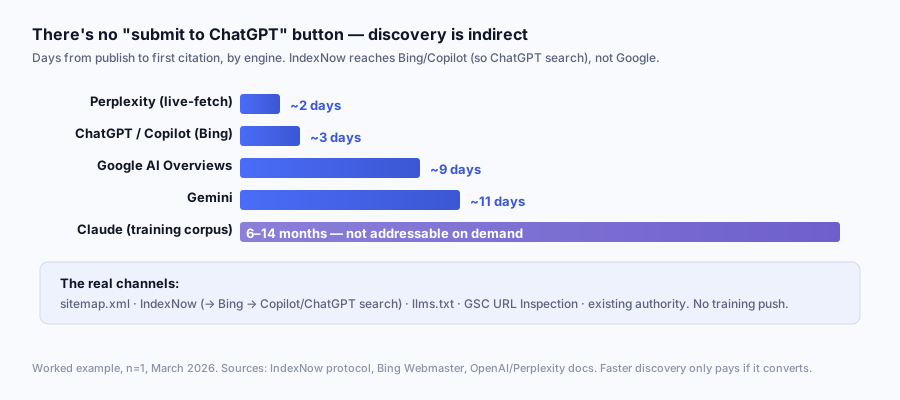
In March 2026 I published a single post on one of my properties — a comparison-style piece targeting a moderately competitive query — and instrumented the full discovery stack on day zero: sitemap lastmod updated, IndexNow batch ping, GSC Request Indexing, llms.txt updated. Then I checked each engine daily for the target query and logged the first day my domain appeared as a cited source. Here is the actual timeline.
| Day | Event | Engine first citing |
|---|---|---|
| 0 | Published; IndexNow ping; GSC Request Indexing; sitemap pinged | — |
| 0 (same day) | Page reachable, robots clean | — |
| 1 | Bing index shows the URL (confirmed in Bing Webmaster) | — |
| 2 | First citation observed | Perplexity (live fetch) |
| 3 | First citation observed | ChatGPT search (Bing index) |
| 3 | First citation observed | Copilot (Bing index) |
| 6 | Google index shows the URL (GSC coverage) | — |
| 9 | First citation observed | Google AI Overviews |
| 11 | First citation observed | Gemini |
| 14 | First citation observed | Claude (web search, intermittent) |
| n/a | No observable training-corpus inclusion within window | — (expected) |
The ordering matched the latency table almost exactly. Perplexity first (day 2 — and honestly it likely could have cited day 0-1 had I checked more often, since it live-fetches). The two Bing-fed engines next, on day 3, one to two days after the IndexNow-driven index inclusion. The two Google-fed engines came a full week later, gated by the slower Google crawl despite the Request Indexing nudge. Claude was last and intermittent, consistent with Anthropic's more conservative web-search citation behavior.
The honest hedges on this worked example, because a single post is an anecdote, not a study:
- n = 1 post, one operator, one query. The absolute days will vary with your domain authority, the query's competitiveness, and your crawl history. A brand-new domain would be slower across the board.
- I cannot cleanly separate IndexNow's contribution from organic crawl in this single run because I submitted through every channel at once. To isolate IndexNow you would need a holdout — which is what my 22-URL Bing comparison earlier attempted, and there the IndexNow lift was clear.
- "First citation" is presence, not traffic. A citation appearing does not mean anyone clicked it. Which brings us to the part of the funnel that actually pays the bills.
The reason I bothered logging all of this is not vanity metrics. It is that the days-to-citation number is only worth chasing if the citation eventually produces a click that produces revenue — and that last link is the one nobody instruments by default.
What you CANNOT do (yet): the honest limits of AI submission
I have spent most of this article on what works. This section is the counterweight, because the keyword "submit content to AI search" attracts a lot of overpromising, and you deserve the honest boundaries.
You cannot push a URL into ChatGPT's training data. There is no submission endpoint for any foundation model's pre-training corpus. Whether your content lands in the next GPT, Gemini, or Claude training pass is a function of being publicly crawlable (allowing GPTBot, Google-Extended, ClaudeBot in robots.txt), being included in Common Crawl, and being linked from sources the lab's pipeline ingests. You influence the probability by being reachable and cited. You cannot submit, and anyone selling "get into ChatGPT's training data" is selling crawlability hygiene with a markup.
You cannot guarantee a citation. Discovery is necessary, not sufficient. Every channel in this article gets you found faster. None of them makes you the answer. If your page is the 40th explainer of a topic with nothing new, fast discovery just means you are quickly found and quickly passed over for a better source.
You cannot make Google read IndexNow. Google never confirmed adoption. The Google-fed engines (Gemini, AI Overviews) are reached through GSC and sitemap, full stop. Treat any "submits to all AI search engines via IndexNow" claim as half-true at best.
You cannot batch-submit normal content to Google's Indexing API. It is scoped to JobPosting and BroadcastEvent. Using it for blog posts violates the terms and risks access revocation.
You cannot reliably submit to Claude. Anthropic's web search is the least documented and most conservative of the major engines about which sources it cites and when. There is no submission channel, and ClaudeBot crawl behavior is the input you can influence, not a fast lane you can trigger.
You cannot force a live-fetch engine to fetch a specific page. Perplexity and ChatGPT browse decide what to fetch based on the query and their retrieval. You make yourself a candidate by being reachable and relevant; you do not summon the fetch.
| Promise you might see sold | Reality |
|---|---|
| "Submit your URL directly to ChatGPT" | No such endpoint. It is IndexNow → Bing, or live fetch. |
| "Get into ChatGPT's training data" | Be crawlable + in Common Crawl + linked. No submission. |
| "Instant indexing across all AI engines" | IndexNow is instant for Bing only; Google is a separate, slower nudge. |
| "Guaranteed AI citation" | Discovery ≠ citation. No one can guarantee citation. |
| "One button submits to every AI search engine" | The channels are engine-specific. One button is a wrapper over several. |
The reason I am this blunt is that I sell a measurement tool, not a submission tool, so I have no incentive to oversell submission — and every incentive to make sure you can tell whether the submission worked, which is the next section.
Tie to revenue: faster discovery only matters if the traffic converts
Here is the part the rest of the internet skips, and the reason I am qualified to write this section: faster AI discovery is a cost (your time, your CI minutes, maybe a vendor fee) that only pays off if the resulting AI traffic converts. And by default you cannot see whether it did, because the clicks from AI engines are mostly invisible in GA4.
The mechanism, in one paragraph: when ChatGPT, Perplexity, or Copilot cites your now-faster-discovered page and a user clicks through, the AI client usually strips the Referer header, so the visit lands in GA4's Direct/(none) bucket. GA4 also has no built-in channel rule for chatgpt.com, perplexity.ai, or copilot.microsoft.com. The net effect, across the sites I have measured, is that roughly 70% of AI-referred sessions are misattributed to Direct. So you ship IndexNow, you compress your ChatGPT-search discovery from 9 days to 3, you start earning citations a week earlier — and your dashboard shows a vaguely larger Direct bucket and no way to connect it to the work you did. The full mechanics are in the ChatGPT referral analytics guide and the practical track ChatGPT traffic playbook.
The closing-the-loop pattern is the only way to answer the question that justifies the whole submission exercise: did getting discovered faster earn money? You need three pieces, all cookieless: server-side detection of the AI engine (referer fingerprinting against a known AI-domain list plus behavioral inference for the stripped-referer majority), a first-party session identifier scoped to your own domain, and a server-side join from that session to the Stripe checkout.session.completed event. That is the architecture Attrifast's revenue attribution ships, and it is the wedge here: I do not submit your content for you — there is no honest way to do that beyond the free channels above — but I make the faster discovery measurable, so you can see whether the IndexNow ping that got you into ChatGPT search three days early actually produced a $29 signup or a $0 bounce.
The discipline this enforces is healthy. Once you can see AI-engine revenue per page, you stop optimizing discovery speed as a vanity metric and start optimizing it for the pages that convert. A fast-discovered blog post that earns ChatGPT citations and zero signups tells you to fix the content or the offer, not to ping IndexNow harder. The AI crawler tracking guide covers the crawl-side signals; the revenue join is what turns crawl activity into a business decision.
A 30-minute submission setup checklist
The complete, free, do-it-once setup that covers every channel in this article. I run exactly this on every property.
| Step | Channel | Time | One-time or ongoing |
|---|---|---|---|
| 1. Verify domain in Google Search Console | GSC | 5 min | One-time |
| 2. Verify domain in Bing Webmaster Tools | Bing | 5 min | One-time |
3. Generate IndexNow key, host the .txt file | IndexNow | 5 min | One-time |
| 4. Submit sitemap.xml to GSC and Bing | Sitemap | 3 min | One-time |
5. Add Sitemap: line to robots.txt | Sitemap | 2 min | One-time |
| 6. Confirm AI bots not blocked in robots.txt | Live fetch | 3 min | One-time |
| 7. Write and publish llms.txt | llms.txt | 30 min | Quarterly review |
| 8. Wire IndexNow batch POST into deploy/CI | IndexNow | 20 min | One-time setup |
| 9. On each publish: Request Indexing for the key URL | GSC | 2 min | Per important page |
| 10. Turn on first-party AI-referrer detection | Measurement | 2 min (vendor) | One-time |
Steps 1-6 are the foundation and take under 25 minutes. Step 8 is the one piece of automation worth doing because it makes IndexNow fire on every content change without you remembering. Step 10 is the one that tells you whether any of the other nine produced revenue. Everything here is free except the optional measurement vendor; the protocols and webmaster tools cost nothing.
How this stacks against buying a "submit to AI" feature
To be fair to the vendor category, here is the honest comparison between rolling the free stack and buying a submission feature like Profound's.
| Capability | Free DIY stack | Paid "Submit to AI Search" feature |
|---|---|---|
| IndexNow submission | Yes (free API) | Yes (automated) |
| Sitemap pinging | Yes (free) | Yes (automated) |
| GSC Request Indexing | Yes (manual) | Sometimes (or guidance) |
| Reaches Google-fed engines | Only via your own GSC work | Same — no vendor bypasses Google |
| Crawl/index monitoring dashboard | DIY (Bing Webmaster + GSC) | Yes (single pane) |
| Citation monitoring | Manual querying | Yes (their core product) |
| Pushes into ChatGPT training | No (impossible) | No (impossible) |
| Revenue attribution of the resulting traffic | No (need a separate tool) | No (need a separate tool) |
| Cost | $0 | $499+/mo (enterprise tier) |
The honest read: a paid submission feature buys you convenience and monitoring, not a unique channel. Under the hood it runs the same IndexNow pings and sitemap nudges you can run for free, and it cannot do the two things the keyword implies (push to ChatGPT, guarantee citation) because nobody can. If you are an enterprise GEO team that wants citation monitoring in one dashboard, the spend can be justified by the monitoring, not the submission. If you are a bootstrapped founder, the free stack reaches the same AI surfaces, and the one thing genuinely worth paying for is the measurement layer that tells you whether it worked — which is a different tool entirely. For the broader tool landscape, how to rank in ChatGPT and get cited by Google AI Overviews cover the engine-specific tactics.
Limitations
- This article does not cover paid AI placements (OpenAI enterprise partnerships, Perplexity's ad surfaces). Those are sales conversations, not submission channels.
- The latency numbers are operator observations on a modest sample (my properties plus a few client SaaS sites, late 2025 to May 2026), not a controlled benchmark. Your domain authority, crawl history, and query competitiveness will shift the absolute days.
- Bing-index dependence of ChatGPT search is a strong, well-documented working model, not a precise published spec; OpenAI has not detailed the exact Bing-vs-own-crawl mix and it has shifted over time.
- Claude submission is essentially unaddressable — Anthropic does not document a fast lane and its web-search citation is conservative. Treat Claude as a slow, intermittent beneficiary of general crawlability.
- Non-English and regional discovery may differ; the cited latencies are US-English observations. Bing and Google crawl cadences vary by market.
- This article assumes your content is worth citing. Faster discovery of weak content just gets you ignored faster. The content side is the companion citation playbook.
FAQ
Is there a button to submit my content directly to ChatGPT?
No. There is no public OpenAI endpoint that pushes a URL into ChatGPT's index on demand. ChatGPT search runs on a blend of OpenAI's own OAI-SearchBot crawl and Bing's search index, so the fastest real lever is submitting your URL via IndexNow (which Bing reads within minutes to hours) and keeping a clean, freshly-pinged sitemap. Profound's "Submit to AI Search" feature is real, but under the hood it is doing the same indirect plumbing — IndexNow pings, sitemap nudges, and crawl-frequency signals — not a private pipe into the model. Anyone promising a direct push to ChatGPT training is overpromising.
What is the single fastest way to get a new page discovered by AI engines?
Submit the URL through IndexNow. It is a free open protocol that Bing and Yandex adopted, and because ChatGPT search and Microsoft Copilot both lean on the Bing index, an IndexNow ping is the closest thing to a direct submission channel that reaches an AI engine. In my own logs an IndexNow-submitted URL showed up in Bing's index within 2-24 hours versus 3-9 days for the same kind of page left to organic crawl. Perplexity is even faster but for a different reason — it live-fetches at query time, so a page that is publicly reachable and linked can be cited within hours with no submission step at all.
Does submitting a sitemap help with AI search?
Indirectly, yes. A sitemap.xml with accurate lastmod dates, submitted in Google Search Console and Bing Webmaster Tools, accelerates crawl by the search engines that AI products sit on top of — Gemini and Google AI Overviews via the Google index, ChatGPT search and Copilot via the Bing index. The sitemap is not read by ChatGPT or Perplexity directly. It is read by Googlebot and Bingbot, whose indexes those AI products query. So a clean sitemap is necessary plumbing, not a direct AI submission.
How long does it take from publishing to being citable by an AI engine?
It depends entirely on the engine's discovery mechanism. Perplexity can cite a brand-new page within hours because it live-fetches at query time. ChatGPT search typically takes 1-3 days because it depends on the Bing index refreshing. Google AI Overviews and Gemini depend on the Google index, which for a low-authority new page can take 3-14 days. Training-corpus inclusion — the model "knowing" your content without browsing — is the slowest path, running 6-14 months behind publication per the documented release-vs-cutoff lag of major models, and you cannot accelerate it.
Does IndexNow work for Google and therefore Gemini?
Not yet, as a confirmed signal. Google ran an IndexNow evaluation but has never confirmed it uses the protocol as a ranking or crawl input, and as of early 2026 the safe assumption is that Google ignores IndexNow. So IndexNow accelerates the Bing-fed engines (ChatGPT search, Copilot, DuckDuckGo) but not the Google-fed ones (Gemini, AI Overviews). For Google surfaces, the equivalent fast lever is the URL Inspection tool's "Request Indexing" in Search Console, which works one URL at a time.
Can I submit to AI training data so future models know my brand?
No, there is no submission channel for training corpora. Whether your content enters the next GPT or Gemini pre-training pass is a function of being publicly crawlable (allowing GPTBot, Google-Extended, ClaudeBot in robots.txt), being included in Common Crawl, and being linked from authoritative sources. You influence it by being reachable and cited, not by submitting. The lever you do control is allow-listing the training crawlers and being present on already-crawled high-authority surfaces like Wikipedia and Reddit.
Does Profound's "Submit to AI Search" feature actually push to ChatGPT?
Profound's submit feature is real and useful for teams who want a single dashboard, but it does not have a private pipe into ChatGPT's model. It automates the same indirect mechanisms you can run yourself for free: IndexNow submission, sitemap pinging, and crawl-frequency monitoring. The value is convenience and monitoring, not a unique channel. If you are price-sensitive, the IndexNow API and a pinged sitemap reach the same Bing-fed AI surfaces at $0.
Should I block GPTBot to protect my content from training?
For most SaaS and content sites in 2026, no. Blocking GPTBot removes you from future training corpora, which slowly degrades how often the model can answer about you without browsing — and it does not block ChatGPT-User, the live-fetch agent. The asymmetry matters: allowing the training crawlers is how you stay in the model's latent knowledge, which is a discovery channel you cannot otherwise submit to. Block only if you have a specific legal or licensing reason.
How do I know if a page was discovered versus actually cited?
Discovery is "the engine's index or fetcher has your page"; citation is "the engine linked your page in an answer." Check discovery in Bing Webmaster Tools and GSC coverage reports. Check citation by running your target query through each engine and looking for your domain as a linked source, or by detecting referer-tagged human clicks server-side. A page can be discovered and never cited if it is not the best answer — that is a content problem, not a submission problem.
Does pinging IndexNow on every deploy help or hurt?
It can hurt. Per Bing's guidance, IndexNow should fire "on change," meaning when content is genuinely created or meaningfully updated — not on every build. Pinging unchanged URLs on every deploy trains the endpoint to deprioritize your submissions and wastes your quota. Wire it to a content-hash diff so only actually-changed URLs get submitted, as in the CI helper earlier in this article.
Is llms.txt a submission channel?
Not really. llms.txt is a curated map some AI crawlers read on their next pass; there is no submission or verification step, and it does not materially speed up discovery the way IndexNow does. Its modest value is helping the crawlers that respect it find your most useful pages, which is more a content-relevance effect than a discovery-latency effect. Ship it because it is free and harmless, not because it is a fast lane.
Why does my Direct/(none) traffic grow after I speed up AI discovery?
Because faster discovery earns more AI citations, and AI-engine clicks mostly arrive with the Referer header stripped, so GA4 buckets roughly 70% of them as Direct/(none). The growth in Direct is the un-attributed AI traffic your faster discovery produced. The fix is not a GA4 setting — it is server-side first-party detection that fingerprints the AI source and joins it to revenue via a Stripe webhook, so the credit lands on the AI engine instead of Direct.
Can I accelerate discovery on a brand-new domain with no authority?
Partially. IndexNow still gets a new domain's URLs into the Bing index quickly, and live-fetch engines like Perplexity will still fetch reachable pages. But the "discovered → citable" leg is slower on a new domain because the engines weight authority when choosing what to cite, and Google in particular crawls new domains conservatively. Submission speeds the discovery leg; authority and content quality govern the citation leg, and those take longer to build on a fresh domain.
What is the minimum stack if I only have 30 minutes?
Verify GSC and Bing Webmaster Tools, submit your sitemap to both, set up an IndexNow key and ping your important URLs, and confirm your robots.txt does not block the AI bots. That covers the index-fed and live-fetch engines for the channels you can control. Add the IndexNow CI automation and first-party revenue detection when you have another hour — the automation keeps discovery fast without manual effort, and the detection tells you whether it earned anything.
Related reading from the Attrifast research stack
For hands-on tools and deeper context, see GEO (generative engine optimization), tracking ChatGPT traffic, and Attrifast's revenue attribution.
The links below are the primary protocol specifications, vendor documentation, and standards references behind the discovery channels and latency claims in this article. For the open protocols (IndexNow, Sitemaps, llms.txt), the canonical spec sites are the authoritative texts; for crawler and index behavior, each vendor's own documentation is the source of record and the most likely thing to change month over month.
Sources
Primary sources for the claims in this article. Numbered citations in the text link to the matching entry.
- [1]IndexNow protocol specification — IndexNow (2026).
- [2]IndexNow documentation for Bing Webmaster Tools — Microsoft Bing (2026).
- [3]Bing Webmaster Tools guidelines and URL submission — Microsoft Bing (2026).
- [4]Sitemaps XML protocol — Sitemaps.org (2026).
- [5]Build and submit a sitemap — Google Search Central (2026).
- [6]Sitemap ping endpoint deprecation announcement — Google Search Central Blog (2023).
- [7]URL Inspection tool and Request Indexing — Google Search Central (2026).
- [8]Overview of OpenAI's bots and how to control them — OpenAI (2026).
- [9]Introducing ChatGPT search — OpenAI (2024).
- [10]PerplexityBot and crawler documentation — Perplexity (2026).
- [11]Microsoft Copilot and Bing integration overview — Microsoft (2026).
- [12]Does Anthropic crawl data from the web, and how can site owners block the crawler? — Anthropic (2026).
- [13]Google crawlers and user-agents (including Google-Extended) — Google Developers (2026).
- [14]The /llms.txt specification — llmstxt.org (2026).
- [15]How Google interprets the robots.txt specification — Google Search Central (2026).
- [16]Google Indexing API (scoped to JobPosting and BroadcastEvent) — Google Developers (2026).
- [17]Reddit signs AI content licensing deal with Google — Reuters (2024).
- [18]AI crawler and bot traffic insights — Cloudflare Radar (2026).
- [19]Schema.org structured data vocabulary — Schema.org (2026).
- [20]Search Engine Land coverage of IndexNow and AI search indexing — Search Engine Land (2026).
For the content side — what actually earns the citation once you are discovered fast — see how to get cited by AI engines. For the file-format mechanics of robots.txt and llms.txt, the llms.txt vs robots.txt breakdown is the technical companion, and the AI crawler tracking guide covers every user-agent and how to verify them. For engine-specific ranking tactics, how to rank in ChatGPT and get cited by Google AI Overviews walk the playbooks. And for the measurement layer that tells you whether faster discovery earned money, Attrifast's revenue attribution joins AI-engine sessions to Stripe server-side, with the surface-specific guide for tracking ChatGPT traffic.