Part of the AEO Hub — browse all 28 AEO guides.
A founder I trade notes with sells a mid-market contract-management SaaS. Last quarter his head of sales mentioned, almost offhand, that three separate inbound demos that month had said the same thing on the call: "ChatGPT recommended you when I asked for the best contract tool for a small legal team." Nobody on the team had done anything they would call "AI visibility." They had a decent G2 profile, one comparison page, and a Reddit account that occasionally answered questions in r/legaltech. That accidental combination was quietly feeding a buying committee that the company could not see, could not measure, and therefore could not defend or grow on purpose.
That is the whole problem with B2B SaaS AI visibility in 2026. The mechanics that get you recommended are real, repeatable, and mostly different from the B2C GEO advice flooding the web. But almost nobody closes the loop from "the model recommended us" to "that recommendation produced a paid customer," so the channel stays invisible right up until a board member asks where the pipeline came from and the honest answer is "we think AI, but we cannot prove it."
I am writing this from inside the same problem, not above it. Attrifast is a B2B SaaS. Getting it recommended in ChatGPT and Perplexity for "best Stripe analytics" or "privacy-first revenue attribution tool" is the exact same problem you have for your category — the same query shapes, the same reliance on third-party trust sources, the same buying committee, the same measurement gap. Everything below is what I am actually doing, plus what I see across the Attrifast customer base, with the caveats called out honestly. If you want the broader attribution context first, the SaaS marketing attribution playbook is the parent piece, and the ChatGPT-not-recommending-my-product post is the troubleshooting companion.
Quick Facts
| Metric | Value | Source |
|---|---|---|
| ChatGPT weekly active users (late 2025) | ~400 million+ | OpenAI [1] |
| Share of B2B buyers using generative AI in research (2025) | ~70%+ and rising | Forrester / Gartner B2B buying research [10][11] |
| Typical B2B buying-committee size | 3-7 stakeholders | Gartner B2B buying research [11] |
| Sources cited per ChatGPT search answer (typical) | 3-5 | OpenAI search docs [3] |
| Largest structured software-review corpora on the web | G2, Capterra | G2 / Capterra research [6][7] |
| Reddit's weighting in AI citations (observed) | Disproportionately high | Backlinko / Profound research [12][13] |
| AI Overviews appearance rate, all SERPs (Ahrefs, 146.1M SERPs, Sept 2025) | 20.5% of SERPs, heavily skewed to informational intent | Ahrefs [9] |
| GA4 default channel for AI referrals | Direct/(none); no built-in AI rule | Google Analytics docs [8] |
| Median % of AI visits hidden in GA4 Direct (2026) | ~65-82%, median ~71% | Attrifast aggregate, n=38 |
| AI-attributed RPV vs Google organic (B2B SaaS) | 1.4-2.1x | Attrifast aggregate, Q1 2026, n=24 |
| Claude referral over-index for developer-tool B2B | Materially above base share | Attrifast aggregate, 2026 |
| Documented OpenAI bots | GPTBot, ChatGPT-User, OAI-SearchBot | OpenAI bot docs [4] |
| Documented Anthropic crawler | ClaudeBot | Anthropic docs [5] |
A few of those rows are industry sources you can audit; a few are my own aggregate measurement across the sites Attrifast instruments, labeled as such. I will keep that distinction visible throughout, because "trust me, the data says" is exactly the kind of unfalsifiable claim that should make you suspicious of any vendor, including me.
Why B2B AI visibility is a different game than B2C
The one-line answer: B2B software buyers ask comparison and shortlist queries, and AI engines answer those by leaning on third-party trust sources — G2, Capterra, Reddit, editorial "best of" listicles — far more than on your own marketing site, so the levers that move B2B citations are mostly off your own domain.
If you have read general GEO advice, almost all of it is implicitly B2C or informational. "Add FAQ schema, write a direct answer in the first 100 words, get cited by Wikipedia." That advice is not wrong, and the how-to-rank-in-ChatGPT playbook covers the on-page mechanics well. But it under-weights the thing that actually decides B2B software recommendations: when a buyer asks an AI engine "what's the best X for Y," the model is making a purchase recommendation, and it does not trust a vendor to tell it which vendor is best. It reaches for aggregated peer signal instead.
Here is the structural contrast, query-shape by query-shape.
| Query class | Typical B2C example | Typical B2B SaaS example | Where the answer comes from |
|---|---|---|---|
| Informational | "how to remove a coffee stain" | "what is revenue attribution" | Your content + general corpus |
| Navigational | "Nike running shoes" | "Attrifast pricing" | Your own site |
| Commercial comparison | "iPhone vs Pixel camera" | "Attrifast vs Plausible" | Comparison pages + reviews |
| Best-of / shortlist | "best cheap headphones" | "best Stripe analytics tool" | G2 + Capterra + listicles + Reddit |
| Use-case-qualified | "best blender for smoothies" | "best attribution tool for bootstrapped SaaS" | Niche listicles + Reddit + use-case pages |
The B2B center of gravity sits in those bottom three rows, and the bottom two rows are answered overwhelmingly from sources you do not own. That single fact reorganizes the entire playbook. In B2C you can often win on your own page. In B2B you have to win on G2, in the listicle, and in the thread — and only then does your own comparison content get pulled in as supporting structure.
A second structural difference: the buyer is not one person. Which brings us to the committee.
The B2B buying committee times AI touchpoints
The one-line answer: a single AI recommendation compounds in B2B because three to seven committee members independently ask AI about the same purchase, and each role asks a different query shape — so you have to be visible across all of them, not just the headline "best [category]" query.
Gartner's long-running B2B buying research puts the typical committee at six to ten stakeholders for considered purchases [11], and even SMB SaaS self-serve buys now routinely pull in three to five people once the price crosses a few hundred dollars a month. The new wrinkle in 2026 is that each of those people does private AI research before the group ever convenes, a shift Forrester's buying-journey work has tracked toward majority self-directed, AI-assisted research [10]. The model's recommendation reaches them separately, in their own conversations, framed by their own role's question.
| Committee role | What they ask AI | Content that wins it |
|---|---|---|
| End user / champion | "easiest [category] tool to set up" | Onboarding/use-case pages, Reddit |
| Technical evaluator | "does [tool] have an API / SSO / SOC 2" | Docs, security page, integration pages |
| Economic buyer | "[tool] pricing vs [competitor]" | Pricing + comparison pages |
| Procurement / security | "is [tool] GDPR compliant / SOC 2" | Trust/compliance page, G2 security data |
| Executive sponsor | "best [category] tool for [company type]" | Listicles, G2 category leader, analyst notes |
If your AI visibility only covers the executive sponsor's "best [category]" query, you win one vote out of five and lose the deal in committee. If the technical evaluator asks "does X have an API" and the model says it does not (because your docs are thin and uncrawlable), that is a veto. B2B AI visibility is a multi-front problem by construction.
The compounding effect is the upside. When you genuinely earn a strong position across the trust sources, one recommendation does not reach one buyer — it reaches the whole committee through their separate conversations, and they walk into the group meeting already aligned. That is the highest-leverage outcome in B2B AI visibility, and it is invisible in any analytics tool that does not connect AI referrals to the eventual paid conversion. The committee dynamic is also why product-led growth attribution gets so tangled — multiple people touch the trial before anyone pays.
Which AI engines B2B buyers actually use
The one-line answer: ChatGPT dominates raw referral volume, Perplexity over-performs on comparison and "best of" queries because it cites sources inline, Claude over-indexes for developer-tool B2B, AI Overviews drive impressions more than clicks, and Copilot matters mostly inside Microsoft-stack enterprises.
Here is how the engines stack up for B2B SaaS specifically, blending public user-base data — ChatGPT alone reports north of 400 million weekly actives [1], and broad consumer adoption is now well-documented [18] — with what I see in referral attribution across the Attrifast base. The "referral share" column is my aggregate measurement, not a published number, and it varies wildly by category.
| Engine | B2B referral strength | Why | Best content to win it |
|---|---|---|---|
| ChatGPT | Highest volume overall | Largest user base; default research tool | All query shapes; listicles + comparison |
| Perplexity | Punches above weight on comparison | Inline citations buyers click | Comparison pages, "best of", source-rich content |
| Claude | Over-indexes for dev tools | Developer-heavy user base | Docs, API pages, technical comparisons |
| Google AI Overviews | High impressions, lower clicks | Often answers in place | Structured FAQ/comparison, schema |
| Microsoft Copilot | Enterprise Microsoft accounts | Embedded in M365 | Enterprise/compliance content |
Two patterns deserve their own treatment because they change strategy, not just budget.
Perplexity over-indexes on comparison. Because Perplexity surfaces inline citations and B2B buyers running a comparison query are in a verify-the-claim mindset, they click those citations at higher rates than ChatGPT users click the sources ChatGPT shows. For a B2B SaaS, a single Perplexity citation on a "best [category]" answer can drive measurable trials even though Perplexity's total user base is a fraction of ChatGPT's. If your category is comparison-heavy — analytics, CRM, project management, dev tools — Perplexity deserves disproportionate attention relative to its user count.
Claude over-indexes for developer-tool B2B. This is the pattern I most often see teams miss. Across the sites I measure, Claude referrals to developer-facing products — APIs, CLIs, infrastructure, observability, dev-experience SaaS — run materially higher as a share of total AI referrals than Claude's overall user-base share would predict, while Claude referrals to non-technical B2B (marketing, HR, finance SaaS) track close to its baseline share. The likely cause is audience composition: Claude has a developer-heavy user base, and developers evaluate dev tools through the assistant they already code with. If you sell to developers and your AI strategy is "ChatGPT-only," you may be silently undercounting a channel. I broke this down with the per-engine numbers in the LLM tracking tools benchmark and the dedicated track Claude traffic page.
| If you sell... | Prioritize | Don't sleep on | Often over-invested |
|---|---|---|---|
| Developer/API/infra | Claude, ChatGPT | Perplexity comparisons | Copilot |
| Marketing/sales SaaS | ChatGPT, Perplexity | AI Overviews | Claude |
| Finance/HR/ops SaaS | ChatGPT, Copilot | AI Overviews | Claude |
| Security/compliance | ChatGPT, Copilot | Perplexity | Gemini consumer |
| SMB self-serve analytics | ChatGPT, Perplexity | Claude (if dev-adjacent) | Copilot |
The strategic point: you cannot pick the right engines to invest in until you measure which ones drive trials for your specific category. The "right" mix for a dev tool is the wrong mix for an HR SaaS. That is the recurring theme — measure first, optimize second.
How AI engines decide which software to recommend
The one-line answer: for "best [category]" queries, AI engines synthesize a recommendation from aggregated peer-trust sources — review platforms, editorial roundups, and community threads — because they have no way to verify a vendor's self-description, and that synthesis is where B2B citations are won or lost.
There are two mechanics underneath every AI recommendation, and conflating them is the most common B2B mistake.
| Mechanic | Governs | Updates | B2B levers |
|---|---|---|---|
| Training corpus (from memory) | No-browse recommendations | Model knowledge cutoff (months) | G2/Reddit/Wikipedia presence over time, brand mentions |
| Live retrieval (browse) | Search-mode + cited answers | Per-crawl (days/weeks) | Fresh comparison pages, listicle inclusion, schema |
When a buyer asks "best CRM for a small sales team" with no browsing, the model answers from its training corpus — heavily shaped by open web corpora like Common Crawl [21] — and what shaped that corpus is your accumulated presence in the trusted sources at the time of the cutoff. When the buyer's tool browses, the model retrieves live pages and the freshest, best-structured comparison and "best of" content wins a citation slot. You need to play both games, and they reward different work on different clocks.
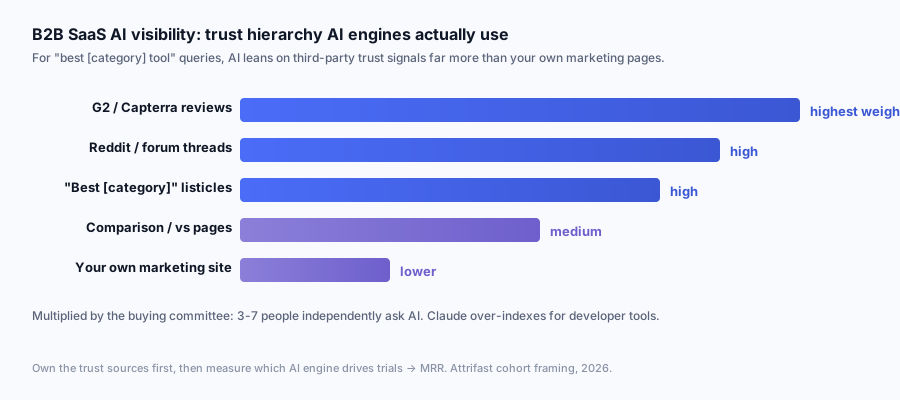
Here is the trust hierarchy I observe the models leaning on for software recommendations, roughly ordered. Treat this as correlational — no AI vendor publishes a ranking algorithm — but it is consistent across the GEO research from Backlinko [12], Profound [2], Ahrefs [13], and Semrush [14], and with what I see in citations.
| Rank | Source type | Why the model trusts it | How you influence it |
|---|---|---|---|
| 1 | Peer review platforms (G2, Capterra) | Aggregated independent signal, structured | Earn real reviews; populate profile |
| 2 | Editorial "best of" listicles | Human-curated, high-authority domains | Pitch to be included |
| 3 | Reddit / community threads | Unstructured peer truth | Be genuinely useful in threads |
| 4 | Comparison content (yours + third-party) | Structured, liftable tables | Build honest comparison pages |
| 5 | Analyst / research mentions | Authority signal | Hard to influence directly |
| 6 | Your own marketing site | Self-description, lowest trust | Make it crawlable and structured |
Notice your own site is last. That is the uncomfortable core of B2B AI visibility: the place you control most is the place the model trusts least for a recommendation. Your owned content matters as supporting structure and for navigational/technical queries — but for the "best [category]" recommendation that decides the shortlist, you are mostly competing through sources you can only influence, not control.
The role of G2 and Capterra in AI software recommendations
The one-line answer: G2 and Capterra are among the most-trusted and most-crawled software-review corpora on the web, their category pages are shaped exactly like the ranked list an AI wants to produce, and a populated profile with real, recent reviews is close to table stakes for "best [category]" AI recommendations in most B2B categories.
Think about the model's problem. It is asked to recommend the best tool in a category. It cannot try the tools. It cannot trust any vendor's claim of being best. What it can do is reach for the largest structured corpus of independent peer judgments — and that is G2 and Capterra [6][7], whose entire data model is "tools, ranked, by real-user reviews, within categories." The category page is, almost literally, the answer template.
| What G2/Capterra provides | Why the model lifts it |
|---|---|
| Category-leader rankings | Pre-ranked answer to "best X" |
| Review counts and star ratings | Quantified trust signal |
| Structured attributes (pricing, features, integrations) | Liftable comparison data |
| Recency of reviews | Freshness signal |
| Use-case and segment filters | Maps to "best X for Y" |
The honest mechanics of building this asset, with the caveats:
- Volume and recency beat a bare profile. A profile with two reviews from 2023 does almost nothing. The category-leader and ranking signals the model lifts are driven by review volume and recency. For an early SaaS, getting your first 15-20 honest reviews from real customers is high-leverage founder work that is hard to backfill later.
- Never buy or incentivize fake reviews. Beyond being against platform policy and increasingly detectable, it poisons the exact trust signal you are trying to build, and the model is getting better at discounting low-trust patterns. The whole reason this asset works is that it is honest peer signal. Faking it defeats the mechanic.
- It is necessary-but-not-sufficient. A strong G2 presence does not by itself win the recommendation; you still need the listicles and the Reddit threads. But its absence is a near-disqualifier in review-heavy categories.
I will be transparent about my own position: this is correlational, not a documented ranking factor any AI vendor publishes. I infer it from citation patterns, the GEO research, and the obvious structural fit between review-platform data and the answer shape. Treat it as a strong, well-grounded hypothesis, not a law.
| Tactic | Effort | Time-to-effect | Honest expected impact |
|---|---|---|---|
| Claim + complete profile | Low | Days | Table stakes; small alone |
| First 15-20 real reviews | Medium | Weeks | High for early SaaS |
| Ongoing review cadence | Medium (recurring) | Months | Sustains category position |
| Respond to reviews | Low | Ongoing | Trust + recency signal |
| Buy fake reviews | — | — | Negative; do not |
Owning the "best [category] tool" listicles
The one-line answer: the editorial "best [category] software" roundups on high-authority sites are written and updated by humans you can reach, AI engines lean on them heavily for shortlist queries, and getting added is a tractable outreach problem plus a genuinely differentiated product angle — not a black box.
When a buyer asks "best [category] tool," the model frequently lifts from the editorial roundups — the "10 best [category] software in 2026" posts on review blogs, comparison hubs, and niche newsletters. These are high-authority, human-curated, and structured as ranked lists, which makes them ideal model fodder, a pattern the AI-citation research from Ahrefs [13] and Semrush [14] documents repeatedly. Unlike the training corpus, they are also directly influenceable: a real person decides what goes in the list, and you can reach that person.
| Listicle type | Authority | Influenceability | Approach |
|---|---|---|---|
| Big review-blog roundups | High | Medium | Targeted pitch + differentiation |
| Niche / vertical newsletters | Medium-high | High | Relationship + genuine fit |
| Comparison hub directories | Medium | High | Submit + maintain listing |
| Competitor "alternatives to X" posts | Medium | Medium | Pitch as a legitimate alternative |
| Affiliate-driven roundups | Variable | High (but disclose) | Affiliate terms; watch trust |
The outreach that works is not "please add us." It is "here is the specific buyer segment you are not currently serving well in your list, and here is why we are the honest best answer for them, with the numbers." For Attrifast, the angle is concrete: most "best analytics tools" lists are dominated by enterprise attribution platforms at $750+/mo, and they have no honest answer for the bootstrapped Stripe-native SaaS under $50k MRR. That gap is the pitch — not "we are better," but "you are missing a segment, and we are the right answer for it." That framing also makes the listicle better, which is why editors say yes.
A note on honesty that is also strategy: the lists that AI trusts most are the ones that read as genuinely editorial, not pay-to-play. Affiliate-stuffed roundups exist and you can get into them, but if the model starts discounting low-trust commercial lists — and the trend is that direction — the durable value is in the editorially credible ones. Pitch the credible ones first.
Comparison and "alternatives to X" pages
The one-line answer: comparison pages are disproportionately valuable for B2B because software buyers run "X vs Y" and "alternatives to X" queries at high rates, AI engines parse comparison tables into clean liftable structures, and an honest head-to-head is exactly the shape the model wants — but the table has to concede where the competitor wins or it gets discounted as marketing.
Your own comparison and alternatives pages serve two jobs. First, they capture buyers in the comparison query class directly through search and AI browsing. Second, they give the model a structured, liftable source on your own domain to cite when it browses — moving your owned content up the trust hierarchy from "vendor self-description" toward "structured comparison data."
| Page type | Query it captures | The honest version |
|---|---|---|
| "Attrifast vs [competitor]" | Direct comparison | Concede their strengths; be specific |
| "Alternatives to [incumbent]" | Switching intent | List real alternatives, not just yourself |
| "Best [category] for [segment]" | Use-case shortlist | Genuinely rank, include competitors |
| "[Category] tool pricing comparison" | Economic-buyer query | Real numbers, updated |
| "[Competitor] pricing explained" | Pre-switch research | Fair, current, non-snarky |
The single thing that determines whether a comparison page works for AI visibility is whether it is honest. A table that rates you best on every axis is transparently self-serving; both the model and the buyer discount it. The comparison pages that win cite real numbers, name the use cases where the competitor is the better choice, and disambiguate clearly — which is also the structural pattern the Princeton GEO research found lifts generative-engine visibility [15]. Counterintuitively, conceding ground builds the credibility that earns the citation and the conversion.
| Comparison-table element | Helps AI citation | Helps conversion |
|---|---|---|
| Real pricing numbers | Strong | Strong |
| Honest "they win here" rows | Strong | Strong |
| Specific feature deltas | Strong | Medium |
| Use-case recommendations | Strong | Strong |
| "We win everything" framing | Negative | Negative |
| Vague qualitative claims | Weak | Weak |
For Attrifast, the comparison pages I am building concede plainly: if you are a 200-person enterprise B2B with a six-month sales cycle and a buying committee of ten, Dreamdata or HockeyStack is the right tool and Attrifast is not. That concession is true, and it makes the page trustworthy when it then says: if you are a bootstrapped self-serve SaaS under $50k MRR running Stripe, Attrifast is the honest answer at $9.99/mo. The feature page on revenue attribution and the bootstrapped-SaaS page carry the same honest-segment framing.
Reddit and community presence for B2B AI citations
The one-line answer: Reddit is disproportionately weighted in AI citations as the source of unstructured peer truth — real practitioners answering "what do you actually use" — so genuine, useful community presence in the threads where your buyers ask for recommendations is a high-leverage B2B AI-visibility lever, and astroturfing actively backfires.
The GEO research from Backlinko [12] and Profound [2] consistently finds Reddit punching far above its size in AI citations — a weighting that became more pronounced after the major engines signed content-licensing deals with Reddit [20]. The reason is intuitive once you see the model's problem: for "what do people actually use for X" — the realest version of a B2B recommendation query — there is no better corpus than practitioners answering honestly in subreddits. The model lifts those threads because they read as ground truth.
| Reddit behavior | Effect on AI visibility | Effect on trust |
|---|---|---|
| Genuinely answer "what do you use for X" threads | Positive | Positive |
| Disclose you are the founder when relevant | Positive | Strong positive |
| Provide value before mentioning your tool | Positive | Positive |
| Astroturf with fake accounts | Negative (and detectable) | Strongly negative |
| Drop links with no context | Negative | Negative |
| Get organically recommended by others | Strong positive | Strong positive |
The honest play, which is also the only durable one: be a real, identified participant who is useful. Answer the question that was asked. Mention your tool only when it is genuinely the right answer, and disclose that you built it. The gold standard is being recommended by someone who is not you — which you earn by having a product good enough that real users vouch for it. I dug into the revenue mechanics of this specifically in Reddit AI citations and revenue, because Reddit-driven AI referrals behave differently in the funnel than direct ChatGPT clicks.
The thing not to do is the thing many vendors quietly do: sock-puppet accounts seeding recommendations. Beyond the platform and ethical problems, it corrupts the trust signal you are trying to build, Reddit's own moderation catches it, and the models are increasingly able to discount manufactured patterns. The mechanic only works because it is real.
| Subreddit type | B2B relevance | How to engage |
|---|---|---|
| Vertical practitioner subs (r/SaaS, r/legaltech, etc.) | High | Be useful; identified |
| "What tool" recommendation threads | Very high | Answer honestly when fit |
| Your competitor's brand mentions | Medium | Engage carefully, never trash |
| General business subs | Low-medium | Selective, high-value only |
The complete B2B AI-visibility playbook, sequenced
The one-line answer: own the trust sources in priority order — G2/Capterra presence, editorial listicles, Reddit/community, honest comparison pages, then on-page structure — and instrument AI-engine revenue attribution before and throughout, because you cannot improve a channel you cannot measure.
Here is the full sequence, ordered roughly by leverage-per-effort for a B2B SaaS that already has product-market fit. The first row is deliberately measurement, not optimization, because everything after it depends on being able to see what is working.
| # | Move | Effort | Time-to-effect | Why this order |
|---|---|---|---|---|
| 0 | Instrument AI-engine revenue attribution | Low (turnkey) | Immediate | Baseline before you change anything |
| 1 | Claim + populate G2/Capterra, get first reviews | Medium | Weeks | Highest-trust source, table stakes |
| 2 | Get into ranking editorial listicles | Medium | Days-weeks | Direct, influenceable, high authority |
| 3 | Build genuine Reddit/community presence | Medium (recurring) | Weeks-months | Unstructured peer-truth signal |
| 4 | Build honest comparison + alternatives pages | Medium | Weeks | Owned liftable source + capture |
| 5 | Add on-page structure (schema, direct answers) | Low | Days | Improves retrieval citation odds |
| 6 | Earn brand mentions / authority over time | High | Months | Feeds training-corpus presence |
| 7 | Map content to committee roles | Medium | Ongoing | Win the whole committee, not one vote |
Two honest caveats on this sequence. First, for a SaaS below product-market fit, most of these are premature — the exception is row 1 (seed your review profiles, because that asset compounds and is hard to backfill). Spend your hours on product and customer conversations until you have a repeatable acquisition motion. Second, the time-to-effect column mixes the two mechanics: rows 1-5 mostly buy you live-retrieval and trusted-source citations on a fast clock, while rows 6-7 buy training-corpus presence on a slow one. Fund the slow work with the fast wins.
Measuring which AI engine actually drives trials and MRR
The one-line answer: presence tracking (does the model mention me) is the vanity layer; revenue tracking (does that mention turn into a paid customer) is the layer almost nobody closes — and you close it with server-side AI-engine referer fingerprinting, a first-party identifier that survives the trial window, and a Stripe webhook join from trial signup and subscription.created back to the originating engine.
This is the Attrifast wedge, so read the next paragraph with the appropriate skepticism: I sell the thing I am about to describe. That said, the architecture is vendor-neutral, you can build it yourself, and the reason most teams do not is not cost — it is that the trial-window join is genuinely fiddly.
The problem in B2B specifically is the trial window. A buyer arrives from a ChatGPT citation, starts a 14-day trial, and converts to paid three weeks later from a direct visit to /billing. Naive attribution credits "direct" for what ChatGPT actually drove. The fix is to persist the originating AI-engine source on the user record at trial signup, then on the Stripe subscription.created event, join the revenue back to that original source rather than the conversion-day session. This is the same trial-to-paid problem I cover in the attribution playbook; AI referrals just make it more acute because they are the most likely to be mislabeled as direct in the first place.
| Layer | What it answers | Tooling | The trap |
|---|---|---|---|
| Presence | Does the model mention me? | Manual prompts, GEO trackers | Vanity if it stops here |
| Referral | Did a click reach my site? | Server-side referer fingerprinting | GA4 buckets it as Direct |
| Trial | Did the click start a trial? | First-party session + signup join | Lost across cross-device |
| Revenue | Did it convert to paid MRR? | Stripe subscription.created join | Conversion-day mis-attribution |
The per-engine AI-referrer detection list, which is the same one across the AI-attribution posts:
| Engine | Referrer domains to fingerprint |
|---|---|
| ChatGPT | chatgpt.com, chat.openai.com, oai.com |
| Perplexity | perplexity.ai |
| Claude | claude.ai |
| Gemini | gemini.google.com |
| Copilot | copilot.microsoft.com |
Why this is cookieless and consent-banner-free: the referer fingerprint is read server-side, the identifier is first-party scoped to your own domain (outside the cross-site cookie rules ITP and the ePrivacy directive target), and the Stripe join uses checkout metadata. None of the three pieces needs a third-party cookie or a banner under most jurisdictions — verify with your own privacy review. For a privacy-first B2B SaaS, that matters: you can report revenue per AI engine without the banner that hurts conversion.
| Metric to report | Why it beats citation counts |
|---|---|
| Trials per AI engine | Ties presence to top-of-funnel reality |
| Trial-to-paid rate per AI engine | Reveals which engine sends quality |
| MRR per AI engine | The number the board actually wants |
| RPV per AI engine vs Google organic | Justifies the channel investment |
| Engine mix shift over time | Detects when a lever started working |
One number from the Attrifast base, labeled as my own aggregate: AI-attributed sessions converted at 1.4-2.1x the rate of equivalent Google organic on the same landing pages across 24 B2B SaaS sites in Q1 2026, with the most likely cause being intent quality — a buyer arriving from an AI recommendation has already read a partial answer and a peer-vouched shortlist. That is exactly why getting recommended is worth the work, and exactly why measuring it is non-negotiable: without the join, the highest-quality channel you have is the one most likely to be invisible. The dark AI traffic in GA4 problem is the flip side of this — when you are not recommended, you cannot even tell, because there is nothing to mis-attribute.
Honest caveats and what I do not know
The one-line answer: nearly everything in B2B AI visibility is correlational rather than a documented ranking factor, the engines change behavior frequently, and any vendor — including me — claiming certainty about how the models decide is overselling.
Let me be explicit about the limits, because the field is full of confident claims that should not be confident.
| Claim in this article | Confidence | Basis |
|---|---|---|
| B2B leans on G2/Capterra/Reddit/listicles | High | Consistent GEO research + citation patterns |
| Comparison tables help citation | High | GEO research + my own tests |
| Claude over-indexes for dev tools | Medium-high | My aggregate measurement, plausible cause |
| AI-attributed RPV is 1.4-2.1x organic | Medium | My aggregate, n=24, B2B SaaS only |
| Specific trust-source ordering | Medium | Inferred, not published |
| Exact engine referral shares | Low-medium | Varies hugely by category |
Things I genuinely do not know: the precise weighting any model gives any source; whether a strong G2 presence is causal or merely correlated with the brand strength that independently drives citations; how durable any of these patterns are as the engines evolve and add commerce or ad surfaces. The 1.4-2.1x RPV figure is real in my data but it is a B2B SaaS aggregate that almost certainly inverts for impulse-driven categories, and it is not a controlled experiment. Treat my numbers as directionally useful field measurement from someone running the same playbook on his own product, not as gospel. The one thing I am confident about is the meta-point: measure revenue per engine, because that is the only claim in this whole space you can actually verify on your own data.
FAQ
How is B2B SaaS AI visibility different from B2C or general GEO?
Three structural differences. Software buyers ask comparison and shortlist queries — "best [category] tool for [use case]", "[A] vs [B]", "alternatives to [incumbent]" — far more than the informational queries that dominate B2C. AI engines answer those by leaning on G2, Capterra, Reddit, and third-party "best of" listicles rather than your marketing site, because peer review and editorial roundups read as more trustworthy than vendor self-description. And the B2B buying committee means three to seven people independently ask AI about the same purchase, so a single citation compounds across stakeholders. The playbook is built around those three facts.
Which AI engines do B2B software buyers actually use to find tools?
ChatGPT is the dominant AI surface by referral volume. Perplexity punches above its user-base weight on comparison and "best of" queries because it cites sources inline and buyers click those citations. Google AI Overviews show up on many category queries but drive fewer clicks because the answer often satisfies in place. Claude over-indexes for developer-facing and technical B2B tools. Microsoft Copilot matters mostly inside Microsoft-365 enterprise accounts. Instrument all five, but expect ChatGPT and Perplexity to drive the majority of measurable trials for most SMB SaaS.
Why does AI lean on G2 and Capterra so heavily for software recommendations?
Because they solve the trust problem the model cannot solve alone. An LLM asked "best CRM for a 10-person team" has no way to verify a vendor's claim of being best, so it reaches for sources that aggregate independent peer signal — review counts, star ratings, category leaders. G2 and Capterra are the largest structured software-review corpora on the public web, heavily crawled, and their category pages are shaped exactly like the ranked list the model wants to produce. Reddit plays the adjacent role of unstructured peer truth. Your owned content alone rarely wins a "best [category]" recommendation.
How do I get my SaaS into the "best [category] tool" listicles that AI cites?
Three parallel motions. Pitch the editorial roundups directly — the "best [category] software" posts are written by humans you can reach, and getting added is a matter of a well-targeted email plus a genuinely differentiated angle, usually a buyer segment the list under-serves. Build your own honest comparison and alternatives pages so your domain is a structured source the model can lift when it browses. And earn organic Reddit and community mentions by being genuinely useful in the threads where buyers ask for recommendations. The combination moves the citation needle for B2B; any one alone rarely does.
Does my company need a G2 or Capterra profile to be recommended by AI?
For most B2B categories in 2026, a populated profile with real reviews is close to table stakes for "best [category]" AI recommendations, because those properties are among the sources the model trusts most for software comparisons. A profile with a handful of reviews does little; the value comes from review volume and recency, which feed the category-leader signals the model lifts. It is necessary-but-not-sufficient — you also need the listicles and Reddit. For an early SaaS, getting your first 15-20 honest reviews tends to pay off more than most other AI-visibility work.
How does the B2B buying committee change my AI-visibility strategy?
A B2B purchase typically involves three to seven stakeholders, and several of them independently ask AI about the same category before they ever talk to each other. That changes the math twice. A single strong citation compounds, because the recommendation reaches multiple decision-makers through their own private AI conversations. And different roles ask different query shapes: the end user asks "easiest tool", the technical evaluator asks "does it have an API / SOC 2 / SSO", the economic buyer asks "pricing vs competitor". To win the committee you need visibility across all those shapes, not just "best [category]". Map content to roles.
Why does Claude over-index for developer-tool B2B specifically?
Across the sites I measure, Claude referrals to developer-facing tools — APIs, CLIs, infrastructure, observability, dev-experience products — run materially higher as a share of total AI referrals than Claude's overall user-base share would predict, while Claude referrals to non-technical B2B track close to baseline. The most likely cause is audience composition: Claude has a developer-heavy user base, and developers evaluate dev tools through the assistant they already code with. If you sell to developers, instrument Claude specifically and do not let a "ChatGPT-only" strategy hide a channel that may be driving meaningful technical trials.
How do I measure which AI engine drives trials and MRR, not just citations?
Citations are the vanity layer; revenue is the layer almost nobody closes. The architecture is three pieces: server-side referer fingerprinting against a known AI-engine domain list so you can label a session as ChatGPT, Perplexity, Claude, Gemini, or Copilot; a first-party identifier scoped to your own domain that survives the trial window; and a Stripe webhook join connecting the trial signup, and later the subscription.created conversion, back to the originating engine. That gives you trials and MRR per AI engine rather than per-engine citation counts. Most GEO tools stop at presence and never tell you which engine pays.
Will blocking GPTBot or ClaudeBot hurt my AI visibility?
It depends which bot and surface. The training crawlers — GPTBot for OpenAI, ClaudeBot for Anthropic — feed the training corpora that govern from-memory recommendations. Blocking them slowly degrades your presence in no-browse answers but does not block the live-fetch agents that browse at query time. For most B2B SaaS the right call is to allow the training and search crawlers both, because training-corpus presence is exactly what gets you recommended when a buyer asks "best [category]" with no browsing — a large share of B2B AI queries. The exception is a specific licensing or legal reason to withhold content, in which case accept the cost knowingly.
How long does it take to start showing up in AI recommendations for B2B queries?
Two timelines. The live-retrieval surface — ChatGPT search, Perplexity, AI Overviews browsing your page — can pick up a well-structured comparison or "best of" page within days to a few weeks of being crawled, and getting added to a trusted third-party listicle can show up almost immediately because the model already trusts that source. The training-corpus surface, which governs from-memory recommendations, lags far behind because it only updates on a model's knowledge cutoff. So you can win Perplexity comparison citations next month and still be invisible to the no-browse model for a year. Plan for both and measure throughout.
Are comparison pages and "X vs Y" content worth building for AI visibility?
Yes, disproportionately for B2B. Software buyers run comparison queries at higher rates than almost any commercial vertical, AI engines parse comparison tables into clean structured representations they are eager to lift, and an honest head-to-head is exactly the shape the model wants when a buyer asks "X vs Y" or "alternatives to X". The caveat that determines whether it works: the comparison has to be genuinely fair and specific. A self-serving table that rates you best on every axis reads as marketing and gets discounted by both the model and the buyer. The pages that win cite real numbers and concede where the competitor is stronger.
Should a bootstrapped SaaS founder spend time on AI visibility at all, or focus on product?
Below early product-market fit, founder hours are usually better spent on product and direct customer conversations, with one cheap exception: claim and seed your G2 and Capterra profiles with your first honest reviews, because that asset compounds and is hard to backfill later. Once you have a repeatable acquisition motion and unexplained direct traffic that smells like AI referrals, AI visibility becomes worth deliberate effort — and the first move is to measure, not optimize, because you cannot improve a channel you cannot see. Instrument AI-engine attribution first, then invest where the data says it is paying.
Can I do AI-visibility revenue tracking without cookies or a consent banner?
Yes. The minimum stack is server-side referer fingerprinting against a known AI-engine domain list, a first-party identifier scoped to your own domain (outside the cross-site cookie rules ITP and the ePrivacy directive target), and a server-side join from the first-party session to a Stripe Checkout via metadata that spans the free-trial window. None of those pieces requires a third-party cookie, a fingerprint hash, or a consent banner under most jurisdictions — verify with your own privacy review. This is the cookieless architecture Attrifast ships, and it lets a privacy-first SaaS report revenue per AI engine without a banner.
Is paying for "guaranteed ChatGPT rankings" from a GEO agency a good idea?
Treat it with the same suspicion as a vendor promising guaranteed Google #1. There is no paid placement in the organic citation surface of ChatGPT or Perplexity as of early 2026, and no published ranking API to guarantee against. A legitimate GEO partner can do real work — pitching you into editorial roundups, improving comparison-content structure, building genuine community presence — but those are probabilistic levers, not guarantees, and honest ones say so. The bigger red flag is any vendor that sells citation tracking but cannot tell you which engine drove a single trial or dollar. Presence without revenue measurement is the vanity trap this article exists to help you avoid.
Sources
Primary sources for the claims in this article. Numbered citations in the text link to the matching entry.
- [1]ChatGPT usage milestones and weekly active users — OpenAI (2025).
- [2]The State of Generative Engine Optimization for SaaS — Profound (2025).
- [3]Introducing ChatGPT search and inline citations — OpenAI (2024).
- [4]Overview of OpenAI's bots: GPTBot, ChatGPT-User, OAI-SearchBot — OpenAI (2026).
- [5]Anthropic crawler and ClaudeBot documentation — Anthropic (2026).
- [6]2024 Buyer Behavior Report — G2 Research (2024).
- [7]Software buyer trends and review-driven discovery — Capterra / Gartner Digital Markets (2025).
- [8]Default channel group definitions for GA4 — Google Analytics Help (2026).
- [9]What triggers AI Overviews? 86 factors and 146 million SERPs analyzed (20.5% of SERPs, September 2025) — Ahrefs (2025).
- [10]The State of B2B Buying: digital and AI-assisted research — Forrester (2025).
- [11]The B2B Buying Journey and buying-group dynamics — Gartner (2025).
- [12]AI Optimization: How to Rank in AI Search — Backlinko (2026).
- [13]Generative Engine Optimization: Growth Strategies and Metrics For the AI Era — Ahrefs (2025).
- [14]AI Overviews and AI search citation research — Semrush (2025).
- [15]GEO: Generative Engine Optimization (Aggarwal et al.) — arXiv / Princeton (2024).
- [16]State of the SaaS Capital Markets and bootstrapped benchmarks — OpenView Partners (2024).
- [17]State of the Cloud and B2B SaaS go-to-market benchmarks — Bessemer Venture Partners (2024).
- [18]Americans' use of ChatGPT and generative AI — Pew Research Center (2025).
- [19]ChatGPT search and citations help article — OpenAI Help Center (2025).
- [20]Reddit content licensing deal with Google for AI training — Reuters (2024).
- [21]Common Crawl — open web corpus used in LLM training — Common Crawl Foundation (2026).
If you want the practical detection code that turns these citations into attributed revenue, the LLM tracking tools benchmark compares the tools and the track Claude traffic page walks the per-engine setup. For the funnel mechanics of Reddit-driven AI referrals, see Reddit AI citations and revenue. And to close the loop from citation to MRR, the revenue attribution feature page and the bootstrapped-SaaS guide walk the architecture end to end.
Related reading from the Attrifast research stack
For hands-on tools and deeper context, see AI visibility score, share of voice in AI search, and AI citation tracking. And for the category that ties all of this back to money — whether your AI visibility actually produced paying customers — see AI revenue attribution, the layer the monitoring tools structurally leave open.