
Part of the AI Search Hub — browse all 35 AI Search guides.
I have been logging AI citations for my own properties by hand since late 2024. The first version was a Google Sheet with one row per prompt and one column per engine, updated on Sunday mornings. The second version was a cron job that hit four APIs and dumped into Postgres. The third version became a small internal dashboard I never shipped because by mid-2025 there were a dozen vendors selling the same thing under a name that had finally stabilized: prompt tracking.
That label hides a lot of confusion. Half the people using the term mean LLM monitoring inside an AI application stack (Langfuse, LangSmith, Helicone). The other half mean something very different: SEO-style visibility tracking against external answer engines. This article is about the second one. The question of whether ChatGPT keeps citing your competitor instead of you, whether a Perplexity model update just kicked you out of the answer for your bottom-of-funnel query, whether your category page is getting picked up by Google AI Overviews. Across the roughly 40 properties I have instrumented and the 200-site Attrifast cohort I now read every week, that is the question this discipline exists to answer.
I will define the term, walk the short history of how it became a category in 2024-2025, contrast it cleanly with rank tracking, lay out who actually needs it and who is wasting their budget, and end with what to do if you decide the answer is yes. The frame I keep coming back to: prompt tracking is the measurement layer of GEO, and like any measurement layer it is necessary but never sufficient. If you cannot tie the citation back to a paying customer, you are buying a vanity scoreboard.
Quick facts
| Spec | Value | Source |
|---|---|---|
| Year the category got a stable name | 2024-2025 | Profound launch, SEOcrawl, Peec, Otterly market entry |
| Typical SMB prompt set size | 30-200 prompts | Attrifast cohort observation |
| Recommended refresh cadence (SMB) | Weekly | Operator practice; engines update on weeks not hours |
| Major engines worth tracking in 2026 | ChatGPT, Perplexity, Claude, Gemini, AI Overviews | Profound, Loamly, Attrifast cohort |
| ChatGPT weekly active users (Q1 2026) | ~800 million | OpenAI / Reuters [1] |
| Perplexity monthly queries (mid-2025) | ~1 billion | Perplexity / TechCrunch [2] |
| AIO appearance rate (Ahrefs, 146.1M SERPs, Sept 2025) | 20.5% of SERPs | Ahrefs [3] |
| Median SMB AI traffic share (Attrifast cohort) | 6-9% of sessions | Attrifast 200-site benchmark [4] |
| Median GA4 Direct that is actually AI-referred | 34% | Attrifast benchmark [4] |
| Typical price band for vendor prompt trackers | $99-$5,000 / month | Profound, Peec, SEOcrawl, Otterly public pricing |
| GEO research paper that started the discipline | Princeton GEO (Aggarwal et al. 2024) | arXiv [5] |
| Recommended minimum samples per prompt for trend | ~30 | Operator practice |
The definition: prompts in, citation logs out
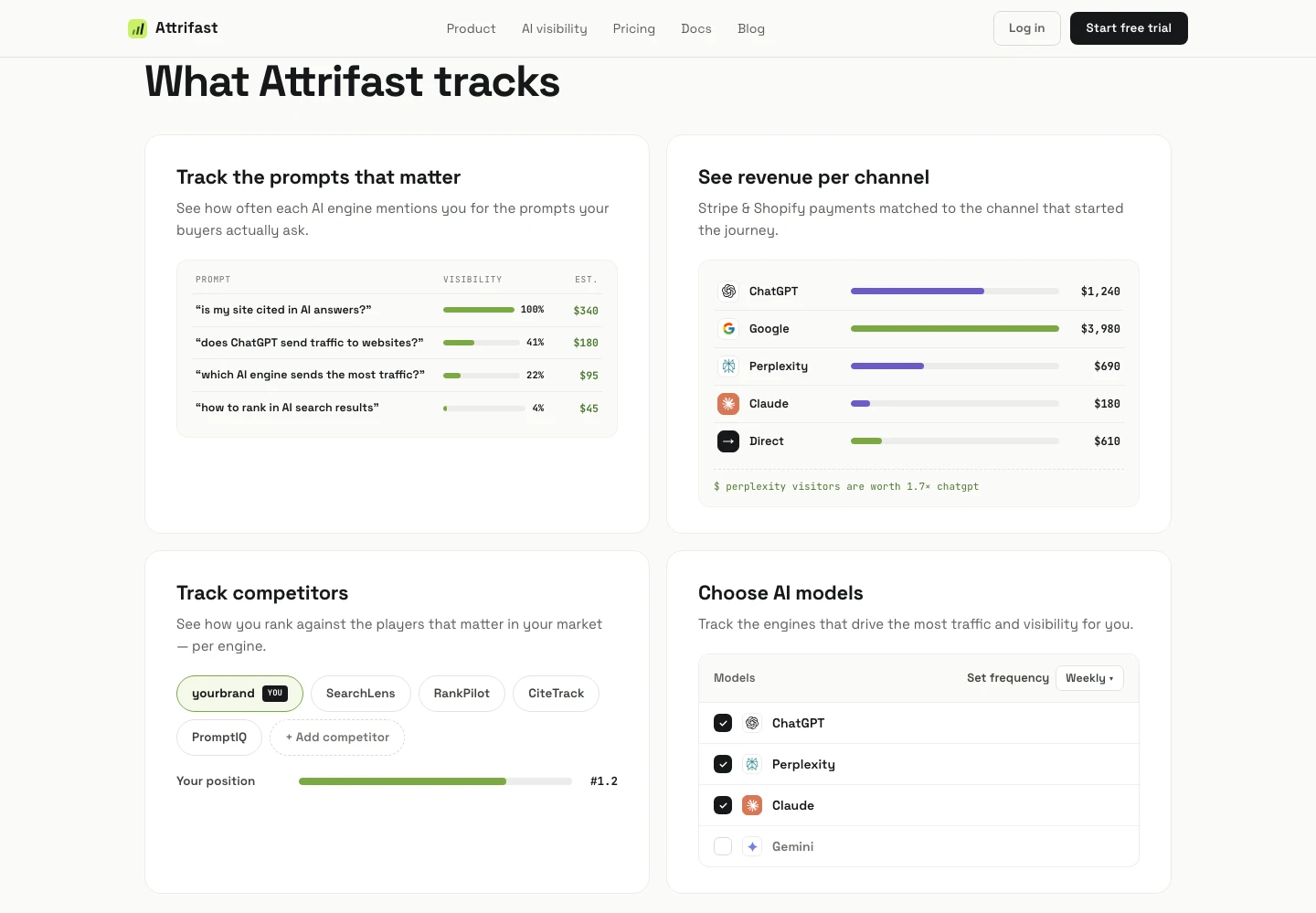
Prompt tracking is the practice of repeatedly sending a defined list of questions to AI answer engines on a schedule, parsing which sources and brands the engines cite in their answers, and storing the results as a time series. You decide which questions matter, the tool (or your own cron) runs them, and you get back a daily-or-weekly log that lets you say whether you appeared, on which prompts, on which engine, in which position within the citation list, and with what kind of supporting context.
The shortest one-line definition I use in conversation: it is rank tracking with the rank replaced by a citation log and the keyword replaced by a sentence. Everything downstream of that is detail.
What lives inside a prompt tracking system, mechanically, is a small data pipeline. There is a prompt set, which is your list of questions. There is a scheduler, which fires those prompts at the engines on a cadence. There is a parser, which extracts the cited URLs (or unlinked brand mentions, where the engine exposes them) out of the responses. There is a store, which holds the per-engine, per-prompt, per-day record. There is a reporting layer, which rolls everything up into citation share, share of voice, per-engine variance, and competitor comparison metrics. None of it is conceptually exotic. The complexity sits in the parser, because every engine returns citations differently and the formats shift across model versions.
| Component | What it does | Where complexity lives |
|---|---|---|
| Prompt set | List of questions to track | Picking prompts that match real buyer questions |
| Scheduler | Fires prompts on a cadence | Rate limits, retries, API auth |
| Engine adapter | Talks to ChatGPT, Claude, Perplexity, Gemini APIs | Format drift across model versions |
| Parser | Extracts cited URLs and brand mentions | Citation footnote shape changes per engine |
| Store | Persists results per engine per prompt per day | Schema needs to survive engine changes |
| Reporting | Computes citation share, SOV, variance | Defining the metric cleanly |
| Alerts | Flags significant changes | Distinguishing signal from noise |
If you read that table and thought it looks like a slightly more complicated rank tracker, you are right. The shape of the system is familiar; the inputs and outputs have just shifted.
A short history: how the category formed in 2024-2025
The discipline existed informally for as long as people have been asking ChatGPT about their own brand. The category formed when several vendors decided at roughly the same time that the question was worth productizing.
The early movers in late 2023 and early 2024 were Otterly and Profound. Otterly framed it as brand monitoring; Profound positioned it as Answer Engine Insights, an enterprise platform aimed at Fortune 500 marketers, and turned it into a category-defining product with a real event franchise (Zero Click). The mid-2024 wave brought Peec, Scrunch, Goodie, Bluefish, AthenaHQ, and Evertune, each carving out a slightly different angle: dashboards for in-house marketing teams, white-label tooling for agencies, brand-sentiment overlays. By late 2025 SEOcrawl had a full per-LLM landing page set for ChatGPT, Claude, Gemini, Perplexity, and Copilot prompt tracking, and the indie-hacker side of the market had Loamly, Geoptie, and a couple of single-founder open-source projects.
That timeline matters because it explains why the category vocabulary is still inconsistent. Some vendors call it prompt tracking, some call it answer engine insights, some call it AI visibility tracking, some call it citation monitoring. Underneath, the data model is roughly the same.
| Year | Event | Effect on category |
|---|---|---|
| 2023 (late) | Otterly, early Profound launch | Term "brand monitoring for LLMs" surfaces |
| 2024 (Q1-Q2) | Profound Answer Engine Insights ships | Enterprise label coalesces |
| 2024 (Q3) | Princeton GEO paper [5] published at KDD | Academic underpinning |
| 2024 (Q4) | Peec, Scrunch, Goodie, Bluefish enter | Mid-market vendor wave |
| 2025 (H1) | AthenaHQ, Evertune, more agencies-focused tools | Vertical specialization |
| 2025 (H2) | SEOcrawl per-LLM prompt-tracking pages | Term "prompt tracking" stabilizes |
| 2025 (Q4) | Profound Zero Click event series | Category branding via event |
| 2026 (Q1-Q2) | Profound Index, public AI visibility datasets | Free leaderboards as funnel tops |
The reason I keep harping on the 2024-2025 window is that anyone publishing prompt-tracking advice before mid-2024 is working from older mental models. The discipline as practiced now (defined prompt set, multi-engine, per-prompt citation share, competitor benchmarking) is a 2025 stack at the earliest.
Prompt tracking versus rank tracking, head to head
The single most useful framing for newcomers is to put the two disciplines side by side. They share genetics but the daily practice is meaningfully different. I have a dedicated piece on the prompt tracking vs keyword rank tracking tradeoff, but the headline contrasts are worth covering here.
| Dimension | Rank tracking | Prompt tracking |
|---|---|---|
| Input | Keyword | Prompt sentence |
| Output | Numeric position 1-100 | Cited-or-not + position in citation list |
| Refresh cadence | Daily for paid, weekly for SMB | Daily-to-weekly, less below weekly |
| Stability across runs | Mostly stable day-to-day | Less stable, same prompt can shift |
| Determinism | High (Google SERP is mostly stable per locale) | Low (model sampling adds variance) |
| Standard vendors | Ahrefs, Semrush, AccuRanker, SE Ranking | Profound, Peec, Otterly, SEOcrawl, Loamly |
| Public ranking theory | Documented in part (Google patents, leaks) | Almost none published |
| Cost band for SMB | $30-$200 / month | $99-$1,000 / month |
| Cost band for enterprise | $500-$5,000 / month | $1,000-$10,000+ / month |
| Tied to attribution? | Yes via Google referer | Often not, referer often stripped |
| Years the discipline has existed | ~20 | ~2 |
The two boards share the same job description (tell me whether I am visible to my buyers) and the same blind spot (presence is not revenue), but the day-to-day work is different enough that the same SEO consultant who is great at rank tracking will need a re-tooling period before they are great at prompt tracking.
A cleaner way to see the divergence is to compare what each board can answer:
| Question | Rank tracking answers? | Prompt tracking answers? |
|---|---|---|
| Where do I rank for "ai citation tracker"? | Yes | No (wrong unit) |
| Does ChatGPT cite me on "best AI citation tracker"? | No | Yes |
| How is my keyword position trending? | Yes | No |
| How is my citation share trending? | No | Yes |
| Did a Google update kick me out? | Yes (via position drop) | No |
| Did a Claude model update kick me out? | No | Yes |
| Which competitors share the top 10 with me? | Yes | No |
| Which competitors share my AI citation set? | No | Yes |
| Did the click that came from this convert? | Partial (GA4 + Search Console) | Almost never |
That last row matters. Neither rank tracking nor prompt tracking sees the revenue side of the funnel without a layer underneath. It is why I keep saying both are necessary and neither is sufficient.
That diagram is the operating model. Notice the H/K branch. You can have rising citation share that produces no revenue because the wins are coming on Claude (which often summarizes without a clickable link) or on AI Overviews (which shave organic CTR). Without revenue attribution underneath, you cannot tell the success case from the noise.
Who actually needs prompt tracking in 2026
The honest answer is fewer people than vendor websites suggest. Across the 200-site Attrifast cohort I read every week, prompt tracking earns its line item for somewhere between a quarter and a third of SMB SaaS sites. Below that share, the channel is too small and the tool is too noisy to be worth paying for.
The clearest fits I see are operators whose buyers explicitly research in AI engines. That is most B2B SaaS selling into developer, marketer, finance, or analyst audiences, because those buyers ask ChatGPT and Perplexity for vendor shortlists. It is ecommerce brands in categories where ChatGPT Shopping returns recommendations (skincare, supplements, software, niche apparel, tools). It is agencies and consultants who need to show clients a "we are tracking your AI visibility" deliverable. It is content publishers in research-heavy verticals (finance, health, B2B research) whose pages are increasingly extracted into AI answers.
The clearest non-fits are local services businesses (a plumber in Houston does not need to know how Claude answers questions about plumbing), pure-content publishers monetized by display ads (the citation does not pay you, the ad does, and AI citations cannibalize the ads), pre-traction startups with under 1000 monthly visitors (the channel does not exist yet for you), and any business whose buyer is not in the habit of asking an AI engine for recommendations.
| Profile | Prompt tracking ROI | Why |
|---|---|---|
| B2B SaaS, $5k-$250k MRR, technical buyer | High | Buyers research in ChatGPT and Perplexity |
| Ecommerce in researched category | Moderate-high | ChatGPT Shopping is meaningful |
| Agency selling visibility deliverables | High | Client reporting requires it |
| Content publisher, research vertical | Moderate | Citations earn referral traffic if engines link out |
| Local services business | Low | Buyer uses Google or Maps, not AI |
| Display-ad-funded publisher | Low-negative | Citations replace ad clicks |
| Pre-traction startup, under 1,000 visits/mo | Low | Channel does not exist yet |
| Enterprise with brand-defense need | High | Catching competitor mentions matters |
A practical test: pull your GA4 sessions for the last 90 days, filter for "(Direct) / (none)" and "google.com / referral" from sources that look like AI clients (chat.openai.com, perplexity.ai, claude.ai, gemini.google.com, bing.com when Copilot-routed). If that set is over 5% of total sessions, prompt tracking is in scope. If it is under 1%, you are early. The 1-5% band is where it depends on whether you expect the channel to grow given your content footprint.
When prompt tracking is worth paying for, and when it is a waste
The vendor pitch is "you need to know whether you are being cited." The operator question is "what would I do differently with that information." That second question separates the worth-paying-for case from the decoration case.
You are in the worth-paying-for zone when at least one of the following is true. You have an active content program and need a feedback loop that tells you whether GEO optimizations moved the needle. You have a competitive market where the question "who else is cited on this prompt" produces a concrete plan to win that prompt. You are reporting visibility to a client or an executive who needs a defensible scorecard. You are running a brand-defense motion where catching a competitor's mention before it solidifies matters.
You are in the decoration zone when you are looking at the dashboard and the only follow-up action is to look at it again next week. That is the failure mode I see most often. A founder buys a $300-a-month prompt tracker, learns that they are cited on 12% of their target prompts on Perplexity and 4% on ChatGPT, and then has no plan for what to do with that fact. Six months later they cancel.
| Situation | Worth paying for? |
|---|---|
| Active content / GEO program with a feedback loop | Yes |
| Competitive category, need competitor visibility data | Yes |
| Reporting visibility to clients or executives | Yes |
| Brand-defense, need to catch competitor mentions | Yes |
| Founder curiosity, no follow-up action plan | No |
| AI traffic under 1% of acquisition | No (yet) |
| No server-side AI traffic attribution in place | Build attribution first |
| Tracking 1-2 prompts you could check by hand | No |
| Tracking 500+ prompts when you can act on 50 | Over-subscribed |
The "build attribution first" row is the one I push hardest in conversations. If you do not know whether the AI engine actually sent a paying visitor (which GA4 will not tell you because the referer is stripped on most AI clients), then knowing your citation share is one rung up the ladder from useless. Fix the GA4 missing AI traffic problem first, then add prompt tracking on top. The order matters because attribution data lets you weight prompt-tracking findings by revenue impact instead of citation count.
What good looks like: a minimum-viable prompt-tracking setup
If you decide it is in scope, here is the simplest setup that produces real signal. I built variants of this for three of my own properties before vendors existed, and I would still build it for a small prompt set today.
The minimum is roughly 50 prompts split across funnel stages, run weekly against ChatGPT, Perplexity, and one other engine (Claude or Gemini, depending on audience), with a competitor set of three to five named brands, parsed for cited domains and unlinked brand mentions, stored with a timestamp, and rolled up to a citation share number that includes a per-engine breakdown. That is roughly two hundred API calls per week and a single chart per prompt. The whole thing fits in a few hundred lines of Python and a Postgres table.
| Component | Minimum viable choice |
|---|---|
| Prompt count | 50 (10 TOFU, 25 MOFU, 15 BOFU) |
| Engine count | 3 (ChatGPT, Perplexity, one of Claude/Gemini) |
| Refresh cadence | Weekly (Mondays before workday traffic peaks) |
| Competitor set | 3-5 named brands |
| Storage | Postgres or a single Google Sheet for the first month |
| Reporting | One chart per prompt + a single citation-share-over-time chart |
| Alerting | Manual review weekly, automated alert when share moves >20% |
The instinct to track more prompts, more engines, more competitors, and at higher cadence is almost always wrong for the first six months. The discipline you actually need is to keep the prompt set stable enough that trend lines mean something. Adding a prompt mid-quarter resets the trend on that prompt. Removing a prompt because it is depressing has the same problem.
A subtle pattern worth naming: the prompts that matter for your business are not the ones with the highest volume on classic keyword tools, they are the ones a buyer near the decision actually asks. "Best AI citation tracker" gets searched on Google in volumes the keyword tools love. "Should I buy attrifast or Profound for my SaaS" gets asked of ChatGPT by a real buyer near the decision, and Google has no visibility into it. Prompt tracking is the only way to see those conversations.
How prompt tracking connects to the broader GEO program
Prompt tracking is the measurement loop inside a larger GEO program. The optimization layer is the content and structural work that wins citations: answer-shaped passages, FAQ and Article schema, entity disambiguation, primary-source citations on the page, presence in the training corpus. The measurement layer is prompt tracking. The revenue layer is server-side attribution.
| Layer | What it does | Tools |
|---|---|---|
| Optimization (GEO) | Wins citations through structure, entity, content | Internal team + content tooling |
| Measurement (prompt tracking) | Logs citation share over time | Profound, Peec, Otterly, SEOcrawl, Loamly |
| Attribution (revenue) | Joins AI sessions to Stripe payments | Attrifast, server-side analytics |
| Strategy | Decides which prompts and engines to win | Internal |
All three layers are needed for a defensible GEO program. The optimization without measurement is dead reckoning. The measurement without attribution is a vanity scoreboard. The attribution without optimization is reporting on a channel you are not investing in. I have watched teams build any one of these and call it a GEO program; none of those programs produced compounding results.
I cover the optimization side in the GEO tactics playbook 2026 and the attribution side in revenue attribution. The measurement piece is the gap this article exists to define.
A few honest caveats about the discipline
Three things I have stopped pretending about, after watching the discipline mature for two years.
First, the engines do not want to be tracked precisely. None of OpenAI, Anthropic, Google, or Perplexity publishes a citation-stable API. The same prompt routed through the chat interface and through the API can produce different citation sets. Vendors paper over this with sampling and averaging, but the underlying instrument is less precise than a rank tracker.
Second, the citation-to-revenue link is loose. Even within engines that link out aggressively (Perplexity is the cleanest case), the click-through on a cited footnote is in the low single digits and the visit-to-payment join is broken without server-side instrumentation. Prompt tracking tells you upstream presence; it does not tell you downstream dollars without help.
Third, the data ages fast. A prompt-tracking history from 2024 says almost nothing about 2026, because GPT-4 to GPT-5, Claude 3 to Claude 4, Gemini 1.5 to Gemini 3, and Perplexity's index changes have each reshuffled citation patterns. Long historical baselines are not as durable as they look on the dashboards.
| Caveat | Implication for how you use the data |
|---|---|
| Engines do not publish stable citation APIs | Treat single-day readings as noisy; use rolling windows |
| Same prompt routes differently via chat vs API | Pick one routing and stick to it |
| Citation-to-click is low single digits | Do not bet revenue projections on raw citation share |
| Visit-to-payment is broken without server-side | Pair with first-party attribution |
| Model updates reshuffle citation patterns | Re-baseline after major launches |
| Engines may add or remove citation behavior | Plan for one parser rewrite per year |
| Smaller engines (Copilot, Grok) have thin data | Do not over-budget for them |
None of this kills the discipline. It just sets realistic expectations. Prompt tracking is closer to social listening than to rank tracking in its noise profile, and the operators who treat it that way (rolling windows, narrow prompt sets, paired with first-party data) get the most out of it.
FAQ
What is prompt tracking in plain English?
Prompt tracking is the practice of repeatedly asking the same questions to AI engines like ChatGPT, Perplexity, Claude, and Gemini on a schedule, then logging which sources and brands the engines cite. You decide which questions matter (your prompt set), the tool runs them daily or weekly, and you get a time-series view of when you appear, when a competitor displaces you, and how often your domain is among the cited sources. The output is not a ranking position, it is a citation log. Across the 40 properties I have instrumented, prompt tracking is what turns vague claims like "we are getting AI traffic" into a defensible scorecard.
When did prompt tracking become a real category?
The phrase had been kicking around since GPT-3.5, but the marketing category coalesced in mid-2024 when Profound shipped Answer Engine Insights and a wave of startups including Peec, Otterly, Scrunch, Goodie, Bluefish, AthenaHQ, and SEOcrawl reached the market within twelve months. By late 2025 SEOcrawl had per-LLM prompt-tracking pages for five engines and Profound was running the Zero Click event series around the same idea. The 2024-2025 window is when prompt tracking went from internal hack to a real SEO budget line. I started running ad-hoc prompt logs against my own properties in late 2024 and the discipline now has a name.
How is prompt tracking different from rank tracking?
Rank tracking asks where my page appears in a ten-blue-link result for a keyword. Prompt tracking asks whether my brand appears inside a generated answer for a question. Input changes from keyword to sentence. Output changes from position number to citation log. Refresh cadence changes from weekly to daily-or-on-demand. Stability is lower (same prompt can cite you Tuesday and skip you Thursday). Attribution is harder (most AI citations strip the referer). You do not replace one with the other; the instruments are different enough that the same vendor rarely does both well.
Who actually needs prompt tracking in 2026?
If more than roughly 5% of your trackable acquisition traffic comes from AI surfaces, or your buyer asks ChatGPT or Perplexity for recommendations, prompt tracking earns its line item. The clearest fits are B2B SaaS founders selling into developers, marketers, or analysts, ecommerce brands in researched categories, and agencies reporting visibility to clients. The clearest non-fits are local-services businesses, pure-content publishers monetized by display ads, and pre-traction startups under 1000 monthly visitors. The dividing line is whether the buyer thinks of you as a researched purchase.
What does a prompt set look like?
A prompt set is the list of questions you track over time, typically 30-200 prompts grouped by funnel stage. TOFU prompts look like "what is the best Stripe revenue attribution tool." MOFU prompts look like "attrifast versus Plausible for revenue tracking." BOFU prompts look like "attrifast pricing." You want breadth to cover real buyer questions and discipline to keep the set stable so trend lines mean something. Most teams start with too many and prune to 50-80 within the first quarter.
How often should prompts be re-run?
For most SMB SaaS sites, daily is overkill and weekly is the right cadence. Engines change citation behavior on weeks, not hours, so daily runs mostly produce noise. Exceptions are major model launches (GPT-5, Claude 4.x, Gemini 3.x), the week after a major new pillar publishes, or the week a competitor launches a comparison targeting you. I run weekly schedules and trigger ad-hoc snapshots around those events. Enterprise teams sometimes run daily for higher temporal resolution, but marginal information per query collapses fast above weekly.
Does prompt tracking actually predict revenue?
Not directly, and anyone selling it as a revenue forecast is overstating the case. Prompt tracking predicts citation share, which is upstream of AI referral traffic, which is upstream of revenue. The chain has two leaky joints: citation-to-click (Claude often summarizes without a hyperlink; Perplexity links aggressively) and click-to-payment (GA4 buckets most AI referrals as Direct, so the visit-to-Stripe join is broken unless you instrument server-side). I have watched citation share rise and revenue stay flat because the cited engine was Claude. Prompt tracking tells you whether you are showing up, not whether the showing up paid.
Why does the same prompt cite different sources on different days?
Three reasons stack up. The engines retrieve a candidate set per-query, and retrieval is not deterministic across sessions. The model samples slightly different generation paths, which selects different supporting sources. The engines push index and ranking updates without versioning, so a competitor that climbed overnight can displace you. The practical consequence is that a single-day reading is noisy and you have to look at rolling-window citation share. Any single-prompt observation with under five samples is anecdotal; thirty samples across a couple of weeks is usually trustworthy.
Which engines should I track?
At minimum ChatGPT, Perplexity, and Google AI Overviews, which covers the bulk of AI-influenced commercial-intent queries for most English-speaking SMBs in 2026. Add Claude if your buyer is technical. Add Gemini if you have a Google Workspace audience. Add Copilot only if your buyer is enterprise-IT. Adding more engines without a real audience reason multiplies your tracking bill without adding signal. Across the Attrifast cohort, ChatGPT plus Perplexity plus AI Overviews account for over 90% of AI-attributed revenue for B2B SaaS, so a three-engine setup covers most of the budget-justifiable scope.
What metrics come out of a prompt tracker?
The headline is citation share, how often your domain appears in cited sources across your prompt set over a window. Underneath sit per-engine variance, prompt coverage, average position within the citation list, citation freshness, mention density, and competitor share of voice on the same prompt set. The most useful derived metric is citation-to-conversion rate when joined to a first-party revenue stream, which most prompt trackers cannot do on their own.
When is prompt tracking a waste of money?
Three situations. If your AI traffic share is under 1% of trackable acquisition, you are spending money to monitor a channel that does not exist yet. If you have not first instrumented server-side AI traffic attribution, you are buying citation metrics without being able to tell whether the citations send any business. If you do not have engineering or content capacity to act on a divergence between engines, the data is decoration. Fix foundations first. The 200-site Attrifast cohort shows the median SMB under 5000 monthly sessions gets more lift from a one-time prompt audit plus a server-side referer fix than from a recurring subscription.
Can I build prompt tracking myself?
Yes, and for small prompt sets it is reasonable. The minimum-viable build is a cron that hits the OpenAI, Anthropic, Google, and Perplexity APIs with your prompt set, parses cited URLs out of the responses, stores them in Postgres with a timestamp, and renders a citation-share-over-time chart. I built exactly that before the category had vendors; operational cost is $30-100 per month in API charges plus a Saturday of engineering. The tradeoff against a vendor is that engines change citation behavior often, you maintain the parser, and you do not get cross-customer competitive benchmarking. For under 50 prompts on three engines I would build. Above that, buy.
How does prompt tracking relate to GEO?
GEO is the optimization discipline; prompt tracking is the measurement layer. You optimize by writing answer-shaped passages, adding schema, improving entity disambiguation, and building primary-source citations into the page. You measure by running prompt tracking before and after those optimizations to see whether citation share moved. Without prompt tracking, GEO is dead reckoning. Without GEO, prompt tracking just tells you that you are invisible without telling you what to do. The two together are the GEO program.
Does Attrifast do prompt tracking?
On a small scale, yes. Attrifast scans 10 prompts monthly against 3 competitors on the $9.99/mo Starter plan, or 30 prompts weekly against 8 competitors on the $49/mo Pro plan, across ChatGPT, Claude, Gemini and Perplexity, rolled into a single AI visibility score. That is a narrow scan and not a substitute for a 200-prompt dedicated tracker. The job it is actually built for is the layer below: we capture the referer server-side when a real human clicks from ChatGPT, Perplexity, Claude, Gemini, or an AI Overview into your site, fingerprint the no-referer AI traffic that GA4 mis-buckets as Direct, and join the session to the Stripe payment by webhook. That gives you AI-engine-to-revenue accounting, which is the question prompt trackers cannot answer on their own. The clean stack is a deep prompt tracker for citation share plus Attrifast for the revenue join.
Related reading from the Attrifast research stack
Attrifast ships only a narrow 10-30 prompt scan of its own; the layer it actually sells is revenue attribution. For the measurement disciplines this article defines, see the GEO tactics playbook for 2026 and the prompt tracking vs keyword rank tracking comparison.
Sources
- OpenAI / Reuters — ChatGPT weekly active users and reach
- Perplexity / TechCrunch — Perplexity monthly query volume reaches 1 billion
- Ahrefs — What triggers AI Overviews? 86 factors and 146 million SERPs analyzed (20.5% of SERPs, September 2025)
- Attrifast — AI traffic revenue benchmark 2026 (200-site cohort)
- Aggarwal et al., Princeton — GEO: Generative Engine Optimization
- Profound — Answer Engine Insights — AI search visibility platform
- SEOcrawl — Prompt tracking SEO software
- Otterly.AI. Brand monitoring for AI search engines
- Peec AI — AI search visibility and citation tracking
- Loamly — Real-time AI visibility tracking
- Geoptie — GEO rank trackers and AI visibility tools
- Google Analytics Help — Default channel groups and attribution windows
- OpenAI — GPTBot and ChatGPT bot documentation
- Anthropic — ClaudeBot and Claude search documentation
- Perplexity — Perplexity bots, citations, and FAQ
- Google Search Central blog — AI Overviews and generative AI in Search
- Ahrefs — Generative Engine Optimization: Growth Strategies and Metrics For the AI Era
- Semrush — AI Overviews and generative search visibility
- Reuters — Reddits content licensing deal with Google for AI training
- Common Crawl Foundation — Common Crawl open web corpus
For the comparison side that maps each axis cleanly against rank tracking, see prompt tracking vs keyword rank tracking. For the KPI layer that sits on top of prompt tracking, see AI visibility metrics and KPIs. For the optimization side this discipline measures, see the GEO tactics playbook for 2026. And for the revenue-join layer that closes the loop, see revenue attribution and the per-engine guides for ChatGPT, Perplexity, Claude, and Gemini.