
Part of the AI Search Hub — browse all 35 AI Search guides.
Two months ago, a founder I help cancelled his $79/month rank tracker because "rank tracking is dead, everyone's switching to prompt tracking." Eight weeks later he was in a panic because his Google organic had dropped 30% over four weeks and he had no idea why, no historical position data to investigate, and no way to tell whether it was a Google update, a competitor move, or a technical regression on his own site. The prompt tracker he had switched to was telling him his citation share was up. None of that helped because the missing revenue was coming from the half of his funnel that rank tracking covers.
That story is the entire argument of this article. The "is rank tracking dead" question keeps surfacing in the SEO community in 2025-2026, and I have a strong opinion about it: no, rank tracking is not dead, but it has stopped being the only scoreboard worth watching. The right move is not to swap one for the other. It is to run both, accept that they measure different things, and tie both to revenue in one SEO dashboard.
This article walks the five concrete differences (granularity, refresh, stability, attribution, cost), gives the honest case for when each one matters, and ends with the strong opinion stated explicitly: do not abandon rank tracking, just stop expecting it to predict AI visibility. The two scoreboards overlap roughly 60-70% per the AI citations vs backlinks analysis, and the 30-40% divergence is where teams burn budget by treating one as a proxy for the other.
Quick facts
| Spec | Value | Source |
|---|---|---|
| Approximate overlap between rankings and AI citations | 60-70% | Attrifast cross-engine analysis [1] |
| Year prompt tracking emerged as a category | 2024-2025 | Profound, Otterly, Peec, SEOcrawl launches |
| Years rank tracking has existed as a discipline | ~20 | Tool ecosystem (Ahrefs, Semrush, Moz, etc.) |
| Typical rank-tracker SMB price band | $30-$200 / month | AccuRanker, SE Ranking, Mangools, Serpfox |
| Typical prompt-tracker SMB price band | $99-$1,500 / month | Profound, Peec, Otterly, SEOcrawl, Loamly |
| Median Google organic share of acquisition (SMB SaaS) | 45-70% | Attrifast 200-site benchmark [2] |
| Median AI traffic share of acquisition (SMB SaaS) | 6-9% | Attrifast 200-site benchmark [2] |
| AI traffic monthly compounded growth (cohort) | 13.4% | Attrifast benchmark [2] |
| Princeton GEO finding: lift from citations/stats | Up to 40% | Aggarwal et al. [3] |
| AIO appearance rate (Ahrefs, 146.1M SERPs, Sept 2025) | 20.5% of SERPs | Ahrefs [4] |
| Median Direct that is actually AI-referred | 34% | Attrifast benchmark [2] |
| Per-engine RPV cohort ranking | Perplexity > Claude > ChatGPT > Gemini > AIO | Attrifast benchmark [2] |
The five differences, in order of weight
I have collected five differences that show up consistently when I switch between a rank tracker dashboard and a prompt tracker dashboard for the same property. They are not all equally important. Granularity and stability are structural and unavoidable. Attribution is the one that actually matters for revenue. Cost is a meaningful but secondary tradeoff.
| Difference | Rank tracking | Prompt tracking |
|---|---|---|
| 1. Granularity | Numeric position 1-100 per keyword | Citation log per prompt per engine |
| 2. Refresh | Daily snapshot, mostly stable | Weekly with multiple samples to denoise |
| 3. Stability | High, step changes visible | Medium, single-day readings noisy |
| 4. Attribution | Clean Google referer flow | Broken/stripped referer on most AI engines |
| 5. Cost | $30-$200/month for SMB | $99-$1,500+/month for SMB |
The middle three (refresh, stability, attribution) are the most consequential because they change how you read the dashboard day-to-day. Granularity is the headline structural difference. Cost is the smallest gap once both are in the budget.
1. Granularity: numeric position vs citation log
A rank tracker tells you that your page ranks position 3 for "ai citation tracker" today, position 4 yesterday, position 3 the day before. The unit is a number from 1 to 100. The number is unambiguous: position 3 means three results above you in the SERP for that query in that locale. A prompt tracker tells you that your domain was cited on three of seven Perplexity runs for "best AI citation tracker," in the second-and-third positions within the citation list, alongside competitors X and Y. The unit is a log entry, not a number.
That difference makes rank tracking easier to summarize. A weighted average position across a keyword set is a clean single number that fits in a dashboard tile. A "citation rate" or "share of voice" across a prompt set is a derived metric that requires aggregation choices (per-prompt, per-engine, per-run) which can be made multiple defensible ways. Two analysts can compute "AI share of voice" from the same prompt log and get different numbers because they aggregated differently.
The implication: rank tracking dashboards converged on a small set of standard metrics decades ago. Prompt tracking dashboards are still in the metric-definition phase, and you need to read methodology footnotes before comparing numbers across vendors.
| Granularity axis | Rank tracking | Prompt tracking |
|---|---|---|
| Primary unit | Position number | Citation log entry |
| Headline metric | Average position | Citation rate / share of voice |
| Aggregation choices | Few, mostly settled | Many, vendor-specific |
| Comparison across vendors | Easy (everyone uses the same units) | Hard (different methodologies) |
| Visual primitive | Bar chart of positions | Heatmap of presence over time |
2. Refresh: daily snapshot vs sampled rolling window
Most rank trackers refresh daily. A single snapshot is sufficient because Google SERPs are mostly the same across users at a given moment in a given locale. Variance within a day is small enough that one well-timed sample produces an accurate reading.
Most prompt trackers refresh weekly with 5-10 samples per prompt collected across the week. A single snapshot is not sufficient because AI engines have model-sampling variance: the same prompt routed to the same engine at the same moment can produce different citation sets for different users. The signal lives in the rolling average, not the single sample. Across the 40 properties I have instrumented, I treat any prompt-tracker observation with under 5 samples in the window as noise.
The operational consequence: a rank tracker is a low-touch dashboard you can glance at and trust. A prompt tracker requires sample-count discipline, rolling-window thinking, and a healthy skepticism of any single observation.
3. Stability: high vs medium
Stability flows from refresh. Rank tracking is high-stability: a page at position 3 today is usually at position 3 or 4 tomorrow. Step changes (a Google update, a competitor displacing you) are visible and investigatable. The signal-to-noise ratio is high enough that a 5-position drop on a tracked keyword is meaningful on its own.
Prompt tracking is medium-stability. A 5-percentage-point drop in citation rate on a single prompt over a week is within normal sampling variance. The same prompt cites you Tuesday, skips you Thursday, cites you Saturday. Only rolling-window averages over multiple weeks separate signal from sampling noise. The same 5-point drop only matters when it is sustained across 4+ weeks on multiple prompts.
| Stability factor | Rank tracking | Prompt tracking |
|---|---|---|
| Single-observation reliability | High | Low |
| Step-change visibility | Clear (algorithm updates) | Diffuse (model updates) |
| Recovery from drops | Outreach, technical fixes, content | Re-baseline + GEO work |
| Time to confirm a real change | Days | Weeks |
| Operator instinct for noise | Well-developed in SEO industry | Still forming in GEO industry |
The stability gap is why prompt-tracking dashboards feel jittery to people coming from rank tracking. The data is not broken; it is just shaped like sampling output, not like a stable scoreboard.
4. Attribution: clean vs broken
This is the most important difference for revenue. Rank tracking sits on top of a well-instrumented referer flow: when a user clicks a Google result, the referer carries the search engine and (in some cases) the query string. GA4 reads that referer, buckets the session as Organic Search / google, and downstream tools can attribute it. The path from "I rank for this keyword" to "this keyword produced revenue" is plumbed.
Prompt tracking sits on top of a broken referer flow. ChatGPT historically stripped the referer entirely; current versions sometimes pass chat.openai.com but often do not. Perplexity passes a referer most of the time. Claude conversation mode often does not link out at all, so there is no click to attribute. Google AI Overviews citations pass a google.com referer that GA4 buckets as Organic Search alongside normal blue-link clicks, making them indistinguishable. The result: a prompt tracker can tell you that you were cited 200 times last week, and your analytics can tell you that you received 8 attributable AI-engine sessions. The middle is opaque.
The practical effect on revenue accounting:
| Attribution step | Rank tracking | Prompt tracking |
|---|---|---|
| Referer captured by browser | Yes | Mixed (often stripped) |
| GA4 channel assignment | Clean (Organic Search) | Broken (Direct/(none)) |
| Per-engine breakdown in GA4 | Native | Manual at best |
| Session-to-conversion join | Standard GA4 attribution | Requires server-side first-party |
| Session-to-payment (Stripe) | Through GA4 / Measurement Protocol | Through Attrifast or server-side stack |
| Per-keyword/per-prompt revenue | Computable with effort | Computable only with full server-side stack |
This is the structural reason a prompt tracker on its own does not give you revenue data, and a rank tracker on its own does not give you AI revenue data. The fix is the layer underneath both, which is why the GA4 missing AI traffic problem and server-side analytics come up so often in this context.
5. Cost: 3-5x premium for prompt tracking
Rank tracking is cheap because it is a crawl problem. The marginal cost of tracking another keyword is a fraction of a cent in proxy bandwidth and parsing. AccuRanker, SE Ranking, Mangools, Serpfox, Wincher, and the rank-tracking components of Ahrefs and Semrush all sit in the $30-$200/month band for SMB use cases, with thousand-keyword setups available for $50-$150.
Prompt tracking is more expensive because each prompt-run consumes one or more LLM API calls, and LLM inference is metered per token. A 100-prompt set across 5 engines run weekly with 7 samples is roughly 3,500 API calls per week, which at current API pricing costs a vendor $50-$200 per week per customer in raw inference, before margin. The retail pricing reflects that: $99-$1,500+ per month at most vendors, with prompt-count multipliers above the entry tier.
| Cost dimension | Rank tracking | Prompt tracking |
|---|---|---|
| Entry-tier SMB pricing | $30-$80 / month | $99-$300 / month |
| Standard SMB pricing | $80-$200 / month | $300-$1,000 / month |
| Enterprise pricing | $500-$5,000 / month | $1,000-$10,000+ / month |
| Cost per tracked unit (keyword vs prompt) | Pennies | Tens of cents |
| Variable cost driver | Crawl bandwidth | LLM inference |
| Free-tool ecosystem | Mature (Mangools free tier, Ubersuggest) | Emerging (Loamly checker, Geoptie free trackers) |
The 3-5x premium is structural, not a markup. It will narrow as inference costs fall, but the gap will not close entirely because prompt tracking will always require more samples per unit of signal.
Why both still matter, but for different funnels
The most defensible posture in 2026 is that rank tracking and prompt tracking measure different parts of the funnel and both still earn their rent for most SMB SaaS and ecommerce sites.
Rank tracking is the right scoreboard for any query where the user still sees and clicks blue links. That includes most commercial-intent queries (where AI Overviews appears less frequently), most local-intent queries (where AIO rarely triggers), and most transactional queries (where searchers want a specific result). The mechanics of Google search have not changed: rank well, get the click. Across the Attrifast cohort, Google organic still drives 45-70% of trackable acquisition for the median SMB, and rank tracking is the scoreboard for that 45-70%.
Prompt tracking is the right scoreboard for queries the user now researches in AI engines before contacting you. That includes vendor-research queries (B2B SaaS especially), informational queries with AIO triggering, comparison queries on Perplexity, shopping queries on ChatGPT Shopping, and any query where the buyer's decision is made before they ever land on your site. Across the cohort, AI traffic is 6-9% of sessions but 9-14% of revenue for B2B SaaS (it over-indexes on conversion), and prompt tracking is the scoreboard for that channel.
| Funnel stage / query type | Rank tracking weight | Prompt tracking weight |
|---|---|---|
| Branded direct-intent | High | Moderate |
| Generic commercial intent | High | Moderate |
| Vendor-comparison ("X vs Y") | Moderate | High |
| Definitional ("what is X") | Moderate | High |
| Informational with AIO | Lower | High |
| Local services | High | Low |
| Pure shopping (transactional) | High | Moderate |
| Research-heavy verticals | Moderate | High |
| Long-tail technical questions | Moderate | High |
Reading down the table, almost every query type has both rank tracking and prompt tracking weight above zero. The split is rarely 100/0 or 0/100. That is why the right answer for most operators is "run both" rather than "switch from one to the other."
When to run only one
The exceptions are real and worth naming clearly.
Run rank tracking only if your business is in a category where AI traffic share is under 1% of acquisition and unlikely to grow meaningfully in the next 6-12 months. That includes most local-services businesses (plumbers, dentists, restaurants, salons), pre-traction startups with under 1000 monthly visitors, and businesses whose buyers are not in the habit of asking AI engines for recommendations (typically older or non-technical demographics, or buyers in highly regulated industries like local healthcare).
Run prompt tracking only is hard to justify and I see it almost never. If AI traffic is meaningful enough to your business to warrant a $300-$1,500/month prompt tracker, Google organic is almost certainly still a meaningful channel and rank tracking is cheaper than the noise of not having historical position data when something breaks. The only situations where I have seen this make sense are pure-play research content businesses where Google rankings are dominated by Wikipedia and large reference sites and the path to traction is through AI citations, not Google rankings.
Run neither if your business is at a stage where any of: (a) you have under 1000 monthly visitors, (b) you do not have a content program, (c) the dashboard would not change any decision you would make in the next quarter. The dashboard is not the work. Pre-content-program businesses should be writing content, not measuring it. The mistake I see most often is founders buying a prompt tracker before they have any content for the engines to cite.
| Situation | Recommended stack |
|---|---|
| B2B SaaS, $5k-$250k MRR, active content | Rank tracker + prompt tracker + revenue attribution |
| Ecommerce, researched category | Rank tracker + prompt tracker + revenue attribution |
| Local services | Rank tracker + revenue attribution |
| Pre-traction startup (under 1,000 visits) | Wait, write content first |
| Pure content publisher (display-ad-funded) | Rank tracker only; AI citations cannibalize ads |
| Research-heavy vertical with weak Google footing | Prompt tracker primary, rank tracker secondary |
| Agency reporting to multiple clients | Rank tracker + prompt tracker + white-label attribution |
The integration question: where dashboards have to be joined
A rank-tracker dashboard and a prompt-tracker dashboard report on the same property but they do not naturally talk to each other. The bridge is the revenue layer underneath both, because revenue is the only common denominator that lets you compare the value of a keyword to the value of a prompt.
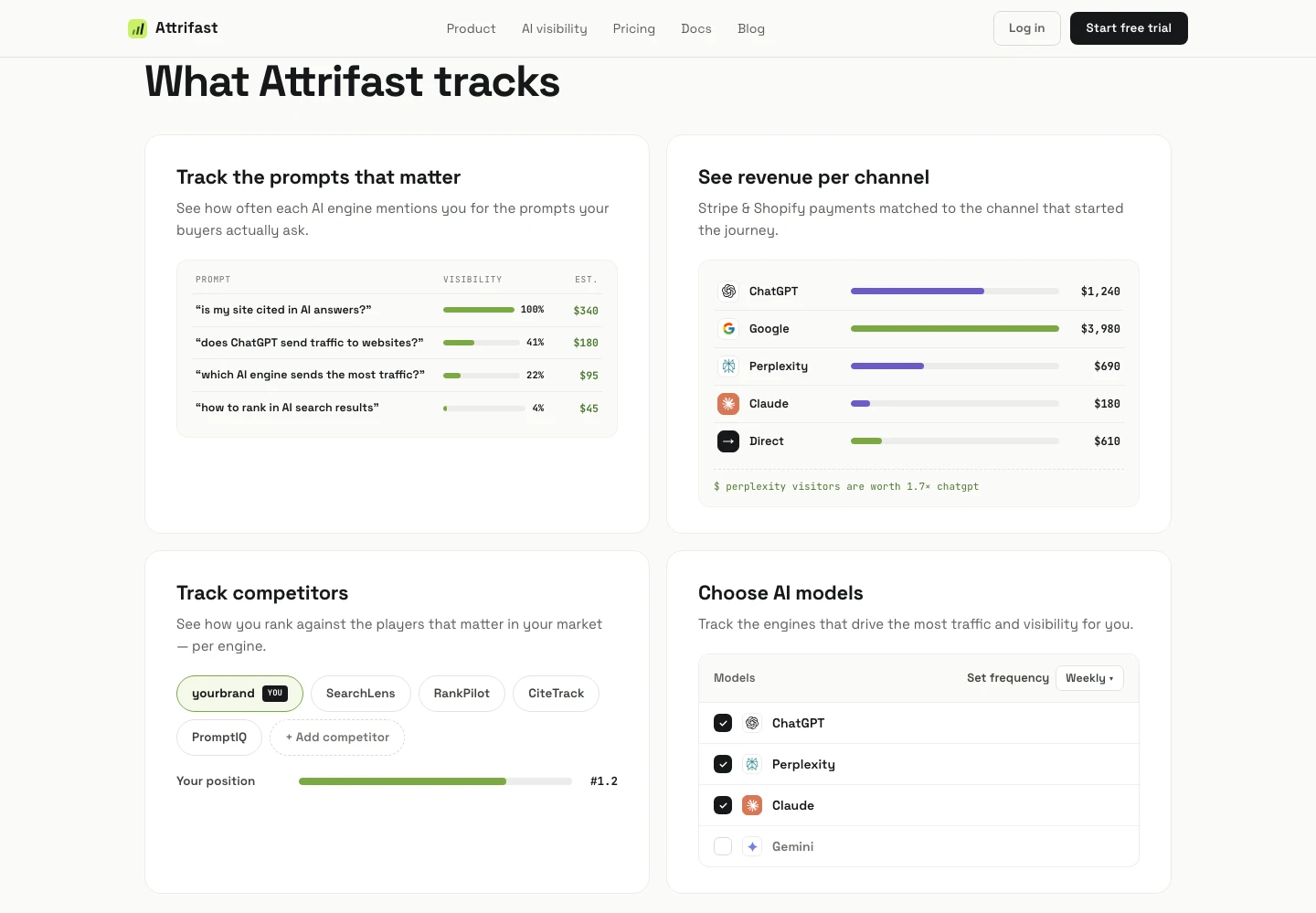
The join I run for the founders I help looks like this. Rank tracker pushes daily position data per keyword to a Postgres table. Prompt tracker pushes weekly citation data per prompt per engine to another Postgres table. Attrifast pushes session-and-Stripe data per source (including AI engines) to a third table. A nightly job joins on time window and source, producing a single dashboard with revenue per keyword and revenue per AI engine in the same view.
| Join key | Source data | Revenue join | Output |
|---|---|---|---|
| Keyword × time | Rank tracker | Attrifast Google organic revenue | Revenue per ranking keyword |
| Prompt × engine × time | Prompt tracker | Attrifast per-engine AI revenue | Revenue per cited prompt |
| Page × time | CMS + rank tracker | Attrifast page-level revenue | Revenue per content page |
| Brand × competitor × time | Prompt tracker SOV data | (External) revenue by category | Revenue-weighted SOV |
The third row is the most useful one in practice. Joining page-level rank data, page-level citation data, and page-level revenue gives you a single ROI ranking across both classic SEO and GEO work. That is the dashboard a content team actually uses to prioritize next-quarter investment.
The reason the join lives outside both upstream tools is structural. A rank tracker does not see your AI-engine revenue because GA4 buckets it as Direct. A prompt tracker does not see your Google-organic revenue because that is not its job. Only a server-side revenue layer sees both. That layer is what revenue attribution was built to be, and it is the only honest way to compare the value of the two upstream scoreboards.
A strong opinion, stated explicitly
Do not abandon rank tracking. Just stop expecting it to predict AI visibility.
The most expensive mistake I have watched founders make in 2025-2026 is canceling their $79/month rank tracker because "AI is the future" and discovering 90 days later that they have no idea why a Google update tanked their organic traffic. Google organic still pays the bills for most SMBs in 2026. The 13.4% monthly growth rate in AI traffic from the Attrifast cohort is real and impressive, but it is growth off a base of 6-9% of acquisition. Meanwhile Google is 45-70% of acquisition and not going anywhere on any planning horizon.
The right move is the barbell. Keep the rank tracker because it covers the channel that still pays. Add the prompt tracker — a ChatGPT rank tracker in the loose sense, though the mechanics differ as this whole piece argues — because it covers the channel that is growing. Tie both to revenue because neither dashboard answers the question "is this paying" on its own. Cancel the rank tracker only when AI surpasses Google organic for your business, which is a 5-7-year question on current trajectories, not a 2026 question.
I cover the upstream half of this in what is prompt tracking and the metric-level detail in AI visibility KPIs and share of voice methodology. The pattern across all four pieces is the same: the new scoreboard is real and worth measuring, the old scoreboard still earns its rent, and the only honest reconciliation is revenue.
FAQ
Is keyword rank tracking dead in 2026?
No, and anyone selling that line is over-rotating on the AI search story. Across the Attrifast cohort, Google organic still produces 40-65% of trackable acquisition for most B2B SaaS and even more for ecommerce. Rank tracking is the scoreboard for that channel, and the channel pays the bills. What is true is that rank tracking does not predict AI visibility, and AI visibility is increasingly a separate scoreboard you need a separate tool for. The right framing is two scoreboards, both earning rent. I have not turned off rank tracking on any property I run.
What is the single biggest difference between prompt tracking and rank tracking?
The unit of observation. Rank tracking observes a numeric position for a keyword on a stable platform with a deterministic SERP. Prompt tracking observes a citation log for a prompt across non-deterministic engines. Everything else (refresh cadence, stability, attribution, cost) flows from that core difference. A rank tracker reads a fixed scoreboard maintained by Google; a prompt tracker samples the output of a generative model that can return different sources on different runs.
How do refresh cadences differ between rank tracking and prompt tracking?
Rank tracking refresh is daily for paid tools and weekly for SMB because Google's SERPs are stable enough that hourly tracking adds little signal. Prompt tracking refresh is weekly with multiple samples because AI engines change citation patterns on weeks not hours, but the within-day variance is higher than for Google. A rank tracker runs 1 sample per day; a prompt tracker runs 5-10 samples per week. The sample-count discipline is the operational difference.
How does stability differ between the two?
Rank tracking is high-stability. A page at position 3 today usually ranks 3 or 4 tomorrow. Algorithm updates produce visible step changes. Prompt tracking is medium-stability at best. The same prompt can cite you Tuesday, skip you Thursday, and cite you again Saturday because of model sampling. Single-day readings are noisy; only rolling windows show signal. You need at least 5 samples per prompt per week before a trend means anything.
How does attribution differ between the two scoreboards?
Rank tracking sits on top of a well-instrumented referer stream: when a user clicks a Google result, the referer lets GA4 attribute the session to organic search. Prompt tracking sits on top of a broken referer stream: most AI engines either strip the referer or pass one GA4 buckets unhelpfully. The practical effect is that a rank-tracking dashboard cross-references with traffic and conversion data directly; a prompt-tracking dashboard requires a separate server-side attribution layer.
How does cost differ?
Rank tracking is cheap. AccuRanker, SE Ranking, Mangools, Serpfox, and Ahrefs sit in the $30-$200/month band for SMB use. Prompt tracking is more expensive per prompt because each run consumes API calls and engines charge for inference. Vendor pricing reflects this: Profound, Peec, Otterly, SEOcrawl, and Loamly sit in $99-$5,000+/month. The 3-5x premium is structural, not a markup.
Should I run both, just one, or neither?
Run both if more than 5% of your trackable acquisition traffic comes from AI surfaces and Google organic is still a meaningful channel. Run rank tracking only if AI traffic is under 1% of acquisition and unlikely to change in 6 months. Run prompt tracking only is hard to justify — if AI traffic is meaningful, Google organic almost certainly still is too. Median SMB SaaS runs both. Median ecommerce runs rank tracking only.
Which one predicts AI visibility better?
Prompt tracking, obviously, because that is what it is built to measure. Rank tracking has weak predictive value for AI visibility because Google rankings are an input to the candidate pool AI engines pull from but not the deciding signal once a page is in the pool. The levers that win citations (answer-shaped structure, primary-source citations, entity disambiguation, brand recognition in training corpus) are not the levers rank tracking measures. The two boards overlap roughly 60-70%; the divergence zone is where rank tracking fails as an AI predictor.
When does rank tracking still matter most?
Three situations. Any query where Google AI Overviews does not yet appear, where classic blue-link ranking drives the bulk of traffic. Ecommerce queries where buyers search commercially on Google (shopping, comparison, local). Any business whose buyers do not yet research in AI engines — local services, restaurants, niche B2C, pre-traction. In all three, the AI surface is small or absent. Even with strong AI growth, Google organic still drives 45-70% of trackable acquisition for the median SMB.
When does prompt tracking matter more than rank tracking?
When your buyer researches in AI engines before contacting you. Most B2B SaaS purchases at $50+ AOV now include an AI research step, especially for developer, marketer, finance, and analyst audiences. When your category triggers high AIO appearance on Google. When you compete in a category where citations are the moat (finance, health, B2B research). When you run a content program whose ROI you can only measure through citation share because Google rankings are commoditized.
Can a single tool do both well?
Rarely well, often poorly. Rank trackers added prompt-tracking features in 2025-2026 (SE Ranking, Mangools, Ahrefs) and prompt trackers added rank-tracking (SEOcrawl, Loamly), but the engineering required to do each well is different enough that bundled versions tend to be weaker on one side. Prompt tracking is a sampling problem with high per-call cost; rank tracking is a crawl problem with low per-call cost. The right stack as of 2026 is usually a dedicated rank tracker plus a dedicated prompt tracker, joined manually in a dashboard.
How does Attrifast fit alongside both scoreboards?
Attrifast is the revenue layer underneath both. Rank tracking tells you which keywords you rank for; prompt tracking tells you which prompts cite you; Attrifast tells you which keywords and prompts produced paying customers. The mechanism is server-side referer capture (catching AI traffic GA4 misses), behavioral fingerprinting for no-referer cases, and a Stripe webhook join from session to payment. With all three you can compute revenue per keyword and revenue per AI engine in the same dashboard.
What is the single most important thing to remember?
Do not abandon rank tracking. The most expensive mistake I have watched founders make is canceling their rank tracker because "AI is the future" and discovering 90 days later that they have no idea why a Google update tanked their organic traffic. Google organic still pays the bills for most SMBs. Add prompt tracking alongside rank tracking, accept that they measure different things, and tie both to revenue. The two scoreboards overlap maybe 60-70% and diverge sharply at the edges — knowing which side a given page sits on is most of the strategic value.
Related reading from the Attrifast research stack
For hands-on tools and deeper context, see prompt tracking, AI citation tracking, and share of voice in AI search.
Sources
- Attrifast — AI citations vs backlinks (overlap analysis)
- Attrifast — AI traffic revenue benchmark 2026 (200-site cohort)
- Aggarwal et al., Princeton — GEO: Generative Engine Optimization
- Ahrefs — What triggers AI Overviews? 86 factors and 146 million SERPs analyzed (20.5% of SERPs, September 2025)
- Backlinko — AI Overviews CTR study
- Profound — Answer Engine Insights — AI search visibility platform
- SEOcrawl — Prompt tracking SEO software
- Peec AI — AI search visibility tracking
- Otterly.AI. Brand monitoring for AI search engines
- Loamly — Real-time AI visibility tracking
- AccuRanker — Rank tracker product documentation and pricing
- SE Ranking — Rank tracker and AI search toolkit
- Ahrefs — Rank tracker product and GEO research
- Semrush — Position tracking and AI Overviews tracker
- Google Analytics Help — Default channel groups and attribution windows
- Google Search Central blog — Generative AI in Search
- OpenAI — GPTBot and ChatGPT bot documentation
- Anthropic — ClaudeBot and Claude search documentation
- Perplexity — PerplexityBot crawler documentation and citation behavior
- Reuters — Reddit content licensing deal with Google for AI training
For the foundational definition of the new discipline, see what is prompt tracking. For the KPI set that sits on top, see AI visibility metrics and KPIs. For the share-of-voice methodology specifically, see how to measure share of voice in AI search. For the broader citations-vs-backlinks story, see AI citations vs backlinks. For the per-engine attribution layer that closes both loops, see revenue attribution and ChatGPT, Perplexity, Claude, and Gemini tracking.