Prompt Tracking
Prompt tracking that ends
at the Stripe payment.
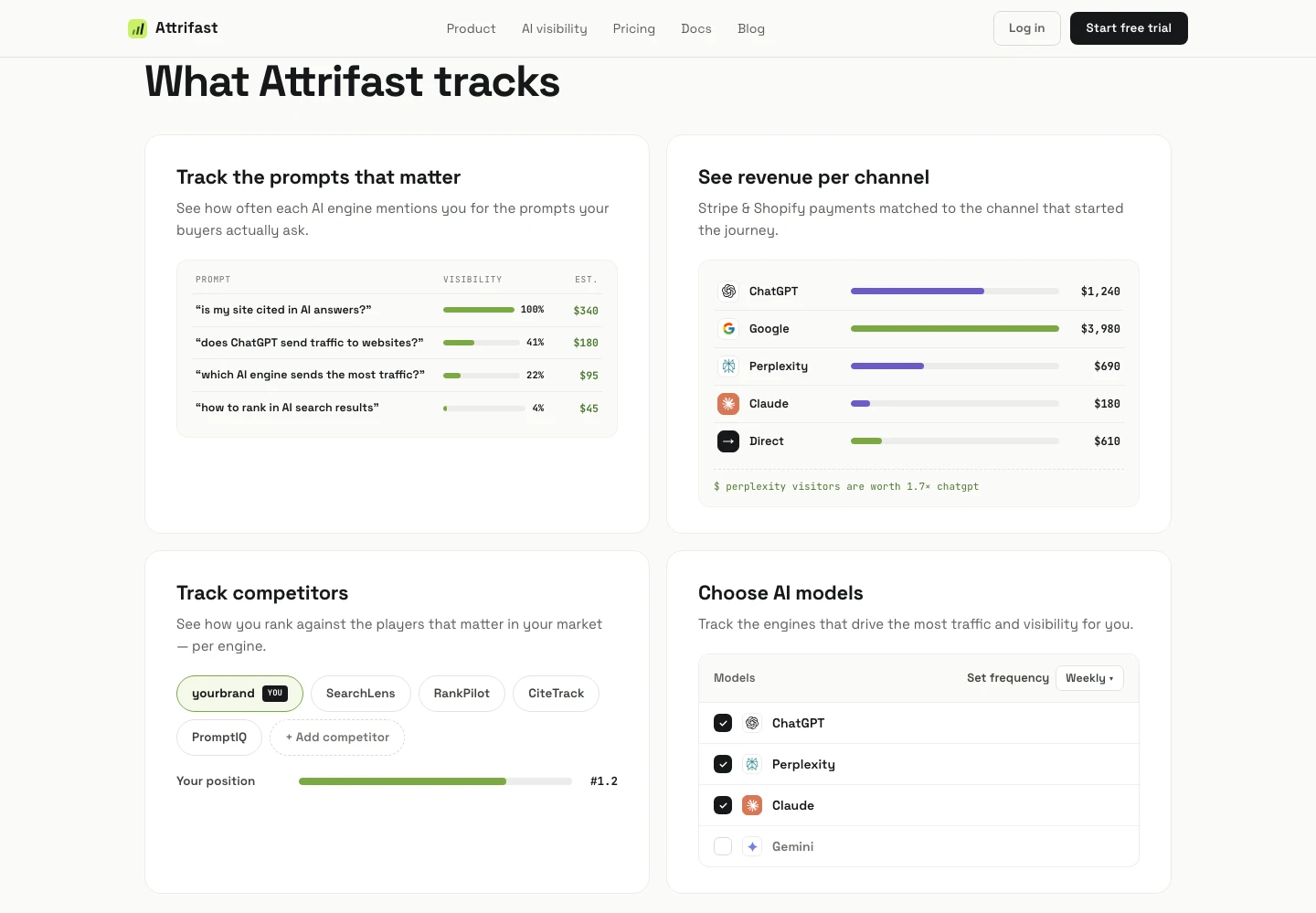
Most prompt tracking software stops at the citation count. Attrifast tracks the full chain — prompt asked, citation earned, click captured, session stored, payment joined back to the AI engine that earned it. Four steps your current tool walks halfway.
7-day free trial · $49/mo Pro · 30 monitored prompts
Prompt → citation → click → session → payment
Tracking prompts without tracking the chain that follows them is rank tracking with no traffic data. The output looks like progress, but it does not move budget.
StageWhat happensWhat Attrifast capturesLayer
PromptBuyer asks ChatGPT "best X tool"Logged in your prompt listPrompt tracking layer
CitationAI engine cites attrifast.comParsed from engine outputCitation parser
ClickVisitor clicks chatgpt.com linkReferrer captured server-sideFirst-party tracker
SessionVisitor browses your siteAnonymous session id storedSession store
Stripe paymentVisitor checks outpayment_intent.succeeded webhookStripe join
Revenue joinPayment matched to the citing engineJoined back per AI engineAttribution pipeline
The last row — payment matched back to the citing AI engine — is the join most prompt tracking software cannot do because they do not own the session pipeline or the Stripe webhook.
Where prompt tracking software typically stops
SEOcrawl builds the cleanest standalone prompt-tracking product I have used. It is also a useful object lesson in where the category as a whole ends today.
SEOcrawl Prompt Tracking
- ✓Per-LLM tracking (ChatGPT, Claude, Gemini, Perplexity, Copilot)
- ✓Citation presence + share-of-source trend lines
- ✓White-label reporting
- ✕No first-party session capture from the click that follows
- ✕No Stripe revenue join per prompt or per engine
Attrifast Prompt Tracking
- ✓Per-LLM scanning across ChatGPT, Claude, Gemini, and Perplexity
- ✓First-party session capture from chatgpt.com / perplexity.ai referrals
- ✓Stripe webhook join — payment back to the citing AI engine
- ✓RPV per AI engine, not just citation share
- ✓$49/mo Pro plan, no demo gate
Why ending at citations is the same mistake as rank tracking with no Search Console
Classic SEO learned this lesson the hard way. For years, rank tracking was its own standalone industry — you paid one vendor for keyword positions and a separate vendor (or GA + GSC) for the traffic and conversion data. Teams optimized rank tracking dashboards in isolation, watched positions improve, and could not explain why revenue did not follow. The reconciliation came when traffic and revenue data joined the rank data on the same dashboard. Until then, rank was a leading indicator pretending to be a scoreboard.
Prompt tracking is at the same stage today. The current generation of prompt tracking software reports a clean citation appearance number, the same way 2008-era rank trackers reported a clean position number. It is genuinely useful information — I would not run an AI-search program without it — but it is one step removed from the decision it is supposed to inform. The buyer who saw the citation either clicked, or did not. The visitor who clicked either bought, or did not. Neither of those events is visible to a citation-only tool.
Two structural problems make the join hard for prompt-tracking vendors: AI engines strip the referer in many flows, so the click that follows a citation often lands in GA4's Direct bucket and is invisible[2]; and most prompt-tracking vendors do not also operate a tracking script that runs on your site, so they have no way to capture the click even when the referer is preserved. Attrifast handles both because it is, at root, a revenue attribution tool that gained a prompt-tracking layer — not a prompt tracker that bolted on attribution.
The fix changes which numbers you look at. Instead of "prompt P's citation share moved from 12% to 18% last week" you look at "ChatGPT drove $740 in Stripe revenue this month, up from $310 — and the cited/uncited matrix shows which prompts earned it the citations." The first is a vanity move. The second is a budget decision. The deeper logic of the two scoreboards lives in our AI citations vs backlinks piece; the practical "how to measure" walkthrough is in how to get cited by AI engines.
Attrifast vs SEOcrawl vs Profound vs Geoptie
Four real prompt-tracking products. Different ceilings, different price points.
CapabilityAttrifastSEOcrawlProfoundGeoptie
Per-LLM prompt scanning
Citation share + trend lines
First-party click capture
Stripe revenue join per AI engine
RPV per AI engine
Sub-$50/mo entry tier
No demo gate
Capability claims based on each vendor's public product pages[5][6][7].
Prompt tracking FAQ
How prompt tracking works, where the category typically stops, and how the Attrifast join makes citation data act-on-able.
›What is prompt tracking?
Prompt tracking is the practice of monitoring a fixed set of buyer-stage prompts on AI engines (ChatGPT, Claude, Gemini, Perplexity) over time, logging whether each prompt cites your domain, your competitors, or neither. It is the AI-search equivalent of rank tracking in classic SEO — but where rank tracking measures a single position in a SERP, prompt tracking measures presence inside a generated answer. The reason it matters is that AI answers replace SERPs for an increasing share of buying-stage queries; if you cannot see which prompts cite you, you cannot tell why your AI traffic shifted week over week. The honest version of prompt tracking always ends at revenue, because a tracked prompt is only useful if the citation it monitors eventually produces a paying customer.
›How is Attrifast different from SEOcrawl prompt tracking?
SEOcrawl runs a clean per-LLM prompt-tracking product across ChatGPT, Claude, Gemini, Perplexity, and Copilot, and they report citation appearance, source share, and trend lines. What they stop short of is the join to your actual traffic and revenue. Their dashboard ends at "you were cited in N answers." Attrifast picks up where they stop: the same per-query scan gives you a cited/uncited matrix for every monitored prompt across ChatGPT, Claude, Gemini, and Perplexity, and next to it the revenue attributed to each AI engine — sessions, paid trials, and Stripe revenue joined at the engine level. So you do not just see "we got cited" — you see which prompts cite you and which engines actually produce paying customers. That is the loop SEOcrawl leaves open. Pick the better tool for your job: if you only need citation monitoring, SEOcrawl is fine; if you need to defend a marketing budget, you need the revenue join.
›How many prompts can I track?
On the $49/mo Pro plan, up to 30 prompts monitored, rescanned every 10 days across ChatGPT, Claude, Gemini, and Perplexity. The $9.99/mo Starter plan tracks up to 10 prompts, rescanned every 30 days. That is intentionally fewer than the high-end enterprise plans of competitors — the goal is depth of measurement per prompt, not vanity count. In practice 30 well-chosen commercial prompts cover the core buying-stage query universe for most SMB SaaS and e-commerce categories.
›Can I bring my own prompt list, or does Attrifast generate them?
Both. You bring whatever prompts you have — from a sales call, from a customer survey, from your GSC top-query report — and we will scan them. During onboarding we also suggest starter prompts (up to the prompt limit on your plan) based on your category, your existing keyword data, and the buyer-stage prompt patterns that show up consistently across the AI-citation research. The list is fully editable: add, remove, retag intent. The system will not silently scan prompts you did not approve.
›How often are prompts scanned?
Scheduled scans run every 10 days on Pro and every 30 days on Starter, and you stay in control: Attrifast runs the scheduled scan and you can also trigger a rescan from the dashboard, at most once every 7 days on Pro (14 days on Starter), across ChatGPT, Claude, Gemini, and Perplexity. Each scan logs the engine's answer, every parsed citation, and whether your domain was cited on each prompt. Trend charts are then computed against the full historical scan record, so you can see when a model retrain dropped you out of an answer, when a fresh competitor displaced you, or when an answer to a specific prompt started linking to a different domain on your site.
›How do you connect a tracked prompt to a Stripe payment?
The chain is mechanical. (1) The prompt-tracking scan logs that engine E cited your domain on prompt P at time T. (2) When a visitor lands from engine E (chatgpt.com, perplexity.ai, etc.), the Attrifast tracker captures the referrer server-side and writes a first-party session id, including the engine source. (3) When that session later completes a Stripe checkout, the payment_intent.succeeded webhook fires and the payment is joined to the session and back through the session to the engine. (4) Reporting aggregates payments per engine over the chosen window — revenue is attributed at the engine level, shown alongside the per-prompt citation matrix that tells you which prompts each engine cites you on. The chain breaks if you stop one step short, which is exactly what GA4 does — it strips most AI engine referrers into the Direct bucket.
›Does this work for non-English prompts?
Yes for the major Latin-script languages (Spanish, French, German, Portuguese, Italian, Dutch) and for the engines that return cited URLs on those locales. Citation parsing is language-agnostic when the engine emits a structured citation array; for engines that only emit bare brand mentions, accuracy depends on entity disambiguation in the target language and is materially weaker for CJK scripts in our current build. We are honest about this on the pricing page rather than waving the flag.
›Can prompt tracking really replace rank tracking?
Not yet, but it is a separate scoreboard that matters more every quarter. AI Overviews render on roughly a fifth to a quarter of tracked SERPs (Ahrefs measured 20.5% of 146.1M SERPs in September 2025; Conductor 25.11% of 21.9M searches that autumn); ChatGPT crossed 800M weekly users and continues to grow. Classic rank tracking still pays because Google organic still drives the majority of trackable search traffic for most sites. Prompt tracking pays because the slice it measures is the slice growing fastest, and because the citation event is invisible to your rank tracker. Most teams I work with now run both, weighted by how much of their actual revenue already comes from AI engines.
Sources
Primary sources for the claims in this article. Numbered citations in the text link to the matching entry.
- [1]GEO: Generative Engine Optimization — Princeton University / KDD (Aggarwal et al.) (2024).
- [2]Default channel groups and attribution windows — Google Analytics Help (2025).
- [3]What triggers AI Overviews? 86 factors and 146 million SERPs analyzed (20.5% of SERPs, September 2025) — Ahrefs (2025).
- [4]ChatGPT usage and product updates — OpenAI (2026).
- [5]Prompt Tracking SEO Software (product overview) — SEOcrawl (2026).
- [6]Prompt Volumes — Uncover keywords driving AI conversations — Profound (2026).
- [7]Free GEO Rank Tracker + per-LLM rank trackers — Geoptie (2026).
Track the prompt. Track the citation. Track the payment.
Stop ending one step short. See citations per prompt and revenue per AI engine across ChatGPT, Claude, Gemini, and Perplexity — from $9.99/mo, or $49/mo Pro for 30 prompts rescanned every 10 days.
- One script tag and a Stripe key — live in minutes
- First-party measurement without third-party cookies
- Recognized AI referrals joined to Stripe payments
7-day free trial · $0 due today · then $9.99/mo · cancel anytime