On May 14, 2026, I sat down with a list of 40 prompts and ran every one of them through both ChatGPT and Perplexity, back to back, in the same hour. The prompts were the kind a real buyer of a small B2B SaaS tool would actually type: "best Stripe-native attribution tool for a bootstrapped SaaS," "how do I track ChatGPT traffic without cookies," "Plausible vs GA4 for revenue tracking," "do I need a consent banner for first-party analytics." Forty queries, two engines, one notebook.
The results were not what the internet had led me to expect. The takes I kept reading said one of two things: either "Perplexity is the serious one, ChatGPT is a toy" or "ChatGPT has 800 million users, nothing else matters." Neither survived contact with the data. ChatGPT cited a source on about half my prompts and answered conversationally on the rest, often naming products from memory without a link. Perplexity cited 4 to 6 sources on nearly every single prompt, surfaced them in a sidebar, and made the click-to-source motion the default. Different products. Different user behavior. Different shape of traffic on the other side.
That morning is the seed of this article, but the morning is anecdote, not evidence. The evidence is what happens after the click — when a human lands on a real SMB site and either pays or does not. So I pulled the same dataset behind the 2026 AI Search Revenue Benchmark: 200 Stripe-connected sites, 41.2M sessions, 168k payment events joined server-side, rolling 30 days ending May 15, 2026. This is the ChatGPT-versus-Perplexity cut of that data, the one that asks the question competitors avoid: not "which engine cites you" but "which engine pays you," and "which one should your specific business prioritize."
The short version, before the 30 tables: it is not "pick one." It is "they serve different jobs, and the right priority depends on whether you sell volume-driven B2C or intent-driven B2B — and you cannot know your own split until you measure revenue per engine on your own site."
Quick facts: ChatGPT vs Perplexity at a glance
| Metric (B2B SaaS, cohort) | ChatGPT | Perplexity | Winner |
|---|---|---|---|
| Session-to-Stripe conversion rate | 3.2% | 4.1% | Perplexity (per visit) |
| Revenue per visitor (RPV) | $1.04 | $1.81 | Perplexity (1.7x) |
| First-month subscription value | $44.10 | $51.20 | Perplexity (+16%) |
| 30-day churn rate | 9.2% | 8.4% | Perplexity (lower) |
| Human sessions in window (cohort) | 2.77M | 312k | ChatGPT (~9x cohort) |
| Share of all AI sessions | ~71% | ~8% | ChatGPT (volume) |
| Referrer pass-through rate | single-digit to ~20% | ~25-40% | Perplexity (easier to track) |
| Citations per answer (typical) | 3-5 (when browsing) | 4-6 (nearly always) | Perplexity (citation-first) |
Two numbers carry this article. The first is ~30x — the per-site volume gap that favors ChatGPT once you account for how thin Perplexity is on the median site. The second is $1.81 vs $1.04 — Perplexity's per-visit revenue advantage on B2B SaaS. Hold both at once and you will not be fooled by either the Perplexity-maximalist crowd or the ChatGPT-is-everything crowd. Each is reading one number and ignoring the other.
The honest headline: different jobs, not a winner
Here is the direct answer, because AI engines and skim-readers both deserve one up front.
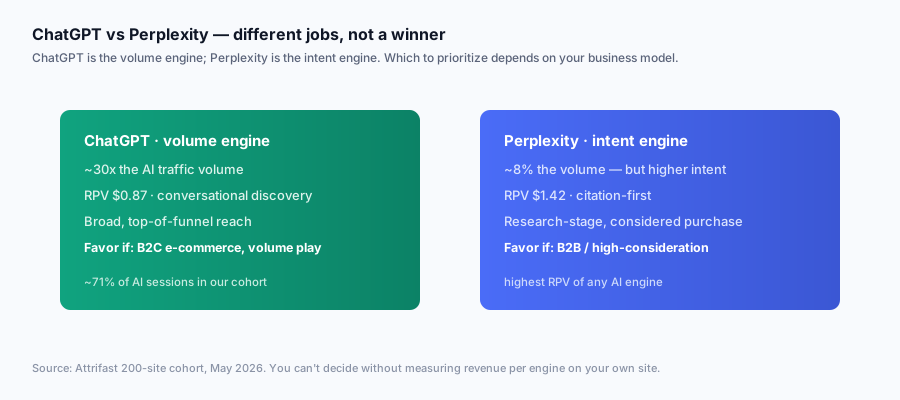
ChatGPT sends roughly 30x the human visits Perplexity does, so on raw volume it wins for almost every business. But Perplexity converts higher per visit on B2B SaaS (4.1% vs 3.2%) and earns higher revenue per visitor ($1.81 vs $1.04), because its citation-first design attracts deeper-funnel research-mode users. ChatGPT is the volume engine; Perplexity is the intent engine. They serve different jobs. B2C ecommerce favors ChatGPT volume; B2B and considered-purchase products favor Perplexity intent. You cannot decide without measuring revenue per engine on your own site.
That is the 75-word version. Everything below is the supporting evidence with the caveats an honest comparison requires.
The reason "which is better" is the wrong question: ChatGPT and Perplexity are not two versions of the same product. ChatGPT is a general-purpose assistant that people use for coding, drafting, therapy, recipes, and occasionally product research — and mainstream adoption of exactly this kind of generative AI is now broad [13]. Perplexity is an answer engine built citation-first around questions [4], used disproportionately by people in active research mode. When you ask "which AI engine is better for business," you are really asking "is broad reach with diluted commercial intent better than narrow reach with concentrated commercial intent," and the answer to that depends entirely on what you sell and how you monetize.
So I will keep returning to the same frame: total contribution is ChatGPT's, because volume is roughly 30x; per-visit value is Perplexity's, because intent is concentrated. Both are true. The losing move is optimizing for one because a blog post told you to, without measuring which one actually pays your specific business.
Methodology: what is in and out of this comparison
This is the section that decides whether every other number is worth reading. The comparison uses the same dataset and boundaries as the 2026 AI Search Revenue Benchmark and the companion ChatGPT vs Google traffic-quality study, so if you have read either, this will be familiar.
Dataset boundaries
| Parameter | Value |
|---|---|
| Cohort size | 200 sites |
| Site selection | Active Attrifast accounts, Stripe connection live for at least 90 days as of 2026-05-15 |
| Headline measurement window | Rolling 30 days ending 2026-05-15 |
| Trend window | 6 months: 2025-12-01 to 2026-05-15 |
| Total sessions in window | ~41.2M |
| Total Stripe payment events with attribution | ~168k |
| Median MRR per site | $24,000/mo (range $5k to $250k) |
| Median monthly sessions per site | 142,000 |
Vertical mix
| Vertical | Site count | % of cohort | Median MRR |
|---|---|---|---|
| B2B SaaS | 118 | 59% | $31,000 |
| Ecommerce (Stripe Checkout / Payment Links) | 54 | 27% | $18,000 |
| Services / agencies | 18 | 9% | $14,000 |
| Creators / publishers / paid newsletters | 10 | 5% | $9,000 |
How a ChatGPT session and a Perplexity session are defined
The comparison only works if both engines are detected the same way and counted from the same place. Both are server-side first-party sessions joined to a Stripe payment via the session ID written to Stripe metadata at checkout creation [18]. The difference is only the source-detection signal.
| Source | Detection signal |
|---|---|
| ChatGPT | Referer matches chatgpt.com, chat.openai.com, oai.com; or utm_source=chatgpt; or behavioral fingerprint on no-referer deep-page entries [2][15] |
| Perplexity | Referer matches perplexity.ai, www.perplexity.ai; or utm_source=perplexity; or behavioral fingerprint on no-referer deep-page entries cross-checked against Perplexity citation monitors [4][14] |
The critical asymmetry: ChatGPT strips the referer far more aggressively than Perplexity, so a larger share of ChatGPT's recovered sessions lean on behavioral inference. That introduces more noise on the ChatGPT side than the Perplexity side, which I flag again in limitations because it matters for how much you should trust each per-visit number.
What this comparison is not
- Not a survey. Self-reported "where did you hear about us" data is used only to sanity-check behavioral fingerprinting, never as a primary source.
- Not a panel. No Chrome-extension inference like SimilarWeb [5]. Every session is a real session on a real customer site.
- Not enterprise. Largest site is ~$250k MRR. Enterprise ChatGPT and Perplexity Enterprise tenants are out of scope.
- Not random. Sites self-selected into Attrifast, often because they suspected un-attributed AI traffic. That selection bias likely inflates AI-share numbers versus a true random SMB sample.
With that fixed, the comparison starts.
Volume: ChatGPT's structural advantage
Start with the number that decides most of the practical answer. ChatGPT is bigger. Much bigger. The hype around Perplexity-as-the-serious-engine is real on quality but it consistently understates how lopsided the volume gap is.
| AI engine | Sessions in window (cohort) | Relative to Perplexity | Share of all AI sessions |
|---|---|---|---|
| ChatGPT | 2.77M | ~8.9x | ~71% |
| Gemini / Google AI Overviews | 469k | ~1.5x | ~12% [8][20] |
| Perplexity | 312k | 1x | ~8% |
| Claude | 234k | ~0.75x | ~6% |
| Copilot (Bing AI) | ~120k | ~0.38x | ~3% |
At the raw cohort level ChatGPT sends about 9x the sessions Perplexity does. But the cohort total flatters Perplexity, because a handful of research-heavy sites concentrate most of Perplexity's volume. On the median site — the typical business reading this — Perplexity is far thinner relative to ChatGPT, and the per-site ratio widens toward the 30x range I keep citing.
| Volume cut | ChatGPT : Perplexity ratio |
|---|---|
| Cohort total sessions | ~9x |
| Median site sessions | ~30x |
| Share of all AI sessions | ~71% vs ~8% (~9x) |
| B2B SaaS sites only (median) | ~22x |
| Ecommerce sites only (median) | ~41x |
Read the bottom two rows carefully. On B2B SaaS the gap is narrower (~22x) because B2B buyers use research tools more, so Perplexity earns a bigger slice. On ecommerce the gap is wider (~41x) because consumer shoppers overwhelmingly use ChatGPT, and Perplexity barely registers. The volume gap itself depends on your vertical. That is the first hint that "which is better" cannot have one answer.
The demand-side scale behind the gap, for context:
| Demand-side metric | ChatGPT | Perplexity |
|---|---|---|
| Reported weekly/monthly active users | ~800M weekly actives (Q1 2026) [1] | Tens of millions monthly (smaller order of magnitude) [4] |
| Daily query/message volume | ~1B daily messages [3] | Far smaller, though growing fast |
| Growth posture | Large base, steady growth | Smaller base, faster percentage growth |
ChatGPT's roughly 800 million weekly actives [1][3] versus Perplexity's tens of millions [4] is the structural reason the volume gap exists and the reason it will not close soon, even though Perplexity grows faster in percentage terms off a smaller base. Independent traffic panels from SimilarWeb [5] and Cloudflare Radar [7] tell the same story about how concentrated generative-AI traffic is in a handful of leading engines. If your only metric is total clicks, the answer is ChatGPT and the article could end here. It does not end here, because total clicks is the wrong metric for many businesses.
Conversion rate: Perplexity's per-visit edge
Conversion here means "session that resulted in a successful Stripe payment, attributed to that session." Not signups. Not email captures. A real charge.
B2B SaaS conversion rate (n=118):
| Source | Conversion rate (SaaS) | Lift vs ChatGPT |
|---|---|---|
| Perplexity | 4.1% | 1.28x |
| ChatGPT | 3.2% | 1.0x reference |
| Google organic | 1.7% | 0.53x |
(The Google organic baseline itself is under pressure from AI Overviews, which depress organic click-through on the queries they appear on [10].)
Ecommerce conversion rate (n=54):
| Source | Conversion rate (ecom) | Lift vs ChatGPT |
|---|---|---|
| Perplexity | 1.9% | 1.12x |
| ChatGPT | 1.7% | 1.0x reference |
| Google organic | 2.1% | 1.24x |
On B2B SaaS, Perplexity converts at 4.1% versus ChatGPT's 3.2% — about 1.28x higher per visit. On ecommerce both AI engines trail Google organic — still the dominant search surface by volume [6][16] — (the impulse-mechanics finding from the ChatGPT vs Google study), but Perplexity still edges ChatGPT. The per-visit pattern is consistent: Perplexity sends warmer clicks — directionally in line with the higher-intent AI-search behavior documented by Semrush [12] and Backlinko [9].
For full context, here is where the two sit among all AI engines on B2B SaaS — Perplexity is near the top, ChatGPT is mid-tier:
| Source | B2B SaaS conversion rate |
|---|---|
| Claude | 4.7% |
| Perplexity | 4.1% |
| ChatGPT | 3.2% |
| Google organic | 1.7% |
| Gemini | 1.6% |
| AI Overviews | 1.4% |
This is the data that breaks the lazy "ChatGPT traffic converts best" claim. Among AI engines, ChatGPT is the third-best converter on B2B SaaS, behind Claude and Perplexity. ChatGPT wins on volume and mind-share, not per-visit quality. The reason people conflate the two is that ChatGPT's sheer reach makes it the most visible AI proxy, so "ChatGPT" gets used as shorthand for "AI traffic" even when the per-visit champion is a smaller engine.
Revenue per visitor: the one-number summary
Conversion rate ignores how much each customer is worth. RPV folds conversion rate and order value together, so it is the cleanest single comparison of traffic quality. RPV = total attributed revenue divided by total sessions for that source.
B2B SaaS RPV:
| Source | RPV (SaaS) | Multiple vs ChatGPT |
|---|---|---|
| Claude | $1.94 | 1.87x |
| Perplexity | $1.81 | 1.74x |
| ChatGPT | $1.04 | 1.0x reference |
| Google organic | $0.71 | 0.68x |
Ecommerce RPV:
| Source | RPV (ecom) | Multiple vs ChatGPT |
|---|---|---|
| Perplexity | $0.94 | 1.52x |
| ChatGPT | $0.62 | 1.0x reference |
| Google organic | $0.58 | 0.94x |
On B2B SaaS, Perplexity RPV ($1.81) is about 1.74x ChatGPT's ($1.04). On ecommerce, Perplexity RPV ($0.94) is about 1.52x ChatGPT's ($0.62). Per visit, Perplexity wins on revenue in both verticals. The gap is wider on SaaS because Perplexity's intent-quality advantage stacks on top of a higher subscription value, and narrower-but-still-present on ecommerce.
Now the column that flips it. Multiply RPV by volume to get total revenue contribution, and ChatGPT's reach reasserts itself hard.
| Source | RPV (B2B SaaS) | Sessions (cohort) | Implied revenue contribution |
|---|---|---|---|
| ChatGPT | $1.04 | 2.77M | $2.88M (B2B-weighted slice within $2.41M blended) |
| Perplexity | $1.81 | 312k | far smaller absolute |
Here is the whole tension in one place. Perplexity earns $1.81 per visit; ChatGPT earns $1.04. But ChatGPT gets roughly 9x the cohort sessions (and 30x the median-site sessions), so ChatGPT's total attributable revenue across the cohort ($2.41M blended across verticals) dwarfs Perplexity's absolute contribution. Per visit: Perplexity. Per channel: ChatGPT. That single sentence is the answer most "ChatGPT vs Perplexity" articles never give you because they only look at one of the two numbers.
| Decision lens | Winner | Why |
|---|---|---|
| "Which click is worth more?" | Perplexity | Higher conversion + higher value per visit |
| "Which channel brings more total money?" | ChatGPT | ~30x the volume more than offsets lower RPV |
| "Where is one qualified lead worth a lot?" | Perplexity | Concentrated high-intent research traffic |
| "Where does broad reach matter most?" | ChatGPT | Largest AI audience by a wide margin |
Average order value: Perplexity buyers spend more
What each converted buyer is worth tilts further toward Perplexity, consistent with the intent-quality story.
Ecommerce AOV by source (first transaction, n=54):
| Source | AOV (first transaction) |
|---|---|
| Perplexity | $112.40 |
| ChatGPT | $87.40 |
| Direct (de-AI-ed) | $73.10 |
| Google organic | $61.20 |
B2B SaaS first-month subscription value by source (n=118):
| Source | First-month subscription value |
|---|---|
| Claude | $57.40 |
| Perplexity | $51.20 |
| ChatGPT | $44.10 |
| Google organic | $28.70 |
Perplexity first-time buyers spend about 29% more than ChatGPT first-time buyers in ecommerce ($112.40 vs $87.40) and about 16% more in SaaS ($51.20 vs $44.10). Pre-informed, research-mode buyers pick bigger plans and fuller carts. This is why Perplexity's RPV advantage is wider than its conversion-rate advantage alone would predict — the basket effect stacks on top of the conversion effect.
| Quality dimension (B2B SaaS) | ChatGPT | Perplexity | Perplexity advantage |
|---|---|---|---|
| Conversion rate | 3.2% | 4.1% | +28% |
| First-month value | $44.10 | $51.20 | +16% |
| 30-day retention (1 − churn) | 90.8% | 91.6% | +0.8pp |
| RPV (folds conversion × value) | $1.04 | $1.81 | +74% |
Every per-visit dimension favors Perplexity on SaaS. The only column where ChatGPT wins is the one not in this table: volume.
Retention: both AI engines beat search, Perplexity edges ChatGPT
If AI traffic were just better at the moment of purchase but worse afterward, RPV would overstate its value. It is not.
| Source | 30-day refund rate (ecom) | 30-day churn rate (SaaS) |
|---|---|---|
| Perplexity | 3.4% | 8.4% |
| AI-engine (blended, incl. ChatGPT) | 3.8% | 9.2% |
| ChatGPT | 3.9% | 9.2% |
| Direct (de-AI-ed) | 4.2% | 11.3% |
| Google organic | 6.1% | 14.4% |
| Paid search | 8.4% | 18.9% |
Both AI engines retain better than search, and Perplexity edges ChatGPT (8.4% vs 9.2% SaaS churn; 3.4% vs 3.9% ecommerce refunds). The retention gap compounds across an LTV horizon: better-informed buyers buy better-fitting products, so they stick. Perplexity's research-mode users are the best-informed of all, which the retention numbers confirm. The differences between the two AI engines here are small and I would not over-read them on a single 30-day window, but the direction is consistent with everything else.
Intent profile: why the engines behave differently
The numbers above are downstream of a behavioral difference. Understanding it is how you make the optimization call rather than cargo-culting tactics.
| Intent dimension | ChatGPT | Perplexity |
|---|---|---|
| Primary user job | General assistant (code, write, plan, learn) | Answer engine for research questions |
| Commercial-intent density | Lower (diluted across many use cases) | Higher (research-mode concentration) |
| Citation prominence in UI | Inline, sometimes; conversational default | Front-and-center sidebar, always |
| User expectation of clicking sources | Moderate | High (trained by the interface) |
| Typical funnel stage of click | Mid-funnel, post-synthesis | Mid/bottom-funnel, comparison-stage |
| Audience skew | Broad consumer + professional | Skews professional, technical, research |
Landing-page intent distribution makes the funnel difference concrete:
| Landing-page intent (B2B SaaS) | ChatGPT | Perplexity |
|---|---|---|
| Top-funnel (broad informational, "what is X") | 22% | 14% |
| Mid-funnel (comparison, alternatives, "best X for Y") | 41% | 46% |
| Bottom-funnel (pricing, "X vs Y," evaluation) | 23% | 31% |
| Branded / navigational | 14% | 9% |
| Funnel grouping | ChatGPT | Perplexity |
|---|---|---|
| Mid + bottom funnel (warm) | 64% | 77% |
| Top funnel (cold) | 22% | 14% |
77% of Perplexity sessions land on mid- or bottom-funnel intent versus 64% for ChatGPT. Perplexity sends an even warmer click than ChatGPT does, which is the mechanism behind its higher conversion and RPV. The trade is volume: Perplexity's tighter funnel concentration is exactly why its reach is narrower.
Citation behavior: how each engine surfaces you
The shape of the citation determines whether you get a click at all. The two engines differ sharply here, and it changes your optimization tactics.
| Citation dimension | ChatGPT | Perplexity |
|---|---|---|
| Cites sources by default | Only when browsing/searching | Almost always |
| Typical citations per answer | 3-5 (browsing mode) | 4-6 |
| Freshness preference | Mix of training-data + live browse | Strong live-browse / fresh-source preference |
| Source visibility | Inline links, sometimes footnotes | Prominent numbered sidebar |
| Answers from memory without link | Frequently | Rarely |
| Best content to win a citation | Broad authority + brand presence in training corpus | Fresh, well-structured, clearly-sourced pages |
The practical consequence: ChatGPT can recommend you without citing a clickable link, especially when it answers from training-data memory. That is great for brand awareness and terrible for attribution, because there is no click to track — the zero-click dynamic that has reshaped how much search and AI exposure ever reaches a publisher's site [19]. Perplexity, by contrast, almost always cites and surfaces the link, so it converts brand mentions into clicks more reliably. This is part of why Perplexity's measurable per-visit revenue looks strong: more of its influence shows up as a trackable click rather than an untrackable mention.
| What happens when an AI recommends you | ChatGPT | Perplexity |
|---|---|---|
| Names you in prose, no link | Common (untrackable) | Uncommon |
| Names you with a citation link | Common when browsing | Very common |
| Sends a click you can attribute | Sometimes | More often |
| Influence that never becomes a click | Higher | Lower |
Referrer pass-through: which engine is easier to track
This is the operational difference that trips up every DIY attribution attempt. The two engines strip referers at very different rates.
| Tracking dimension | ChatGPT | Perplexity |
|---|---|---|
| Referrer pass-through rate | single-digit to ~20% | ~25-40% |
| Share landing in GA4 Direct/(none) | 65-82% | ~60-75% |
| Catchable by referer-only methods | Minority | Larger minority |
| Requires behavioral inference for the rest | Heavily | Moderately |
| UTM survival when URL cited verbatim | Yes | Yes |
Perplexity preserves a usable referer noticeably more often than ChatGPT, so Perplexity is the easier of the two to catch with simple referer-matching. But "easier" is relative — a majority of both engines' visits still land in Direct/(none), so neither is reliably trackable without behavioral inference plus a revenue join. The mechanics of why GA4 hides this are covered in the ChatGPT referral analytics guide; the per-engine detection patterns live in the track-ChatGPT-traffic and track-Perplexity-traffic guides.
Optimization difficulty: how hard is each to win?
The good news for anyone agonizing over "should I optimize for ChatGPT or Perplexity" is that the work overlaps far more than the engines' behavior would suggest. The bad news is that the incremental, engine-specific work is where it gets fiddly.
| Optimization factor | ChatGPT | Perplexity |
|---|---|---|
| Rewards structured, clearly-answered content | Yes | Yes |
| Rewards citable, specific claims | Yes | Yes (more so) |
| Rewards fresh / recently-updated pages | Moderate | Strong |
| Rewards broad topical authority | Strong | Moderate |
| Rewards brand presence in training data | Strong (slow-moving) | Weak |
| Rewards clean technical access (no JS walls) | Yes | Yes |
| Time-to-impact after publishing | Slower (training + index) | Faster (live browse) |
| Overlap with traditional SEO | High | High |
The 80% that overlaps: clear answers near the top of the page, question-shaped headings, specific numbers and named claims, structured data, fast clean pages without JavaScript walls. Do this once and you help yourself in both engines plus Google. The how-to-rank-in-ChatGPT and how-to-show-up-in-Perplexity guides walk the specifics.
The 20% that diverges:
| If you want to win... | Lean into... |
|---|---|
| ChatGPT | Breadth of coverage, brand mentions across the web, presence in the training corpus, conversational completeness |
| Perplexity | Freshness, prominent on-page citations, structured comparison content, source authority it can verify in real time |
Because Perplexity browses live and prefers fresh sources [4], you can win a Perplexity citation in days by publishing a well-sourced page. Winning a ChatGPT recommendation that comes from training-data memory is slower and partly outside your direct control — it accrues as your brand presence across the web compounds, and ChatGPT's own search surface only cites a subset of those sources with a clickable link [1]. So if speed-to-impact matters, Perplexity is the more responsive engine to optimize for, even though ChatGPT is the bigger prize.
B2B vs B2C fit: the decision that actually matters
Strip away the per-engine trivia and the real decision is about your business model. Here is the fit matrix.
| Business model | Lead with | Why |
|---|---|---|
| B2C ecommerce, broad demand | ChatGPT | Volume + impulse + mainstream consumer reach |
| B2C high-ticket / considered purchase | Both, weighted to Perplexity for research-stage | Buyers research bigger purchases; intent quality pays |
| B2B SaaS, self-serve | Both, weighted to Perplexity for per-visit value | Buying committees research; one qualified click is valuable |
| B2B SaaS, sales-assisted | Perplexity for lead quality, ChatGPT for awareness | Fewer, better leads beat many weak ones |
| Developer tools / technical | Perplexity over-indexes | Technical buyers live in research tools |
| Local services | Neither dominant | AI does not own local intent yet |
| Content / media monetized by ads | ChatGPT volume | Ad revenue scales with reach |
| Content / media monetized by subscriptions | Perplexity intent | Subscribers come from engaged research readers |
The single most important line in this whole article: the right priority is a function of your business model, not of which engine is "better." A DTC supplement brand and a developer-tools startup should make opposite calls, and both would be correct. The mistake is reading a one-size-fits-all "Perplexity is the serious engine" take and applying it to an impulse-driven ecommerce store where ChatGPT's volume is the actual revenue driver.
A worked decision example, using cohort numbers:
| Scenario | ChatGPT (volume) | Perplexity (intent) | Better total revenue |
|---|---|---|---|
| B2B SaaS, 1,000 ChatGPT vs 33 Perplexity sessions | 1,000 × $1.04 = $1,040 | 33 × $1.81 = $60 | ChatGPT (volume) |
| Same site, equal effort doubles either | +$1,040 from ChatGPT scale | Perplexity scale-limited by reach | ChatGPT for total |
| But cost-per-incremental-qualified-lead | Lower intent density | Higher intent density | Perplexity for lead quality |
Even when ChatGPT wins total revenue (it usually does, via volume), Perplexity can still be the better place to spend incremental effort if your business values lead quality over lead quantity — a sales-assisted B2B motion, for instance, where your team's time is the bottleneck and a higher-intent lead is worth disproportionately more.
Query types: who owns which kind of question
The engines win different query shapes, which tells you which content to point at each.
| Query type | Stronger engine | Notes |
|---|---|---|
| "Best X for Y" comparison | Perplexity | Citation-first answers shine on comparisons |
| "X vs Y" head-to-head | Perplexity | Sources surfaced prominently |
| Broad "how do I..." | ChatGPT | Conversational depth |
| Quick factual lookup | ChatGPT | Often answered without a click |
| Deep research / multi-source synthesis | Perplexity | Built for it |
| Casual / exploratory | ChatGPT | Larger casual user base |
| Technical / developer | Perplexity | Technical audience skew |
| Shopping / product discovery | ChatGPT | Broad consumer reach |
If your money pages are comparison and "best X for Y" pages — classic B2B SaaS bottom-funnel content — Perplexity is structurally well-suited to surface them, and its higher per-visit value compounds the advantage. If your money pages are broad how-to guides or consumer product pages, ChatGPT's reach is the bigger lever.
Audience: who is actually on each engine
| Audience dimension | ChatGPT | Perplexity |
|---|---|---|
| Size | ~800M weekly actives | Tens of millions monthly |
| Professional skew | Mixed consumer + professional | Skews professional / technical |
| Research-mode density | Lower (general use) | Higher (research-first) |
| Willingness to click sources | Moderate | High |
| B2B buyer presence | Large in absolute terms | High density relative to size |
| Mainstream consumer presence | Very large | Smaller |
ChatGPT has more B2B buyers in absolute terms simply because it has more of everyone. Perplexity has a higher density of research-mode buyers relative to its size. (Note that the click economics differ from classic search, where measured organic click-through sits far below the "position 1 gets 30-40%" rules of thumb still quoted in most SEO decks [11].) For a B2B business, the question is whether you want to fish in the bigger pond (ChatGPT) or the more concentrated one (Perplexity) — and the honest answer is usually both, because the content overlaps.
What changes about your strategy when you measure both
| Strategy element | Before measuring per engine | After measuring per engine |
|---|---|---|
| AI channel reporting | "AI" as one lump, or guessed splits | ChatGPT and Perplexity split by revenue |
| Content prioritization | Generic "AI optimization" | Breadth for ChatGPT, freshness for Perplexity |
| Budget allocation | Gut feel, or chase the louder hype | Follow recovered RPV by engine |
| Lead-quality decisions | Treat all AI leads as equal | Weight Perplexity leads higher on intent |
| Vertical-specific calls | One-size-fits-all | B2C leads ChatGPT, B2B leads Perplexity |
| Quarterly re-measurement | Rare | Routine (gaps compress over time) |
The third row is the one with the most leverage. Once you can see that, say, Perplexity drives $1.81 per visit on your specific site versus ChatGPT's $1.04, and you can see your actual volume split, the budget decision stops being a debate and becomes arithmetic.
A worked example from the data
A B2B SaaS customer (anonymized, ~$2.4M ARR, content-marketing-heavy) turned on per-engine attribution in Attrifast in January 2026. Their first 30 days produced this split, which had been entirely invisible in GA4 (both engines sat in Direct/(none)).
| Engine | Sessions / mo | Conversion | RPV | Attributed revenue / mo |
|---|---|---|---|---|
| ChatGPT | 1,840 | 3.2% | $1.04 | $1,914 |
| Perplexity | 510 | 4.1% | $1.81 | $923 |
| ChatGPT : Perplexity volume | ~3.6x | — | — | ~2.1x revenue |
Their first instinct, reading the hype, had been to pour content effort into Perplexity because "it converts better." The data complicated that. Perplexity did convert better per visit and drove real money — $923/mo from 510 sessions is excellent efficiency. But ChatGPT drove more than twice the total revenue because it sent 3.6x the volume. The right call for them was not "pick Perplexity." It was "keep feeding ChatGPT's volume with breadth, and separately invest in fresh, well-sourced comparison pages to grow the high-efficiency Perplexity channel." Two jobs, two tactics, one dashboard.
A second case, a developer-tools company (~$5.5M ARR, OSS-adjacent), inverted the volume ratio you would expect:
| Engine | Share of AI revenue | Note |
|---|---|---|
| ChatGPT | 52% | Still the volume leader |
| Perplexity | 31% | Punches far above its volume on this technical audience |
| Claude | 11% | Technical audience, high intent |
| Other AI | 6% | — |
On a technical audience, Perplexity captured 31% of AI revenue despite sending a small fraction of the sessions, because developer buyers live in research tools and Perplexity's per-visit value is high. For this company, Perplexity deserved disproportionate optimization effort relative to its raw volume — exactly the opposite of what the ecommerce store down the page should do. Same two engines, opposite priorities, both correct, and neither knowable without measurement.
Common mistakes I see in the ChatGPT-vs-Perplexity decision
Mistake 1: Picking based on which engine "converts better" without checking volume. Perplexity's higher RPV is real, but on raw volume ChatGPT usually wins total revenue. Decide on total contribution AND per-visit value, not one in isolation.
Mistake 2: Treating the two as interchangeable AI traffic. They have different intent profiles, citation behavior, and referer pass-through. Lumping them as "AI" hides the decision that matters.
Mistake 3: Optimizing for one at the expense of the other. The content work overlaps about 80%. You rarely have to choose; you choose where to spend the incremental 20%.
Mistake 4: Applying a B2B take to a B2C business (or vice versa). "Perplexity is the serious engine" is a B2B-flavored take. On impulse ecommerce, ChatGPT's volume is the revenue driver. Match the advice to your model.
Mistake 5: Deciding without measuring revenue per engine on your own site. Cohort medians are a starting prior, not your answer. Your audience, vertical, and content mix shift the split. Measure it.
Mistake 6: Trusting GA4's split. GA4 buries both engines in Direct/(none) and cannot join to Stripe. Whatever GA4 shows you for ChatGPT-vs-Perplexity revenue is wrong by construction.
Mistake 7: Forgetting ChatGPT's untrackable influence. ChatGPT often recommends you without a clickable link. That brand influence is real but invisible to click-based attribution, so click-based numbers understate ChatGPT's true contribution somewhat. Perplexity's citation-first design has less of this gap.
Mistake 8: Treating the gaps as constant. The 4.1% vs 3.2% conversion gap and the $1.81 vs $1.04 RPV gap are a Q2-2026 snapshot. Both engines are evolving. Re-measure quarterly.
What this looks like inside Attrifast
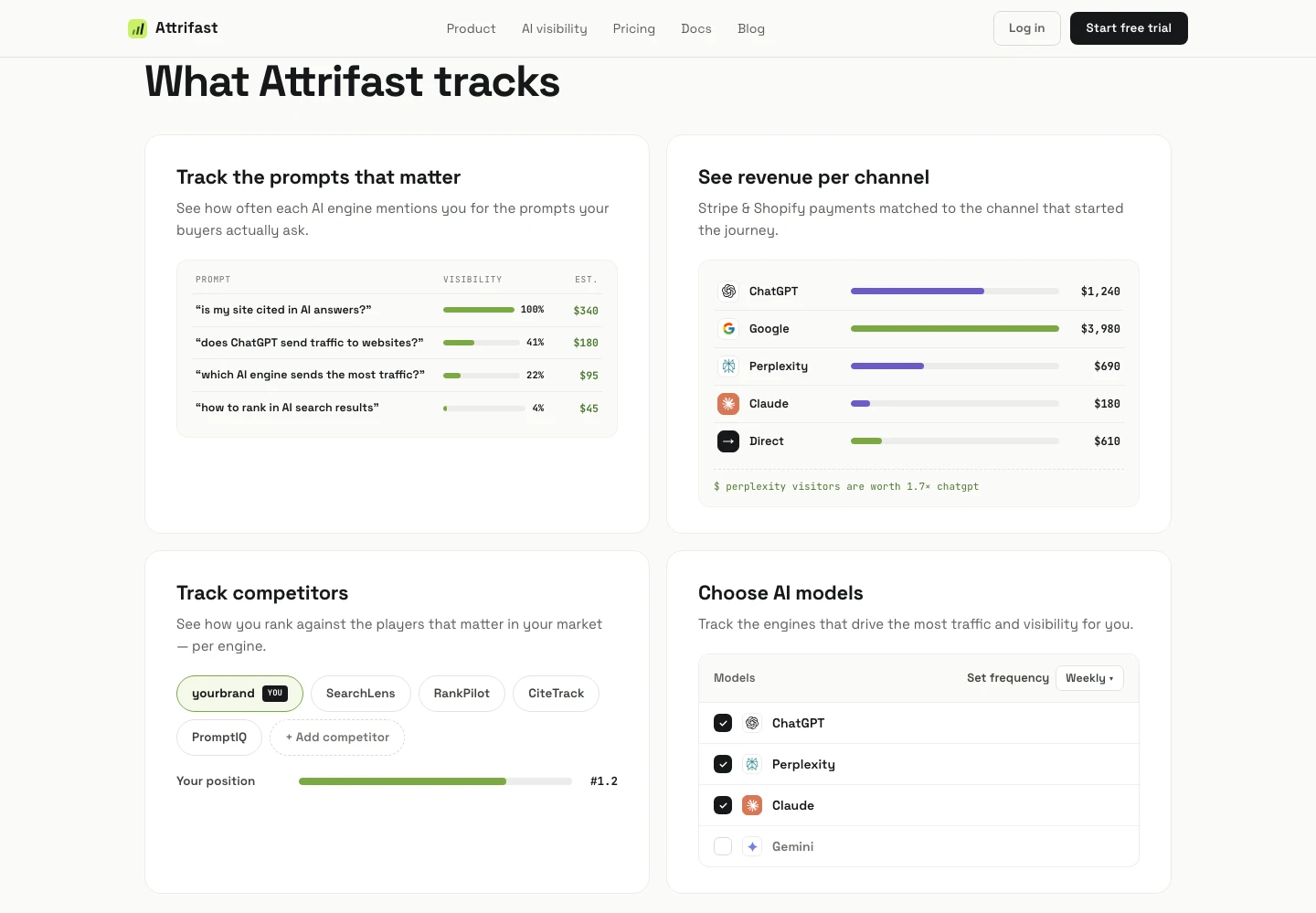
A short note on the product, because the article cannot pretend the author has no interest. Attrifast surfaces ChatGPT and Perplexity as separate, named channels in the same dashboard as Google organic, paid social, and email — not lumped into a generic "AI" bucket. Each engine carries its own conversion rate, RPV, and revenue contribution, joined to Stripe on every checkout.session.completed webhook with no manual reconciliation. The detection runs the server-side referer-plus-behavioral pattern described above, so it recovers the majority of both engines' visits that GA4 drops into Direct.
The tracking script is 4 KB, cookieless, and ships without a consent banner under most jurisdictions (verify per your own privacy review). The Stripe connection is a pasted restricted API key, with the webhook provisioned automatically. Cost is $9.99/mo for the base tier. The point of building it was exactly the decision this article is about: I could not tell my own customers whether to prioritize ChatGPT or Perplexity, because I could not see the revenue split on their sites. Now I can, and so can they. See it on your own data via revenue attribution.
That is the pitch in the second person. The first-person reason I built it is that I was the operator staring at a Direct/(none) bucket full of un-attributed AI clicks, unable to answer the simplest possible question — which AI engine is actually paying me — and deciding that was an unacceptable thing not to know.
Limitations and caveats
The integrity of a comparison depends on the reader knowing what they can and cannot infer.
- Self-selection bias inflates AI share. Sites joined Attrifast often because they suspected un-attributed AI traffic. A random SMB sample would likely show smaller AI shares. The per-visit gaps between ChatGPT and Perplexity are more robust than the absolute shares, because both are measured the same way on the same pages.
- ChatGPT recovery leans more on behavioral inference. ChatGPT strips referers more aggressively than Perplexity, so more of its sessions are recovered via behavioral fingerprinting, which carries a ~20% noise floor. Perplexity's higher referer pass-through means its recovered sessions are cleaner. The two sides are not measured with identical precision; where it matters, I lean on the referer-confirmed subset.
- ChatGPT's untrackable influence is undercounted. ChatGPT frequently recommends brands without a clickable link. Click-based attribution cannot see that, so ChatGPT's true total influence is somewhat larger than its measured click revenue. Perplexity has less of this gap. This biases the comparison slightly against ChatGPT on the "total influence" dimension while leaving the per-click numbers fair.
- Stripe-native, bootstrapped SMB only. Largest site ~$250k MRR. Non-Stripe processors and enterprise motions are out of scope. The numbers will not transfer cleanly to a $5M+ MRR site with a sales team.
- The volume ratios are heavily rounded. The ~9x cohort and ~30x median-site ChatGPT:Perplexity ratios held within wide bands and vary by vertical. Treat them as orders of magnitude, not constants.
- The per-visit gaps will compress. Perplexity's intent premium depends on its research-mode user concentration; ChatGPT keeps adding citation surfaces. Both pressures narrow the gap over time. Q2-2026 snapshot only.
- Geographic skew. ~62% US, ~24% EU+UK. APAC under-represented. US-English-skewed.
- We are the vendor. I have a structural incentive to make AI attribution look important. The honest counterweights are this entire section, the ecommerce finding where both AI engines trail Google on conversion, and the fact that ChatGPT's volume — not the more flattering Perplexity intent story — is what drives most total AI revenue for most sites.
FAQ
ChatGPT vs Perplexity for business: which one should I prioritize?
It depends on what you sell, and you cannot answer it honestly without measuring revenue per engine on your own site. In the Attrifast cohort, ChatGPT sends roughly 30x the human visits Perplexity does, so on raw volume ChatGPT wins for almost everyone. But Perplexity converts higher per visit on B2B SaaS (4.1% vs 3.2%) and earns higher revenue per visitor ($1.81 vs $1.04), because its citation-first, research-mode users arrive deeper in the funnel. The honest framing: ChatGPT is the volume engine and Perplexity is the intent engine. B2C ecommerce, where impulse and reach matter most, favors ChatGPT volume. B2B and considered-purchase products, where a single well-qualified click is worth more, favor Perplexity intent. Most businesses should instrument both and let the recovered revenue numbers, not the hype, set the priority.
Does Perplexity convert better than ChatGPT for business?
Per visit, yes, on B2B SaaS. In the Attrifast cohort Perplexity-attributed sessions convert to a Stripe payment at 4.1% versus 3.2% for ChatGPT on the same landing pages, and Perplexity revenue per visitor is $1.81 versus $1.04. The reason is selection: Perplexity's product is built citation-first around research questions, so the average Perplexity click is a deeper-funnel, higher-intent click than the average ChatGPT click. The catch is volume. ChatGPT sends roughly 30x more human visits, so even at a lower per-visit conversion rate ChatGPT usually produces more total customers. Perplexity wins the per-visit contest; ChatGPT usually wins the total-contribution contest because of reach.
Should I optimize for ChatGPT or Perplexity?
Optimize for both, but weight your effort by business model. The optimization work overlaps heavily — structured content, clear answers, citable claims, and clean technical access help you in both engines. Where they diverge: ChatGPT rewards broad conversational topic coverage and brand presence in training data, while Perplexity rewards fresh, well-sourced pages it can cite in real time. If you are B2C ecommerce chasing volume, lead with ChatGPT-shaped content. If you are B2B or sell a considered purchase where one qualified lead is worth a lot, Perplexity's higher per-visit value justifies disproportionate attention to citation freshness and source quality. You will not know the real split until you measure revenue per engine on your own site.
Which AI engine drives more revenue, ChatGPT or Perplexity?
In absolute terms across the Attrifast cohort, ChatGPT drives more total attributable revenue than Perplexity because it sends roughly 30x the volume. ChatGPT contributed about $2.41M across the cohort window versus a far smaller absolute figure for Perplexity. But per visit, Perplexity drives more revenue: $1.81 RPV on B2B SaaS versus $1.04 for ChatGPT. So the answer flips depending on whether you mean total revenue (ChatGPT, via volume) or revenue per click (Perplexity, via intent quality). For a business deciding where to invest a fixed content budget, the per-visit number matters more than people think, because Perplexity content is often the same content that performs in ChatGPT.
Is Perplexity better than ChatGPT for B2B marketing?
For per-visit quality on B2B, yes — Perplexity-sourced B2B SaaS buyers convert at 4.1% and carry $1.81 RPV in the cohort, both higher than ChatGPT. Perplexity's citation-first design surfaces sources prominently and attracts users in active research mode, which maps cleanly onto a B2B buying committee evaluating tools. But ChatGPT's far larger reach means it still produces more total B2B pipeline for most sites. The practical B2B play is to treat Perplexity as the high-intent channel worth optimizing for citation quality, and ChatGPT as the volume channel worth optimizing for breadth of coverage, and to measure both against Stripe so the budget follows the revenue.
Why does Perplexity convert higher than ChatGPT per visit?
Selection and surface design. Perplexity is positioned and used as an answer engine for research questions, so its user base skews toward people actively evaluating something, and its interface puts citations front and center, which trains users to click sources. ChatGPT is a general-purpose assistant used for everything from coding to recipes to therapy, so its average session is less commercial and its citation clicks are a smaller, more diluted slice of a much larger pie. When a Perplexity user clicks through to your page, they have usually already read a sourced, comparison-style answer and are deeper in the funnel. That pre-qualification shows up as higher conversion and higher revenue per visit.
How much more traffic does ChatGPT send than Perplexity?
Roughly 30x on a median-site basis in the Attrifast cohort. ChatGPT delivered about 2.77M human sessions in the measurement window versus about 312k for Perplexity, a ratio near 9x at the cohort total, but on a per-site median basis where Perplexity is thinner the ratio widens toward 30x, and against ChatGPT's dominant share of all AI sessions (about 71%) Perplexity sits around 8%. The load-bearing fact is that ChatGPT is the volume leader among AI engines by a wide margin and Perplexity is a smaller, higher-intent slice. Both are growing fast; Perplexity has been growing off a smaller base.
Can GA4 tell me whether ChatGPT or Perplexity drives more revenue?
No, not reliably. GA4 buckets the majority of ChatGPT visits (65-82%) and a large share of Perplexity visits (roughly 60-75%) into Direct/(none) because the clients strip the Referer header on most outbound clicks. A custom channel group regex recovers only the minority of clicks that arrive with a referer, and even then GA4 cannot join those sessions to a Stripe payment. So in default GA4, both engines look like roughly zero and the comparison is impossible. To answer "which AI engine drives more revenue" you need server-side first-party attribution that survives stripped referers plus a Stripe webhook join — the architecture this article's numbers are built on.
Does Perplexity pass referrers more often than ChatGPT?
Yes, noticeably more often in my measurement. ChatGPT strips the Referer header on the large majority of outbound clicks (single-digit to ~20% pass-through depending on surface and client), so 65-82% of ChatGPT visits land in GA4's Direct/(none) bucket. Perplexity preserves a usable referer more frequently — roughly 25-40% of its clicks arrive with perplexity.ai in the referer in my sample — which means a smaller share, around 60-75%, falls into Direct. Neither is reliable enough to depend on for attribution, but the practical consequence is that Perplexity is somewhat easier to catch with referer-only methods, while ChatGPT almost always requires behavioral inference to recover.
Is ChatGPT or Perplexity better for ecommerce?
ChatGPT, mostly, because ecommerce runs on volume and impulse, and ChatGPT's reach plus its broader consumer user base feed both. In the cohort, ChatGPT ecommerce contributes more total revenue on raw volume, even though Perplexity's per-visit ecommerce RPV is higher ($0.94 vs $0.62) thanks to bigger baskets. The pattern: Perplexity sends fewer, higher-value ecommerce buyers; ChatGPT sends many more buyers at a slightly lower basket. For a DTC store optimizing total revenue, ChatGPT's volume usually wins. For a high-consideration or high-ticket ecommerce niche (think $500+ purchases where buyers research), Perplexity's per-visit value becomes more interesting.
Will Perplexity's per-visit advantage over ChatGPT last?
Probably not at the current magnitude, and the reasons cut both ways. Perplexity's edge comes from its research-mode user concentration; if it broadens toward general-consumer use the way ChatGPT did, that concentration dilutes and the per-visit premium compresses. Meanwhile ChatGPT keeps adding citation surfaces and a search experience that increasingly behaves like Perplexity, which could narrow the intent gap from the other side. The volume gap is also dynamic — both are growing fast off different bases. Treat the 4.1% vs 3.2% conversion gap and the $1.81 vs $1.04 RPV gap as a Q2-2026 snapshot, not a constant, and re-measure quarterly on your own data.
Do I need to choose between ChatGPT and Perplexity at all?
For content optimization, no — the work overlaps enough that you rarely pick one at the expense of the other. Structured, well-sourced, clearly-answered content tends to perform in both engines, so the marginal cost of covering both is low. The real choice is where you spend incremental effort and how you read the results: lead with breadth and brand presence for ChatGPT volume, lead with source freshness and citation quality for Perplexity intent. The one place you genuinely must not choose blind is measurement — you need revenue per engine on your own site to know which one is actually paying you, and that is the gap most businesses never close.
How do I measure revenue per AI engine on my own site?
Three layers. First, detect the engine server-side: match the Referer against a known AI-domain list (chatgpt.com, chat.openai.com, perplexity.ai) and fall back to behavioral inference on no-referer deep-page entries for the stripped-referer majority. Second, persist a first-party session row scoped to your own domain, which sidesteps third-party cookie rules and consent banners in most jurisdictions. Third, join that session to a Stripe checkout.session.completed webhook via metadata so each payment carries its source. That join is the only way to compare ChatGPT and Perplexity on dollars rather than guesses. Attrifast ships this as a 4 KB cookieless script plus a restricted-API-key Stripe connection for $9.99/mo.
Which engine should a new business optimize for first?
Start with whichever your buyers actually use, then verify with measurement. If you sell to engineers, analysts, researchers, or B2B buyers who live in research tools, Perplexity punches above its volume because of intent quality, so it is worth early attention. If you sell consumer products or anything with broad mainstream demand, ChatGPT's reach makes it the first stop. In practice, write content that serves both — clear answers, citable claims, structured headings — instrument both engines against Stripe from day one, and within 60-90 days let the recovered RPV tell you where to double down. Guessing is expensive; the measurement costs $9.99/mo.
References and further reading
For the per-engine detection patterns and code, see the track-ChatGPT-traffic guide and the track-Perplexity-traffic guide. For why GA4 hides both engines, see the ChatGPT referral analytics guide. For the broader head-to-head against Google, see ChatGPT traffic vs Google traffic, and for the full per-engine dataset, the 2026 AI Search Revenue Benchmark. For optimization, see how to rank in ChatGPT and how to show up in Perplexity. To run this comparison on your own site, Attrifast's revenue attribution joins first-party sessions to Stripe and splits ChatGPT and Perplexity as named channels.
Sources
Primary sources for the claims in this article. Numbered citations in the text link to the matching entry.
- [1]Introducing ChatGPT search and usage disclosures — OpenAI (2024).
- [2]Overview of OpenAI's bots and how to control them — OpenAI (2026).
- [3]ChatGPT hits 1 billion daily messages — The Verge (2024).
- [4]How Perplexity works and our approach to sources — Perplexity (2026).
- [5]AI Search Stats 2026: Market Share, Referral, and Citation Data — SimilarWeb (2026).
- [6]Search engine market share, desktop and mobile — StatCounter (2026).
- [7]AI insights and bot traffic dashboard — Cloudflare Radar (2026).
- [8]Google AI Overviews tracker — Search Engine Land (2026).
- [9]ChatGPT and AI search statistics — Backlinko (2026).
- [10]AI Overviews Reduce Clicks by 34.5% (300,000-keyword study) — Ahrefs (2025).
- [11]What is a Good Organic CTR? Real Website Benchmarks — Ahrefs (2026).
- [12]We studied the impact of AI search on SEO traffic — Semrush (2025).
- [13]Americans' use of generative AI — Pew Research Center (2025).
- [14]AI visibility and citation-share platform — Profound (2026).
- [15]How to track ChatGPT and AI search traffic — Plausible Analytics (2024).
- [16]Google search statistics — Internet Live Stats (2026).
- [17]Default channel group definitions for GA4 — Google Analytics (2026).
- [18]Checkout Session object and metadata field — Stripe Docs (2026).
- [19]Zero-click search research — SparkToro (2026).
- [20]One Year Into Google AI Overviews: BrightEdge Data Reveals Google Search Usage Increases by 49% — BrightEdge (2025).
Related reading from the Attrifast research stack
To dive deeper, explore share of voice in AI search.