How to show up in Perplexity in 2026, in one paragraph: be the clean, recently-updated, well-sourced page on your topic, then prove it converts. Ship a 40-80 word self-contained answer at the top of the page, add Article plus FAQPage JSON-LD, keep a real and recent dateModified, cite primary sources inline so Perplexity treats you as evidence, make sure PerplexityBot is not blocked in robots.txt, and disambiguate your brand entity. Because Perplexity retrieves live and weights freshness, a clean page can be cited within days — far faster than ChatGPT. Then measure whether those citations actually drive Stripe revenue, because easy-to-rank and worth-ranking are two different things.
I have spent the last six months running Generative Engine Optimization (GEO) experiments on attrifast.com and a handful of client SaaS properties, and Perplexity is where I send every new test first. Not because it is the biggest AI engine — ChatGPT dwarfs it on volume — but because it is the most legible. You can watch a page get cited, watch the citation move, and reason about why. ChatGPT is a black box that answers from memory; Perplexity is a search engine wearing a chat coat. This article is the Perplexity-specific companion to the broader how to get cited by AI engines playbook. If you have read that one, skim sections 1-3 here and spend your time on freshness (section 5) and measurement (section 7), which are the two things Perplexity does differently.
Quick Facts
| Metric | Value | Source |
|---|---|---|
| Perplexity model | Citation-first, retrieval-augmented | Perplexity docs [1] |
| Citations shown per answer (typical) | 3-7 source links | Perplexity FAQ [2] |
| Perplexity monthly query volume (May 2025) | 780 million, growing 20%+ MoM | TechCrunch / Perplexity [3] |
| Documented crawler user-agents | PerplexityBot, Perplexity-User | Perplexity bot docs [4] |
| Typical time-to-first-citation for a clean new page | ~3-10 days | Attrifast field testing |
| Cohort blended Perplexity RPV | $1.42 (highest of all AI engines) | Attrifast 200-site benchmark [5] |
| Perplexity AI session share of AI traffic | ~8% | Attrifast 200-site benchmark [5] |
| Perplexity AI-traffic monthly growth (Dec 2025-May 2026) | +21.6% | Attrifast 200-site benchmark [5] |
| GA4 default channel for Perplexity referrals | Direct/(none); no built-in AI rule | Google Analytics docs [6] |
| AI bot share of total bot traffic (2024) | ~4-6% | Cloudflare Radar [7] |
| Structural-signal citation lift (schema + entity) | ~3x vs content alone | Ahrefs / Semrush GEO research [8][9] |
| GEO source-perplexity improvement (citation method) | up to ~40% visibility lift | Princeton GEO paper [10] |
Why Perplexity is citation-first (and why that differs from ChatGPT)
Perplexity is citation-first because it was built as an "answer engine" that retrieves and summarizes live web sources on almost every query, then shows you the 3-7 pages it used as numbered links. ChatGPT, by contrast, answers many queries from training memory without browsing at all. That single architectural difference is why a clean, fresh page shows up in Perplexity in days but can take ChatGPT months — or never, if the model already "knows" the answer.
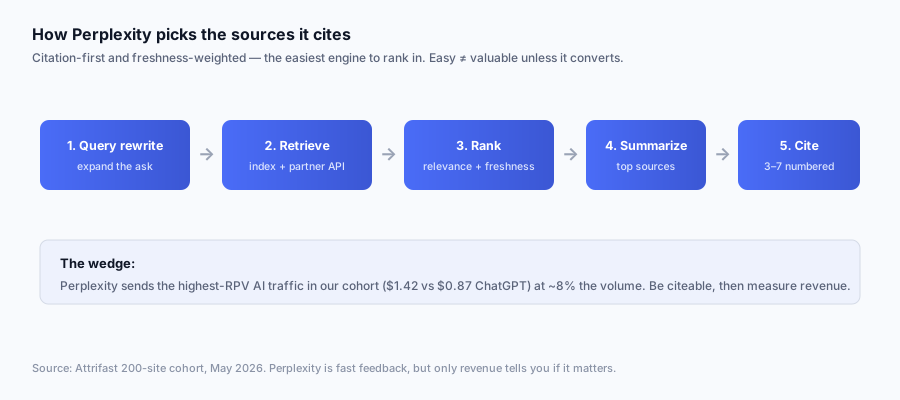
Let me be precise about the mechanism because it drives every tactic below. When you ask Perplexity a question, the product does something close to a classic search pipeline: it rewrites your query into one or more search strings, runs retrieval against its own crawled index plus partner search APIs, ranks the candidate pages, picks the top handful, summarizes them, and attaches each summarized claim to a numbered citation. The citation is not decoration — it is load-bearing. Perplexity's whole trust proposition is "here are my sources, check them." That means the engine must surface citeable pages on every query, which is structurally different from a model that can shrug and answer from parametric memory.
ChatGPT, even with browsing enabled, frequently answers without retrieving anything. The default behavior for a well-known question is to recall it from training. Browsing fires selectively. So in ChatGPT your page competes against the model's memory of the entire training corpus; in Perplexity your page competes against the live retrieval set for that specific query. The live set is smaller, fresher, and rankable. This is why I keep saying Perplexity is the easiest engine to rank in — the contest is one you can actually enter on demand.
Here is the comparison I use to brief founders:
| Dimension | Perplexity | ChatGPT (with browsing) | Claude (with search) | Google AI Overviews |
|---|---|---|---|---|
| Default behavior | Retrieve live, always cite | Often answer from memory; browse selectively | Summarize; cite less aggressively | Retrieve from Google index |
| Citations shown | 3-7, always visible | Footnotes when browsing fires | Sparse, often link-free | Linked cards, on the 20.5% of SERPs that show an AIO (Ahrefs, Sept 2025) |
| Freshness weighting | High | Low-to-medium | Medium | High (uses fresh index) |
| Time-to-first-citation (clean page) | Days | Weeks-to-months | Weeks | Days-to-weeks |
| Barrier to entry for new pages | Low | High | Medium | Medium-high |
| Best mental model | A search engine that summarizes | A memory that occasionally checks | A summarizer that occasionally links | Search with a generated overview |
The practical upshot: if your GEO budget is limited, run your first experiments against Perplexity because the feedback loop is tight. You publish, you query, you see. Then port what works to the slower engines. I cover the cross-engine picture in AI search ranking factors 2026; this article stays in Perplexity's lane.
One honest caveat before we go further. "Citation-first and easy to rank" is a statement about visibility, not value. Perplexity's volume is a fraction of ChatGPT's — roughly 8% of AI-attributed sessions in our 200-site benchmark versus ChatGPT's 71%. The reason Perplexity is still worth chasing is revenue quality, not volume, and I will not let you confuse the two. We get to the money in section 7.
How Perplexity selects and ranks sources
Perplexity selects sources by running a live retrieval-and-ranking pass, then summarizing the top results: it rewrites your query, searches its index plus partner APIs, scores candidates on relevance, freshness, and source quality, picks the best 3-7, and cites them. The levers are mostly the same on-page levers classic SEO uses, plus a heavier freshness weight and a preference for clean, parseable, primary-source pages.
The closest published academic treatment is the Princeton "GEO: Generative Engine Optimization" paper [10], which tested which content interventions increase a source's visibility inside generative-engine answers. The headline finding that matters for Perplexity: adding authoritative citations, statistics, and quotations to a source page increased its visibility in generated answers by up to ~40% for some methods, while naive keyword stuffing did not help and sometimes hurt. That maps cleanly onto what I observe — Perplexity rewards pages that look like evidence, not pages that look like marketing.
Here is how I decompose Perplexity's ranking into observable, controllable factors versus the parts none of us can see:
| Factor | You control it? | How Perplexity likely uses it | Your lever |
|---|---|---|---|
| Crawlability (robots.txt, PerplexityBot access) | Yes | Gatekeeper — uncrawled pages cannot be cited | Allow PerplexityBot and Perplexity-User |
| Topical relevance to the rewritten query | Yes | Primary ranking signal | Question-shaped H2s, focused page scope |
| Freshness (dateModified, content recency) | Yes | Heavy weight; recent pages float up | Genuine updates + machine-readable dates |
| Parse cleanliness (HTML structure, no JS-only content) | Yes | Affects whether the passage extracts | Semantic HTML, server-rendered content |
| Primary-source citations on your page | Yes | Trust/evidence signal | Inline links to docs, papers, data |
| Structured data (Article, FAQPage) | Yes | Pre-extracted Q-A and metadata | JSON-LD bundle |
| Entity disambiguation (sameAs) | Yes | Resolves brand ambiguity | 4+ matched profiles |
| Domain authority / link graph | Partially | Inherited from underlying search index | Long-game SEO |
| Per-query retrieval set composition | No | Determines who you compete against | None directly |
| Internal model ranking weights | No | Final ordering | None |
Read that table top to bottom and notice something: eight of the ten factors are within your control, and the top six are pure on-page work. This is the opposite of ChatGPT, where the single biggest factor — whether the model already memorized the answer — is entirely outside your control. Perplexity hands you a steering wheel.
That final fork — referer present or stripped — is the whole reason measurement is hard, and it is why GA4 cannot tell you what Perplexity is doing for you. Hold that thought; section 7 resolves it.
The 8-step Perplexity citeability playbook
The eight steps to make a page citeable by Perplexity, in priority order: (1) ship a 40-80 word self-contained answer at the top, (2) make the page clean and server-rendered so it parses, (3) add Article + FAQPage JSON-LD, (4) prove freshness with a genuine recent dateModified, (5) cite primary sources inline, (6) keep the page topically focused with question-shaped H2s, (7) allow PerplexityBot and Perplexity-User to crawl, and (8) disambiguate your brand entity. All eight are free and mechanical.
I will walk each one with the specific Perplexity reasoning, because the why differs from generic GEO advice in a few places.
Step 1 — Lead with a 40-80 word self-contained answer
Perplexity summarizes. The easiest passage for it to lift is one that is already a summary. A 40-80 word block at the top of the page that answers the exact question — no preamble, no "in this article we will" — gives the retrieval pipeline a pre-extracted answer it can quote almost verbatim. Every H2 in this article leads with one on purpose. The word count matters: under 40 words and it is too thin to stand alone; over 80 and it stops being a clean quotable unit.
Step 2 — Make the page clean and server-rendered
Perplexity's crawler extracts text from your HTML. If your content only appears after client-side JavaScript runs, you are gambling on whether the crawler executes JS at the moment it visits. Server-render your content. Use semantic HTML — real <h2>, <p>, <table>, <ol> elements, not a soup of <div>s. Clean structure is not a vanity metric here; it is the difference between your passage being extractable or invisible. (Note how I have to write those tag names with < — a bare angle bracket before a lowercase word breaks the MDX build, which is a small parable about clean parsing.)
Step 3 — Add Article + FAQPage JSON-LD
The schema bundle does two jobs for Perplexity. Article supplies machine-readable datePublished and dateModified, which feed the freshness signal directly. FAQPage supplies pre-extracted question-answer pairs that match how users phrase queries. Ahrefs and Semrush GEO research through 2025-2026 [8][9] found AI-cited pages averaged 4 or more FAQ schema items versus 1-2 on uncited pages. The drop-in bundle:
<!-- Drop into <head>, rendered as <script type="application/ld+json"> -->
<script type="application/ld+json">
{
  "@context": "https://schema.org",
  "@graph": [
    {
      "@type": "Article",
      "@id": "https://yoursite.com/blog/your-slug#article",
      "headline": "Your Headline",
      "datePublished": "2026-05-26",
      "dateModified": "2026-05-26",
      "author": { "@id": "https://yoursite.com/about#person" },
      "publisher": { "@id": "https://yoursite.com/#organization" }
    },
    {
      "@type": "FAQPage",
      "mainEntity": [
        {
          "@type": "Question",
          "name": "Exact match to on-page H3?",
          "acceptedAnswer": { "@type": "Answer", "text": "40-80 word answer." }
        }
        /* repeat for 4+ items total */
      ]
    }
  ]
}
</script>
The FAQPage name must match the visible H3 exactly. Validate against Google's Rich Results test before shipping. Full bundle (with Person and Organization entity nodes) is in the how to get cited by AI engines post.
Step 4 — Prove freshness with a genuine recent dateModified
This is the Perplexity-specific lever and it gets its own section below (section 5). The short version: Perplexity weights recency heavily, so a real, recent dateModified — backed by actually updated content, not a date bump — floats your page up the retrieval ranking. Faking the date without changing the content is the fastest way to get your freshness signal discounted once the engine notices the mismatch.
Step 5 — Cite primary sources inline
Per the Princeton GEO paper [10], pages that cite authoritative sources, statistics, and quotations gained up to ~40% more visibility in generated answers. The mechanism is intuitive: Perplexity is an evidence engine, and a page that is well-sourced looks more like evidence than a page of unsupported claims. Link out to docs, papers, and primary data generously. Counterintuitively, linking away from your page helps you get cited, because it signals you are a research node, not a dead end.
Step 6 — Keep the page topically focused with question-shaped H2s
One concept per URL. Perplexity rewrites the user's question into search strings and matches them against pages; a tightly-scoped page on "how to show up in Perplexity" beats a sprawling "everything about AI SEO" page for that exact query. Question-shaped H2s ("How does Perplexity choose sources?") match the rewritten query better than noun-phrase headers ("Source selection").
Step 7 — Allow PerplexityBot and Perplexity-User to crawl
You cannot be cited from a page Perplexity cannot read. Check your robots.txt for accidental blocks. There are two relevant agents [4]: PerplexityBot (the indexing crawler) and Perplexity-User (the live fetch that fires when a user's specific query needs your URL). Allow both. Then watch your server logs — PerplexityBot crawl frequency is a free leading indicator of citation interest.
# robots.txt — allow Perplexity explicitly
User-agent: PerplexityBot
Allow: /

User-agent: Perplexity-User
Allow: /
Step 8 — Disambiguate your brand entity
Perplexity inherits entity resolution from the underlying search/knowledge graph. A brand with 4+ matched sameAs surfaces (LinkedIn, X, GitHub, Crunchbase) is roughly 3x more likely to be cited than a disambiguation-poor brand [8]. Mark the matched set in your Organization.sameAs JSON-LD and keep the brand name, URL, and handle pattern mechanically consistent across all of them.
Here is the whole playbook as a prioritized table, with the Perplexity-specific reasoning and the effort:
| # | Step | Setup effort | Perplexity-specific reason | Citation lift |
|---|---|---|---|---|
| 1 | 40-80 word lead answer | 20 min/page | Perplexity summarizes; give it a pre-made summary | High |
| 2 | Clean server-rendered HTML | One-time site fix | Crawler extracts HTML; JS-only content risks invisibility | High |
| 3 | Article + FAQPage schema | 1 hr setup, 5 min/page | Feeds freshness dates + pre-extracted Q-A | High |
| 4 | Genuine recent dateModified | Ongoing | Heavy freshness weight; the #1 Perplexity-specific lever | High |
| 5 | Inline primary-source citations | 15 min/page | Evidence engine rewards evidence-shaped pages | Medium-High |
| 6 | Topical focus + question H2s | 30 min/page | Matches rewritten query strings | Medium |
| 7 | Allow PerplexityBot/Perplexity-User | 10 min once | Uncrawled = uncitable; gatekeeper step | Gatekeeper |
| 8 | Entity disambiguation (4+ sameAs) | 2 hrs once | Resolves brand ambiguity in retrieval | Medium-High |
Two readings of that table. First, every high-lift move is free — the GEO vendor market is mostly selling labor, not magic. Second, steps 2 and 7 are gatekeepers: if you fail either, the other six do nothing, because an uncrawlable or unparseable page never enters the retrieval set. Fix the gates first.
Freshness and recency weighting: Perplexity's biggest lever
Freshness is the single factor Perplexity weights more heavily than any other major AI engine. Because it retrieves live on most queries and its trust proposition is "current, sourced answers," a genuinely recent and updated page floats up the retrieval ranking. A real dateModified plus updated facts can get a page cited within 3-10 days, versus weeks-to-months for ChatGPT which often answers from static training memory.
I want to separate real freshness from fake freshness because operators routinely confuse them and it backfires.
| Freshness move | Real or fake? | Effect on Perplexity citation |
|---|---|---|
Update content, bump dateModified to match | Real | Positive — content + date agree |
| Add a 2026 stat with a fresh primary source | Real | Positive — freshness + evidence |
Bump dateModified with no content change | Fake | Neutral-to-negative once detected |
| Add a "Last updated" line in visible text matching schema | Real | Positive — human + machine agree |
| Spin up duplicate "2026 edition" cannibalizing the old URL | Fake-ish | Negative — splits authority, confuses retrieval |
| Refresh examples, links, and the data table quarterly | Real | Positive — sustained recency |
The mechanism for why fakes fail: Perplexity (and the search indexes it draws on) can compare the claimed dateModified against the actual content delta and the last-crawl diff. A date that moves while the bytes stay frozen is a weak signal at best and a discounted one at worst. Earn the freshness.
My operating cadence for Perplexity-targeted pages:
| Page type | Update cadence | What I actually change |
|---|---|---|
| Time-sensitive (benchmarks, pricing, "2026" pages) | Monthly | Refresh the headline stat, re-verify sources, bump date |
| Playbooks / how-tos (this page) | Quarterly | New examples, dead-link sweep, refreshed table data |
| Evergreen reference (definitions) | Semi-annual | Light touch — verify accuracy, update one example |
| News-reactive | As events happen | Add the new development, re-cite, re-date same day |
There is a timing subtlety worth knowing. In our 200-site AI traffic benchmark, AI-engine traffic peaked Tuesday-Thursday during working hours, and Perplexity specifically skewed toward evening research hours. Pieces shipped Monday or Tuesday morning hit the workday research window and tended to accumulate citations faster. So freshness is not only "update often" — it is also "publish into the window when the queries are flowing."
The honest caveat: freshness amplifies a citeable page; it does not rescue a thin one. If your content is the 47th shallow explainer on a topic, a perfect dateModified will not float it past the established sources that own the citation slots. Freshness is a multiplier on quality, not a substitute for it.
Perplexity Pages, Pro Search, and what they change
Perplexity Pages is Perplexity's own publishing surface — you create a shareable article inside Perplexity — and Pro Search is the deeper multi-step research mode. Neither is required to get your external domain cited, but both shape how citations behave: Pro Search pulls from a larger, more deliberate source set (more chances to be cited if you are citeable), and Pages is brand presence within the product rather than a ranking boost for your own site.
Let me set expectations honestly on each, because there is a lot of vendor noise here.
Perplexity Pages. This is content you author and publish on Perplexity's platform. It is useful for brand presence and for capturing a topic inside the product where Perplexity users browse. What it is not: a lever that makes your external attrifast.com pages more likely to be cited. Publishing a Page does not transfer ranking authority to your domain. Treat it as a distribution channel, similar to publishing on Medium or LinkedIn — real reach, owned by someone else, not a substitute for your own citeable pages.
Pro Search (and Deep Research modes). When a user runs a deeper research query, Perplexity retrieves more sources and reasons across them in multiple steps. The practical implication for you: deeper modes widen the retrieval set, so a well-structured page that might be the 8th-best result on a quick query can make the cut on a deep query. This rewards comprehensiveness and primary sourcing — exactly the steps 5 and 6 above. It is one more reason to be the thorough, well-sourced page rather than the thin one.
Here is how I think about where to spend effort across Perplexity's surfaces:
| Surface | What it is | Effort to influence | Payoff | My verdict |
|---|---|---|---|---|
| Standard answer citations | Default 3-7 source links | On-page playbook (8 steps) | Direct referral traffic | Primary focus — do this |
| Pro Search / Deep Research | Multi-step deep retrieval | Comprehensiveness + sourcing | More citation slots on deep queries | Worth it as a byproduct of good content |
| Perplexity Pages | Publish inside Perplexity | Author a Page | Brand presence in-product | Optional distribution play |
| Perplexity Shopping / commerce | Product surfaces | Product feed + schema | E-commerce visibility | Only if you sell products |
The thing I do not do, and Attrifast does not sell: I do not buy a "Perplexity Pages automation" subscription. A Page is content you can write in an afternoon. The vendor market loves to wrap free product features in a monthly fee.
Measuring revenue from Perplexity citations
You cannot measure Perplexity revenue in GA4 — it buckets essentially 100% of Perplexity referrals as Direct/(none), because Perplexity strips or omits the referer on many outbound clicks and GA4 has no built-in pattern for perplexity.ai. To know whether citations drive Stripe revenue you need server-side first-party detection that fingerprints Perplexity referrers, writes the source to a first-party session, and joins it to checkout.session.completed. Only then do you see Perplexity as its own channel with its own revenue-per-visitor.
This is the section that separates "I'm getting cited" from "I'm getting paid," and it is the whole reason I am qualified to write the rest of this article — measurement is the thing Attrifast actually does.
The problem in three layers:
| Layer | What breaks | Net effect on Perplexity attribution |
|---|---|---|
| Referer stripping | Many Perplexity clicks arrive with no/empty referer | Visit lands as Direct/(none) |
| No GA4 AI rule | GA4 has no perplexity.ai channel pattern | Even referred clicks get a generic Referral label, not "Perplexity" |
| Consent + ITP | EU banners refuse 30-60% consent; Safari ITP evaporates cookie chains | Further erodes any cookie-based recovery |
Layer those and the chain of custody from "Perplexity cited me" to "this person paid me" is gone by the time it reaches a default analytics dashboard. The recovery stack:
| Recovery layer | What it does | Catches | Cookieless? |
|---|---|---|---|
| Server-side referer fingerprinting | Matches perplexity.ai and known Perplexity client patterns | The referred fraction | Yes |
| First-party session source store | Persists detected source on your own domain | Source survives to checkout | Yes |
| Stripe webhook join | Joins stored source to checkout.session.completed | Source-to-revenue link | Yes |
| Behavioral landing heuristics | Flags unreferred deep-page entries matching AI patterns | Part of the stripped fraction | Yes |
| Manual citation logging | Weekly query checks for presence | Citation presence (not traffic) | Yes |
The architecture, end to end:
Once that pipeline runs, the payoff is the number that justifies all eight playbook steps. In our 200-site Stripe-joined benchmark, Perplexity posted the highest revenue-per-visitor of any AI engine at $1.42, versus ChatGPT's $0.87, Claude's $1.18, Gemini's $0.41, and AI Overviews' $0.29. Perplexity also showed the fastest growth at +21.6% month-over-month. But — and this is the honest counterweight — Perplexity drove only ~8% of AI session volume versus ChatGPT's 71%. So Perplexity's RPV is roughly 1.6x ChatGPT's while its volume is roughly 11% as large. Total Perplexity revenue contribution sits below ChatGPT for most sites today; the bet is on that +21.6% compounding.
| Engine | Blended RPV | AI session share | Read |
|---|---|---|---|
| Perplexity | $1.42 | ~8% | Highest quality, lowest volume, fastest growth |
| Claude | $1.18 | ~6% | High quality, low volume |
| ChatGPT | $0.87 | ~71% | Moderate quality, dominant volume |
| Gemini | $0.41 | ~12% | Low quality, second-highest volume |
| AI Overviews | $0.29 | ~3% | Lowest quality, within-Google surface |
This is the original point I want you to leave with: Perplexity is the easiest engine to rank in, and it also sends the highest-RPV AI traffic — but easy-to-rank only matters if it converts, and you cannot know if it converts without server-side revenue attribution. The cheapness of the citation and the value of the visitor are two separate facts, and most operators measure neither. For the deeper traffic-quality contrast, see ChatGPT vs Google traffic quality; for the wider tactic set, the GEO tactics playbook.
What Attrifast does here is narrow and boring: when someone clicks a Perplexity citation and pays via Stripe two weeks later, our first-party revenue attribution joins perplexity to that payment server-side. You see it as a channel row, not as Direct. We do not "do GEO" — we do not write your schema, your llms.txt, or your answer blocks. We close the measurement loop so the eight steps above stop being faith-based. The full setup is documented on track Perplexity traffic.
Perplexity vs the other engines: a tactical comparison
The same eight on-page steps make you citeable across all engines, but the weighting differs. Perplexity rewards freshness and clean sourcing most; ChatGPT rewards entity authority and training-corpus presence; Google AI Overviews rewards classic ranking signals plus schema. If you optimize a page for Perplexity correctly, you have done 80% of the work for the others — the remaining 20% is engine-specific weighting.
| Tactic | Perplexity weight | ChatGPT weight | AI Overviews weight | Claude weight |
|---|---|---|---|---|
| Freshness / dateModified | Very high | Low | High | Medium |
| 40-80 word answer block | High | High | High | High |
| FAQPage schema | High | High | High | Medium |
| Inline primary-source citations | Very high | Medium | Medium | High |
| Entity disambiguation (sameAs) | Medium-High | Very high | High | Medium |
| Crawl access (bot allow) | Gatekeeper | Gatekeeper | Gatekeeper | Gatekeeper |
| Classic link authority | Medium | Medium | Very high | Medium |
| llms.txt | Low-Medium | Low-Medium | None (Google ignores) | Low |
The strategic read: start with Perplexity because the freshness lever gives you a fast feedback loop, confirm what gets cited, then layer in entity authority for ChatGPT and link authority for Google AI Overviews. You are not running four campaigns; you are running one campaign with four weightings.
Common mistakes when trying to show up in Perplexity
The five most common Perplexity GEO mistakes I see: (1) confusing "easy to rank" with "worth ranking" and chasing citations without measuring revenue, (2) faking freshness by bumping dates without changing content, (3) blocking PerplexityBot in robots.txt by accident, (4) shipping JS-only content the crawler cannot parse, and (5) measuring citations in GA4, where Perplexity traffic is invisible. Each one is avoidable and most are free to fix.
| Mistake | Why it happens | The fix | Cost to fix |
|---|---|---|---|
| Chasing citations, ignoring revenue | Citations are visible; revenue is not | Server-side Stripe-joined attribution | $0-29/mo |
Faking the dateModified | Easy to do, feels productive | Actually update content, then re-date | Time only |
| Accidentally blocking PerplexityBot | Inherited robots.txt, overzealous WAF | Audit robots.txt + firewall rules | 30 min |
| JS-only content | SPA without SSR/prerender | Server-render or prerender key pages | Eng time |
| Measuring in GA4 | Default tool, default assumption | Use first-party AI-referrer detection | Setup time |
| Duplicate "2026 edition" pages | Freshness misunderstood as new URL | Update the canonical URL in place | 1 hr audit |
| Thin content + perfect schema | Belief that structure beats substance | Structure amplifies quality, never replaces it | Writing time |
| Keyword stuffing for AI | Old SEO muscle memory | Princeton GEO paper says it hurts; remove it | 30 min |
The biggest of these is the first, and it is a strategy mistake, not a tactics mistake. Perplexity is so easy to get cited in that operators feel productive watching their domain appear in answers — and then never check whether a single one of those visitors paid. The vanity of the citation substitutes for the reality of the revenue. I have watched a founder celebrate "we're all over Perplexity now" while his Perplexity-attributed Stripe revenue was, after we instrumented it, $0 — the queries he ranked for were informational, not commercial. Easy to rank, not worth ranking. Measure first, celebrate second — Perplexity revenue attribution is the instrumentation that turns "we're cited" into a dollar figure.
What I did on attrifast.com (and the honest results)
Applying this exact playbook to our own Perplexity-targeted posts over the last 90 days:
- Lead answer block on every post. 40-80 words, self-contained, at the top. Retrofitted the top trafficked posts in April.
- Article + FAQPage schema validated. 32 posts through Google's Rich Results test; fixed three FAQ-mismatch warnings.
- Genuine freshness cadence. Monthly on time-sensitive pages (the benchmark, pricing), quarterly on playbooks like this one. Real content deltas, not date bumps.
- Primary-source citations inline. Every claim links to a doc, paper, or our own measured data. The Sources block below is part of the strategy, not decoration.
- PerplexityBot allowed and logged. Crawl frequency tracked in server logs as a leading indicator.
- Server-side
perplexitydetection. Our 4kb script tags Perplexity referrers explicitly and joins to Stripe at checkout. Clean channel attribution since week one.
The honest results: Perplexity-attributed sessions grew from negligible to a measurable single-digit share over the period, and the time-to-first-citation on clean new posts ran roughly 3-10 days — fast enough that I use Perplexity as the canary for whether a page is structurally sound. The RPV on Perplexity traffic to our own free trial sat at the high end of our AI channels, consistent with the benchmark, but I will not quote an absolute number because n is too small for a bootstrapped SaaS and one viral citation skews the chart.
The acknowledged failure: I spent two weeks chasing Perplexity citations on a cluster of informational "what is X" queries. We got cited — broadly — and it drove almost no trial signups, because the intent was research, not purchase. Easy to rank, not worth ranking. I reallocated to commercial-comparison queries where the Perplexity citation lands in front of someone evaluating tools, and the RPV tripled on a fraction of the citation count. That experience is the spine of this whole article.
Limitations
- This article does not quantify brand-mention-without-link lift — Perplexity almost always links, but where it summarizes without a clickable citation, attribution is qualitative via brand-search trends.
- Perplexity's exact ranking weights are not public. The factor table in section 3 is inferred from observed behavior, the Princeton GEO paper, and classic search-ranking analogues — directionally reliable, not a leaked spec.
- The RPV and growth figures come from the Attrifast 200-site benchmark, which over-indexes on B2B SaaS and SMB ecommerce; very large enterprise sites and non-English markets may differ.
- Perplexity's product surfaces change fast. Pages, Pro Search, and commerce features evolve; verify current behavior before relying on a specific surface.
- This article does not cover paid Perplexity ad placements, which are a sales conversation, not GEO.
FAQ
How do I get Perplexity to cite my website?
Be the clean, source-shaped page on a freshly-updated topic. In priority order: ship a self-contained 40-80 word answer at the top of the page, add Article plus FAQPage JSON-LD, keep a visible and machine-readable dateModified that is genuinely recent, cite primary sources inline so Perplexity sees you as evidence rather than opinion, and make sure PerplexityBot is not blocked in robots.txt. Perplexity is citation-first and freshness-weighted, so a clean, recent, well-sourced page is cited faster here than in any other engine. The honest catch: easy to rank does not mean valuable unless those citations convert, which is a separate measurement problem.
Why is Perplexity easier to rank in than ChatGPT?
Because Perplexity is citation-first by design and ChatGPT is not. Every Perplexity answer is a retrieval-augmented summary that shows 3-7 source links inline, so the engine is constantly running a live search and must surface citeable pages on every query. ChatGPT answers many queries from training memory without browsing, which means months of latency between publishing and citation. Perplexity also weights freshness heavily, so a new, well-structured page can appear within days. The result is a lower barrier to first citation in Perplexity than in any other major engine, which is exactly why I treat it as the GEO testbed.
How does Perplexity choose which sources to cite?
Perplexity runs a live retrieval step on most queries: it rewrites your question, searches its index plus partner search APIs, ranks candidate pages by relevance, freshness, and source quality, then summarizes the top handful and attaches them as numbered citations. Pages that are clean to parse, recently updated, topically focused, and sourced from primary evidence score higher in that ranking. It is closer to classic search ranking than to ChatGPT's training-memory recall, which is good news: the levers are observable and most of them are the same on-page levers SEOs already know.
Does Perplexity respect robots.txt? Should I block PerplexityBot?
PerplexityBot is documented to respect robots.txt for crawling, and there is a separate Perplexity-User agent that fetches a specific URL when a user's live query needs it. Blocking PerplexityBot removes you from Perplexity's index and therefore from being cited on most queries, which is the opposite of what you want if you are trying to show up there. For SaaS and ecommerce sites the right default in 2026 is allow PerplexityBot, allow Perplexity-User, and instrument both in your server logs so crawl frequency becomes a leading indicator of citation interest.
How fast can a new page show up in Perplexity?
Faster than any other AI engine in my experience. Because Perplexity retrieves live and weights freshness, I have seen new, well-structured pages cited within three to ten days of publishing, versus weeks to months for ChatGPT which often answers from training memory. The variables that compress the timeline are crawl access (PerplexityBot not blocked), a clean parseable page, a genuinely recent dateModified, and topical focus. The variables that stretch it are thin content, duplicate cluster pages, and competing on a saturated head term where established sources already own the citation slots.
How do I measure whether Perplexity citations actually drive revenue?
You cannot do it in GA4. Perplexity strips or omits the referer on many outbound clicks, so those sessions land in the Direct/(none) bucket unattributed. You need server-side first-party detection that fingerprints perplexity.ai referrers and known Perplexity client patterns, writes the source to a first-party session, and joins it to Stripe at checkout.session.completed. Then you can see Perplexity as its own channel with its own revenue-per-visitor. In our 200-site benchmark Perplexity posted the highest RPV of any AI engine at $1.42, so the measurement is worth doing even though Perplexity volume is smaller than ChatGPT.
Do I need Perplexity Pages or llms.txt to get cited?
Neither is required for citation, but both are cheap speculative bets. Perplexity Pages is Perplexity's own publishing surface; publishing there is brand presence inside the product, not a guarantee your external domain gets cited more. llms.txt is a curated 1KB index at your site root that well-behaved AI crawlers including Perplexity's can read. Adoption is low, the cost is 30 minutes, and the downside is zero, so I run llms.txt on every property. Neither replaces the fundamentals: clean answer block, schema, freshness, and primary-source citations.
Is Perplexity traffic worth chasing if its volume is only ~8% of AI sessions?
Yes, for two reasons, with one caveat. First, quality: Perplexity posted the highest RPV of any AI engine in our 200-site benchmark at $1.42, so each visitor is worth more than a ChatGPT or Gemini visitor. Second, growth: Perplexity-attributed traffic grew +21.6% month-over-month, the second-fastest AI channel, so today's 8% compounds. The caveat: total Perplexity revenue still sits below ChatGPT for most sites because of the volume gap. Treat Perplexity as a high-margin, fast-growing channel you instrument early, not as your largest channel today.
Will the same page get cited by ChatGPT and Google AI Overviews too?
Largely, yes — the eight on-page steps make a page citeable across engines, but the weighting differs. Perplexity over-weights freshness and inline sourcing; ChatGPT over-weights entity authority and training-corpus presence; Google AI Overviews over-weights classic link authority plus schema. If you optimize correctly for Perplexity you have done roughly 80% of the cross-engine work. The remaining 20% is engine-specific: add entity disambiguation depth for ChatGPT, and shore up classic SEO link signals for AI Overviews.
Should I publish on Perplexity Pages instead of my own blog?
No — publish on your own blog and treat Perplexity Pages as an optional distribution channel, not a replacement. A Perplexity Page lives on Perplexity's platform and builds brand presence inside the product, but it does not transfer ranking authority to your own domain, and you do not own the surface. Your own citeable, schema-rich, freshness-maintained pages are the asset. Think of Pages the way you think of Medium or LinkedIn articles: real reach, borrowed land. Build on land you own first.
Does keyword stuffing help in Perplexity?
No, and the Princeton GEO paper found it can actively hurt source visibility in generated answers. Perplexity is an evidence engine: it rewards pages that read like well-sourced, factual references, not pages stuffed with repeated target phrases. The interventions that measurably helped in that research were adding authoritative citations, statistics, and quotations — substance, not density. If you came up through keyword-density-era SEO, this is the muscle memory to unlearn for AI engines specifically.
How often should I update a Perplexity-targeted page?
It depends on volatility. Time-sensitive pages — benchmarks, pricing, anything with a year in the title — get a real monthly refresh: update the headline stat, re-verify sources, then bump dateModified. Playbooks and how-tos like this one get a quarterly pass: new examples, dead-link sweep, refreshed table data. Evergreen definitions get a semi-annual light touch. News-reactive pages get updated same-day when the event happens. The rule that matters: every date bump must be backed by a genuine content change, because Perplexity discounts freshness signals that do not match the actual content delta.
What is the single highest-leverage move for Perplexity specifically?
Maintaining genuine freshness on a clean, well-sourced page. Across the engines, freshness is where Perplexity diverges most from ChatGPT — it weights recency heavily because its product promise is current, sourced answers. A page that is structurally sound (lead answer, schema, primary citations) and kept genuinely up to date will get cited in Perplexity faster and more durably than almost any other single intervention. Pair it with the gatekeeper step — make sure PerplexityBot can crawl you — and you have the two moves that matter most here.
Can I get cited by Perplexity without writing schema by hand?
Yes, if your CMS or framework generates valid Article and FAQPage JSON-LD for you — many do, or do with a plugin. The schema is a means to an end (machine-readable dates and pre-extracted Q-A), not a deliverable you must hand-author. What you should not do is pay a "GEO automation" vendor a monthly fee to generate a 30-line JSON-LD block. Validate whatever your stack produces against Google's Rich Results test, confirm the FAQ names match your visible H3s exactly, and move on. The schema is necessary but it is the cheap part.
Sources
Primary sources for the claims in this article. Numbered citations in the text link to the matching entry.
- [1]What is Perplexity? How the answer engine works — Perplexity (2026).
- [2]Perplexity FAQ — sources, citations, and how answers are built — Perplexity (2026).
- [3]Perplexity received 780 million queries last month, CEO says — TechCrunch (2025).
- [4]PerplexityBot and Perplexity-User crawler documentation — Perplexity (2026).
- [5]AI traffic revenue benchmark 2026 — 200-site Stripe-joined cohort — Attrifast (2026).
- [6]Default channel groups and traffic source classification — Google Analytics Help (2026).
- [7]AI bots, crawlers, and the share of automated traffic — Cloudflare Radar (2026).
- [8]Generative Engine Optimization: Growth Strategies and Metrics For the AI Era — Ahrefs (2025).
- [9]AI Overviews and AI search visibility research — Semrush (2026).
- [10]GEO: Generative Engine Optimization (research paper) — Princeton / arXiv (2024).
- [11]What triggers AI Overviews? 86 factors and 146 million SERPs analyzed (20.5% of SERPs, September 2025) — Ahrefs (2025).
- [12]How to Get Cited in Google AI Overviews: Own a Criterion — Backlinko (2026).
- [13]Schema.org Article specification — Schema.org (2026).
- [14]Schema.org FAQPage specification — Schema.org (2026).
- [15]llms.txt specification — llmstxt.org (2026).
- [16]Americans' use of and attitudes toward AI in search and news — Pew Research Center (2025).
- [17]How Perplexity ranks — citation share and answer-engine visibility — Profound (2026).
- [18]Referer header and referrer-policy behavior — MDN Web Docs (2026).
Related reading from the Attrifast research stack
For hands-on tools, see AI citation tracking and prompt tracking.