Part of the AI Search Hub — how AI engines pick brands, how to track them, and whether they drive revenue.
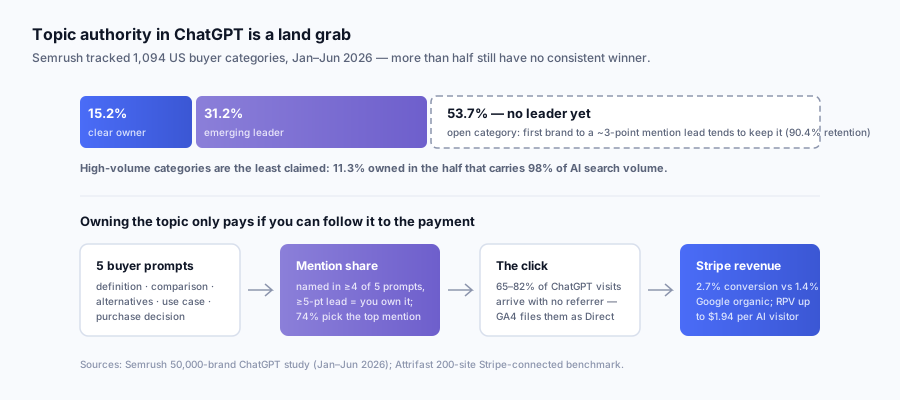
This summer, Semrush published the most useful piece of AI search research this year: a six-month, 1,094-category map of who actually owns buyer topics inside ChatGPT [1], alongside a companion study with Kevin Indig on how that authority spreads between topics [2]. Full disclosure up front, as usual: Semrush sells an AI visibility toolkit, we sell AI visibility tracking joined to revenue attribution, and this post engages with their data because it is good, large-sample, first-party data — 50,000+ brands, 220,000+ domains, 600,000+ recorded citations — that deserves more than a hot take.
The finding everyone quoted was that ownership is rare. The finding I think matters more is where it is rare, what fails to predict it, and how fast it hardens once someone gets ahead. Put those three together and the study reads less like a report and more like a starting gun: more than half of the buyer categories ChatGPT answers every day have no consistent winner, the incumbents' SEO moats are not deciding who takes them, and the winners that do emerge keep the seat 90% of the time.
This post walks through the five findings that survive scrutiny, what I'd push back on, and then the question both studies leave open — the one we work on at Attrifast: when you do win a topic, what is it worth in revenue, and how would you know?
What Semrush actually measured
The methodology matters here because "topic authority" gets used loosely. Semrush's definition is mechanical, and that is its strength [1]:
| Design choice | Detail |
|---|---|
| Scope | 1,094 US topical categories, tracked monthly, January–June 2026 |
| Sample | 50,000+ brands, 220,000+ domains, 600,000+ citations, 220,000+ URLs |
| Prompts per category | 5 buyer-shaped prompts: definition, comparison, alternatives, use case, purchasing decision |
| Primary metric | Brand mentions in the answer text — not source citations |
| "Category owner" | Highest mention share + appears in ≥4 of 5 prompts + ≥5-point lead over the runner-up |
| "Emerging leader" | Appears in ≥3 of 5 prompts without meeting the ownership bar |
| "Unsettled" | No brand appears in ≥3 of 5 prompts |
Two design choices deserve applause. First, measuring categories rather than single prompts: a brand that wins "best crm for startups" but vanishes on "hubspot alternatives" does not own the CRM topic, and buyers ask both. We made the same argument from the query side in our breakdown of ChatGPT's query fan-out — one user question becomes many internal searches, so single-prompt rank tracking measures a lottery ticket, not a position.
Second, scoring mentions over citations. Semrush's earlier shopper research found 74% of users chose the top-mentioned brand as their final pick [1][4] — people read the answer, not the footnotes. Hold that thought, because the citation-vs-mention split turns out to be one of the study's sharpest findings.
Finding 1: More than half of buyer categories have no owner
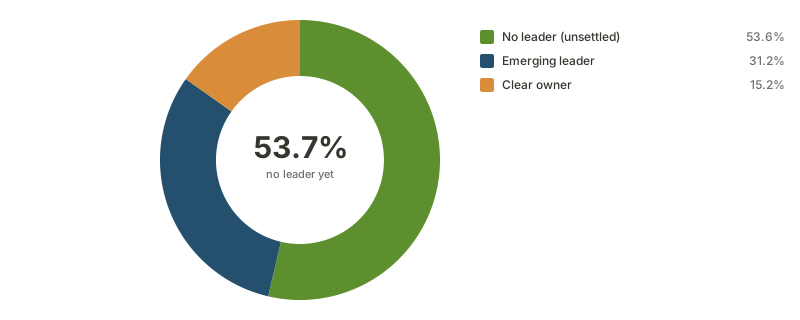
The distribution across all 1,094 categories [1]:
Source: Semrush — 'AI visibility is a topic-level game', 1,094 US categories, Jan–Jun 2026
15.2% owned. 31.2% with an emerging leader. 53.7% with nobody consistently present at all. For every category where a brand has done to ChatGPT what HubSpot did to "CRM" in Google, there are five and a half categories where the seat is empty or contested.
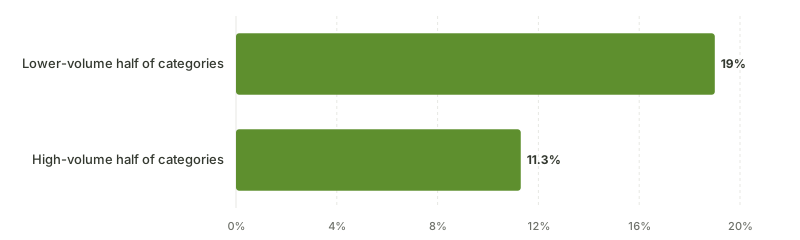
And the emptiness is worst where the demand is largest. Semrush split categories by search volume, and the pattern inverts what you'd expect from Google, where big-money head terms are the most fortified real estate on the internet:
Source: Semrush — 'AI visibility is a topic-level game', 1,094 US categories, Jan–Jun 2026
High-volume categories have owners 11.3% of the time; low-volume ones, 19%. The top half of categories also carries 98% of the AI search volume in the study [1]. Read that again from a strategy seat: the categories with almost all of the demand are the least claimed. In Google terms, it is as if the ten-figure head terms were sitting on page one with a weak #1 and no entrenched incumbents.
Why would popular topics be harder to own? The study doesn't fully adjudicate, but the mechanics are guessable: high-volume categories attract more competing brands, more content, more Reddit threads with more contradictory opinions — so the model's evidence base is noisier and its answers hedge across more names. Which means nobody clears the ≥4-of-5-prompts, ≥5-point bar. Contested is not the same as closed.
Finding 2: Your SEO moat barely transfers
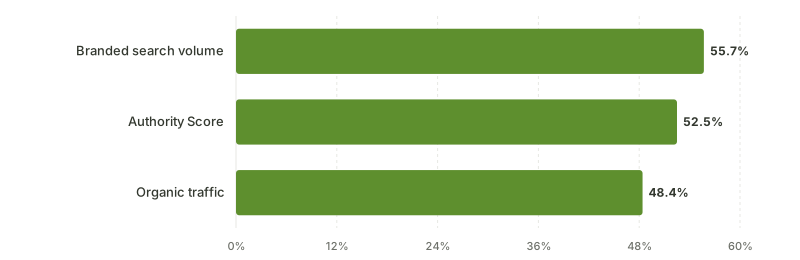
This is the finding that should reorder some 2026 roadmaps. For each owned category, Semrush compared the owner against the runner-up on three classic SEO strength metrics. If traditional SEO decided AI visibility, owners should dominate these comparisons. They don't [1][3]:
Source: Semrush — owner vs runner-up comparisons across owned categories, Jan–Jun 2026
A coin flip is 50%. Branded search volume predicted the winner 55.7% of the time, Authority Score 52.5%, and organic traffic 48.4% — the organic-traffic leader actually lost the ChatGPT category more often than they won it. Search Engine Land's summary of the study put it plainly: topic ownership is rare, and SEO alone doesn't explain it [3].
I'd add two glosses from our side of the fence. First, this is consistent with what we see in the ranking-factor evidence: domain authority correlates with the retrieval layer — whose pages get read — while the recommendation layer runs on entity-level evidence: how often, how consistently, and in what company your brand name appears across the model's sources. Those are different supply chains. Backlinks buy you retrieval; mentions buy you the answer. We wrote up the mechanics of that split in AI citations vs backlinks.
Second — and this is the part I'd frame more bluntly than Semrush chose to — a near-coin-flip is astonishing news for small brands. Fifteen years of accumulated domain authority is worth almost nothing at the mention layer. The moat your bigger competitor spent a decade digging protects the castle on a battlefield the buyers are walking away from. We have watched single-digit-headcount companies out-mention listed incumbents in their category for the cost of systematic review-site coverage and six months of consistent shipping. The window where that asymmetry holds will not stay open forever.
Finding 3: Once a lead passes ~3 points, it locks in
Here is the urgency mechanism. Semrush ran month-over-month comparisons on every category and measured how often the #1 changed [1]:
- In categories with a clear owner, the owner held the top spot in 90.4% of month-over-month comparisons.
- In emerging or unsettled categories, leadership changed hands in 1,950 of 5,470 comparisons — roughly one flip for every 2.8 measurements.
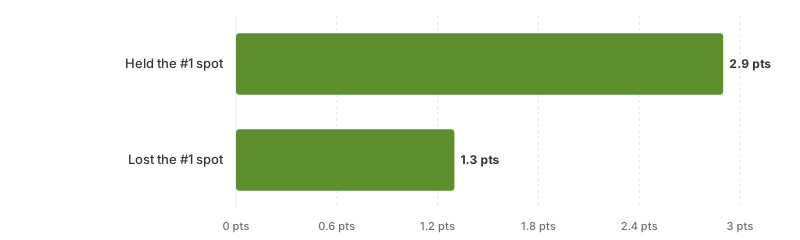
And the difference between holding and losing was margin, not magic:
Source: Semrush — month-over-month leadership comparisons, 1,094 categories, Jan–Jun 2026
Leaders who kept their position had a median lead of 2.9 points. Leaders who got flipped had a median lead of 1.3 points. Somewhere around three points of mention share, a lead stops being a rank and starts being a regime: the model keeps drawing on the same evidence base, the brand keeps appearing, the appearance generates more third-party coverage, and the loop closes.
The strategic readout is asymmetric in a way I want to spell out:
- If a competitor already owns your category with a wide lead — the honest read is that dislodging them is a multi-quarter project, and you may be better served picking an adjacent, unsettled category (Finding 5 tells you which ones qualify as adjacent).
- If your category is in the 53.7% — the first brand to reach a durable ~3-point lead gets 90%-retention physics working for them instead of against them. Semrush's own caution applies: growth doesn't equal safety, and a 1.3-point lead is a coin toss every month until you widen it.
- Either way, this is a "before it hardens" market. The study covers January to June 2026. Every month, some slice of the 53.7% graduates into the 15.2%.
Finding 4: The citation leaderboard and the mention leaderboard disagree
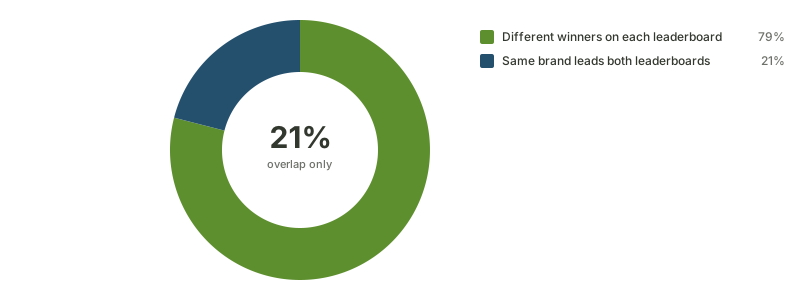
The finding with the most immediate tooling implication: across categories, the most-cited domains and the most-mentioned brands overlapped in only 21% of cases, with a slightly negative correlation of −0.229 [1].
Source: Semrush — citation-leader vs mention-leader overlap across 1,094 categories, Jan–Jun 2026
Being ChatGPT's favorite source and being ChatGPT's favorite answer are close to independent outcomes. The publishers, review sites, and aggregators that get cited are usually not the brands that get recommended — ChatGPT reads G2 and names you (or your competitor). It is entirely possible — common, even — to celebrate a citation dashboard trending up while the answer text sends every buyer to someone else. We diagnosed exactly this failure mode, from the individual founder's side, in ChatGPT cited my competitor, not me.
Combined with the 74% top-mention preference [1][4], the conclusion for measurement is uncomfortable but clear: if your AI visibility tool only reports citations, you are optimizing the leaderboard buyers don't see. You need mention share, per prompt, per category — which is precisely what share of voice tracking is for.
Finding 5: Authority spreads to nearby topics — and dies at distant ones
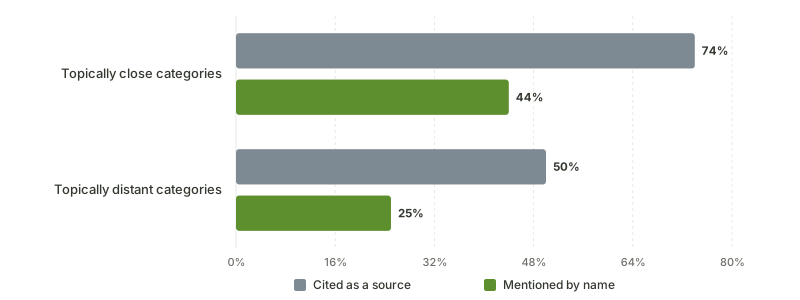
The companion study with Kevin Indig's Growth Memo [2][5] asked the expansion question: once you have authority in one category, how far does it carry? They analyzed 283,215 domain-category citation observations and 76,493 brand-mention observations, tracking 1,458 brand entities as they appeared across 45,578 category expansions [2]. The gradient is steep:
Source: Semrush × Growth Memo — 'How topical authority spreads in ChatGPT', Jan–Jun 2026
In topically close categories, expanding brands were cited as a source 74% of the time and mentioned by name 44% of the time. In distant categories, citations fell to 50% and mentions to 25% — and citations that included the brand's name were nearly 4× more common in close categories than distant ones [2]. Depth compounds; distance dilutes.
Two supporting details worth carrying into planning. Mention share only responded once a brand covered at least three of a category's five prompts — partial coverage of one prompt bought approximately nothing [2]. And industries differ: finance and real estate showed authority spreading relatively broadly, while legal and healthcare set a higher bar, where even full prompt coverage and repeat citations didn't reliably convert into mention share [2].
The composite picture from both studies: pick two or three semantically adjacent categories, cover all five prompt shapes in each, and go deep before you go wide. Semrush's recommendation and ours agree on this completely.
What neither study can tell you: the dollar value of a topic
Now the pushback — the same one I made about Otterly's survey study, and it applies to every visibility-layer research program including Semrush's: the pipeline ends at the mention. The study can tell you that you own "expense management software" in ChatGPT. It cannot tell you what owning it is worth, because the next two links in the chain — the click and the payment — happen outside the visibility tool's field of view. And the click is genuinely hard to see: 65–82% of ChatGPT-originated visits arrive with no referrer and land in GA4's Direct bucket [7], so even your own analytics won't connect the topic you won to the customers it produced.
That join is the part we build. Across the 200 Stripe-connected sites in our benchmark [6], the visitors who arrive from AI answers — the direct output of the mention share Semrush measures — behave like this:
- 34% of the traffic sitting in GA4's "Direct" bucket is actually AI-referred [6][7]. The topic you own is probably already paying you; the payment is just filed under the wrong name.
- AI-referred visitors convert at 2.7% versus 1.4% for Google organic in the same cohort [6]. The engine did the shortlisting before the click — which is exactly what the 74% top-mention preference [1] predicts.
Source: Attrifast 200-site Stripe-connected benchmark, 2025-06 to 2026-05
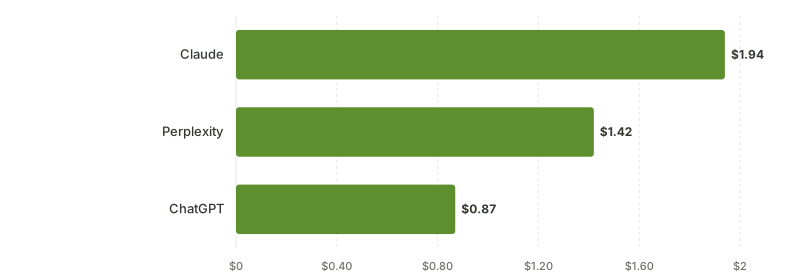
- Revenue per visitor runs from $0.87 (ChatGPT) to $1.42 (Perplexity) to $1.94 (Claude) [6] — engine order that no citation count predicts, visible only when each AI session is joined server-side to the Stripe payment it became.
So the full measurement stack for topic authority has three layers, and the studies cover exactly one of them:
| Layer | Question | Instrument | Who covers it |
|---|---|---|---|
| Mention share | "Does ChatGPT name us across our category's prompts?" | Prompt tracking, share of voice | Semrush's study; Attrifast prompt tracking |
| The click | "Did the mention produce a visit?" | AI-referrer detection (GA4 misses most of it) | First-party detection [7] |
| The payment | "Did the visit produce revenue, and how much?" | Session-to-Stripe join | Attrifast revenue attribution |
A topic-authority strategy measured only at layer one is a faith-based initiative. Measured through layer three, it becomes a budget line you can defend: this category, this mention share, this many sessions, this much MRR. That is the number that survives a board meeting.
The 90-day plan to claim an unowned category
Everything above, converted into a sequence. Nothing here requires an enterprise budget; it requires consistency across ninety days.
Weeks 1–2: Map and baseline. List the categories a buyer would place you in — not your feature names, the buyer's words. For each, write the five prompt shapes (what is X, best X, X alternatives, X for [use case], is X worth it) and run them through ChatGPT, Perplexity, Claude, and Gemini. Record who gets mentioned, who gets cited, and your own share. This is exactly what a prompt tracker automates on a schedule; the metrics that matter are mention share per category, not a single vanity "visibility score."
Weeks 2–4: Pick two or three categories and close the prompt-coverage gap. Choose unsettled or narrowly-led categories (a 1.3-point leader is a coin flip; a 5-point owner is a siege) that sit topically close to your anchor strength [2]. Then cover all five prompt shapes with genuinely deep pages — remember, mention share didn't move until brands covered at least three of five [2]. Depth in three adjacent categories beats a thin presence in ten.
Weeks 3–8: Build the third-party mention base. ChatGPT's recommendations synthesize from review sites, comparison listicles, community threads, and press — so your brand needs to exist, consistently named, in those sources. Get on the review platforms your category reads, appear in the "best X" listicles (write your own honest one too), and show up in Reddit and community answers where your category is discussed. This is the evidence base the model draws its mentions from; on-page schema alone does not close a mention gap.
Weeks 3–8, in parallel: Tighten entity signals. One canonical brand name everywhere, consistent one-line descriptions, structured data on your key pages, and a same-named presence across the profiles ChatGPT's sources index. Entity confusion splits your mention share across variants; you're handing the model reasons to hedge.
Weeks 8–12: Instrument the revenue side and re-measure. Turn on AI-referrer detection and a payment join before your mention share moves, so you can attribute the change. Weekly mention-share tracking will show whether you are approaching the ~3-point lead where positions historically hold [1]; the revenue join shows whether the category is worth widening the lead in. If it converts like our benchmark suggests — 2.7% and up to ~$1.94 per visitor [6] — you'll have the rarest thing in AI search: a topic-authority investment case written in dollars.
The scoreboard
| Finding | The number | What to do with it |
|---|---|---|
| Most categories are unowned | 53.7% no leader; 15.2% owned [1] | Treat 2026 as a land grab; pick your categories now |
| Demand is where owners aren't | 11.3% ownership in the high-volume half carrying 98% of volume [1] | Don't assume the big categories are closed — check |
| SEO doesn't decide it | 55.7% / 52.5% / 48.4% owner-led rates [1][3] | Stop waiting for domain authority to save (or doom) you |
| Leads harden fast | 90.4% retention; 2.9 vs 1.3-point median leads [1] | Get past ~3 points before someone else does |
| Citations ≠ mentions | 21% overlap, −0.229 correlation; 74% pick the top mention [1][4] | Track mention share, not just citations |
| Authority is local | 74%→50% cited, 44%→25% mentioned close vs distant [2] | Expand to adjacent categories, cover ≥3 of 5 prompts |
| The studies stop at the mention | 2.7% vs 1.4% conversion; $0.87–$1.94 RPV [6] | Join mentions → sessions → Stripe, and budget on dollars |
A short product note, since this article should not pretend its author has no interest: the layer Semrush's study measures and the layer your CFO cares about are two different layers, and Attrifast is the product that connects them — prompt-level mention tracking across ChatGPT, Perplexity, Claude, and Gemini, sitting in the same dashboard as first-party AI-session detection and a Stripe join that credits each payment to the engine and topic that produced it, at $9.99/mo. The 200-site benchmark cited throughout is our aggregated, anonymized customer data; the methodology is on the research page.
Sources
Primary sources for the claims in this article. Numbered citations in the text link to the matching entry.
- [1]AI visibility is a topic-level game: a study of 50,000 brands in ChatGPT — Semrush (2026).
- [2]How topical authority spreads (and where it doesn't) in ChatGPT — Semrush (2026).
- [3]ChatGPT topic ownership is rare, and SEO alone doesn't explain it — Search Engine Land (2026).
- [4]ChatGPT recommendations drive more brand website visits: Study — Search Engine Land (2026).
- [5]Does topical authority matter in AI Search? — Growth Memo (2026).
- [6]AI Traffic Revenue Benchmark 2026 — 200 Stripe-connected sites, per-engine RPV and conversion — Attrifast (2026).
- [7]The AI search attribution gap: GA4 says 0.1%, your signup survey says 10.6% — Attrifast (2026).
- [8]Claude Drives 10.6% of Our Signups. Google Analytics Says 0.1% — measuring AI search conversions — Otterly.ai (2026).
- [9]GEO: Generative Engine Optimization — Princeton / Georgia Tech (arXiv) (2024).
- [10]Introducing ChatGPT search — OpenAI (2024).
FAQ
What is topic authority in ChatGPT?
Topic authority in ChatGPT is the degree to which one brand is consistently named across the many different prompts a buyer asks inside a single category — the definition question, the comparison, the alternatives list, the use-case fit, and the purchase decision. Semrush's 2026 study operationalized it as mention share: a brand owns a category when it appears in at least four of five representative prompts with a lead of five percentage points or more over the runner-up. It is measured on brand mentions in the answer text, not on which domains get cited as sources, because those two leaderboards turn out to be almost unrelated.
How did Semrush measure topic ownership in ChatGPT?
Semrush tracked 1,094 US topical categories in ChatGPT monthly from January to June 2026, covering 50,000+ brands, 220,000+ domains, and 600,000+ recorded citations. Each category contained five representative buyer prompts (definition, comparison, alternatives, use case, purchasing decision). A brand counts as the category owner when it holds the highest mention share, appears in at least four of the five prompts, and leads the runner-up by at least five percentage points. Brands appearing in three or more prompts without meeting that bar are emerging leaders; categories where no brand reaches three prompts are unsettled.
Does good SEO mean ChatGPT will recommend my brand?
Not reliably. In Semrush's data, the category owner also led the runner-up on branded search volume only 55.7% of the time, on Authority Score 52.5%, and on organic traffic just 48.4% — all within a few points of a coin flip. Strong SEO correlates with the retrieval layer (getting your domain cited as a source) more than with the recommendation layer (getting your brand named in the answer). The practical implication cuts both ways: an SEO moat does not automatically transfer to ChatGPT, and a smaller brand without one is not automatically locked out.
How do I become the brand ChatGPT recommends in my category?
Work the mention layer, not just the citation layer. In practice that means five things: cover every prompt shape a buyer asks in your category (definition, comparison, alternatives, use case, purchase) rather than one hero page; go deep in two or three anchor categories before expanding, because authority transfers to topically close categories and dies at distant ones; earn third-party mentions in the sources ChatGPT synthesizes from — review sites, comparison listicles, Reddit and community threads; keep entity signals consistent (same brand name everywhere, structured data, consistent descriptions); and track your mention share weekly so you can see whether the lead you are building has passed the ~3-point threshold where positions historically lock in.
Do ChatGPT citations and brand mentions measure the same thing?
No — and this is one of the most decision-relevant findings in the study. Only 21% of categories had the same winner on the most-cited-domain leaderboard and the most-mentioned-brand leaderboard, and the correlation between the two was slightly negative (-0.229). Citations measure whose pages ChatGPT reads; mentions measure whose brand it names in the answer. Users overwhelmingly act on the answer text — Semrush's earlier shopper research found 74% chose the top-mentioned brand as their final pick. If your visibility tool only reports citations, you are optimizing the leaderboard buyers don't see.
How do I measure whether ChatGPT topic authority actually drives revenue?
You need two instruments joined together. A prompt tracker replays your category's buyer prompts on a schedule and reports mention share — that is the leading indicator. A first-party attribution layer then detects the AI-referred sessions arriving at your site and joins them to payments — that is the scoreboard. The join matters because most AI clicks arrive with no referrer (65–82% of ChatGPT visits land in GA4's Direct bucket), so a dashboard that stops at citations or traffic cannot tell you what a topic is worth. In Attrifast's 200-site benchmark, AI-referred visitors convert at 2.7% versus 1.4% for Google organic, with revenue per visitor ranging from $0.87 (ChatGPT) to $1.94 (Claude) — numbers you can only see with a session-to-Stripe join.