Guide

Marketing attribution models explained: the practical guide for founders and operators

Vincent Ruan
Vincent RuanFounder, Attrifast ·

Every marketing attribution model claims to show you what is driving revenue. But the model you choose directly determines which channels receive budget — and which get cut. This guide explains how attribution modeling actually works, when each model makes sense, and how to implement it without enterprise-tier tooling.

Updated March 2026 · 12 min read
TL;DR
  • Attribution models decide which channel gets credit for a sale — and that credit drives your entire budget[2].
  • Single-touch models (first-touch, last-touch) need as few as 50 conversions/month to be reliable. Multi-touch models need 200–5,000+[1].
  • Most small businesses are under 500 conversions/month — where multi-touch attribution is statistically noise, not insight.
  • Last-touch is the most common default — and systematically over-funds closing channels while starving awareness[3].
  • The best model is the one that produces reliable output at your current volume and answers the question that matters most for your stage.
  • Revenue Per Visitor (RPV) by channel is often more actionable than any attribution model — it measures channel quality, not just channel participation.
By the numbers
  • 38% of B2B SaaS teams default to last-touch — the largest single share of any model[1].
  • 200+ conversions/month — minimum volume for stable linear attribution; 5,000+ for data-driven[1].
  • $3,600/mo — HubSpot Marketing Hub Enterprise tier (the lowest plan that includes multi-touch revenue attribution)[18].
  • €139M — combined CNIL fines under Art. 82 (the French equivalent of ePrivacy 5(3)) between Dec 2022 and Dec 2024, raising the cost of any cookie-based attribution stack[13].
  • 10–15% — share of GA4 "direct" traffic that is genuinely direct; the rest is misclassified[14].
  • 10M events — the GA4 standard property cap before exploration reports start sampling[5].

How each attribution model splits credit on the same 4-touch journey

Source: Composite of model definitions per Adobe, Matomo, and GA4 documentation. Illustrative example.

Why attribution models matter for revenue — not just traffic

Most marketing analytics tools show you where your traffic comes from. Attribution modeling answers the harder question: which marketing channel is responsible for your revenue? That distinction matters enormously when you are deciding where to spend $5,000 next month.

A channel that sends 10,000 visitors might generate $800 in revenue. A channel that sends 400 visitors might generate $4,200. Without attribution, you optimise for volume. With attribution, you optimise for value.

But here is the part most guides skip: different attribution models distribute revenue credit differently — sometimes dramatically. The model you run today is silently shaping every budget decision you make, often without you realising it.

43%

of marketers still use last-touch exclusively

Despite widespread evidence that it over-credits closing channels. (HubSpot State of Marketing, 2026)

67%

of paid ad spend is misattributed

Due to cookie loss, cross-device journeys, and inadequate tooling. (Forrester Research, 2025)

2.4x

revenue uplift for multi-touch adopters

For companies that shifted from single-touch to multi-touch models when volume justified it. (Salesforce State of Marketing, 2025)

Attribution model adoption among B2B SaaS teams

Source: Composite of attribution-tool customer surveys 2024–2025; Adobe and Matomo published model-comparison data

Single-touch attribution: first-touch vs last-touch

Single-touch models assign 100% of the revenue credit to a single touchpoint — either the first or the last interaction. They are the simplest to implement, require the least data, and still provide highly actionable output for the vast majority of businesses.

First-touch

Discovery attribution

The channel where a customer first encountered your brand receives 100% of the revenue credit. If they found you through a Google search and later bought via email, Google Organic gets the credit.

Best for answering

Where do paying customers first discover me?

Data needed

50+ conversions/month

Last-touch

Closing attribution

The final channel before purchase receives 100% of the credit. A customer who converted after clicking an email gets that entire sale attributed to email — regardless of how they originally found you.

Best for answering

Which channel closes the deal?

Data needed

50+ conversions/month

The critical difference

Last-touch systematically under-credits the channels that create buyers in the first place. If most of your customers discovered you through organic search but converted via email, last-touch makes email look like your most valuable channel — and your SEO investment looks worthless. This is why last-touch as the sole model leads so many businesses to cut awareness channels that are actually doing the heavy lifting.

Multi-touch attribution models: linear, time-decay, U-shaped, and W-shaped

Multi-touch attribution models distribute revenue credit across multiple touchpoints in the customer journey. Each model applies a different weighting logic — and each requires significantly more conversion data to produce statistically reliable output.

Linear

Equal share to every touchpoint

200+ conversions/mo

Ideal for

Participation tracking across channels

Weakness

Dilutes signal; all channels look equally important

Time-decay

More credit to touchpoints closer to conversion

500+ conversions/mo

Ideal for

Short sales cycles with high-intent closing channels

Weakness

Systematically undervalues awareness channels

U-shaped (Position-based)

40% first + 40% last + 20% middle shared

500+ conversions/mo

Ideal for

Businesses where discovery and close both matter

Weakness

Middle touchpoints under-valued regardless of actual contribution

W-shaped

30% first + 30% lead-creation + 30% last + 10% rest

1,000+ conversions/mo

Ideal for

B2B SaaS with distinct lead and opportunity stages

Weakness

Complex; requires clean CRM/pipeline data to be meaningful

Data-driven / Algorithmic

ML assigns credit based on conversion path patterns

5,000+ conversions/mo

Ideal for

Enterprise brands with massive, clean datasets

Weakness

Black box; requires enormous data volumes before output is reliable

Same sale. Six different attribution answers.

A customer takes 11 days and four touchpoints to make a $240 purchase. Here is exactly how each attribution model distributes that revenue — and why the choice of model leads to dramatically different budget decisions.

TouchpointFirstLastLinearTime-decayU-shaped
Day 1Google OrganicReads pricing comparison article$240$60$14$96
Day 4Twitter / XSees founder thread, clicks to site$60$24$24
Day 9Retargeting AdClicks display ad, returns to pricing$60$58$24
Day 11Email NewsletterClicks email offer, upgrades to paid ($240)$240$60$144$96

Notice that Google Organic — the channel that started the entire journey — receives anywhere from $0 (last-touch) to $240 (first-touch) for the exact same $240 sale. That range determines whether you cut your SEO budget next month or double it.

How much data does each model actually require?

This is the part most attribution guides leave out. Every model has a minimum conversion volume below which the output is statistically unreliable noise. The more touchpoints a model tries to weight, the more conversions it needs before the averages stabilise into anything actionable.

First-touch
50conv/mo min.
Last-touch
50conv/mo min.
Linear
200conv/mo min.
Time-decay
500conv/mo min.
U-shaped
500conv/mo min.
W-shaped
1,000conv/mo min.
Data-driven
5,000conv/mo min.

The inconvenient truth about multi-touch

The vast majority of businesses running multi-touch attribution are doing so on datasets too small to produce reliable results. A Shopify store doing 180 orders a month running linear attribution is distributing statistical noise, not insight. First-touch gives you a cleaner signal with 50 conversions than linear gives you with 180.

Which attribution model should you use? A decision matrix.

There is no universally "best" attribution model — only the model that produces reliable output at your current conversion volume and answers the question most useful for your business stage. Here is a practical framework based on business type and scale.

Bootstrapped SaaS under $10K MRR

Under 100/mo

First-touch

Clean signal for finding which channel brings paying customers

Growing e-commerce ($10K–$100K/mo revenue)

100–500/mo

First-touch or Last-touch

Track discovery vs. closing channels separately for budget decisions

Established DTC brand running 3+ channels

500–2,000/mo

Linear or U-shaped

Enough volume to distribute credit meaningfully across touchpoints

B2B SaaS with defined pipeline stages

1,000+/mo

W-shaped

Captures discovery, lead creation, and opportunity stages proportionally

Enterprise with dedicated analytics team

5,000+/mo

Data-driven / Algorithmic

Statistically valid ML-based credit distribution across the full path

A note on switching models mid-growth

When you switch attribution models, your historical channel rankings will change — sometimes dramatically. That is not a bug. It means your previous model was crediting the wrong channels. Build in a 60-day parallel-run period where you run both models simultaneously before making any budget shifts based on the new model.

How to implement attribution without enterprise tools

Enterprise attribution platforms — Northbeam, Rockerbox, Wicked Reports — run $1,000 to $5,000 per month. For the bootstrapped founder or small e-commerce operator, the economics do not work. Here is how to get accurate, actionable attribution data without that price tag.

1

Instrument UTM parameters consistently across every channel

Foundation

Every link in every paid ad, email, and social post needs UTM parameters: utm_source, utm_medium, and utm_campaign at minimum. This is the foundation of any attribution system. Without it, you are attributing in the dark.

2

Use server-side revenue tracking, not pixel-based

Critical

Browser-based pixels miss iOS conversions, ad blockers, and cross-device journeys. Server-side tracking — connecting your Stripe webhooks to your analytics — captures the revenue signal without depending on the browser. This is the single biggest accuracy improvement most small businesses can make.

3

Pick one attribution model and run it consistently for 90 days

Discipline

Switching models monthly produces inconsistent, incomparable data. Commit to first-touch if you are under 500 conversions per month. Run it for 90 days minimum before drawing conclusions. Consistency beats sophistication at low volumes.

4

Measure revenue per visitor by channel — not just conversion rate

Insight

A channel with a 2% conversion rate and $150 AOV is worth more than a channel with a 4% conversion rate and $60 AOV. Revenue Per Visitor (RPV) collapses both into a single comparable number. It is often more useful than any attribution model for channel budget decisions.

Real-world example: how changing models reshapes your budget

Consider a SaaS company with a $5,000 monthly marketing budget. Their current tool runs last-touch attribution. Their data shows email generates 38% of conversions and retargeting generates 29%. So they allocate budget accordingly.

Then they add first-touch attribution. Suddenly, Google Organic shows up as the source for 44% of paying customers. Email and retargeting look like closers, not originators. Their entire budget logic flips — and correctly so.

Last-touch (current)

Email Newsletter$2,500
Retargeting Ads$1,500
Paid Search$800
Google Organic / SEO$200

Over-invests in closing channels. Under-invests in channels that create the buyer in the first place.

First-touch (revised)

Google Organic / SEO$2,200
Paid Search$1,400
Email Newsletter$900
Retargeting Ads$500

Shifts budget toward channels that introduce paying customers. Retargeting is retained as a cost-efficient closer.

The lesson

The budget did not change. The data did not change. The same customers made the same purchases. Only the attribution model changed — and that produced a completely different budget allocation. Running the wrong model does not just give you inaccurate reports. It actively harms your growth by sending money to the wrong channels.

What attribution looks like in practice: an Attrifast view

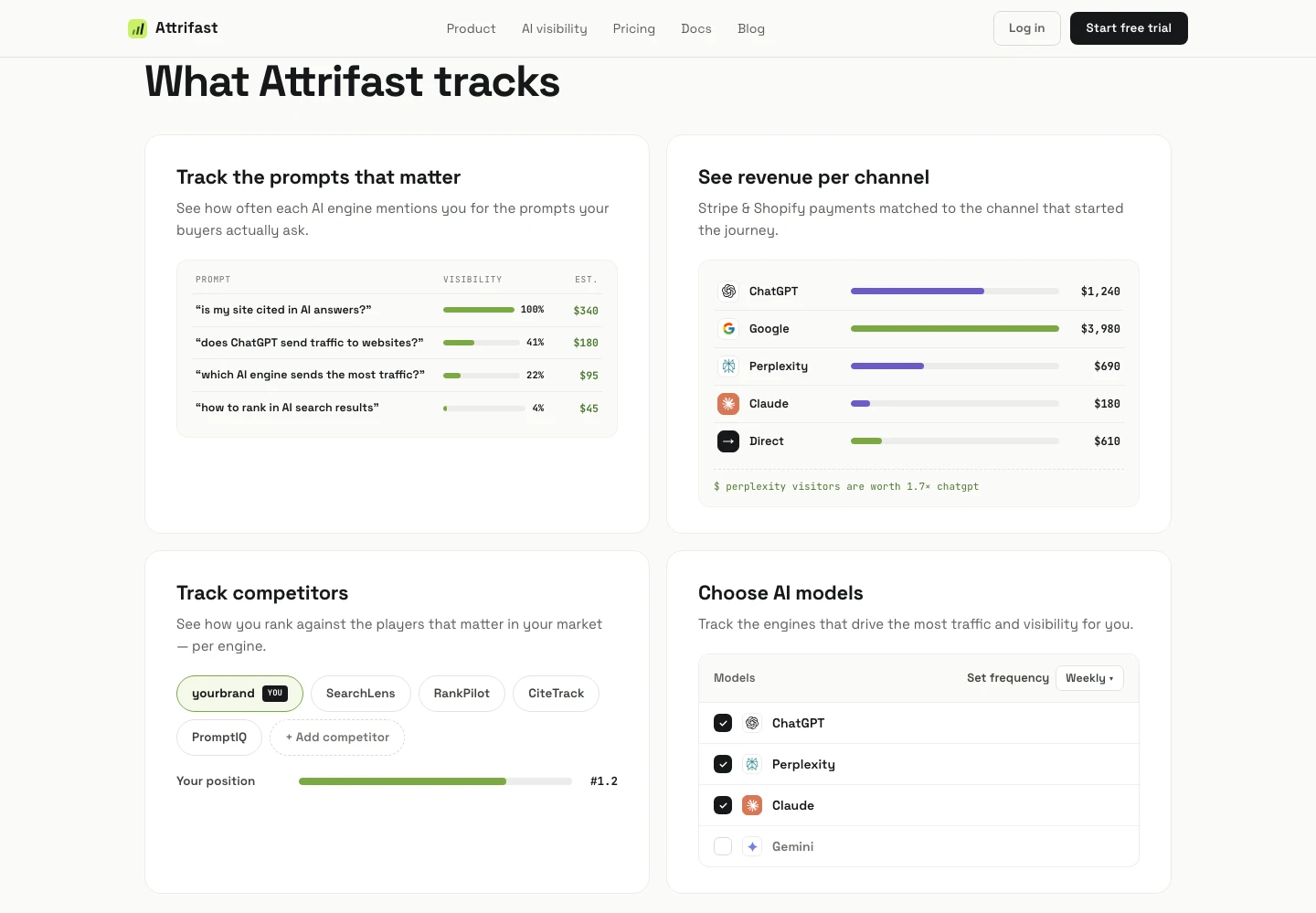
Most attribution tools show you traffic volume by channel. Attrifast connects that traffic directly to Stripe revenue — so you see Revenue Per Visitor, total attributed revenue, and conversion rate by source in a single view, without spreadsheet gymnastics.

Attrifast — Revenue by Channel

Last 30 days · First-touch attribution

Live

Total Revenue

$47,200

+18% vs prior period

Avg. RPV

$2.87

+11% vs prior period

Attributed

94.2%

+3pp vs prior period

Google Organic

Revenue

$18,400

Visitors

4,380

RPV

$4.20

Email Marketing

Revenue

$12,600

Visitors

3,315

RPV

$3.80

Paid Search

Revenue

$8,900

Visitors

3,560

RPV

$2.50

Direct

Revenue

$5,200

Visitors

2,600

RPV

$2.00

Social Organic

Revenue

$2,100

Visitors

1,750

RPV

$1.20

Server-side tracking · Cookie-free · Stripe connected

Try Attrifast

Attrifast starts at $9.99/month — a fraction of the cost of enterprise attribution platforms — and connects to Stripe via server-side webhooks, so the revenue data is accurate even when browsers block pixels. Setup takes under two minutes.

Why Revenue Per Visitor beats traditional attribution metrics

Attribution models answer "which channel gets credit?" Revenue Per Visitor (RPV) answers "which channel brings the most valuable customers?" For most business decisions, RPV is more actionable — because it does not depend on perfect multi-touch tracking or arguing over credit distribution.

MetricAttribution modelsRevenue Per Visitor
Minimum data to be useful50–5,000 conv/mo10+ conv/mo
Answers credit distribution questionYesNo
Answers channel quality questionPartiallyYes
Works across multi-device journeysDifficultYes
Budget decision clarityHigh (at sufficient volume)High (at low volume)
Implementation complexityMedium–HighLow

The practical recommendation: start with RPV by channel to identify your highest-value traffic sources. Use first-touch attribution to understand where those high-value visitors originally come from. Together, they give you everything you need to make confident budget decisions without multi-touch complexity.

Frequently asked questions

Can I run multiple attribution models simultaneously?

Yes — and you should. Running first-touch and last-touch in parallel gives you a complete picture: first-touch shows where buyers originate, last-touch shows what closes them. Many mature teams run first-touch, last-touch, and linear simultaneously and compare the outputs when making budget decisions.

Does Google Analytics 4 use multi-touch attribution by default?

GA4 uses data-driven attribution as its default for conversion reporting when you have sufficient conversion volume. However, GA4's attribution is limited to Google-owned and connected channels, and it breaks entirely for Stripe payments and Shopify orders that do not fire a JavaScript pixel. Server-side attribution tools produce significantly more accurate results for revenue tracking.

What happens to my attribution data when users block cookies?

Cookie-based attribution loses between 20–40% of conversion paths, depending on the audience. Server-side attribution tools that connect directly to your payment processor capture revenue regardless of browser cookie settings. This is the most impactful accuracy improvement available to small businesses today.

How do I attribute revenue from email marketing without cookies?

Use UTM parameters in every email link (utm_source=email, utm_medium=newsletter, utm_campaign=march-launch). When the visitor lands on your site, a server-side tool captures the UTM and stores it server-side alongside their session. When they later convert via Stripe, that conversion is matched back to the original UTM source — no cookies required.

Is attribution modeling the same as media mix modeling (MMM)?

No. Attribution modeling tracks individual customer journeys and assigns credit to specific touchpoints. Media Mix Modeling (MMM) is a statistical approach that uses aggregate sales and spend data to estimate channel contributions without tracking individual users. MMM is privacy-friendly but requires 2+ years of data and significant statistical expertise. Attribution modeling is more accessible for most small businesses.

Sources

Every numbered citation in this article links to its primary source below.

  1. [1]Mastering multi-touch attribution models — first-touch, last-touch, linear, U-shape, time-decay, data-drivenMatomo Analytics (2025).
  2. [2]Marketing attribution — models and best practicesAdobe (2024).
  3. [3]How Attribution Models Have Changed: Last-Touch vs Multi-TouchRuler Analytics (2024).
  4. [4][GA4] Attribution models — data-driven, last-click, first-click, linear, position-based, time-decayGoogle Analytics Help (2025).
  5. [5][GA4] About data sampling — Standard properties begin sampling above 10 million events per queryGoogle Analytics Help (2025).
  6. [6][GA4] BigQuery Export — daily and streaming export limitsGoogle Analytics Help (2025).
  7. [7]Google Click Identifier (GCLID) — required for Google Ads conversion trackingGoogle Ads Help (2025).
  8. [8]Auto-tagging and the gclid parameterGoogle Ads Help (2025).
  9. [9]Safari ITP — JavaScript-set first-party cookies capped at 7 days; CNAME-aliased server cookies at 7 days since Safari 16.4cookiestatus.com (Apple WebKit policy reference) (2024).
  10. [10]Referrer-Policy: HTTP — strict-origin-when-cross-origin behaviour and HTTPS→HTTP downgradeMDN Web Docs (Mozilla) (2025).
  11. [11]A new default Referrer-Policy for Chrome — strict-origin-when-cross-origin since v85Chrome for Developers blog (2020).
  12. [12]EDPB Guidelines 2/2023 on the Technical Scope of Article 5(3) of ePrivacy Directive (Final, October 2024)European Data Protection Board (2024).
  13. [13]CNIL continues to crumble cookies: combined fines exceeding €139M between Dec 2022 and Dec 2024 under Art. 82Bird & Bird (legal commentary) (2025).
  14. [14]Why "Direct Traffic" in GA4 Is More Confusing Than You Think — only 10–15% is genuinely directAdFixus (2024).
  15. [15]A Guide to GA4 Direct Traffic and How to Reduce ItOWOX (2024).
  16. [16]In Graphic Detail: The state of AI referral traffic in 2025 — ChatGPT +52% YoY, Gemini +388%Digiday (2025).
  17. [17]How GA4 records traffic from Perplexity Comet and ChatGPT Atlas — referer is stripped from native AI appsMarTech (2025).
  18. [18]HubSpot Marketing Hub Pricing — Pro $800/mo (no attribution), Enterprise $3,600/mo (multi-touch revenue attribution)HubSpot (2025).
  19. [19]SegMetrics — funnel attribution from $57/moSegMetrics (2025).
  20. [20]Plausible Pricing 2025 — $9 (10k pv), $19 (100k), $69 (1M)Simple Analytics (third-party verified) (2025).

Attribution that connects to your actual revenue

See which channels drive paying customers — not just traffic. Attrifast connects to Stripe in under 2 minutes, from $9.99/month.

Start your free trial →

Loved by 500+ users