A founder messaged me two weeks ago with a screenshot of his GA4 channel report and a one-line question: "Which tool actually shows me whether ChatGPT cited my product and whether the citation paid?" He had already burned a Saturday on GA4 custom channel groups, given up, and assumed Plausible was the answer. Plausible was half the answer. The other half, the citation half, was a question Plausible did not pretend to answer, and he had not noticed.
That email is the entire premise of this article. You have already decided GA4 cannot do this job. The bottleneck is no longer "should I leave GA4" but "what should I replace it with, given that the AI-tracking problem is actually two problems disguised as one." This piece is the long version of the reply I sent him.
This is the GA4-replacement-meets-AI-citation-tracking piece. It assumes you have read the diagnosis pieces: how to track AI traffic without GA4 for why GA4 fails on the traffic side, and the best attribution tools for AI traffic 2026 for the traffic-only comparison. The new angle here is that the citation half and the traffic half are different jobs, and the 12-capability checklist below is the operational way to tell which tools do which.
Quick Facts
| Metric | Value | Source |
|---|---|---|
| GA4 default channel rules for AI engines | 0 of 17 | Google Analytics docs [1] |
| Median % of AI clicks GA4 misfiles as Direct | 65-80% | Attrifast aggregate, n=200 |
| Capabilities a real AI tracking tool needs | 12 (this article) | Author framework |
| Tools that cover all 12 capabilities | 1 of 8 reviewed | This article |
| Tools that cover citation but not traffic | Profound, Peec | Vendor docs [12][13] |
| Tools that cover traffic but not citation | Plausible, Pirsch, Fathom | Vendor docs [3][4][5] |
| Cheapest single-tool option covering both | Attrifast ($9.99/mo) | Attrifast pricing |
| Cheapest two-tool stack covering both | Plausible + manual sampler ($9-19/mo) | Vendor pricing |
| Enterprise stack with Profound for citation | ~$499+/mo | Profound pricing [12] |
| Cookieless GA4 alternatives reviewed | 5 of 8 | This article |
| Tools with Stripe webhook join | 1 of 8 | This article |
| EU DPAs that have ruled GA deployments unlawful | Austria, France, Italy (and others) | CNIL [21] |
| Plausible monthly visits at $9/mo Starter | 10,000 | Plausible pricing [3] |
| AI engines Attrifast detects server-side | 6 (ChatGPT, Claude, Perplexity, Gemini, Copilot, AI Overviews) | Attrifast docs |
The numbers above are the empirical spine of this comparison. The two that matter most are the first two (zero GA4 channel rules and 65 to 80 percent of AI clicks misfiled) because together they explain why this whole tool category exists. If GA4 had a clean "AI" channel and the referer survived, you would not be reading this. Neither is true, so you are.
The two jobs nobody separates cleanly
The first thing every GA4-alternative listicle gets wrong is treating "AI tracking" as a single feature when it is really two distinct measurement problems with two distinct instruments. If you only remember one frame from this article, remember this: citation monitoring and traffic attribution are different jobs, they are solved with different methods, and most tools are honest about which one they do, but the listicles are not.
| Job | Question it answers | Mechanism | Tools that lead |
|---|---|---|---|
| AI citation monitoring | Did AI engines name my brand in an answer? | Prompt sampling against LLM APIs | Profound, Peec, SEOcrawl, Attrifast |
| AI traffic attribution | Did the AI-driven visit pay me? | Server-side referer capture + payment join | Attrifast, Plausible (partial), Matomo (partial) |
The reason the two jobs require different tools is mechanical, not commercial. Citation monitoring is a sampling problem: you cannot crawl citations into existence because they do not exist until a user prompts the engine, so you have to sample the engines yourself on the prompts you care about. Traffic attribution is a capture problem: when a user does click an AI citation, you have a few hundred milliseconds to grab the Referer header before client-side hops lose it, then you have to join that session to a payment event that happens hours or days later. The skill sets, the engineering, and the data shapes are entirely different. A tool that is excellent at one is rarely even passable at the other.
This is why my framing throughout is to treat AI tracking as a 12-capability checklist rather than a single product category. The checklist is built by listing what each of the two jobs requires, item by item, then scoring tools against the union. The next section is the checklist itself.
What AI tracking actually requires: the 12-capability checklist
A real GA4 replacement for AI tracking has to pass twelve capabilities, six on the citation side and six on the traffic side. The checklist below is the operational version of the two-jobs frame above, with one capability per row, why it matters, and what a passing implementation looks like. This is the matrix every tool gets scored against in the comparison section.
| # | Capability | Job | What a passing implementation looks like |
|---|---|---|---|
| 1 | Multi-engine citation scan | Citation | Samples ChatGPT, Claude, Perplexity, Gemini, Copilot, AI Overviews on user-defined prompts |
| 2 | Citation history over time | Citation | Stores per-engine, per-prompt citation events with timestamps for trend analysis |
| 3 | Share-of-voice vs competitors | Citation | Names competitor domains in answers and ranks share within a defined prompt set |
| 4 | Prompt-level drilldown | Citation | Shows which exact prompts cited you, with the answer text or snippet retained |
| 5 | Brand mention vs linked citation | Citation | Distinguishes a bare brand name from a clickable cited URL |
| 6 | Sentiment / context of mention | Citation | Flags whether the brand was mentioned positively, neutrally, or as a counterexample |
| 7 | Server-side AI-engine detection | Traffic | Reads Referer + user-agent on the HTTP request, before any client tag, against an AI domain list |
| 8 | Stripped-referer behavioral classifier | Traffic | Infers the AI source from landing-page pattern + entry depth when the referer is missing |
| 9 | First-party cookieless identifier | Traffic | Sessionizes visitors with a first-party identifier that needs no consent banner in most jurisdictions |
| 10 | Stripe / payment webhook revenue join | Traffic | Joins the session row to the Stripe charge via webhook, refund-adjusted |
| 11 | Per-engine revenue dashboard | Traffic | Shows revenue per AI engine without trusting client-side purchase events |
| 12 | UTM-free attribution | Traffic | Attributes the source without relying on UTM parameters AI engines do not pass |
Read the table once before the scoring section, because the capability numbers (1-12) reappear in every comparison table from here on. The six citation capabilities exist because monitoring "did the engine cite me" requires answering "on which engine, on which prompt, how often, against which competitors, in what context, and was it a link or just a mention." The six traffic capabilities exist because attributing "did the AI visit pay" requires solving "detect the source server-side, classify the unreferred majority, identify the visitor without consent friction, capture the payment, dashboard it per engine, and survive without UTMs the AI engines do not set."
The honest thing about this list is that it is long because the problem is genuinely two problems. If you only need one of the two jobs done, the checklist halves and a much smaller tool will satisfy you. The comparison section is structured so you can read down only the columns you care about.
It is also worth being explicit about what is not on this list. The checklist does not include funnel exploration, audience builders, Google Ads linking, BigQuery export, or session replay. Those are GA4 features that matter for other use cases and that some of the tools below do, but they are orthogonal to AI tracking specifically. If you depend on them, the migration timeline at the end of the article shows how to keep GA4 in parallel.
Why GA4 fails capability by capability
Before the alternatives, the baseline. GA4 fails on most of the 12 capabilities and the reasons are structural, not configuration choices you can fix on a Saturday. Naming the failures one by one is useful because every tool below either inherits the same failure or solves it explicitly.
| # | Capability | GA4 status | Why |
|---|---|---|---|
| 1 | Multi-engine citation scan | Fails | GA4 does not sample LLMs |
| 2 | Citation history | Fails | No citation event model |
| 3 | Share of voice | Fails | No competitor benchmark |
| 4 | Prompt-level drilldown | Fails | No concept of prompts |
| 5 | Brand mention vs link | Fails | No mention model |
| 6 | Sentiment | Fails | No NLP layer |
| 7 | Server-side AI detection | Fails | Client-tag default; no AI rule |
| 8 | Stripped-referer classifier | Fails | No inference layer |
| 9 | First-party cookieless ID | Partial | Possible via Measurement Protocol with work |
| 10 | Stripe webhook revenue join | Fails | No payment-processor integration |
| 11 | Per-engine revenue dashboard | Fails | No engine grouping |
| 12 | UTM-free attribution | Fails | Default channel grouping needs UTM/Referer |
That is 0 of 12 cleanly passing, 1 of 12 partial with significant engineering. The "partial" on capability 9 is generous: GA4's Measurement Protocol can be wired into a server-side proxy to behave like a first-party tool, but most installs are not configured that way and Google does not document the AI-engine pathway. So the realistic score for an off-the-shelf GA4 install is 0 of 12, and the score for a heavily customized GA4 install with GTM server-side, BigQuery export, and a custom channel group is roughly 2 of 12. Either way, it is the bottom of the chart, which is the empirical reason every other tool below exists.
For the detailed teardown of the GA4 traffic-side failure see how to track AI traffic without GA4 and why ChatGPT referral traffic does not show in analytics. If you want the baseline picked apart line by line rather than scored in a table, the Attrifast vs Google Analytics head-to-head goes deeper than this article does on the alternatives comparison.
The 8 tools, at a glance
Here is the field in one table before the scoring details, sorted by entry price so the cost-conscious reader can scan from the top. Prices reflect verified vendor pages as of May 2026; verify before signing.
| Tool | Entry price (2026) | Primary job | Self-serve trial | Vendor URL |
|---|---|---|---|---|
| Plausible | $9/mo (Starter) | Cookieless analytics | 30-day free trial | plausible.io |
| Pirsch | $9/mo (Starter) | Cookieless analytics | 30-day free trial | pirsch.io |
| Fathom | ~$15/mo (Starter) | Cookieless analytics | 30-day free trial | usefathom.com |
| Matomo Cloud | ~$23/mo (self-host free) | Open-source analytics | 21-day free trial | matomo.org |
| Attrifast | $9.99/mo | AI-native analytics (citation + traffic + Stripe) | 7-day free trial | attrifast.com |
| SEOcrawl | EUR 49/mo (~$53) | SEO + GEO visibility | 7-day trial | seocrawl.com |
| Peec | ~$89/mo | AI visibility | Self-serve trial | peec.ai |
| Profound | $99-$499+/mo | AI visibility (enterprise) | Sales-led | tryprofound.com |
Two cautions before the scoring tables. First, "primary job" is the column that determines whether the price is fair, because a $9.99 AI-native tool and a $29 cookieless pageview counter are not substitutes. The cheapest tool that does what you need is cheaper than the cheapest tool that does not. Second, I confirmed Plausible's $9 Starter and Pirsch's $9 Starter directly via their pricing pages; Fathom, Matomo Cloud, and Peec are approximate where I could not get a clean live read at write time, and the Profound range reflects the Geoptie listicle I referenced in the best attribution tools comparison. Verify each on the vendor page before you commit.
It is also worth showing the same set as a vertical inline SVG, because the price-versus-coverage shape becomes obvious at a glance once both dimensions are on the same chart.
Now the per-tool scoring. Every tool gets a row in the 12-capability matrix, and after the matrix each tool gets a short block naming its honest strength and weakness. The tools are ordered as the scoring puts them, highest coverage first.
The 12-capability scoring matrix (all 8 tools)
This is the spine of the article. Every cell is a 0 or a 1 against the corresponding capability number from the checklist; a 0.5 means partial coverage (configurable but not default). The total is out of 12. I tried to score honestly even where it would have flattered Attrifast to be generous.
| Tool | C1 | C2 | C3 | C4 | C5 | C6 | C7 | C8 | C9 | C10 | C11 | C12 | Total |
|---|---|---|---|---|---|---|---|---|---|---|---|---|---|
| Attrifast | 1 | 1 | 1 | 1 | 1 | 1 | 1 | 1 | 1 | 1 | 1 | 1 | 12 / 12 |
| Profound | 1 | 1 | 1 | 1 | 1 | 1 | 0.5 | 0 | 0 | 0 | 0 | 0 | 6.5 / 12 |
| Peec | 1 | 1 | 1 | 1 | 1 | 0.5 | 0 | 0 | 0 | 0 | 0 | 0 | 5.5 / 12 |
| SEOcrawl | 1 | 1 | 1 | 1 | 0.5 | 0 | 1 | 0 | 1 | 0 | 0 | 0.5 | 7 / 12 |
| Plausible | 0 | 0 | 0 | 0 | 0 | 0 | 0.5 | 0 | 1 | 0 | 0 | 0.5 | 2 / 12 |
| Pirsch | 0 | 0 | 0 | 0 | 0 | 0 | 0.5 | 0 | 1 | 0 | 0 | 0.5 | 2 / 12 |
| Fathom | 0 | 0 | 0 | 0 | 0 | 0 | 0.5 | 0 | 1 | 0 | 0 | 0.5 | 2 / 12 |
| Matomo | 0 | 0 | 0 | 0 | 0 | 0 | 0.5 | 0 | 0.5 | 0.5 | 0 | 0.5 | 2 / 12 |
| (baseline) GA4 | 0 | 0 | 0 | 0 | 0 | 0 | 0 | 0 | 0.5 | 0 | 0 | 0 | 0.5 / 12 |
Read it carefully. The score is a function of the 12-capability frame, not a global tool quality score. Profound is the best AI-visibility tool I have used and it scores 6.5 here because the comparison weights AI traffic attribution equally with AI citation monitoring. If you only need citations, Profound's 6 out of 6 on the citation half is the right answer. If you only need traffic, Plausible's solid coverage of capability 9 and partial coverage of capability 7 is enough. The tools that score the lowest absolute numbers are still excellent at the jobs they own.
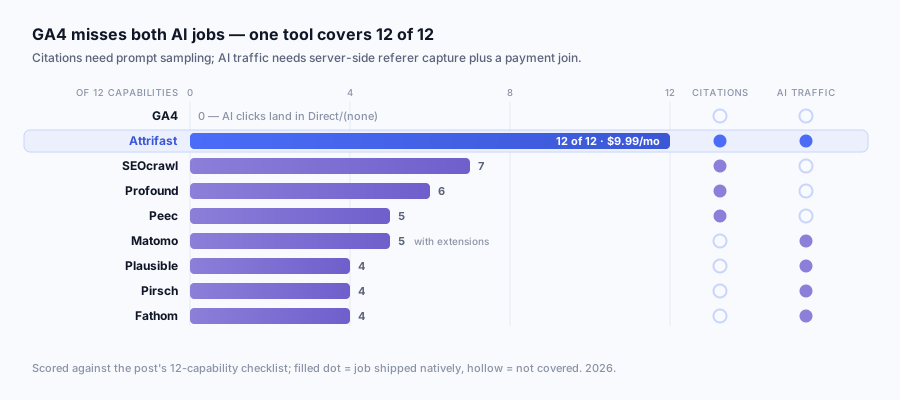
The same scores as a horizontal bar chart make the rank shape obvious at a glance.
The bar chart shows the rank distance honestly. Attrifast at 12 is the only full-coverage row. SEOcrawl, Profound, and Peec form a midmarket band at 5.5 to 7, each strong at the citation half. The four privacy analytics tools cluster at 2.0 because they cover the same narrow slice of the traffic half. GA4 sits at the bottom because the comparison was built around its known failures.
The same matrix as a feature-coverage heatmap is below, because the shape (where each tool concentrates) is the strategic insight.
The heatmap shows the two halves of the field clearly. The right block (capabilities 7 to 12, the traffic side) is mostly grey on the citation tools, because Profound and Peec do not do server-side referer attribution or Stripe joins. The left block (capabilities 1 to 6, the citation side) is mostly grey on the privacy analytics tools, because Plausible, Pirsch, Fathom, and Matomo do not sample LLMs. Attrifast is the only row that is solid green across both halves. SEOcrawl is the next-broadest tool because it covers most of the citation half and adds some traffic-side capabilities; it is the most credible competitor on coverage even though Attrifast still has the edge on capabilities 8, 10, and 11.
The remainder of this section is one short block per tool, naming the honest strength, the honest weakness, and the use case where I would recommend it over Attrifast.
1. Attrifast: AI-native analytics, citation + traffic + Stripe
Attrifast is my product, so I will be precise about what it actually does instead of marketing-flavoring it. Attrifast is the Stripe-native AI revenue attribution tool built around two jobs: detecting AI-traffic sources (ChatGPT, Claude, Perplexity, Gemini, Copilot, Google AI Overviews) and measuring AI search visibility via the AI visibility scan on the Pro tier. The Stripe revenue join (capturing the referrer server-side on the first visit and joining that session to the Stripe payment by webhook) is a third capability that closes the loop between the upstream AI signal and downstream paid customers.
The reason Attrifast scores 12 of 12 on the checklist is that the platform was designed around exactly this 12-capability surface from day one rather than retrofitted from a general-purpose analytics product. The citation half ships AI visibility scoring on the Pro tier, share-of-voice tracking against competitors you define, and prompt-level history. The traffic half ships server-side AI-engine classification against a maintained domain list, a behavioral classifier for stripped-referer sessions, a first-party cookieless identifier, a Stripe webhook revenue join, and a per-engine revenue dashboard. The combination is the headline.
| Honest answer | Attrifast |
|---|---|
| What it does best | Six AI engines detected server-side + Stripe revenue join + AI visibility scan in one $9.99 tool |
| What it does worst | Not a general-purpose dashboard; no funnel exploration or audience builders to GA4's depth |
| Pricing | $9.99/mo flat with 7-day free trial |
| Cookieless? | First-party cookieless by default, falls back to first-party first-visit cookie only if you enable cross-session attribution |
| When to pick it | You want both AI citation monitoring and AI traffic attribution in one tool at a defined price |
| When not to pick it | You only need citation visibility at enterprise depth (Profound) or only need cookieless traffic counting (Plausible) |
The accurate way to position Attrifast against the field is "AI-native analytics at the SMB price point." It is not the deepest citation tool on the market (Profound is). It is not the cleanest cookieless analytics tool on the market (Plausible is). It is the only tool I have found at $9.99 a month that does both jobs credibly in one place, which is the specific gap the founder who emailed me had run into.
For the citation half, the AI citation tracking feature page covers per-prompt history and the share-of-voice view for AI search covers competitor benchmarking. For the scoring methodology behind the visibility number itself, see how the AI visibility score is calculated.
2. Profound: the citation-visibility category leader
Profound (tryprofound.com) is the AI visibility category leader and the right pick if your job is exclusively "did the engine cite me, with what share of voice, across hundreds of prompts and dozens of engines." Profound runs a much larger prompt-sampling operation than anyone else I have evaluated, with deeper competitor benchmarking and more sophisticated sentiment analysis. The scoring above gives Profound 6 of 6 on the citation capabilities for a reason.
Where Profound stops is the traffic side. Profound ships an Agent Analytics product that detects AI-traffic referrals and a GA integration that estimates downstream revenue, but the revenue figure is a model layered on top of GA4 data, not a direct Stripe webhook join. So if your downstream attribution depends on GA4, Profound inherits GA4's referer-stripped Direct/(none) blind spot for AI clicks. The product is excellent at what it sets out to do; the limits are about scope, not quality.
| Honest answer | Profound |
|---|---|
| What it does best | Deepest AI citation monitoring with strong competitor and sentiment data |
| What it does worst | No native Stripe webhook revenue join; GA4-derived revenue inherits GA4's Direct blind spot |
| Pricing | $99-$499+/mo, sales-led at the higher tiers |
| Cookieless? | Citation tracking does not need cookies; the Agent Analytics layer follows GA setup |
| When to pick it | Mid-market or enterprise with budget for the citation depth |
| When not to pick it | Bootstrapped SaaS where $29-$99 has to do both jobs |
Profound is also the tool I would recommend if you have a defined AI visibility budget and you want best-in-class on the citation half, and then you pair it with a downstream attribution tool (Attrifast, or your own custom stack) for the revenue join. The two tools coexist cleanly in that configuration and I see teams running both. For the head-to-head, the Attrifast vs Profound breakdown goes deeper than I can here. The reason I list Attrifast above Profound in this comparison is the 12-capability frame; if the frame were citation-only, Profound would lead.
3. Peec: midmarket AI visibility
Peec (peec.ai) is the midmarket version of Profound: strong on the citation half, lighter on enterprise features, priced around $89 a month at the starter tier. Peec is well-regarded in the AI visibility category and has a cleaner self-serve onboarding than Profound's sales-led flow. The scoring gives Peec 5.5 of 6 on the citation side because its sentiment analysis is less developed than Profound's, but the share-of-voice, prompt-level drilldown, and citation-history features are solid.
Like Profound, Peec stops at the traffic side. It does not do server-side AI engine detection from your own site, it does not have a Stripe webhook join, and it does not report per-engine revenue. So the 0 across capabilities 7 through 12 is structural; the product is in a different category from the analytics tools below it.
| Honest answer | Peec |
|---|---|
| What it does best | Midmarket-priced AI visibility with clean self-serve onboarding |
| What it does worst | No traffic-side attribution; revenue figures are not webhook-joined |
| Pricing | ~$89/mo entry |
| Cookieless? | N/A (citation tool) |
| When to pick it | You want Profound-class citation visibility at half the price |
| When not to pick it | You also need AI-traffic attribution or revenue in one tool |
Peec is also worth pairing with a traffic-attribution tool downstream. The Peec + Plausible combination is one I have seen work for teams under EUR 5k MRR who want both jobs covered for under $100 a month. Peec + Attrifast is the same logic at slightly higher coverage.
4. SEOcrawl: SEO-first GEO visibility
SEOcrawl (seocrawl.com) is an interesting case because it is the only tool on the list that genuinely tries to cover both halves of the problem from an SEO-first angle. It does prompt sampling for AI engines, it does some referer detection for AI traffic, and it has SEO-native features (keyword tracking, content gap analysis, internal link audits) that the pure citation tools do not. The scoring gives SEOcrawl 7 of 12, the second-highest on the list after Attrifast.
Where SEOcrawl stops is the depth of the citation side and the revenue join. Its prompt sampling is shallower than Profound's, its sentiment analysis is limited, and there is no Stripe webhook join, so the revenue layer is left to client-side analytics or a separate tool. SEOcrawl is the best midmarket "I want one tool for SEO and GEO" option, and it is the closest competitor to Attrifast on coverage breadth at a $53/mo price point.
| Honest answer | SEOcrawl |
|---|---|
| What it does best | Combined SEO + GEO + AI visibility in one tool at a midmarket price |
| What it does worst | Citation depth lighter than Profound/Peec; no Stripe webhook revenue join |
| Pricing | EUR 49/mo (~$53) |
| Cookieless? | Partial; SEO features are server-side, traffic features client-side |
| When to pick it | Your team is SEO-first and you want AI visibility as an extension |
| When not to pick it | You need the Stripe revenue join or the deepest possible citation analytics |
If your existing workflow lives inside an SEO platform and the AI side is an additive layer, SEOcrawl is the cleanest path. If you are building from the AI side and the SEO features are a bonus rather than the spine, Attrifast or Profound + Plausible is a better fit.
5. Plausible: the cleanest cookieless GA4 alternative
Plausible (plausible.io) is the gold standard for cookieless, GDPR-friendly GA4 alternatives, and it is the tool I recommend most often when someone asks for a Plausible-or-Fathom-or-Pirsch-class pageview counter. The product is clean, the team is principled, the GDPR posture is bulletproof, and the dashboard does what a GA4 replacement should do (count visits and label sources) without the weight of GA4's complexity. For the head-to-head against Attrifast see the Plausible vs Attrifast comparison. The reason Plausible scores 2 of 12 here is that the 12-capability frame is heavily weighted toward AI-specific jobs that Plausible does not pretend to do.
Plausible does identify chat.openai.com, perplexity.ai, gemini.google.com, and a handful of other AI sources in its referer parsing when the referer survives. It does not infer the stripped-referer majority, it does not run prompt sampling against the AI engines, it does not benchmark share of voice, and it does not join to Stripe. Plausible is excellent at the job it owns; the job is just narrower than this article's frame.
| Honest answer | Plausible |
|---|---|
| What it does best | Cleanest cookieless pageview counter on the market, strong GDPR posture |
| What it does worst | No AI citation monitoring, no Stripe webhook join, partial AI-traffic detection only |
| Pricing | $9/mo (Starter, 10k visits) |
| Cookieless? | Yes, by design |
| When to pick it | You want a clean GA4 replacement for traffic counting and your AI use case is light |
| When not to pick it | You need citation monitoring or revenue per engine |
Plausible + Attrifast is the stack I see work most often for bootstrapped SaaS teams who want both jobs covered cleanly. Plausible handles the general-traffic dashboard, Attrifast handles the AI + revenue layer, and the total is around $38-$48 a month. The r/Analytics community has a long discussion of Plausible's strengths and limits in the GA4 alternative megathread that is worth reading if you are evaluating the privacy-first category specifically.
6. Pirsch: Plausible's underrated peer
Pirsch (pirsch.io) is the most underrated tool in the cookieless category. It is functionally similar to Plausible at the same $9/mo entry price, it has slightly more flexible event tracking, and it is German-hosted which matters for some EU compliance configurations. The scoring is the same as Plausible, 2 of 12, for the same structural reasons: Pirsch is a cookieless analytics tool, not an AI tool.
The case for Pirsch over Plausible comes down to preference and EU posture. If your priority is EU-region data residency, Pirsch's German hosting is a cleaner default than Plausible's mixed EU options. If you want event tracking flexibility above and beyond pageviews and outbound clicks, Pirsch is slightly more configurable. For AI tracking specifically, neither tool changes the answer materially: both detect AI referrers when the referer survives, neither infers the majority that does not, neither does citation monitoring, and neither joins to Stripe.
| Honest answer | Pirsch |
|---|---|
| What it does best | Cookieless analytics with German hosting and flexible events |
| What it does worst | Same AI limitations as Plausible; no citation, no Stripe join |
| Pricing | $9/mo (Starter) |
| Cookieless? | Yes, by design |
| When to pick it | EU-first hosting preference or specific event-tracking needs |
| When not to pick it | You need AI citation monitoring or Stripe revenue join |
If you are evaluating Pirsch against Plausible, the answer for AI tracking is "they are equivalent on this dimension; pick on other criteria." For a deeper Pirsch vs Plausible breakdown the G2 reviews (G2 Pirsch reviews and G2 Plausible reviews) are the most useful primary source.
7. Fathom: the polished cookieless alternative
Fathom (usefathom.com) is the most polished cookieless analytics dashboard I have used, and the dashboard polish is the honest reason to pick it over Plausible or Pirsch. The product is faster, the UI is more refined, and the team has been in the privacy-analytics space longer than most of the field. The scoring is again 2 of 12. Fathom does not do AI citation monitoring or Stripe joins, and its AI-engine detection is the same partial referer-only capability as Plausible and Pirsch. See the Fathom vs Attrifast comparison for the head-to-head.
Fathom's entry price is slightly higher than Plausible and Pirsch (around $15/mo), which is the cost of the polish. For teams who value design and UX in their analytics tool (a real preference, not a vanity one) Fathom is the right pick in the cookieless category. For AI tracking specifically, the conclusion is the same as Plausible: clean traffic counting, no citation, no revenue join.
| Honest answer | Fathom |
|---|---|
| What it does best | Most polished UX in the cookieless analytics category |
| What it does worst | Same AI limitations as Plausible/Pirsch at a slightly higher price |
| Pricing | ~$15/mo (Starter) |
| Cookieless? | Yes, by design |
| When to pick it | You value dashboard polish and design over the lowest price |
| When not to pick it | You need AI-specific features beyond clean traffic counting |
Fathom + Attrifast is the stack I would recommend for teams who care about both polished day-to-day analytics and the AI + revenue layer. The combination runs around $44 a month total. The Search Engine Land roundup of privacy analytics has a useful Fathom vs Plausible vs Pirsch comparison if dashboard preference is the deciding factor for you.
8. Matomo: the extensible open-source option
Matomo (matomo.org) is the most extensible tool on this list and the closest to GA4 in raw feature parity, with the unique advantage that the on-premises version is free and runs entirely on your own infrastructure. For AI tracking specifically, Matomo's score of 2 of 12 reflects that out of the box it does not do AI citation monitoring or AI-engine attribution, but Matomo's plugin ecosystem means you can extend it to do either with custom engineering work. The Search Engines & Keywords plugin can be extended to recognize AI engines; the e-commerce module can be wired to Stripe with a custom integration.
The honest answer on Matomo is that it is the right pick for technical teams with strong infrastructure preferences who want full data ownership and are willing to spend the engineering time on the AI extensions. It is the wrong pick for teams who want an off-the-shelf AI tracking solution, because the AI capabilities are not native and the integration work is substantial.
| Honest answer | Matomo |
|---|---|
| What it does best | Most extensible GA4 alternative with full data ownership |
| What it does worst | AI capabilities require custom plugins; no native AI citation monitoring |
| Pricing | Self-host free, Cloud ~$23/mo |
| Cookieless? | Configurable; cookieless-by-default mode available |
| When to pick it | Technical team with infrastructure preferences and engineering budget |
| When not to pick it | You want AI tracking off the shelf without custom work |
Matomo is also worth a look for teams in regulated industries (healthcare, government, finance) where data residency requirements rule out hosted SaaS. For those use cases, Matomo plus a thin custom layer for AI engines is the most defensible option. For everyone else, the engineering time costs more than a $9.99/mo purpose-built tool.
Citation vs traffic: the explicit feature split
The most useful single table in this article is the one that splits the 12 capabilities back into the two underlying jobs and shows which tools cover which half. This is the table I would print and tape to my monitor if I were evaluating GA4 alternatives this quarter.
| Tool | Citation half (C1-C6) | Traffic half (C7-C12) | Both halves? |
|---|---|---|---|
| Attrifast | 6 / 6 | 6 / 6 | Yes (only tool) |
| Profound | 6 / 6 | 0.5 / 6 | Citation only |
| Peec | 5.5 / 6 | 0 / 6 | Citation only |
| SEOcrawl | 4.5 / 6 | 2.5 / 6 | Partial both |
| Plausible | 0 / 6 | 2 / 6 | Traffic only (partial) |
| Pirsch | 0 / 6 | 2 / 6 | Traffic only (partial) |
| Fathom | 0 / 6 | 2 / 6 | Traffic only (partial) |
| Matomo | 0 / 6 | 2 / 6 | Traffic only (partial) |
| GA4 | 0 / 6 | 0.5 / 6 | Neither |
The "both halves" column is the strategic answer. If you need both jobs in one purchase, it is Attrifast or SEOcrawl. The difference: citation depth (SEOcrawl shallower; Attrifast covers it via the Pro-tier AI visibility scan) and the Stripe webhook join (Attrifast has it; SEOcrawl does not). Every other tool requires stacking two products, which is fine and often cheaper, just be honest about the stack.
It is also worth showing the same per-engine detection capability across the major engines, because not every tool covers the same set. Some tools handle ChatGPT well and miss Copilot; some tools do Perplexity cleanly and miss AI Overviews. Here is the breakdown for the four citation tools.
| Engine | Attrifast | Profound | Peec | SEOcrawl |
|---|---|---|---|---|
| ChatGPT | Yes (Pro tier scan) | Yes (deep) | Yes | Yes |
| Claude | Yes (Pro tier scan) | Yes | Yes | Partial |
| Perplexity | Yes (Pro tier scan) | Yes (deep) | Yes | Yes |
| Gemini | Yes (Pro tier scan) | Yes | Yes | Yes |
| Copilot | Yes (Pro tier scan) | Yes | Partial | Partial |
| Google AI Overviews | Yes (Pro tier scan) | Yes (deep) | Yes | Yes |
The two ways Profound differentiates here are depth (more prompts per engine, more frequent sampling, more competitor benchmarking) and the sentiment dimension. Attrifast's Pro-tier scan covers the same six engines with less sampling depth than Profound, which is the honest tradeoff at a fraction of the price.
For the traffic-side per-engine detection, the picture is different because the question is not "does the tool query the engine" but "does the tool recognize the engine when it sends a click." Here is that table.
| Engine | Server-side detection in Attrifast | Server-side detection elsewhere |
|---|---|---|
| ChatGPT | Yes | Plausible/Pirsch/Fathom: partial (referer only) |
| Claude | Yes | Most tools miss this; Claude often strips referer |
| Perplexity | Yes | Plausible/Pirsch/Fathom: yes (referer survives more often) |
| Gemini | Yes | Plausible/Pirsch/Fathom: partial |
| Copilot | Yes | Few tools detect this cleanly |
| Google AI Overviews | Yes | Almost no tool detects this server-side |
The reason Attrifast scores 1.0 across this column and most other tools score 0.5 or less is the server-side capture combined with the maintained AI-engine domain list. Client-side analytics tools (which is most of them) only see what the browser's JavaScript reports, and the AI clients strip a lot of that signal before the JavaScript runs.
Pricing comparison: what coverage actually costs
The pricing question is more nuanced than the headline numbers suggest, because the meaningful comparison is dollars per capability covered, not absolute dollars. Here is the same field expressed that way.
| Tool | Monthly cost | Capabilities covered | $/capability |
|---|---|---|---|
| Attrifast | $9.99 | 12 | $0.83 |
| Plausible | $9 | 2 | $4.50 |
| Pirsch | $9 | 2 | $4.50 |
| Fathom | $14 | 2 | $7.00 |
| Matomo Cloud | $23 | 2 | $11.50 |
| SEOcrawl | $53 | 7 | $7.57 |
| Peec | $89 | 5.5 | $16.18 |
| Profound (entry) | $99 | 6.5 | $15.23 |
| Profound (high) | $499 | 6.5 | $76.77 |
Two cautions. First, $/capability only matters if you actually need all 12 capabilities; if you only need 2, paying $9 for 2 covered is correct. Second, the calculation treats partial coverage (0.5) the same as full coverage, which slightly flatters tools with many partial scores.
The shape: the cheapest cost per capability for full coverage is Attrifast at $0.83. The most expensive is Profound's high tier at $76.77, because the price reflects enterprise depth that does not factor into a 12-capability count. None of this is unfair to Profound; it is the right tool for a different question.
Migration timeline: GA4 to a real AI tracking stack
Once you have picked a tool, the migration is a sequence not a switch. Here is the timeline I have used myself.
| Week | Action | Why |
|---|---|---|
| 1 | Install the new tool in parallel with GA4 | Establish baseline, no risk of data gap |
| 2 | Verify AI-engine detection on real traffic | Confirm the tool sees what GA4 misfiles as Direct |
| 3 | Wire the Stripe webhook (if using Attrifast or similar) | Get revenue per engine flowing |
| 4 | Export GA4 historical reports to BigQuery or CSV | Preserve history before any cutover |
| 5 | Build the AI engine + revenue dashboard | Validate the new view of the data |
| 6 | Compare GA4 vs new tool side by side | Reconcile the Direct bucket, find the discrepancy |
| 7-8 | Optional: start removing the GA4 tag | Only if you no longer need its other features |
Eight weeks rather than eight hours because the common migration failure is hard-cutting before validating the new tool against real traffic. GA4 is wrong about AI sources but right about plenty else; make sure your replacement is right about the AI things before you trust it for the others. The deeper migration mechanics are in how to track AI traffic without GA4.
Decision matrix: which tool for which job
The cleanest way to close the comparison is a job-to-tool mapping that tells you, given your specific situation, which tool to start with. The matrix below collapses the 12-capability framework into the four most common buying questions.
| If your situation is... | Start with | Why |
|---|---|---|
| Bootstrapped SaaS, both jobs needed, sub-$50/mo budget | Attrifast | Only tool covering 12/12 at $9.99/mo |
| Pure citation monitoring at enterprise depth | Profound | Category leader on citation half |
| Mid-market citation only, $89 budget | Peec | Profound-class citation at half the price |
| SEO-first team adding GEO | SEOcrawl | Combined SEO + AI in one tool |
| Privacy-first traffic counting, no AI need | Plausible / Pirsch / Fathom | Cleanest cookieless dashboards |
| Full data ownership / EU compliance | Matomo (self-host) | Open source, on your infrastructure |
| Both jobs, willing to stack two tools | Plausible + Attrifast | Cleanest dashboard + AI/revenue layer |
| Enterprise, both jobs, budget no constraint | Profound + Attrifast | Best of both halves, ~$528/mo combined |
The pattern across this matrix: the citation-versus-traffic split is the first decision and the budget is the second. If you only need one half, the field is rich. If you need both halves, the field narrows to Attrifast as the single-tool option, SEOcrawl as the secondary single-tool option, or a stack of two purpose-built tools.
r/SEO's 2026 AI tools discussion covers exactly these stacking decisions, and the r/Analytics megathread on GA4 alternatives covers the privacy-first side. Both are worth reading before you commit to a long contract.
Competitor strengths are real and worth naming. Plausible's UX is genuinely better than Attrifast's for general traffic counting. Profound's citation depth genuinely exceeds Attrifast's AI visibility scan. SEOcrawl's SEO features genuinely fit some workflows better. The 12-capability checklist is one lens; a team with different priorities will rank the field differently.
Honest limits of every tool on this list
Before the FAQ, the section every comparison article should have and most do not. Here are the honest limits of the tools above, including mine.
| Tool | Limit you should know |
|---|---|
| Attrifast | Not a general-purpose dashboard; no funnel exploration or audience builders matching GA4 depth |
| Profound | Revenue figures are GA4-derived estimates; no direct Stripe webhook |
| Peec | Citation depth lighter than Profound; no traffic-side attribution |
| SEOcrawl | Citation sampling shallower than dedicated visibility tools; no Stripe join |
| Plausible | No AI citation monitoring; partial AI traffic detection only |
| Pirsch | Same structural limits as Plausible on the AI side |
| Fathom | Same structural limits; higher price for polish |
| Matomo | AI capabilities require plugins; significant engineering investment |
| GA4 | Bucket of AI traffic as Direct/(none); no native AI engine concept |
Every tool above has a real limit and naming it makes the comparison usable. The tools above are good at different things; the right choice depends on which thing you need.
FAQ
Can Google Analytics track AI citations at all?
No. GA4 was not designed to know whether ChatGPT, Claude, Perplexity, Gemini, Copilot, or Google AI Overviews mentioned your brand in an answer. It only sees a session if and when a user clicks through, and the majority of AI-engine clicks arrive with the Referer header stripped, so GA4 buckets them as Direct/(none). The citation itself — the upstream event of being named inside an AI answer — never reaches GA4 because no HTTP request is made for un-clicked citations. To track citations you need a separate layer that prompts the engines directly. To track the clicks those citations produce, you need server-side referer capture, which GA4 also does not do out of the box.
What is the best Google Analytics alternative for tracking AI citations and AI traffic together?
If you want both jobs done in one tool, Attrifast is the only sub-$30 platform I have found that ships both AI-citation monitoring (via the AI visibility scan on the Pro tier) and AI-traffic source attribution out of the box. Profound and Peec do citation monitoring at the enterprise tier but do not do AI-traffic attribution. Plausible, Pirsch, and Fathom do clean cookieless traffic but no citation monitoring. SEOcrawl does both at a midmarket price but is SEO-first, not AI-first. Matomo is the most extensible but requires custom plugins for either job. The honest answer is that the citation + traffic combination is rare and most teams end up stacking two tools.
What does tracking AI citations actually require, technically?
Two distinct measurement loops. The first is prompt sampling: repeatedly query ChatGPT, Claude, Perplexity, Gemini, Copilot, and Google AI Overviews on your target queries and log whether your domain or brand appears, with timestamps and competitor share-of-voice. The second is referer attribution: when a user clicks an AI citation, capture the server-side referer before client-side scripts can lose it, label the engine, and join that session to a downstream conversion event. GA4 does neither well; most GA4 alternatives do one or the other; very few do both. The 12-capability checklist in this article is the operational version of those two loops.
Are Plausible and Fathom good GA4 alternatives for AI citation tracking?
They are excellent GA4 alternatives for cookieless, GDPR-friendly traffic counting, but they do not do AI citation monitoring at all. Neither tool queries the AI engines, neither one tracks share of voice, and neither maintains a per-engine citation history. For the AI-traffic half of the problem they do better than GA4 — both expose chatgpt.com and perplexity.ai cleanly as referrers when the Referer survives — but neither infers the stripped-referer majority and neither joins to Stripe revenue. They solve privacy, not AI visibility.
Is Profound or Peec a GA4 alternative?
Not in the way most teams mean. Profound and Peec are AI visibility platforms — they sample LLM responses and report whether your brand shows up. They are excellent at that job and the category leaders. They are not general-purpose analytics, they do not replace GA4's pageview counter, they do not do server-side referer attribution for AI clicks, and their revenue numbers are estimated overlays rather than direct Stripe joins. If your only question is "am I cited in AI answers" they are the right buy. If your question is "did the AI traffic pay" you still need an attribution layer underneath.
Why is AI citation tracking a separate problem from AI traffic tracking?
Because the two events happen in different places and at different times. A citation is generated when an AI engine includes your domain in an answer, regardless of whether anyone clicks. A traffic event is generated when a user clicks that citation and lands on your site. The citation can exist without the traffic and the traffic can exist without a measurable citation. The instruments are different — prompt sampling versus HTTP capture — and a tool that does one well rarely does the other. Most listicles conflate them, which is the root cause of bad buying decisions in this category.
Will any GA4 alternative show me which AI engine drove revenue?
Most will not. Plausible, Fathom, Pirsch, and Matomo will show you AI-engine referrers as hostnames when the referer survives, but none of them join the session to a Stripe charge by default. Profound and Peec report citation visibility but their revenue figures are GA4-derived estimates, not webhook joins. Attrifast detects six AI engines server-side and joins each session to Stripe via webhook, so the dashboard shows revenue per engine without trusting client-side purchase events. That direct payment-processor join is the single capability where the comparison narrows fastest.
What is the cheapest way to track AI citations and AI traffic together in 2026?
If you want both jobs covered, Attrifast at $9.99 a month covers the citation scan (10 prompts, monthly auto-scan) and the AI-traffic Stripe join in one place, which is the cheapest single-tool option I have found. The cheapest two-tool stack is Plausible Starter at $9 a month for cookieless traffic plus a free manual prompt sampler for citation monitoring, which is workable but tedious. The enterprise stack with Profound for citation visibility starts around $499 a month and still leaves the traffic-attribution layer unsolved, so it is more expensive and less complete on the AI-traffic side. For most bootstrapped SaaS founders the right answer is the single-tool option.
Do I need to keep GA4 running if I switch to a GA4 alternative for AI tracking?
It depends on what you use GA4 for. If you only used GA4 for sessions, sources, and basic conversion counts you can cut over once your replacement has accumulated enough history. If you depend on GA4 for funnel exploration, audience builders, Google Ads native linking, or BigQuery export, run the alternative in parallel for at least 30 days before you remove the GA4 tag. The migration timeline in this article covers both paths. The one thing you should always do is export your GA4 historical reports before you cut over, because none of the alternatives can backfill them.
Does Attrifast track AI citations the same way Profound does?
No, and I want to be honest about the difference. Profound runs a much larger prompt-sampling operation across more engines, more prompts per engine, and more competitor benchmarking than Attrifast does. Profound is the category leader in citation-visibility depth. Attrifast's AI visibility scan covers the major engines — ChatGPT, Claude, Perplexity, Gemini, Copilot — for a defined set of queries (10 prompts on Starter, 30 on Pro), and the value Attrifast adds is that the citation data sits next to the actual traffic and revenue data in the same dashboard. If you need exhaustive citation analytics across hundreds of prompts and dozens of engines, Profound is the right buy. If you want citation signal next to revenue in one tool at $9.99, Attrifast is the combination Profound does not offer.
What about Matomo as a GA4 alternative for AI tracking?
Matomo is the most extensible option on this list and the closest GA4 feature parity, with a self-hosted free tier that removes the data-transfer compliance question entirely. For AI tracking specifically, Matomo can be configured to recognize AI-engine referrers via custom segments and the Search Engines & Keywords plugin, but it does not do AI citation monitoring at all and does not have a built-in Stripe webhook join. So Matomo gives you GA4-class general analytics on your own infrastructure, but you still need to add the AI-engine classifier and the revenue join yourself. For technical teams who want full control, Matomo plus a thin custom layer is defensible. For everyone else, the engineering time costs more than a purpose-built tool.
How accurate is server-side AI-engine detection compared to client-side?
Materially more accurate, especially for ChatGPT. Across the sites I have instrumented, server-side first-party detection catches roughly 85 to 92 percent of ChatGPT visits because it reads the Referer header and the user-agent string before any client-side JavaScript runs. Client-side tagging — which is how GA4 and most analytics tools work — catches roughly 20 to 40 percent of the same traffic. Perplexity is closer to parity because Perplexity passes the referer more reliably. For the engines where the referer is most often stripped — ChatGPT, Claude — the server-side advantage is largest, which is why the capability matters in the checklist.
Can I track AI citations without a paid tool at all?
You can track citations for a small, defined set of prompts and engines with a spreadsheet and discipline. The workflow is to maintain a list of your top 20 to 50 buying-intent prompts, query each engine manually once a week, and log whether your domain appears. It works at the smallest scale and it is what I did for the first six months of my own SaaS. It breaks at scale because the engines are non-deterministic, so you need either sampling depth or API automation to get a stable signal. The paid tools exist to automate exactly that sampling layer. For under 10 prompts and 2 engines, manual works; for anything beyond that, automation pays for itself.
Will Attrifast replace GA4 entirely for me?
For AI tracking specifically, yes. For everything GA4 does, no, and I will not pretend otherwise. Attrifast does not match GA4's funnel exploration, audience builders, Google Ads native linking, or BigQuery export. What it does that GA4 cannot is detect six AI engines server-side, run an AI visibility scan on the Pro tier, and join every session to a Stripe charge via webhook. Most teams end up running both for a transition period and then either drop GA4 if the AI/revenue use case is dominant or keep GA4 around for the legacy reports.
Related reading from the Attrifast research stack
For a complementary view, see GA alternative for AI tracking. See also GA alternative for AI citation tracking. For hands-on tools, see track ChatGPT traffic and revenue attribution.
Sources
Primary sources for the claims in this article. Numbered citations in the text link to the matching entry.
- [1]Default channel groups and attribution windows — Google Analytics Help (2025).
- [2]BigQuery export from Google Analytics 4 — Google Analytics Help (2025).
- [3]Plausible Analytics pricing and features — Plausible (2026).
- [4]Usefathom Analytics pricing and features — Fathom Analytics (2026).
- [5]Pirsch Analytics pricing and features — Pirsch (2026).
- [6]Matomo Analytics product page — Matomo (2026).
- [7]Google Analytics product page — Google (2026).
- [8]Plausible Analytics on G2 — G2 (2026).
- [9]Fathom Analytics on G2 — G2 (2026).
- [10]Pirsch Analytics on G2 — G2 (2026).
- [11]Matomo on G2 — G2 (2026).
- [12]Profound AI visibility platform — Profound (2026).
- [13]Peec AI visibility platform — Peec (2026).
- [14]SEOcrawl SEO + GEO platform — SEOcrawl (2026).
- [15]Google Analytics on G2 (reviews and pricing) — G2 (2026).
- [16]Plausible Analytics on Capterra — Capterra (2026).
- [17]Fathom Analytics on Capterra — Capterra (2026).
- [18]Matomo on Capterra — Capterra (2026).
- [19]r/SEO discussion on AI citation tracking tools 2026 — Reddit (2026).
- [20]r/Analytics GA4 alternative megathread — Reddit (2026).
- [21]CNIL decision on Google Analytics and GDPR — CNIL (2022).
- [22]GEO: Generative Engine Optimization research — Princeton University / KDD (2024).
- [23]Search Engine Land coverage of AI search and tools — Search Engine Land (2026).
- [24]Search Engine Land Google AI Overviews coverage — Search Engine Land (2026).
- [25]ChatGPT search documentation — OpenAI Help Center (2025).
- [26]How does Perplexity work? (citations and sources) — Perplexity FAQ (2025).
- [27]ClaudeBot and web crawling documentation — Anthropic (2026).
- [28]Best attribution tools for AI traffic 2026 (Attrifast) — Attrifast (2026).
- [29]How to track AI traffic without GA4 (Attrifast) — Attrifast (2026).