I am not the one who writes the tracking code. Vincent does that. I ran the store side, which mostly meant that when a number looked wrong, I was the one who had to decide whether to keep spending against it.
This is about a number that looked right for two years and was not.
The report I stopped opening
We started selling online in 2021. Shopify store, a small catalogue, the two of us doing everything. For the first year I opened the traffic report every Monday morning the way you check the weather — not really deciding anything with it, just wanting to know.
The report was consistent. One channel sat at the top of it almost every week. So that channel got the attention: more content aimed at it, more of the small budget we had, more of my time. That is what you are supposed to do with your best channel.
It was not our best channel. It was our biggest channel. Those turned out to be different things, and nothing in the report I was reading could have told me the difference, because the report only had one column that mattered and it was counting the wrong thing.
Here is the arithmetic I was missing. A channel's contribution to the business is:
visitors × what each visitor is worth
A sessions report gives you the first number, in large friendly type, sorted descending. It gives you nothing at all about the second. And the second number is not a rounding factor — across the channels on a single store it swings by more than four to one:
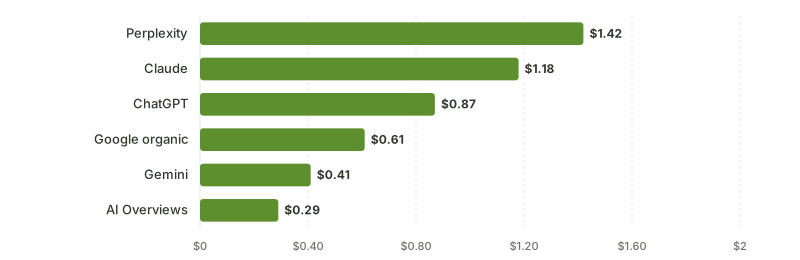
Source: Attrifast 200-site benchmark, cohort-blended RPV across Stripe-connected sites, June 2025 to May 2026
Read the top and bottom of that chart against each other. A Perplexity visitor is worth roughly five times an AI Overviews visitor and better than two times a Google organic one. Which means a thousand visits from the top of that list beats two thousand from the middle of it — and a traffic report, sorted by volume, would have shown you exactly the opposite conclusion in exactly the same week.
I want to be precise about what those figures are, because I have opinions about people who are not. They are cohort medians from 200 Stripe-connected sites, not our store's numbers, and your own will differ — that is rather the point of measuring instead of reading a benchmark. What travels between stores is not the values. It is the spread.
Volume rank and revenue rank are different lists
The failure mode is easy to state and weirdly hard to see from inside a dashboard: the channel ranking you act on depends entirely on which column you sorted by, and almost every default report sorts by the one that does not pay you.
| What you sort by | What it actually ranks | What it hides |
|---|---|---|
| Sessions | How much attention a channel produced | Whether that attention buys anything |
| Conversion rate | How often a visit becomes an order | Order size — a channel can convert well on cheap baskets |
| Total revenue | Contribution, correctly | Nothing, but it rewards whatever channel is simply largest |
| Revenue per visitor | What one more visit is worth | Volume — so read it alongside the count, never alone |
Revenue per visitor is the one I check first, because it is the only one that answers the question I actually have on a Monday, which is where should the next hour go. Total revenue tells you where you are. RPV tells you where the margin is on the next visit you can earn. And because it already has volume in the denominator, a channel cannot climb it by being big.
The catch is that RPV is genuinely hard to compute honestly, and that is not a tooling failure so much as a plumbing one. You need the channel that started the session and the payment that session eventually produced, joined to each other. Analytics owns the first. Your payment processor owns the second. Nothing in the default setup introduces them.
We tried the plugins first. Shopify has plenty and most of them track something real — sessions, pageviews, an add-to-cart. None of them closed that join, so none of them could answer the question, and after a while I stopped opening those too.
Then a channel appeared that none of the reports had a row for
Sometime in 2024 the Direct row started growing and I could not explain it. Direct is supposed to be people typing your name in. Ours was climbing faster than anything that could plausibly be brand recall for a store our size.
Direct is where analytics puts a visit when it cannot see where the visit came from. Increasingly that means an AI assistant. When someone clicks a link inside a ChatGPT or Perplexity answer, the referrer is frequently stripped in transit — Clickport measured roughly two-thirds of ChatGPT clicks arriving with a referrer intact and the other third with nothing at all. The ones with nothing land in Direct.
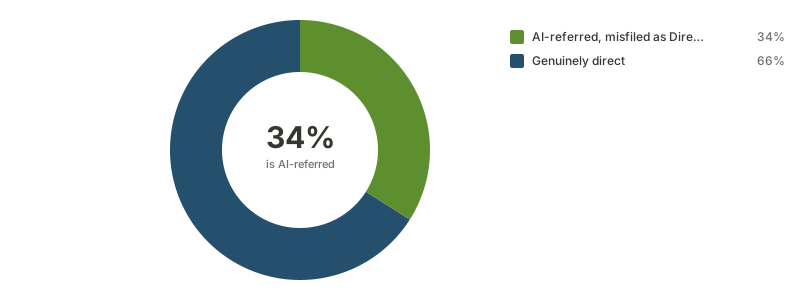
Source: Attrifast 200-site benchmark — median share of GA4 Direct sessions traceable to an AI engine once a first-party visitor ID is carried through checkout
A third. And it is worse than mislabelling, which I would have shrugged at. Google's own attribution documentation says that every attribution model excludes direct visits from receiving credit unless the entire path is direct. So the traffic was not merely filed under the wrong name — it was structurally ineligible to be credited for anything, and the credit went to whatever paid or organic touch happened to sit in the path instead.
Which is how you end up doing what I did: pouring effort into the channel the report was praising, while the channel quietly producing better customers had no row of its own.
Better, not just different:
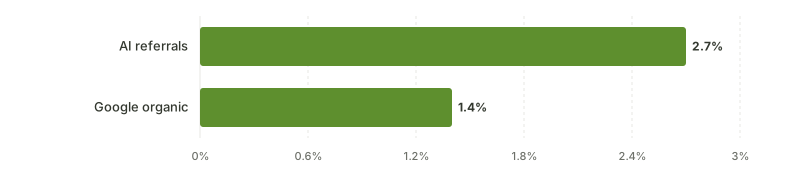
Source: Attrifast 200-site benchmark, B2B SaaS segment, AI-referred sessions vs Google organic on the same sites
Someone who arrives after asking an assistant a question has already had their comparison shopping done for them. They show up further along. That is the intuition, and the conversion numbers are consistent with it — though I would call it consistent rather than proven, since we cannot randomise who gets recommended by an AI engine and who does not.
The part that happens before anyone visits
The thing that took me longest to internalise is that by the time a buyer reaches your store from an AI answer, the important step already happened, somewhere you were not watching.
The assistant did not look at your store when the question was asked. It quoted pages a crawler fetched earlier — days or weeks earlier — and whether your pages were fetched and readable at that moment decided whether you could be named at all.

That log is the closest thing AI search has to an index-status check, and it is the one report on this list a store owner can act on the same afternoon. If GPTBot has never fetched your comparison page, nothing on that page can be quoted back to a buyer, and no amount of writing more of them changes it. OpenAI, Anthropic and Perplexity all publish their crawler names and how to control them, so this is verifiable rather than mystical.
I check it for a narrow reason: it tells me whether a page I just published exists as far as an assistant is concerned. Everything else about AI visibility is slower and noisier. This part is binary.
What I actually open on Monday
The routine is three things and takes about ten minutes. I am including it because when I was looking for this, every article I found was written for someone with an analytics team.
1. Revenue per visitor, by channel, last 30 days. Not sessions. Sorted by RPV, with the visit count beside it so I can see which of the good ones are big enough to matter. A channel with excellent RPV and forty visits is a note to self, not a plan.
2. The Direct row. Specifically, how much of it resolved to a named source this month versus last. Direct going up is not news. Direct going up while nothing else explains it is the signal that a channel exists which your reports have no name for yet.
3. Which pages the crawlers fetched. Mostly to confirm that anything I published in the last fortnight has been read by something. When it has not, that is a technical problem with a technical fix, and it is better to find it in week one than in month three.
That is the whole thing. There is no fourth report. I spent two years with more dashboards than that and less idea what was happening.
What I would tell 2021 me
Not "use better software" — although obviously I would say that now, having spent three years building some. The thing I would actually say is smaller and it is about which question to ask.
I was asking where is the traffic coming from, which has an easy answer that every tool will give you for free. The question I needed was which channel produced the money in the bank account, which has a harder answer, requires joining two systems nobody joins by default, and is the only one of the two that should ever change what you do on Monday.
The channels change. In 2021 the argument was social versus search. Now a meaningful share of the discovery happens inside an assistant before anyone arrives, and the reports have not caught up — same shape of problem, new row missing from the table. The habit of asking which question you are answering is the part that transfers.
If you want the technical version of this, Vincent wrote up how the payment join actually works and what is really inside your Direct bucket. If you are on Shopify specifically, the Shopify revenue attribution guide is the setup, and the apps comparison covers what else is out there, including where we are not the right answer.
FAQ
Why is my biggest traffic channel not my biggest revenue channel?
Because sessions and revenue are different quantities and nothing forces them to rank the same way. Contribution is visitors multiplied by what a visitor is worth, and the second term varies by more than 4× across channels on one store — $1.42 for a Perplexity visitor against $0.61 for a Google organic one in the 200-site benchmark. A traffic report ranks by the first number only.
What is revenue per visitor and how do I calculate it?
Revenue a channel produced, divided by the visitors it sent in the same window. It is the one channel metric volume cannot flatter, because volume is already in the denominator. Computing it honestly needs the session's channel joined to the payment it produced — divide settled revenue rather than checkout order value, so refunds and failed cards are netted out before you act on it.
Where does AI traffic show up in Shopify or GA4 reports?
Three places, rarely labelled. Referrals with an intact referrer land in Referral. Google's AI Assistants channel catches some engines but excludes AI Overviews and AI Mode, which count as Organic Search, and does not list Perplexity. Everything arriving with no referrer lands in Direct — a median 34% of which is AI-referred in the benchmark.
Do I need to replace Google Analytics to see revenue by channel?
No, and it is usually the wrong move. GA4 is good at behaviour, funnels and Ads audiences, and it is free. It just cannot name the channel behind a specific settled payment, because its unit is an event with a value parameter rather than a charge. Add the payment-joined layer beside it and leave the rest alone.
Why do AI crawlers matter to a store owner?
Because the answer a buyer reads was assembled from pages a crawler fetched earlier. If GPTBot never fetched your comparison page, nothing on it can be quoted. It is the one part of AI visibility that is binary and checkable the same day.
The bottom line
Our biggest channel was not our best one, and the report I was reading every Monday for two years was structurally incapable of telling me so. It was not a bad report. It was answering a question I had stopped needing an answer to.
Sort by what a visit is worth, not by how many of them there were. Then go and find out what is inside your Direct row, because on a median store a third of it is a channel you have not named yet — and by the benchmark, it is a channel whose visitors are worth more than the one currently getting all your attention.
It takes one script tag and one Stripe key to see it on your own store: start the 7-day trial, nothing due today.
References
- Attrifast — AI traffic revenue benchmark 2026: 200 Stripe-connected sites, per-engine RPV and conversion rate
- Google Analytics Help — Default channel group, including the AI Assistants channel and AI Overviews classification
- Google Analytics Help — Get started with attribution: direct visits are excluded from receiving credit
- Clickport — Why ChatGPT traffic shows as Direct in GA4, April 2026
- OpenAI — Overview of OpenAI's crawlers and how to control them
- Stripe — Checkout Session object: client_reference_id and metadata as attribution join keys