Most people who search for "how did you hear about us" want one of two things: a list of options to paste into a form, or a reason to believe the answers. This article gives you both, in that order of usefulness, and it is honest about the second one. The question is cheap and it sees things no tracking script can. It is also answered badly by a lot of people. The published data lets us put numbers on both halves.
I build attribution software, so I have an obvious bias toward tracked data. I am still recommending a survey, because a tracked source and a stated source fail in different directions, and the places where they disagree are where the interesting customers are.
The short version, in one table
| Decision | What to do | Why |
|---|---|---|
| Wording | "Where did you first hear about us?" | "First" pushes people past yesterday's Google search toward the original source |
| Field type | 6–9 options in random order, plus "Other" with a text box | A fixed order inflates whatever is listed first[6]; pure free text gets one-word answers |
| Required? | Optional on lead forms; fine to require after a purchase or signup is already complete | A required field before the conversion costs you conversions; after it, it costs nothing |
| Placement | Immediately after the conversion: order-confirmation page, first onboarding screen, or the demo form itself | On-page surveys at that moment get several times the response of an email sent later[8] |
| AI option | "ChatGPT / AI assistant" as its own line | Tracking files most of these visits under Direct or Organic Search[5] |
| What to do with it | Store the answer next to the tracked source and the revenue, then read the disagreements | Each method is wrong alone in a different way |
What tracking cannot see, measured
A tracking script records the last hop: the page or app a browser was on before it reached you. It cannot record a podcast, a conversation, a Slack thread, or a recommendation that someone read and then typed your name into a search bar. All of those arrive as "Google" or as nothing.
Refine Labs ran the comparison for a year across 620 conversions where the buyer declared intent. Their attribution software and their form field were describing the same customers[1].
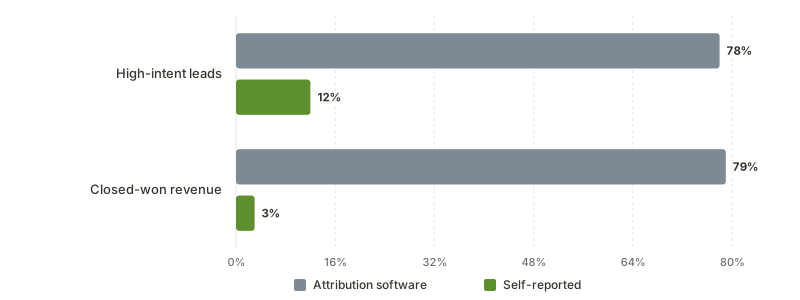
Source: Refine Labs, The Attribution Mirage (2024) — 620 declared-intent conversions over 12 months
Software said web search produced 78% of high-intent leads and 79% of closed-won revenue. Customers said 12% and 3%. In the same study, customers credited what Refine Labs calls dark social (podcasts, communities, word of mouth, social feeds) with 85% of those leads and 98% of that revenue, and the software had no row for podcasts or communities at all[1].
Read that carefully, because it is easy to over-learn. It does not say search is worthless. It says search was the last step for people who had already decided, and the software gave the last step all the credit. One B2B company with a heavy podcast presence is also not your company. The direction of the error is the transferable part.
The mechanism is not mysterious. GA4 assigns the Direct channel when it has no source information for a session[10], and a large share of apps send none. SparkToro tested this with roughly 100 people clicking unique links from 11 networks, 1,113 visits in all[2].
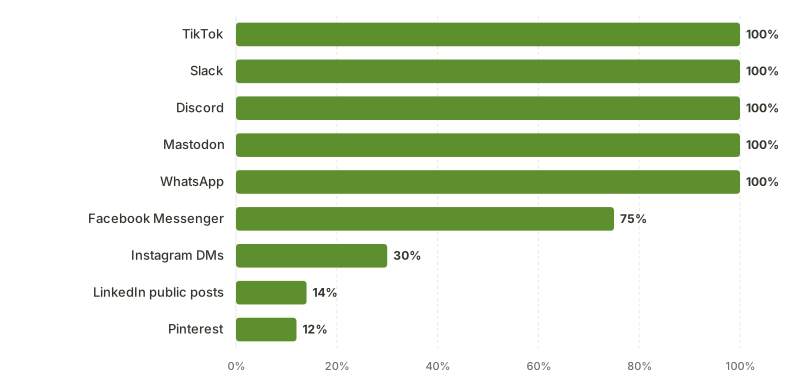
Source: SparkToro with Really Good Data (2023) — 1,113 visits, 11 networks, 16 unique URLs
Every visit from TikTok, Slack, Discord, Mastodon and WhatsApp was recorded as Direct. So was 75% of Facebook Messenger traffic[2]. If your customers talk about you in group chats, your analytics has been describing them as people who typed your URL from memory. There is a longer explanation of that bucket in what direct traffic actually is.
Why this question matters again in 2026: AI assistants
For a few years the survey was a B2B-marketing talking point. Then a new source appeared that behaves like dark social at scale. Someone asks ChatGPT or Claude for a recommendation, reads your name in the answer, and opens a new tab. No link was clicked, so no referrer exists, so the visit is Direct, or it is "Organic Search" because they searched your brand name to find the site.
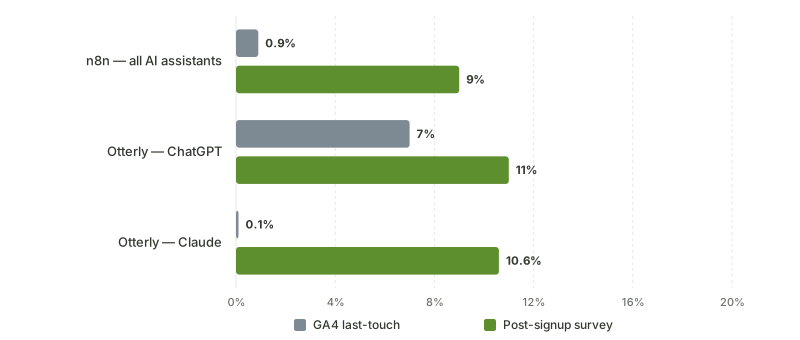
Three companies have now published both numbers for the same signups.
Source: Graphite × n8n (June 2026); Otterly.ai (July 2026) — same signups, two measurement methods
n8n's GA4 credited AI assistants with roughly 0.9% of conversions. Its post-conversion survey, which asks "how did you hear about us?", put the figure near 9%. Graphite, which ran the analysis, concluded that about 90% of those conversions never clicked a citation link[3]. Otterly's pair is stranger: GA4 gave Claude 0.1% of signups and the survey gave it 10.6%, while ChatGPT moved only from 7% to 11%[4]. Otterly's explanation is interface design. ChatGPT hyperlinks the brands it mentions, and Claude at the time mostly did not, so a Claude recommendation could only ever arrive as a typed URL[4].
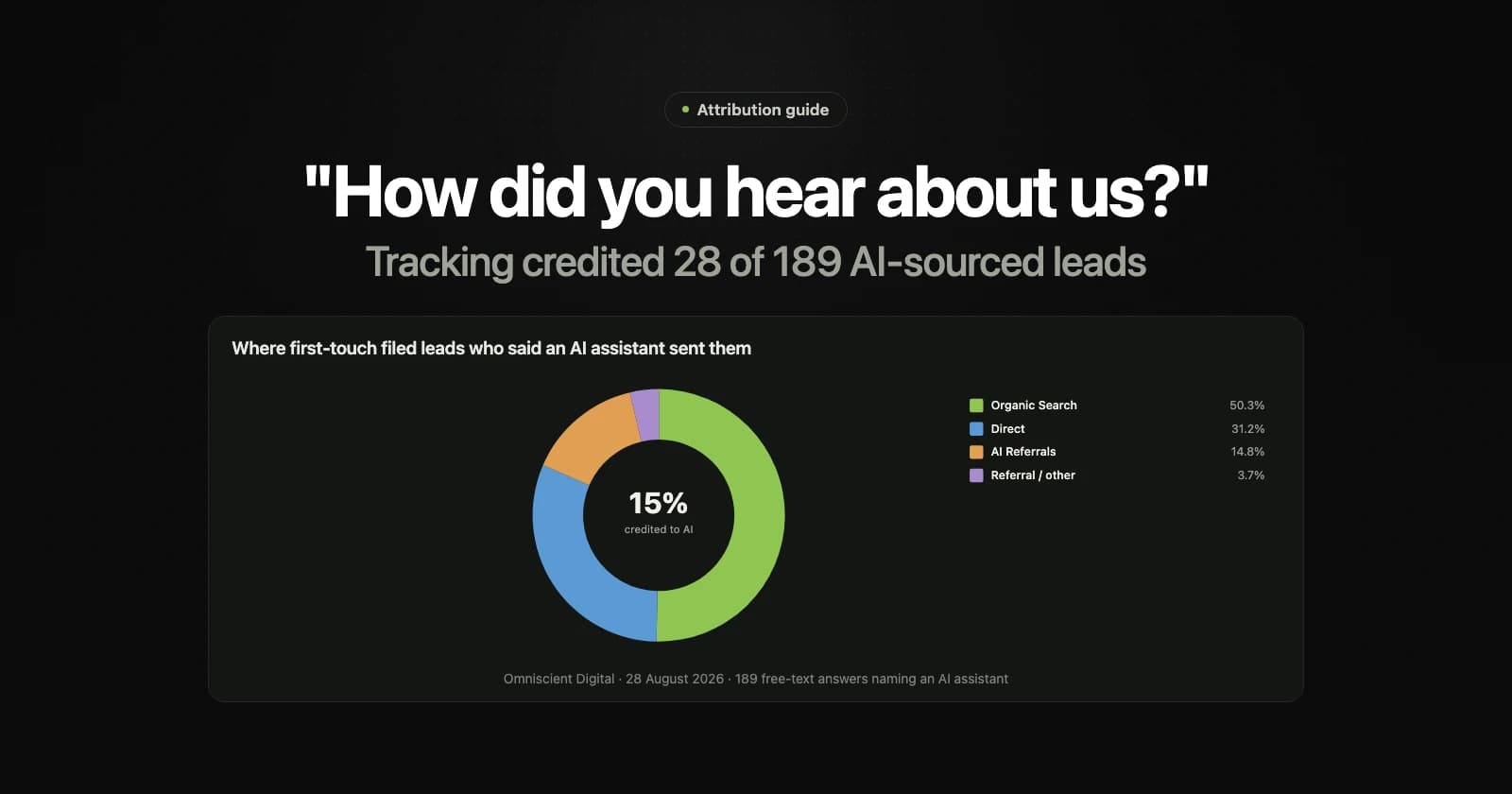
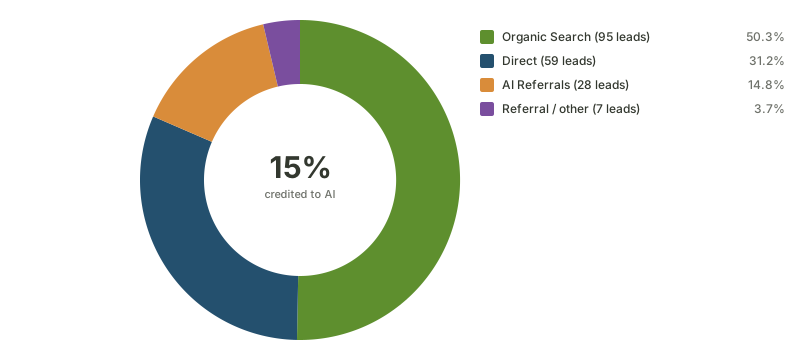
Omniscient Digital looked at the same problem from the other side. They took 189 leads who had written ChatGPT, Claude, Gemini, Perplexity or just "AI" into a free-text field, and checked where first-touch tracking had filed each one[5].
Source: Omniscient Digital (August 2026) — 213 free-text answers, 189 naming an AI assistant
Tracking credited 28 of the 189 to AI, which is 15%. Ninety-five went to Organic Search and 59 to Direct[5]. If that agency had judged its AI-search work on the tracked number alone, it would have been judging it on about one lead in seven.
This is the practical case for the survey in 2026. It is currently the only instrument that can see a recommendation that produced no click. Better tracking recovers the clicks that do happen, including the ones that lose their referrer along the way (we cover that in dark AI traffic in GA4 and why ChatGPT referrals go missing). It cannot recover a click that never happened.
How far to trust the answers
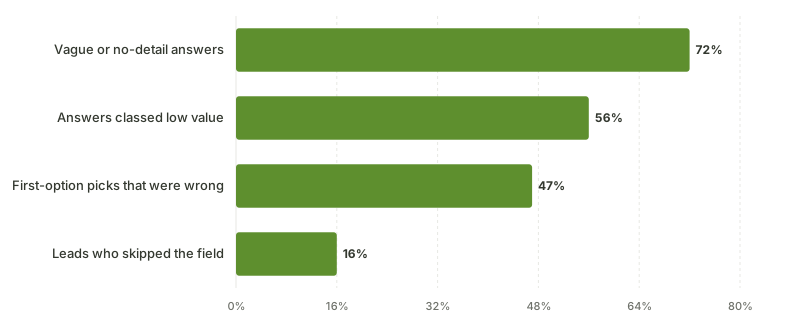
Now the other half. Ruler Analytics added the field to its own lead form and then audited the answers against its tracked data[6].
Source: Ruler Analytics (2022) — own lead form, answers checked against tracked attribution; each bar has its own denominator
Seventy-two percent of answers gave vague detail or none. Typical responses were a single word: "Google", "Article", "Online". Ruler classed 56% of answers as low value. Among leads who chose the first option in the dropdown, 47% were wrong when checked against tracking, and 16% of leads skipped the field entirely[6]. Ruler sells attribution software and has a reason to find the survey wanting, in the same way Refine Labs has a reason to find software wanting. Both sets of numbers are still real.
The known failure modes, from that audit and from Recast's review of the method[7]:
- Recency. People report the most recent touch they remember. "Google" often means "I googled your name after my colleague mentioned you."
- Memorability. Vivid channels such as TV, podcasts and a friend's recommendation get over-reported. Forgettable ones such as a retargeting ad or a comparison-site listing get under-reported[7].
- Order effects. Whatever sits first in a fixed list collects lazy clicks[6].
- One answer for a many-step journey. The buyer who heard a podcast, saw an ad, read a review and then searched gives you one of those four.
- Non-response. Recast puts skip rates on optional fields around 30%[7]. The people who skip are not a random sample.
So the survey is not the truth either. It is a second witness. It is unreliable about the last step, which tracking already records well, and useful about the first step, which tracking cannot record at all. That division of labour is the whole reason to run both. For what each tracked model is good at, see first-touch vs last-touch attribution.
The options list: copy these
Keep the list short enough to read in three seconds. Randomise the order on every load, and pin "Other" to the bottom. Name sources the way customers would say them, not the way your channel report does. Nobody thinks of themselves as "Paid Social".
B2B SaaS and software
- Search engine (Google, Bing)
- ChatGPT or another AI assistant
- A colleague or friend told me
- YouTube or a podcast
- A community (Reddit, Slack, Discord)
- Review or comparison site (G2, Capterra)
- Newsletter or blog
- Other: ________
Ecommerce and DTC
- TikTok
- A friend or family member
- Google search
- ChatGPT or another AI assistant
- YouTube or a creator I follow
- Podcast
- Saw it in a shop or at an event
- Other: ________
Local and professional services
- A friend, neighbour or colleague
- Google search or Google Maps
- ChatGPT or another AI assistant
- Facebook or Nextdoor
- Saw your van, sign or office
- Another business referred me
- Other: ________
Three notes on these lists. First, "Friend" and "AI assistant" should always be present, because they are the two big sources that tracking cannot see. Second, when someone picks a broad option, a conditional follow-up earns its place: "Which podcast?", "Which AI assistant?", "What did you search for?". That single follow-up is what turns Ruler's one-word answers into something you can act on. Third, Growth Method argues for pure free text on the grounds that dropdowns "test the respondent's knowledge of marketing channel names rather than their actual journey"[9]. That works well at low volume, where a person can read every answer. Past a few hundred answers a month you will want the categories, and the "Other" box keeps the free-text door open.
Where to put it, and what response rate to expect
| Placement | Typical response | Notes |
|---|---|---|
| Order-confirmation or thank-you page | KnoCommerce reports a 45% average across its customers; 60%+ is its "elite" tier[8] | Best option for ecommerce. The purchase is done, so there is no conversion to lose |
| First screen of onboarding after signup | Similar dynamics to a confirmation page; no large public benchmark | Best option for self-serve SaaS. One question, skippable |
| Inside the demo or contact form, optional | Expect some skips: 16% in Ruler's audit[6], around 30% in Recast's review[7] | Keeps the answer attached to the lead record from the first second |
| Email sent afterwards | 10–15% is typical[8] | Last resort. Memory has faded and response bias is worse |
| Asked aloud on the sales call | No public benchmark | Richest answers and smallest sample. Log it in the CRM field, not in call notes |
Timing beats everything else on this list. The person has just chosen you and the path is fresh in their mind. KnoCommerce's example of Oats Overnight getting a 58% response on a 20-question post-purchase survey shows how much goodwill exists at that moment[8]. You only need one question of it.
Reading the survey against your tracked data
The payoff comes from the join. For every customer you want three fields in one row: what tracking says, what the customer says, and what they paid. Then the disagreements sort themselves into a small number of patterns.
| Tracking says | Customer says | What it usually means |
|---|---|---|
| Direct | ChatGPT / AI assistant | A recommendation with no click. Your AI visibility is producing customers your dashboard cannot see |
| Organic Search (brand term) | Friend, podcast, AI assistant | Search was the doorway, not the cause. Do not credit SEO for it |
| Organic Search (non-brand term) | Agreement. This is what real search-driven demand looks like | |
| Paid Social | Friend | Both are probably true: the ad reminded, the friend convinced. Do not cut the ad on this alone |
| Paid Search | The customer cannot tell an ad from a result. Trust the tracked source here | |
| Anything | "Other", blank or one word | Noise. Exclude it; do not force it into a bucket |
Two rules make the comparison honest. Weight by revenue, not by count. In the Refine Labs data, web search was 12% of self-reported leads and 3% of self-reported revenue, so a count-based view would have flattered it fourfold[1]. And trust each witness on its own ground: tracking for the last step and for anything involving an ad click, the customer for the first step and for anything that happened off the internet.
If you use Attrifast, the simplest implementation is one custom event per answer. For example, call window.attrifast.track('heard_ai_assistant') when that option is submitted (custom events docs). Each answer then becomes a goal you can read by tracked channel, which is the disagreement table above built automatically. The tracked side, source through to the Stripe payment, is what revenue attribution already does. The survey is the part you have to add.
Six mistakes that ruin the data
- A fixed option order. You will measure the popularity of position one.
- Asking before the conversion and making it required. You will pay for the data in lost signups.
- Channel-report vocabulary. "Organic Social" means nothing to a customer. "Instagram" does.
- No AI option. Those customers will pick "Google" or "Other", and you will conclude that AI sends you nothing.
- Counting answers instead of revenue. Ten students who found you on TikTok are not one enterprise contract that came from a referral.
- Replacing tracking with the survey. The survey cannot tell you which campaign, keyword or page worked. Ruler found that only 1.4% of its leads would have gone unattributed without the form field, against 16% who would have gone unattributed without tracking[6].
What this does not tell you
- Every study cited here is one company, or one agency's client base, measuring itself. Most are vendors with a position to defend. The numbers show the direction and rough size of the gap, not a constant you can apply to your own funnel.
- None of them can verify the customer's answer. "ChatGPT" in a form field is a claim, the same way "Direct" in GA4 is a claim.
- The AI-assistant figures are from 2026 and the interfaces are changing. If Claude and others hyperlink more of their recommendations, part of that gap moves back into tracked data.
- There is no large public benchmark for survey response on SaaS onboarding screens. Measure your own.
FAQ
What should I ask instead of "How did you hear about us?"
Ask "Where did you first hear about us?" The word "first" matters because people default to the most recent thing they remember, which is usually a Google search for your name. Recency bias is the best-documented weakness of this survey, and the wording change is the cheapest correction available. If you have room for a follow-up, make it conditional on the answer: "Which podcast?" or "Which AI assistant?"
What are good options for a "How did you hear about us?" dropdown?
Six to nine options in the customer's own vocabulary, shown in random order, with a free-text "Other" pinned last. For software: search engine, ChatGPT or another AI assistant, a colleague or friend, LinkedIn, YouTube or a podcast, a community such as Reddit or Slack, a review site, a newsletter or blog. For ecommerce, swap in Instagram, TikTok, creators and in-store. Always include a friend option and an AI-assistant option, because those are the two large sources that tracking cannot see.
Should "How did you hear about us?" be a required field?
Not before the conversion. A required field on a lead form or checkout adds friction at the one moment you cannot afford it. After the conversion, on a thank-you page or the first onboarding screen, requiring it costs nothing in conversions, though a visible skip link tends to produce more honest answers than a forced click. Optional fields get skipped by roughly 16% to 30% of people in the published audits.
How accurate is self-reported attribution?
Accurate about the first touch, unreliable about the last touch. Ruler Analytics found 72% of answers on its own form were vague and 47% of first-option picks were wrong when checked against tracking. Refine Labs found that software credited web search with 79% of closed-won revenue while customers credited it with 3%. Neither method is the truth. The survey sees word of mouth, podcasts and AI recommendations that leave no click, and tracking sees the campaign, keyword and page that the customer has forgotten.
Should I add ChatGPT as an option in my survey?
Yes. In three published 2026 comparisons, GA4 credited AI assistants with a fraction of what customers reported: about 0.9% against 9% at n8n, 0.1% against 10.6% for Claude at Otterly, and 28 of 189 self-identified AI leads at Omniscient Digital. Most AI recommendations produce a typed URL or a brand search rather than a click, so they land in Direct or Organic Search. Without the option, those customers pick "Google" or "Other".
Open text field or dropdown?
A short randomised list with a free-text "Other" is the practical middle. Pure free text avoids suggesting answers and works well when a person can read every response, but in Ruler's audit most free answers were a single word. A dropdown alone is easy to analyse but inflates whatever is listed first. If you choose free text at volume, plan to classify the answers into categories before you analyse them.
Where should the survey go for a Shopify store?
On the order-confirmation page, immediately after purchase. KnoCommerce reports a 45% average response rate for post-purchase surveys across its customers, with 60% and above as its top tier, while surveys sent by email afterwards typically get 10% to 15%. The purchase is already complete, so the question cannot cost you the sale.
Continue the research path
- What is direct traffic? — the bucket most untracked sources end up in
- Dark AI traffic in GA4 — recovering the AI visits that do click but lose their referrer
- The AI search attribution gap — why AI-influenced revenue is under-counted, and by how much
- Attribution for product-led growth — where a signup survey fits in a self-serve funnel
- GA4 conversion tracking — what the tracked side can and cannot do
- Track which marketing channel drives revenue
Sources
Primary sources for the claims in this article. Numbered citations in the text link to the matching entry.
- [1]The Attribution Mirage — Refine Labs (2024).
- [2]New Research: Dark Social Falsely Attributes Significant Percentages of Web Traffic as 'Direct' — SparkToro (2023).
- [3]Last-Touch Attribution Only Captures 10% of n8n's AEO Conversions — Graphite (2026).
- [4]Claude drives 10.6% of our signups; Google Analytics says 0.1% — Otterly.ai (2026).
- [5]First-Touch Attribution Captures 15% of Our AI-Sourced Leads — Omniscient Digital (2026).
- [6]Asking 'How Did You Hear About Us' Isn't Enough — Ruler Analytics (2022).
- [7]'How did you hear about us?' survey and the limitations of self-reported attribution — Recast (2023).
- [8]How to increase survey response rate (and what counts as good) — KnoCommerce (2025).
- [9]Self-Reported Attribution: The Best Way to Measure AI Search — Growth Method (2026).
- [10][GA4] Default channel group — Google Analytics Help (2026).