
Part of the AI Search Hub, AEO Hub, and the generative engine optimization guide.
Semrush published a piece this month called “Traffic Is Down — Now What?” and it is one of the more honest things a large SEO vendor has written about the AI era: it concedes that traditional SEO no longer guarantees the click, and its prescription is classic marketing — PR, ads, social, events, brand story. Seven moves, all reasonable.
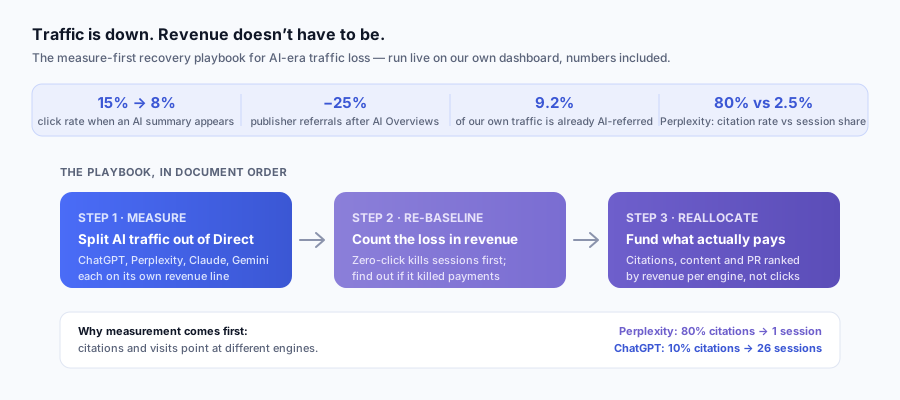
I want to make one argument on top of it, and then show you the playbook we actually run — on our own site, with this week's numbers, including the cell in the revenue column that still reads $0.
The argument: every one of those seven moves spends money against a loss you have not measured yet. Most teams diagnosing “AI traffic loss” are reading it through an analytics setup that (a) files the majority of AI-referred visits under Direct and (b) counts the damage in sessions, a currency AI answers have permanently devalued. Fix the measurement first and the recovery plan usually changes shape — sometimes drastically.
The loss is real — and your analytics is exaggerating it
Two things are true at once, and most traffic-drop conversations only admit one of them.
The loss is real. Pew Research tracked real user sessions and found that when Google shows an AI summary, users click a traditional search result on just 8% of visits, versus 15% when no summary appears. They click the source link inside the AI summary on 1% of visits. That is not a ranking problem; your page can sit at #3 all year while the pool of searchers who ever reach a click shrinks by nearly half. Digiday reported publisher referral traffic down roughly 25% after AI Overviews rolled out.
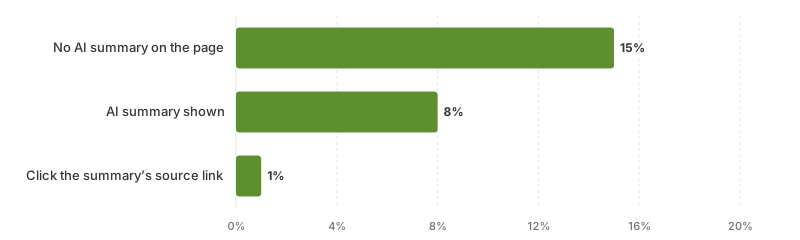
Source: Pew Research Center, July 2025 — analysis of real browsing sessions
And your analytics is exaggerating it. The sessions you gain from AI engines mostly arrive invisible. ChatGPT, Perplexity and Claude strip or omit the referrer on most outbound clicks, so GA4 files them under Direct/(none) — in our measurements, 65-82% of ChatGPT-originated visits land there. The result is a double distortion: the organic line shows the full loss, while the AI line shows almost none of the gain. You end up mourning traffic that partially came back through a door your analytics does not have a name for. We wrote up the mechanics in dark AI traffic in GA4, and the broader diagnostic — separating AI impact from core updates and measurement loss — in why did my Google traffic drop?
Here is what that looks like when the door does have a name. This is our own dashboard for the seven days ending 14 August 2026 — small numbers, published anyway:
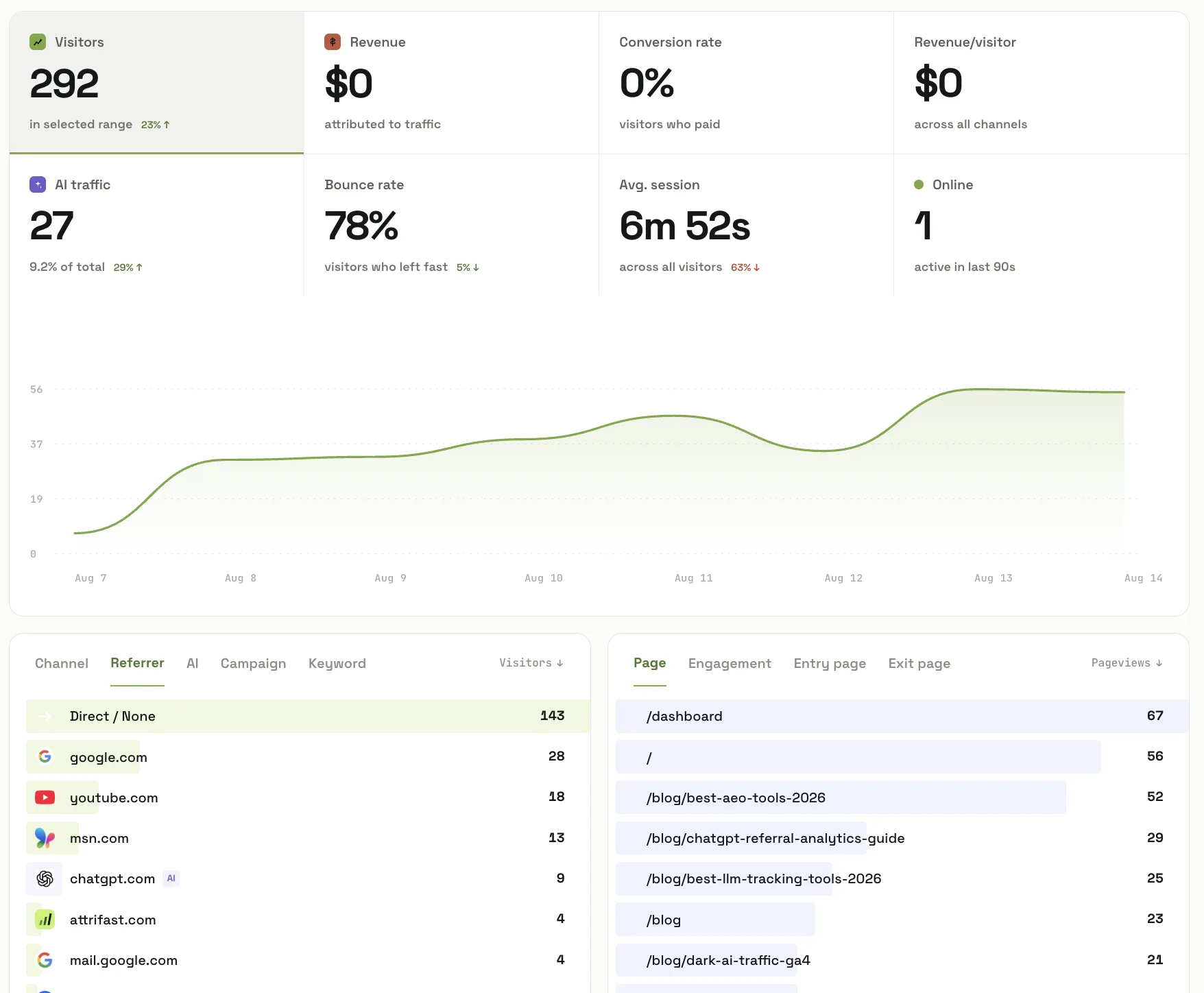
Three things in that screenshot drive everything below:
| Number | Value | Why it matters |
|---|---|---|
| AI share of traffic | 27 visitors — 9.2% of 292, +29% WoW | The gain side of the ledger, visible only because AI engines are fingerprinted |
| Direct/(none) share | 143 visitors — 49% | Even with AI detection on, half the traffic is unattributed; without it, the 27 would hide in here too |
| chatgpt.com in the referrer table | #5 referrer, above our own product domain | An engine that barely existed as a channel two years ago now outranks most of our named sources |
If your dashboard cannot produce that first row, everything Semrush recommends — and everything below — runs blind.
What Semrush gets right, and the number the playbook is missing
The seven moves in their article, with the measurement each one needs before it deserves budget:
| Semrush's move | Fair summary | The missing number |
|---|---|---|
| 1. Sticky content | Original viewpoints, series, shareable formats | Which content AI engines cite, per engine |
| 2. PR campaigns | Third-party coverage builds citation-worthy authority | Which third-party domains engines already cite in your category |
| 3. Digital ads | Buy the exposure organic lost | Revenue per paid channel vs revenue per AI engine |
| 4. Consistent social | Familiarity feeds brand demand | Branded query trend; social-referred revenue |
| 5. Merchandise | Physical brand presence | (Honestly: vibes. We skip this one.) |
| 6. Events | Authority by association | Mentions and citations generated per event |
| 7. Brand story | Narrative consistency everywhere | Branded search demand over 18 months |
None of this is wrong. Reddit, LinkedIn, Wikipedia and YouTube dominate LLM citations in Semrush's own January 2026 study, and brand mentions on those surfaces are exactly what PR and social produce. The problem is sequencing. Brand campaigns take quarters, and their effect on AI answers is unattributable unless the instrumentation existed before the campaign. Run the three steps below first; they take days, not quarters, and they tell you which of the seven moves to fund.
Step 1: Split AI traffic out of Direct before touching anything else
Nothing else in the playbook works until ChatGPT, Perplexity, Claude, Gemini and Copilot are separate, named lines in your analytics — because the recovery you are managing is partly already happening inside your Direct bucket.
Attrifast does this with a continuously updated signature set — referrer domains where engines pass one, user-agent and behavioral fingerprints where they do not. One nuance worth understanding whichever tool you use: referrer counting alone under-counts badly. This week our referrer table shows 9 visitors whose browser passed a chatgpt.com referrer — but the engine panel attributes 26 sessions to ChatGPT once stripped-referrer visits are fingerprinted back to their source. A referrer-only “AI traffic report” would have missed two-thirds of it.
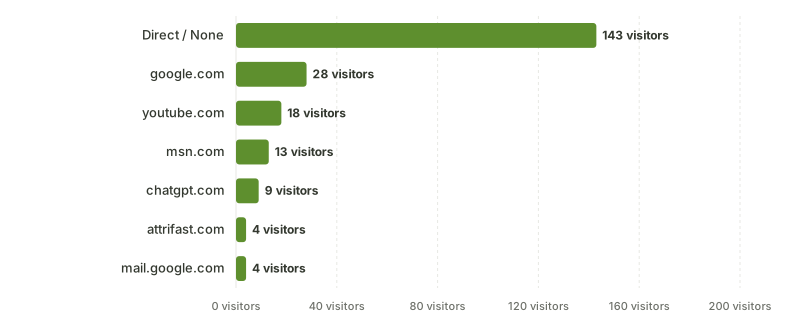
Source: Attrifast dashboard, attrifast.com — visitors per referrer, AI engines fingerprinted separately
What to look for in your own split, in week one:
- AI share of total. Ours is 9.2%. Cross-industry averages are still low single digits, so if you are above ~5% your category has already tipped and the rest of this playbook is urgent rather than optional.
- Growth rate. Ours grew 29% week-over-week. The absolute number matters less than the slope.
- Engine mix. This becomes the whole story in Step 3.
Step 2: Re-baseline the loss in revenue, not sessions
Sessions are the wrong denominator for AI-era decisions, for a reason Pew's data makes obvious: the clicks AI answers remove are disproportionately the low-intent ones — definitional queries, quick facts, listicle skims. The searcher who still clicks through an AI answer has survived an extra filter. Fewer sessions, higher intent per session. Zero-click is a revenue question, not a traffic question, and it needs a revenue answer.
So before declaring a crisis, rebuild the baseline in money:
- Join sessions to payments. Stripe or Shopify, matched to the session that started the journey. This is the only join that turns “traffic is down 30%” into “revenue is down 4%” — or “revenue is flat”, which is a different crisis (and a much cheaper one).
- Compute revenue per visitor by channel. If organic RPV is rising while organic sessions fall, AI answers are eating your cheap sessions and keeping your buyers. That changes the recovery target completely.
- Publish the honest window. Here is ours: this week's dashboard shows $0 revenue attributed in range. Twenty-seven AI visitors, a 6m52s average session, and not one of them has paid yet in this window. We ship the screenshot anyway, because a playbook demoed only on flattering weeks is an ad, and because the next section shows exactly why those 27 visits are still the right thing to optimize.
If your measured loss in revenue is small, most of the Semrush spend is optional. If it is large, you now know which channels lost paying visitors rather than skimmers — and that list, not total sessions, is the recovery target.
Step 3: Chase citations where buyers ask — and never confuse citations with traffic
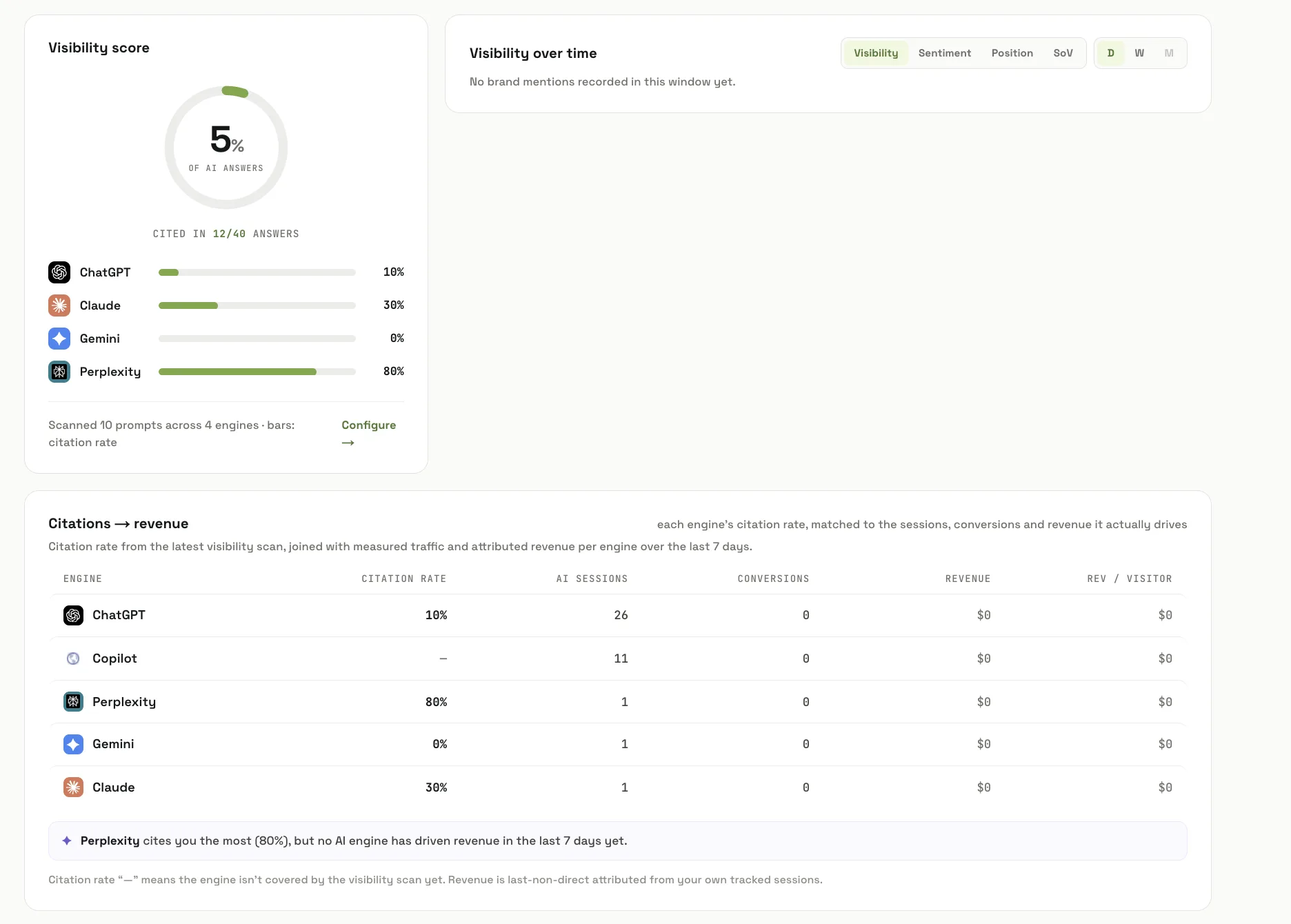
The visibility layer of this playbook is a scheduled scan: ask the engines the questions your buyers ask, record who gets cited. Ours ran this week — 10 prompts across ChatGPT, Claude, Gemini and Perplexity, 40 answers, cited in 12:
Now put the two layers side by side, because this is the finding that justifies the whole measure-first argument:
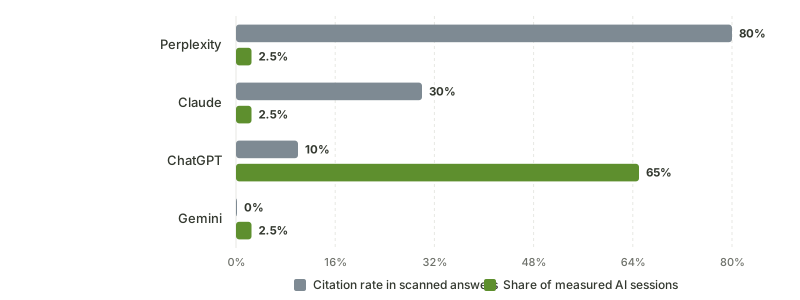
Source: Attrifast visibility scan (10 prompts × 4 engines) + AI session attribution, attrifast.com, week ending 14 Aug 2026
The engines invert. Perplexity cites us in 80% of answers and delivered 1 session — 2.5% of measured AI sessions. ChatGPT cites us in 10% of answers and delivered 26 — 65%. Copilot is not even in the scan yet and out-delivered three scanned engines. A team optimizing on citation rate alone — which is what every monitoring-only visibility tool encourages — would conclude Perplexity is the success story and double down there. The session data says user volume lives at ChatGPT, and the revenue row (all zeros, this week, honestly) says the tiebreaker is still to be decided.
The other lever in this step is prompt selection, and it is worth more than any optimization trick. When we ran our own scan in public, the same domain scored 0% on broad category prompts and 75% on commercial-intent prompts — same engines, same day, same pipeline. Nothing changed but the question. Scan the questions your buyers actually type, or the score will describe a market you are not in.
Step 4: Earn the third-party mentions engines already trust
This is where Semrush's PR and social advice lands — with a targeting list attached. Engines answering category questions do not primarily cite vendors; they cite the surfaces that discuss vendors. In our 40-answer scan, the domains cited most often were:
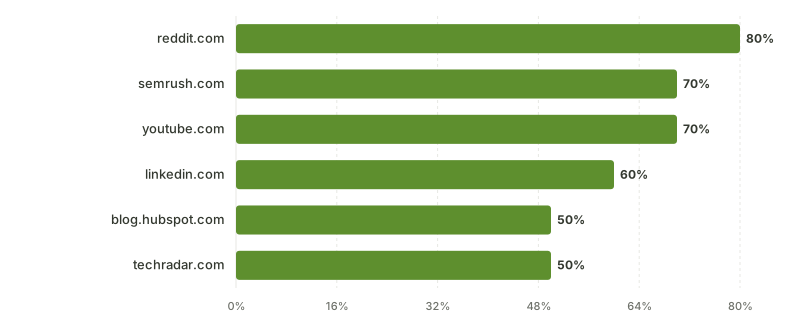
Source: Attrifast AI Visibility re-run, attrifast.com, 3 August 2026 — share of prompts where the domain appeared
Reddit in 80% of prompts. Semrush's own blog in 70%. YouTube 70%, LinkedIn 60%, then a band of review sites and SEO blogs at 50%. This matches Semrush's study of LLM citations almost exactly — Reddit, LinkedIn, Wikipedia, YouTube at the top — which means the two datasets, theirs at massive scale and ours at n=40, are describing the same machine.
The practical consequence: your visibility scan's cited-sources list is a ranked PR target list. Not “launch a PR campaign” in the abstract — get into the specific Reddit threads, listicles and review pages the engines already pull from for your category's questions. One placement on a page cited in 80% of answers beats ten placements the engines never retrieve. That is a week of outreach with a measurable citation-rate effect, not a quarter of brand spend with an unattributable one.
Step 5: Rebuild the middle of the funnel AI cannot answer
Look back at the top-pages panel in the first screenshot. Excluding the app itself, every top page on our site this week is a data post — the AEO tools test (52 pageviews), the ChatGPT referral analytics guide (29), the LLM tracking comparison (25), the dark AI traffic explainer (21).
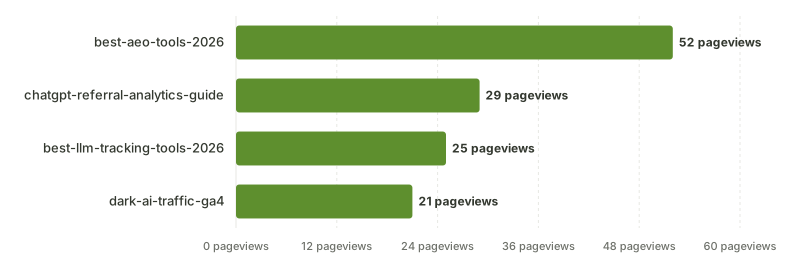
Source: Attrifast dashboard — pageviews per page, app and index pages excluded
None of these are the definitional posts an AI answer replaces. They are pages with first-party numbers, named tools, tested claims and tables — the material engines cite and the material a post-AI-answer searcher still needs a human source for. This is Semrush's “sticky content” recommendation with a sharper spec:
- Publish numbers nobody else has. Screenshots of your own dashboards, your own test results, your own failures. (Engines cited our public 0/100 scan post; nobody cites a paraphrase.)
- Write for the comparison stage. “What is X” is gone to the answer box. “X vs Y with real data” and “we tested 8 X” still earn both the citation and the click.
- Answer the question completely near the top, then go deeper than the answer box can. The AI summary quotes your top; the surviving clicker stays for the depth. Small teams beat incumbents inside ChatGPT on exactly this asymmetry — incumbents cannot publish their raw numbers; you can.
The 30-day version
| Days | Do | Output |
|---|---|---|
| 1-2 | Install AI-aware analytics; connect Stripe/Shopify | Every engine a named line; sessions joined to payments |
| 3-7 | Let a full week accrue; run first visibility scan on buyer-intent prompts | AI share %, engine mix, citation rate per engine |
| 8-14 | Re-baseline: revenue per channel vs last quarter; branded vs non-branded query split | The real loss, in dollars; brand-demand health check |
| 15-21 | Outreach to the top 5 domains your scan says engines cite; fix commercial-intent prompt gaps | Placement shortlist worked; prompt set corrected |
| 22-30 | Ship one data post with first-party numbers; set weekly scan + revenue review | The five weekly numbers on one page |
Then — with baselines in place — fund the Semrush list in whatever order your revenue-per-engine table suggests. That is the whole playbook: their marketing, our measurement, in that order reversed.
Run this playbook on your own traffic
One script tag splits ChatGPT, Perplexity, Claude, Gemini and Copilot out of Direct; a Stripe key joins every session to the payment it produced; the visibility scan runs on schedule. The dashboards in this post are the product, unedited.
- One script tag and a Stripe key — live in minutes
- First-party measurement without third-party cookies
- Recognized AI referrals joined to Stripe payments
7-day free trial · $0 due today · then $9.99/mo · cancel anytime
FAQ
Why is my traffic dropping even though my rankings look stable?
Because the click, not the ranking, is what AI answers remove. Pew Research measured that when Google shows an AI summary, users click a traditional result on just 8% of visits, versus 15% when no summary appears — and they click the source link inside the summary only 1% of the time. Your page can hold position #3 all year while the share of searchers who ever reach a click falls by nearly half. Digiday reported publisher referral traffic down roughly 25% after AI Overviews rolled out. Stable rankings with falling clicks is the signature of AI-answer exposure, not an SEO failure.
How do I find out how much traffic I am actually losing to AI?
You cannot read it out of a default GA4 property, because most AI-referred visits arrive with the referrer stripped and get filed under Direct/(none) — our measurements put 65-82% of ChatGPT-originated visits in that bucket. First deploy analytics that fingerprints AI engines by referrer and user-agent signatures so ChatGPT, Perplexity, Claude, Gemini and Copilot each get their own line. Then compare two things over the same window: what the AI engines send you (gained traffic) and what your organic click-through lost since AI summaries appeared on your queries (lost traffic). On our own site, that instrumentation moved 27 visitors — 9.2% of a 292-visitor week — out of Direct and into a channel we can act on.
Should I optimize for AI citations or for AI traffic?
Measure both, because they invert. In our latest visibility scan, Perplexity cited attrifast.com in 80% of answers but delivered 2.5% of our measured AI sessions; ChatGPT cited us in only 10% of answers and delivered 65% of AI sessions. A citation is an impression, not a visit — engines differ enormously in how often users click through. If you optimize purely for citation rate you will over-invest in the engine that mentions you politely and under-invest in the one that actually sends buyers. The tiebreaker is revenue per engine, which is why the citations-to-revenue join matters more than either number alone.
Is Semrush right that brand marketing fixes AI traffic loss?
Directionally yes — AI engines preferentially cite established brands and the third-party sites that discuss them, so PR, social presence and brand demand all feed citation likelihood. Semrush's own January 2026 study found LLMs cite Reddit, LinkedIn, Wikipedia and YouTube more than almost anything else, and our own 40-answer scan agrees: reddit.com appeared in 80% of prompts, semrush.com and youtube.com in 70%, linkedin.com in 60%. The gap in the playbook is sequencing: brand campaigns take quarters and their effect on AI answers is unattributable unless you instrumented AI traffic and per-engine revenue first. Measure, then baseline, then spend — otherwise you cannot tell which of the seven brand moves paid.
Can traffic lost to AI Overviews actually be recovered?
Partly, and the recoverable part is specific. Top-of-funnel definitional clicks are largely gone — the AI answer satisfies them and no rewrite brings them back. What is recoverable: commercial-intent visibility (in our own scan the same domain scored 0% on broad category prompts and 75% on buyer-intent prompts the same day), placement on the third-party pages engines already cite, and mid-funnel content AI answers cannot complete — comparisons with real data, pricing analysis, first-party benchmarks. The goal is not restoring the old session count; it is replacing low-intent lost sessions with fewer, higher-intent AI-referred ones, which is why the baseline must be revenue rather than sessions.
What should I track weekly during a traffic recovery?
Five numbers, one per playbook stage: AI share of traffic (ours is 9.2% and grew 29% week-over-week), AI sessions per engine (ChatGPT 26, Copilot 11, the rest 1 each for us this week), citation rate per engine from a scheduled visibility scan (10-80% spread for us), branded search demand as a health check on brand campaigns, and revenue per channel with AI engines broken out. The first four are leading indicators; the last is the one you reallocate budget on. Any tool stack that produces those five numbers works — ours happens to produce them on one dashboard.
Sources
Primary sources for the claims in this article. Numbered citations in the text link to the matching entry.
- [1]Traffic Is Down — Now What? Marketing Success In the Age of AI — Semrush (2026).
- [2]Google users are less likely to click on links when an AI summary appears in the results — Pew Research Center (2025).
- [3]Google AI Overviews linked to 25% drop in publisher referral traffic, new data shows — Digiday (2025).
- [4]Semrush AI Overviews study — which domains LLMs cite most — Semrush (2026).
- [5]We Re-Ran Our Own AI Visibility Scan After Finding a Bug In It: The Raw Data — Attrifast (2026).
- [6]ChatGPT Referral Analytics: Why 70% of AI Traffic Hides in Direct — Attrifast (2026).
- [7]Zero-Click Search Revenue Impact: What Really Happens to Your Money When AI Answers for You — Attrifast (2026).
- [8]Why Did My Google Traffic Drop? A 2026 Diagnostic Walkthrough — Attrifast (2026).
- [9]Dark AI Traffic: Why GA4 Files Your ChatGPT Visitors Under Direct — Attrifast (2026).
- [10]The Best AEO Tools in 2026, Tested — Attrifast (2026).