
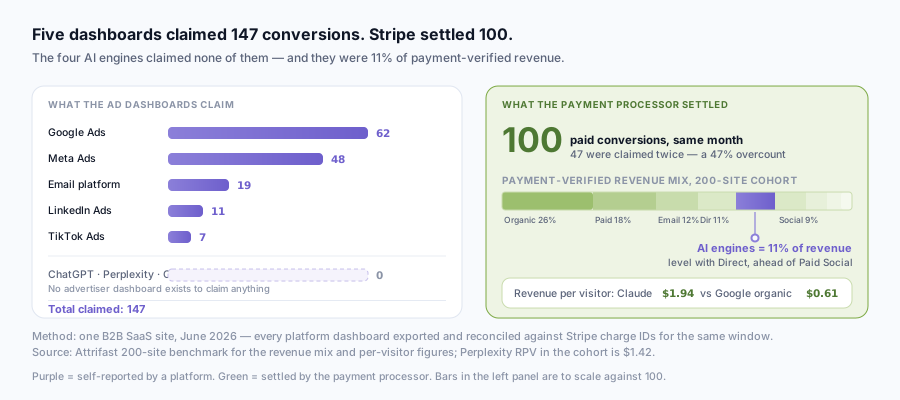
The first time I reconciled a month of marketing dashboards against a Stripe payout, I assumed I had made an export error. Google Ads said 62 conversions. Meta said 48. The email platform claimed 19, LinkedIn 11, TikTok 7. That is 147 conversions for a month in which the payment processor settled exactly 100 paid customers.
Nobody was lying. Every one of those dashboards was correct inside its own rules. They were just all counting the same people, and no system in the stack had the job of noticing.
Then there was the other half of the problem, which I did not see for another six weeks. Of those 100 real customers, eleven had arrived from ChatGPT, Perplexity, Claude, or Gemini. None of the five dashboards claimed them, because AI answer engines do not ship an advertiser console. They were sitting in the Direct bucket in GA4, quietly making the "word of mouth is strong this quarter" story sound plausible.
This guide is about fixing both halves at once. Every other cross-channel attribution guide I have read stops at the classic six — search, social, paid, email, direct, referral. In 2026 that list is missing a channel family that carries the highest revenue per visitor in my entire benchmark cohort.
What is cross-channel marketing attribution?
Cross-channel marketing attribution is the practice of assigning credit for a single conversion across every channel that touched the buyer, using one measurement system that sits outside all of those channels.
The load-bearing word is outside. Google Ads can tell you what Google Ads did. Meta can tell you what Meta did. Neither can tell you what happened between them, because neither can see the other's touches — and both are graded on claiming as much as they defensibly can. Cross-channel attribution is not a smarter version of platform reporting. It is a referee.
A working cross-channel setup needs three things, in this order:
- A durable visitor identity that survives across sessions, devices where possible, and the gaps between touches. First-party, server-set, and yours.
- A complete touch log — every recorded arrival, with its source, timestamp, and landing page, in one table.
- A conversion record that is financially true. Not a pixel fire, not a thank-you-page view: a settled payment, with its amount, from the processor.
Miss the third and you are attributing events. Miss the first and you are attributing sessions. Only when all three are present are you attributing revenue, which is the only version of this that survives a conversation with a CFO.
If you want the taxonomy of weighting rules that sits on top of this — first-touch, last-touch, linear, time-decay, position-based, data-driven — I wrote a full walkthrough of the standard attribution models. This article is about the layer beneath: getting the touches into one place, honestly, before you argue about how to split them.
Why do Meta and Google both claim the same conversion?
Because both are following their own published rules, and the rules overlap.
Google Ads counts a conversion when there was an ad click inside the conversion window. If you never customized it, that window is 30 days, and it can be set anywhere from 1 to 90 days depending on the conversion source [4]. Meta's default ad-set attribution setting is a 7-day click plus a 1-day view — which means a user who merely scrolled past your retargeting creative yesterday and bought today gets booked as a Meta conversion. On top of the window, Google Ads then applies its own attribution model to decide how credit distributes among Google-side interactions before anything reaches your report [5], so the number you read has already been arbitrated once — inside the channel that benefits from it.
A single buyer can satisfy both rule sets without doing anything unusual — click a Google ad on day 9, scroll past a Meta retargeting ad on day 13, pay on day 14. Repeat that across a month and the dashboards diverge from the bank account like this:

Source: Attrifast — five platform dashboards reconciled against Stripe charge IDs for one B2B SaaS site, June 2026
The five platform bars sum to 147: 62 + 48 + 19 + 11 + 7. The payment processor settled 100. That is a 47% overcount, and it is squarely inside the 30-50% range that independent reviews of ecommerce accounts report when they sum platform-claimed conversions against actual orders [3].
Here is why this matters more than it looks. The overcount is not evenly distributed. Retargeting-heavy channels overclaim hardest, because view-through windows let them attach to demand that other channels created. So the distortion does not just inflate your total — it systematically over-rewards the channels closest to the purchase and under-rewards the channels that created the demand in the first place. Budget follows reported ROAS, reported ROAS is inflated for the wrong channels, and the flywheel spins the wrong way for a quarter before anyone checks.
And notice the bottom row of that chart: the AI engines claim zero. Not because they sent nothing — in that same month they sent eleven paying customers — but because there is no dashboard for them to claim from. A measurement system that only aggregates what platforms self-report will always show AI as zero, forever, no matter how much revenue it drives.
What does the channel mix look like once you join to payments?
This is the part that reorganized how I think about channel strategy. Below is the payment-verified revenue mix across the 200-site benchmark cohort — every conversion matched to a settled charge, not a pixel.

Source: Attrifast 200-site benchmark — last-touch revenue share joined to Stripe payments, 2026
AI engines land at 11% of revenue — tied with Direct, ahead of Paid Social, and roughly two-thirds the size of Paid Search. For a channel family that did not meaningfully exist three years ago and that most attribution vendors still do not model, that is a large number sitting in plain sight.
It gets more interesting when you switch from share of revenue to revenue per visitor, which is the fairer cross-channel comparison because it normalizes for wildly different traffic volumes:

Source: Attrifast 200-site benchmark — median revenue per visitor by channel, 2026
The spread is roughly seven to one from top to bottom. Claude visitors are worth $1.94 each, Perplexity $1.42, and ChatGPT $0.87 — against $0.61 for Google organic and $0.34 for paid social. The per-engine figures come from the same payment-verified cohort as the revenue-mix chart above [10], and the reason the AI engines sit so high is selection: an answer engine only sends a click after it has already answered the question, so the visitor arrives pre-qualified rather than exploratory. Zoom out and the pattern is consistent with what other operators find when they instrument this properly: Otterly published a breakdown showing Claude driving 10.6% of their signups while Google Analytics reported 0.1% [9].
Two honest caveats before anyone reallocates budget on this. First, AI traffic is small in absolute session terms — high RPV on 400 sessions is not a substitute for mediocre RPV on 40,000. Second, RPV rankings shift with category: Similarweb's 2026 measurement shows ChatGPT's share of generative AI web traffic sliding from roughly 76% to 53% year over year while Gemini climbed past a quarter and Claude tripled [7], so the mix under you is moving faster than most annual planning cycles.
The strategic point is not "AI beats Google." It is that AI engines behave like a distinct channel with a distinct economic profile, and any cross-channel attribution model that treats them as Direct is throwing away your highest-value cohort.
Deterministic or probabilistic: which one is honest at your scale?
Every vendor in this category sells one of two philosophies, and the marketing rarely says which.
Deterministic attribution matches a specific visitor to a specific payment using a stored identifier. No inference. Either the join key is there or it is not. When it is not, you get an honest unattributed row.
Probabilistic attribution — including media-mix modeling and most "data-driven" or "AI-powered" attribution — fits a statistical model to aggregate patterns and estimates how credit should distribute. No join key required, which is exactly why it is attractive in a post-cookie world.
Here is the comparison that actually decides it:
| Deterministic (payment-joined) | Probabilistic (modeled / MMM) | |
|---|---|---|
| How credit is assigned | Stored session ID matched to a settled charge | Statistical fit over aggregate spend and outcome data |
| Minimum honest volume | None — works at 3 conversions/month | ~50+ conversions per channel per week; 2-3 years of history for stable MMM coefficients |
| Handles offline and view-through | No — click and visit only | Yes, that is its main advantage |
| Failure mode | Visible: an unattributed bucket you can size | Invisible: confident-looking numbers with wide, undisclosed intervals |
| Survives ITP/ATT/consent loss | Partially — first-party server-side identity holds where cookies do not | Yes, it never depended on identity |
| Auditable against a bank statement | Yes, charge by charge | No, only in aggregate |
| Typical honest use | SMB and mid-market, digital-first, subscription or ecommerce | Large spenders with meaningful offline, TV, or view-through media |
I am not neutral here and I will say why. At SMB scale, probabilistic attribution is usually unfalsifiable. If a model tells you paid social contributed 18% of incremental revenue and your entire month was 30 sales, there is no experiment cheap enough to prove it wrong, and there is no confidence interval narrow enough to bid against. What you get is a number that feels like measurement and functions like a prior.
The failure mode of deterministic attribution is at least legible: you see exactly how many conversions could not be joined, and you can go fix the leak. In the cohort, well-instrumented sites carry a 3-8% unattributed bucket. That is a number you can put in a board deck without hedging.
The right synthesis for most teams under roughly $5M in revenue: run deterministic as the system of record, and use holdout tests — not models — when you need an incrementality read on a specific channel.
What does one real customer journey look like end to end?
Abstractions are easy to nod along to, so here is a single customer, followed from first touch to settled payment. This is a composite of a real path from the cohort, with the numbers preserved.
| Day | What the buyer did | What each system recorded |
|---|---|---|
| 0 | Asked ChatGPT "best revenue attribution tool for a bootstrapped SaaS", clicked a cited comparison page from the iOS app | First-party script stores visitor v_8f31 with source=chatgpt. GA4 sees no referrer and files the session as Direct |
| 6 | Read two more articles after a Google search for "stripe attribution" | First-party log appends a second touch, source=google/organic. GA4 records Organic Search |
| 9 | Searched the brand name, clicked the brand's own paid search ad | Google Ads logs a click and opens a 30-day conversion window [4]. First-party log appends source=google/cpc |
| 12 | Clicked a link in the trial nurture email | Email platform logs a click and will claim any conversion in its window |
| 13 | Scrolled past a Meta retargeting ad without clicking | Meta logs an impression, opening a 1-day view-through claim |
| 14 | Returned directly, started the trial, paid | Stripe creates a charge with client_reference_id = v_8f31 [8] |
Count the claims. Google Ads claims it. The email platform claims it. Meta claims it on a view. Three platform-reported conversions, one real payment — the 147-versus-100 problem in miniature.
Now count what each model says about the same path:
- First-touch: 100% to ChatGPT. The only model that credits the channel that created the demand — and the only one that will never appear in a platform dashboard.
- Last non-direct click: 100% to the trial nurture email. Rewards the touch that was closest to a decision the buyer had already made.
- Linear across five touches: 20% each, which flatters the email and the retargeting impression equally with the discovery moment.
- Payment-joined first-party: the ordered path, the settled amount, and an explicit note that no advertising platform saw touch one.
That last row is the entire argument for cross-channel attribution done outside the platforms. The path is only reconstructable because one system held the identity across all fourteen days and then matched it to a payment record. Stripe's Checkout Session object carries client_reference_id and metadata precisely so an external system can carry its own key through the payment [8] — that field is the single most underused piece of attribution plumbing I encounter.
If the first-touch-versus-last-touch tension in that list is where your team keeps getting stuck, the head-to-head on first-touch and last-touch attribution works through when each one is defensible.
How do you implement cross-channel attribution — GA4 or a dedicated revenue join?
There are two realistic paths, and both are legitimate. They have different ceilings.
Path A: GA4 custom channel grouping
Google made this materially better in May 2026 by adding an AI Assistants channel to the default channel group, with no configuration required [1][2]. The published engine examples cover ChatGPT, Gemini, DeepSeek, Copilot, and Grok. That is real progress and it is free.
The limits are worth knowing before you rely on it:
- Perplexity is absent from that published list and still lands in Referral — which matters because Perplexity carries the second-highest RPV in the cohort at $1.42.
- It counts forward only. Sessions before the rollout are not reclassified.
- No referrer means no rule can help. Across 371,847 sessions measured in April 2026, 35.7% of AI traffic arrived with no referrer at all, mostly from mobile apps [6]. Channel grouping operates on the referrer; if there is nothing to match, the session goes to Direct regardless of how good your regex is.
- GA4's conversion is an event, not a payment. Refunds, failed cards, proration, and annual-versus-monthly mix are all invisible.

Source: Attrifast 200-site benchmark, cross-checked against Clickport referrer measurement (371,847 sessions, April 2026)
You can push GA4 much further with a custom channel grouping plus server-side enrichment — Analytics Mania has the most careful public walkthrough of the regex patterns involved [11]. It closes a lot of the gap. It does not close all of it:

Source: Attrifast 200-site benchmark — reported AI revenue vs payment-verified baseline, 2026
Path B: a dedicated payment-joined revenue attribution layer
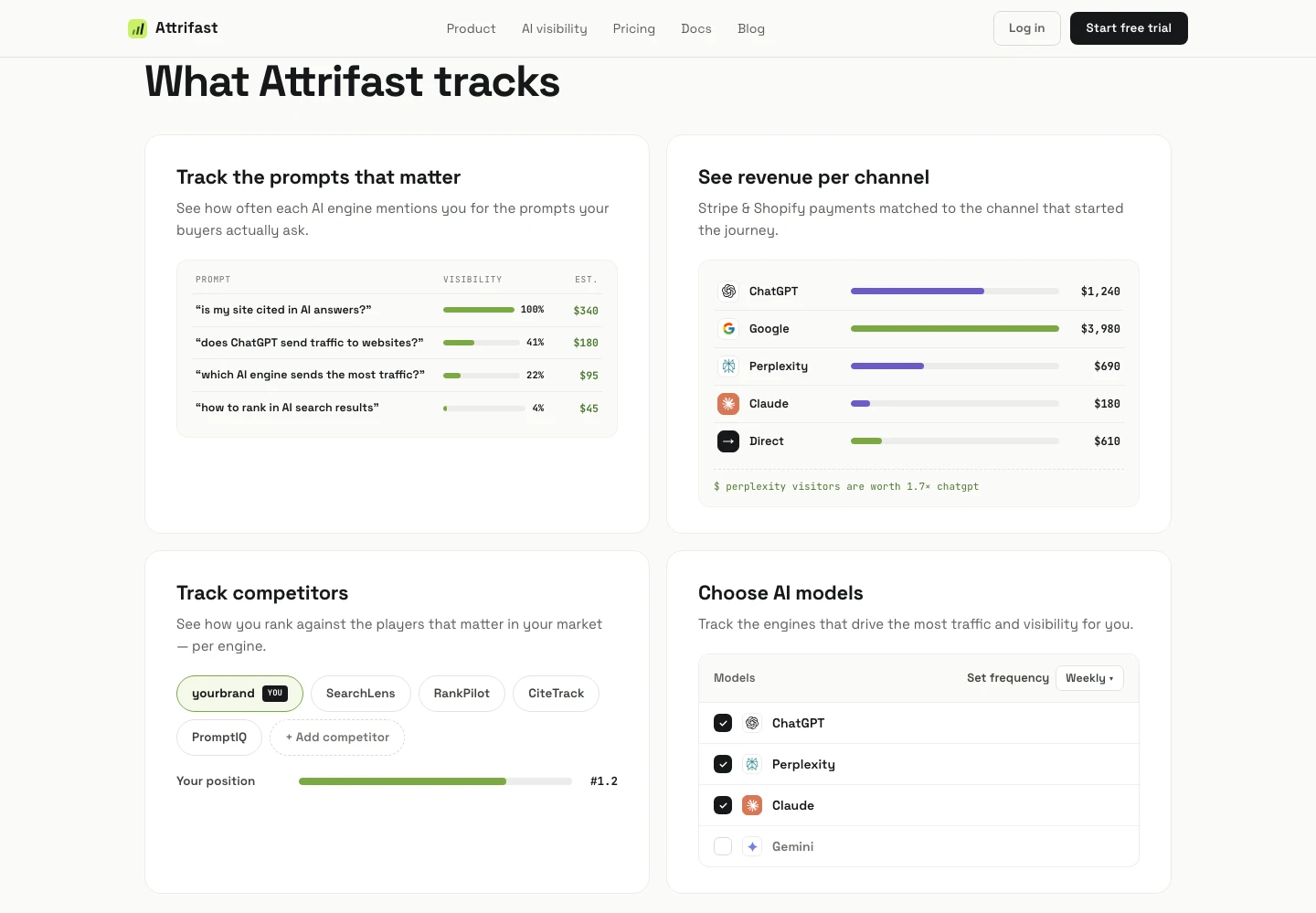
The alternative is to run a first-party script that stores the session server-side, pass its visitor ID through checkout, and let the payment webhook close the loop. The join is deterministic, the conversion is a settled charge, and refunds subtract. What comes out the other side is a channel report denominated in money:
| Dimension | GA4 custom channel grouping | Payment-joined revenue attribution |
|---|---|---|
| Cost | Free (plus your engineering time) | $9.99-$49/mo at the SMB end; $175-$1,500/mo for the incumbent tools |
| Setup effort | 2-6 hours of regex, plus ongoing maintenance as engines change | One script tag plus one payment-processor connection |
| Unit of truth | Session and event | Settled charge, net of refunds |
| AI engines as first-class channels | Partial — AI Assistants channel, Perplexity in Referral | Yes, all four engines tracked separately by RPV |
| No-referrer sessions | Lost to Direct | Recoverable via server-side signals when they exist |
| Multi-touch path reconstruction | Limited by GA4's modeling and lookback | Full ordered path per paying customer |
| Median AI revenue undercount in the cohort | 41% with a custom grouping; 64% on defaults | 3% |
| Honest weakness | Cannot see payments at all | Cannot see offline, view-through, or brand-lift effects |
Neither column is a trap. If your marketing is 90% paid media with heavy view-through and offline components, Path A plus a modeling vendor is the right shape. If your revenue lands in a payment processor and you need to know which channel produced it, Path B answers a question Path A structurally cannot. The comparison of cross-channel attribution software by what it joins to goes tool by tool.
What does cross-channel attribution software cost in 2026?
All prices below were checked against public pricing pages in July 2026. Where a vendor gates pricing behind a demo, I have said so rather than repeating a number I cannot verify.
| Tool | Entry price | Joins conversions to | AI engines as their own channel |
|---|---|---|---|
| Northbeam | ~$1,500/mo [15] | Ad platforms + ecommerce orders | No |
| Wicked Reports | $250/mo [17] | CRM + ecommerce orders | No |
| Hyros | ~$230/mo entry, annual commitment, demo-gated [18] | Ad platforms + CRM | No |
| Similarweb | $199/mo [7] | Market and traffic estimates, not your orders | Partial (traffic-level, not revenue) |
| SegMetrics | $175/mo [16] | CRM + payment data | No |
| Triple Whale | $129/mo [14] | Shopify orders + ad platforms | No |
| AnyTrack | $100-$300/mo [13] | Ad platforms + conversion APIs | No |
| Attrifast | $9.99/mo Starter, $49/mo Pro | Stripe settled charges | Yes — ChatGPT, Perplexity, Claude, Gemini reported separately |
Attrifast pricing in full, so nothing is hidden: Starter $9.99/mo or $99.90/yr; Pro $49/mo or $490/yr; 7-day free trial with $0 due today; no free tier. There is a larger tier called Agency for teams managing many client properties — it is waitlist-only right now and I am not quoting a price for something that has not shipped.
The reason the price gap is so wide is scope, not quality. Northbeam and Hyros are built for teams spending six figures a month on media, where view-through modeling and offline ingestion genuinely matter. That machinery is expensive to run and expensive to sell. If your question is narrower — which channel produced the charges in my Stripe account, including the AI ones — you are buying a much smaller machine.
Where does this break, and how would you know?
I would rather you find these before you find them at the wrong moment.
Cross-device journeys stay broken. A buyer who discovers you on a phone via ChatGPT and pays on a laptop will show up as two visitors unless something logs them in on both. Deterministic attribution does not solve identity resolution; it just refuses to guess. Expect 5-15% of paths to be split this way in consumer contexts.
In-app AI browsers are getting quieter, not louder. The share of AI sessions arriving with no referrer has been climbing as more of this traffic moves into mobile apps [6]. Any measurement approach that depends on the referrer header is on a slowly shortening clock.
Attribution is not incrementality. Even a perfect cross-channel model tells you which channels touched revenue, not which channels caused it. Branded paid search is the canonical case: it will look excellent in every attribution model and may be buying clicks you would have gotten free. Holdout tests answer that question; attribution never will.
The AI channel mix moves quarterly. ChatGPT's share of generative AI web traffic fell from roughly 76% to 53% in twelve months while Gemini and Claude took the difference [7], and citation dynamics keep shifting as engines change retrieval behavior — the Princeton GEO work showed that content-side optimization alone can move visibility in generative answers by up to 40% [12]. A channel breakdown built on last year's engine weights is already stale.
Your own numbers should disagree with the platforms — by a predictable amount. If Google Ads and Meta together claim 140% of your settled conversions, that is normal. If they claim 400%, something is misconfigured. Reconcile monthly and watch the ratio, not the absolute gap.
FAQ: cross-channel marketing attribution
What is cross-channel marketing attribution?
It is the practice of assigning credit for one conversion across every channel that touched the buyer, using a measurement system that sits outside all of those channels. The word doing the work is cross: each ad platform, email tool, and AI engine sees only its own slice, so arbitration has to happen somewhere they all report into. In 2026 the channel list runs to ten families, not six — organic search, paid search, paid social, organic social, email, direct, referral, affiliate, and the AI answer engines, which behave as a distinct channel with their own conversion rate and revenue per visitor.
What is the difference between a cross-channel attribution model and multi-touch attribution?
Multi-touch attribution is a rule for splitting credit among touches you already recorded. Cross-channel attribution is the prior problem of recording those touches at all, across systems that do not talk to each other. Choosing a multi-touch weighting rule before the touch log is complete just distributes a distorted total more elegantly. Fix the identity chain and the payment join first; the weighting argument gets much shorter afterwards.
Should I use deterministic or probabilistic attribution?
At small and mid-size scale, deterministic. Probabilistic modeling needs volume to be honest — roughly 50 or more conversions per channel per week, and two to three years of history before media-mix coefficients stabilize. Below that, a model fitted to 30 monthly sales is largely a restatement of your assumptions. Deterministic payment-joined attribution has no minimum volume because it estimates nothing; it matches a stored session to a settled charge and reports an explicit unattributed bucket for everything it cannot match.
Does GA4 handle AI channels now?
Partly. The AI Assistants channel added in May 2026 classifies a good share of AI referrals with no configuration [1][2], but Perplexity is missing from the published engine list and still lands in Referral, and roughly a third of AI sessions carry no referrer for any rule to read [6]. Sites on the default grouping still undercount AI-referred revenue by a median 64% against a payment-verified baseline.
How much does cross-channel attribution software cost in 2026?
Checked against public pricing pages in July 2026: Northbeam around $1,500/mo, Wicked Reports from $250, Hyros roughly $230 at entry on an annual commitment and demo-gated, Similarweb $199, SegMetrics $175, Triple Whale $129, AnyTrack $100-$300. Attrifast sits below that band at $9.99/mo Starter ($99.90/yr) and $49/mo Pro ($490/yr), with a 7-day free trial and $0 due today. There is no free tier.
What is revenue per visitor, and why use it for cross-channel comparison?
Revenue per visitor is settled revenue divided by unique visitors from a channel. It is the fairer cross-channel yardstick because it survives channels of wildly different size — 400 sessions a month cannot be compared to 40,000 on conversion counts alone. In the benchmark the spread runs about seven to one, from $1.94 on Claude down to $0.29 on AI Overviews, which is exactly why session-share rankings and revenue rankings so often disagree.
The bottom line
Cross-channel marketing attribution is not a modeling problem first. It is a plumbing problem: one durable identity, one complete touch log, one financially true conversion record. Solve those and the choice of weighting rule becomes a ten-minute conversation instead of a quarterly argument.
The 2026 update to the classic playbook is that the channel list grew. Organic search, paid search, paid social, organic social, email, direct, referral, affiliate — and now four AI answer engines that in my cohort carry 11% of revenue and the highest revenue per visitor of anything measured. Guides that stop at six channels are describing a market that ended around 2023.
If you want to see the ten-channel version of your own numbers, it takes one script tag and one Stripe connection: see how the AI revenue join works, or compare the Starter and Pro plans — $9.99/mo and $49/mo, 7-day free trial, nothing due today — and find out what your Direct bucket has actually been hiding.
References
- Default channel group — the GA4 channel list, including the AI Assistants channel — Google Analytics Help (2026)
- Google Analytics Adds AI Assistant As Default Channel Group — Search Engine Journal (2026)
- How double-counting conversions in ad platforms skews budget allocation — Ruler Analytics (2026)
- About conversion windows — 30-day default click-through window, configurable 1-90 days — Google Ads Help (2026)
- About attribution models — how Google Ads assigns conversion credit — Google Ads Help (2026)
- Why ChatGPT traffic shows as Direct in GA4 — 371,847 sessions, 35.7% with no referrer — Clickport (2026)
- AI search stats 2026 — generative AI traffic share by platform — Similarweb (2026). Similarweb subscription pricing checked at similarweb.com/corp/pricing, July 2026.
- Checkout Session object — client_reference_id and metadata as attribution join keys — Stripe (2026)
- Claude drives 10.6% of our signups; Google Analytics says 0.1% — Otterly.ai (2026)
- AI traffic revenue benchmark 2026 — 200 Stripe-connected sites, per-engine RPV and conversion — Attrifast (2026)
- How to track AI traffic in Google Analytics 4 — custom channel group setup — Analytics Mania (2026)
- GEO: Generative Engine Optimization — measuring visibility across generative engines — arXiv, Aggarwal et al., Princeton/Georgia Tech (2024)
- AnyTrack pricing — $100 to $300 per month tiers — AnyTrack, checked July 2026
- Triple Whale pricing — $129 per month entry — Triple Whale, checked July 2026
- Northbeam pricing — approximately $1,500 per month — Northbeam, checked July 2026
- SegMetrics pricing — $175 per month entry — SegMetrics, checked July 2026
- Wicked Reports pricing — $250 per month entry — Wicked Reports, checked July 2026
- Hyros — attribution platform with demo-gated pricing, approximately $230 per month at entry on an annual commitment — Hyros, checked July 2026