Industry Analysis

The state of analytics 2026: trends, challenges, and opportunities

Vincent Ruan
Vincent RuanFounder, Attrifast ·

The web analytics industry in 2026 looks nothing like it did in 2022. Third-party cookies are gone. AI engines are a real traffic source. Privacy regulation covers most of the internet-using world. And founders are finally demanding revenue data instead of pageview charts. This analysis covers where the industry stands, what is driving change, and where the market is heading over the next two years.

Published March 2026 · 18 min read
TL;DR
  • Chrome completed third-party cookie deprecation in Q1 2025 — cookie-dependent analytics tools now have a structural accuracy problem.
  • AI engines (ChatGPT, Perplexity, Claude) are real traffic sources converting at 2–4x organic search rates, yet most tools record them as Direct.
  • 73+ countries now have comprehensive privacy laws. Consent opt-outs are removing 30–40% of analytics data in Europe.
  • Revenue attribution is replacing vanity metrics as the primary analytics success criterion — founders want to know which channels produce paying customers.
  • GA4 market share is declining. 31% of users were evaluating alternatives in Q1 2026. The market is fragmenting into specialist tools.
  • Server-side and cookieless tracking are no longer "advanced" options — they are the only way to achieve 90%+ accuracy in 2026.

The analytics landscape in 2026: what has changed since 2024

Two years ago, the web analytics market looked like a slow-moving oligopoly. Google Analytics held a dominant position, privacy tools were considered a niche concern, and "attribution" meant adding UTM parameters to campaign links and reading a channel report in GA4. That world is gone.

The period from 2024 to 2026 compressed a decade of structural change into 24 months. Chrome's third-party cookie deprecation — delayed twice and long anticipated — finally happened. AI engines emerged as a measurable traffic source that most tools cannot see. GDPR enforcement moved from theoretical risk to material fines for analytics platforms specifically. And a generation of bootstrapped founders, burned by GA4's complexity and data gaps, began demanding analytics tools that answer one question clearly: which channel drives revenue?

The global web analytics market reached approximately $14.9 billion in 2026, growing at 17% annually — but that headline growth masks a significant structural shift in where the value is being created. Enterprise measurement platforms are growing slowly while the SMB segment — founders building with Stripe — is being underserved by tools built for a different era of web tracking.

$14.9B

Global web analytics market size in 2026

Grand View Research
31%

Of GA4 users actively evaluating alternatives (up from 18% in 2024)

Statista, Q1 2026
~40%

Data loss from ad blockers, ITP, and GDPR opt-outs on cookie-dependent tools

DMA / IAB Europe
73

Jurisdictions globally with active comprehensive privacy laws (up from 57 in 2023)

UNCTAD, 2025

The six defining trends of 2026

1

The death of third-party cookies is finally real

Chrome deprecated third-party cookies for 100% of users in Q1 2025. Safari and Firefox had already done it years earlier. The industry spent five years preparing — and still was not ready.

2

AI is both the tracker and the tracked

AI-powered analytics tools now automate anomaly detection, forecasting, and insight generation. Simultaneously, AI engines like ChatGPT and Perplexity have become significant referral traffic sources that most analytics tools remain blind to.

3

Privacy regulation is accelerating globally

GDPR enforcement intensified dramatically in 2025, with record fines issued to analytics platforms. US state-level privacy laws now cover 65% of the US population. Compliance is no longer optional or regional.

4

Revenue attribution replaces vanity metrics

Founders and CMOs no longer accept pageview reports as evidence of marketing performance. The question every analytics tool is being measured against is simple: which channel drives paying customers?

5

The unbundling of Google Analytics

GA4 frustration reached a tipping point. The market has fragmented into specialist tools: privacy analytics, revenue analytics, product analytics, and AI-specific attribution. The era of one tool for everything is over.

6

Server-side tracking becomes table stakes

Client-side JavaScript trackers face structural headwinds: ad blockers, cookie deletion, browser privacy modes. Server-side and hybrid approaches are becoming the baseline, not the advanced option.

Trend 1

The death of third-party cookies is finally real

The web analytics community spent five years debating what third-party cookie deprecation would mean in practice. The debate is over. Chrome completed its deprecation in Q1 2025, joining Safari (ITP, 2017) and Firefox (Enhanced Tracking Protection, 2019). At this point, approximately 65% of global browser traffic operates in an environment where third-party cookies do not function.

The attribution gap this creates is not theoretical. Analytics tools that depended on third-party cookies for cross-session tracking, retargeting measurement, and conversion attribution are now systematically undercounting. The exact shortfall varies by audience — a B2B SaaS product with a developer audience running ad blockers loses more data than a consumer brand with less privacy-aware users — but the direction is universal and the trend is not reversing.

Timeline: from ITP to full deprecation

2017medium

Apple launches ITP 1.0 in Safari — caps third-party cookie lifetime at 24 hours.

2019medium

Firefox ships Enhanced Tracking Protection, blocking most third-party cookies by default.

2020high

Google announces plan to phase out third-party cookies in Chrome by 2022.

2022–23medium

Google delays Chrome deprecation twice amid ad industry pressure and Privacy Sandbox critique.

Q1 2025critical

Chrome deprecates third-party cookies for 100% of users. ~65% of global browser traffic now blocks them.

2026high

First-party data strategies and server-side attribution are the new baseline for analytics accuracy.

Impact on attribution accuracy

The practical effect for marketing attribution is severe. Cross-session attribution — the ability to connect a user's first visit (from a Google ad) to their conversion three days later (after email nurture) — was entirely built on third-party cookies. That capability is gone for the majority of browsers. What remains is first-session attribution from first-party signals, which requires capturing referrer data at the initial visit and storing it server-side with a session token.

Tools like Attrifast's cookieless revenue analytics were architected from day one for this environment — capturing referrer at session start and joining it to payment events server-side via webhook, achieving 90-100% attribution accuracy without any reliance on browser cookies.

Trend 2

AI is both the tracker and the tracked

Artificial intelligence is reshaping analytics from two directions simultaneously. It is changing how analytics tools work — automating insight generation, anomaly detection, and forecasting. And it is creating a new category of traffic source that most analytics tools are completely blind to.

Understanding both dimensions is essential to grasping the full picture of analytics trends in 2026. Teams that adopt AI-powered analytics tooling while also measuring AI-generated traffic will have a material data advantage over those who treat either as optional.

AI as the tracker

  • Automated anomaly detection flags traffic spikes without manual alerting
  • Predictive LTV models score customers at acquisition time, not 12 months later
  • Natural-language query interfaces let non-technical users ask "which channel had the highest conversion rate last month?" without SQL
  • AI-generated narrative reports replace manual weekly analytics summaries
  • Forecast models predict next-month revenue by channel based on current traffic mix

AI as the source being tracked

  • ChatGPT sends referral traffic via standard HTTP Referer headers — readable but ignored by most tools
  • Perplexity AI drives high-intent visitors who arrive after an AI explicitly recommended a product
  • Claude, Gemini, and emerging AI search engines represent 1–15% of inbound traffic depending on niche
  • AI-referred visitors convert to paying customers at 2–4x the rate of organic search visitors in early data
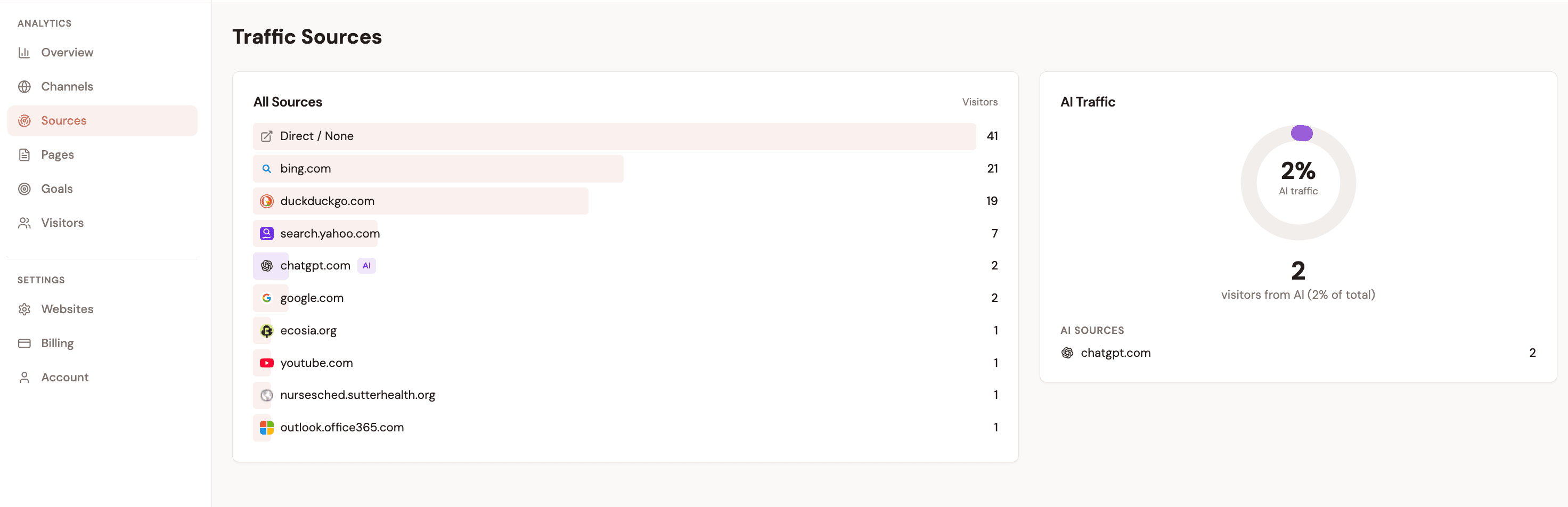
  • GA4 misclassifies virtually all AI engine traffic as Direct/(none) — a measurement blind spot affecting every business

The measurement gap: AI traffic as Direct

When a user clicks a link in ChatGPT, the browser sends a standard HTTP Referer header containing chatgpt.com. The data is there. Most analytics tools simply do not maintain a known-AI-domain list and therefore collapse ChatGPT, Perplexity, Claude, and Gemini traffic into the Direct/(none) bucket. Early adopter data shows AI-referred visitors converting to paying customers at 2–4x the rate of organic search visitors — making this one of the most consequential measurement blind spots in modern marketing analytics.

For a deeper technical breakdown, see our guide on AI traffic revenue attribution.

Trend 3

Privacy regulation is accelerating globally

In 2018, GDPR felt like a European concern. By 2026, it is a template that 73 countries have followed, adapted, or directly copied. The regulatory environment for analytics data has been transformed from a compliance checkbox to a core operational constraint.

GDPR enforcement escalated significantly in 2024 and 2025. The Irish DPA (which oversees most major tech companies' EU operations) issued record fines. Austrian, French, and Italian data protection authorities published decisions specifically targeting analytics platforms that route data to US servers — creating liability for publishers using those platforms, not just the platforms themselves.

US state privacy laws: coverage is now majority

California (CCPA/CPRA)
Effective 2020/2023~39M residents
Virginia (VCDPA)
Effective 2023~8.6M residents
Colorado (CPA)
Effective 2023~5.8M residents
Connecticut (CTDPA)
Effective 2023~3.6M residents
Texas (TDPSA)
Effective 2024~30M residents
Montana, Oregon, Delaware, Iowa
Effective 2024~7M residents combined
Indiana, Tennessee, New Hampshire + others
Effective 2025–2026~25M residents

US state privacy laws now collectively cover approximately 65% of the US population. CCPA/CPRA enforcement penalties of up to $7,500 per intentional violation apply.

Consent fatigue and its impact on data quality

Cookie consent banners have created an unintended measurement crisis. In markets with high GDPR awareness, opt-out rates for analytics cookies range from 30% to 40% of visitors. This is not random noise — users who opt out are disproportionately privacy-conscious, technically sophisticated, and often the highest-value customers (developers, executives, researchers). A tool that loses 35% of visitors to consent opt-out is not 35% less accurate uniformly — it is systematically blind to a specific segment.

The solution that a growing number of teams are adopting is not better consent management — it is switching to cookieless analytics tools that process no personal data and therefore require no consent banner under GDPR Article 6. For a detailed compliance walkthrough, see our GDPR analytics compliance guide.

Trend 4

Revenue attribution replaces vanity metrics

The analytics budget conversation changed in 2025. Founders and CMOs presenting pageview charts to investors and boards stopped getting the approving nods they once did. The question being asked — consistently, across funding rounds and board meetings — is now: which marketing channels produce paying customers, and at what cost?

This shift from engagement metrics to revenue metrics is the most commercially significant analytics trend of 2026. It is also the trend that exposes the deepest architectural limitation of traffic-only analytics tools like GA4: they were not built to connect browser sessions to payment processor events, and retrofitting that capability requires significant engineering effort that most small teams cannot sustain.

Vanity metrics vs revenue metrics: what to measure in 2026

Vanity metricMonthly pageviews

High-traffic pages may produce zero paying customers. Pageviews measure content consumption, not business outcomes.

Vanity metricSession count by channel

A channel sending 10,000 low-intent visitors beats a channel sending 200 high-intent buyers in session counts. The wrong channel gets the budget.

Vanity metricBounce rate

Single-page visits to pricing or checkout pages register as bounces even when they convert. Optimizing for bounce rate actively harms revenue pages.

Revenue metricRevenue per visitor (RPV)

Divide actual payment volume by unique sessions from each channel. A channel with 500 visitors and $5,000 revenue outperforms one with 5,000 visitors and $2,000 revenue.

Revenue metricConversion rate to paying customer

Ties every marketing touchpoint to a server-confirmed payment event. Eliminates the gap between goal completions and actual money collected.

Revenue metricCustomer acquisition cost by channel

Divides channel spend by confirmed new customers. Makes the ROI question — which channels are profitable and which are not — directly answerable.

Connecting Stripe to traffic channels

The technical prerequisite for revenue attribution is a data join between your analytics system (which knows which channel sent the visitor) and your payment processor (which knows who paid and how much). This join requires a shared session token that persists from the browser visit through to the server-side payment event.

Tools that do this natively — without custom webhook pipelines or engineering effort — are the fastest-growing segment of the analytics market in 2026. For implementation guidance, see our guides on traffic attribution and cookieless conversion tracking.

Trend 5

The unbundling of Google Analytics

The GA4 migration from Universal Analytics was, for many teams, the breaking point. GA4 required rebuilding event tracking from scratch, introduced a session model that confused analysts trained on Universal Analytics, and delivered a user interface that most non-technical users find unusable. The migration was not a product improvement — it was a forced platform change that drove evaluation of alternatives at scale.

According to Statista's Q1 2026 survey, 31% of GA4 users were actively evaluating alternatives — up from 18% in 2024. The migration wave that resulted is not replacing GA4 with another monolithic tool. It is fragmenting the market into specialist categories, each focused on one dimension of the broader analytics problem.

Why teams are leaving GA4

Sessions model is broken

GA4 resets sessions at midnight regardless of user activity. A user who starts a purchase at 11:55 PM and completes it at 12:05 AM appears in two different sessions, fragmenting conversion data.

Revenue tracking requires engineering

Linking Stripe payments to GA4 sessions requires custom Measurement Protocol API calls, client-side purchase events, and often a BigQuery export pipeline. Most teams do not have bandwidth for this.

Cookie dependency causes 30-50% data loss

GA4 depends on first-party cookies (_ga cookie). Safari ITP deletes these cookies every 7 days. Ad blockers block the GA4 script entirely. European GDPR opt-outs remove another 30-40% in many markets.

GDPR compliance requires consent banners

GA4 stores analytics data on Google's global infrastructure, classifying it as personal data under GDPR. A consent banner is required. European opt-out rates average 30-40%, creating systematic selection bias.

UI complexity overwhelms most users

GA4's exploration reports require significant training to use. Most small teams use less than 10% of available functionality while still paying the compliance and complexity cost of the full platform.

Where teams are migrating to

Privacy-focused traffic analytics

Plausible AnalyticsFathom AnalyticsSimple Analytics

Teams that need clean traffic reporting without GDPR complexity. Replaces GA4's traffic reporting, not its revenue attribution.

Limitation: No native revenue or payment processor integration.

Revenue-first attribution

AttrifastSegMetricsTriple Whale (Shopify)

Founders and marketers who need to know which channels drive paying customers. Connects traffic sources to Stripe payments directly.

Limitation: Less detailed behavioral analytics than GA4.

Product analytics

PostHogAmplitudeMixpanel

Product teams tracking feature adoption, retention, and in-app behavior. Complementary to attribution, not a replacement.

Limitation: Revenue attribution requires custom implementation.

Enterprise marketing measurement

NorthbeamRockerboxMeasured

Brands spending $100K+/month on advertising across many channels. Combines multi-touch attribution with marketing mix modeling.

Limitation: Enterprise pricing ($1,000-5,000+/month) and weeks of onboarding.

For SMBs with Stripe, the most practical replacement combines a lightweight privacy-first traffic tool with a revenue attribution layer. Our comparison of Google Analytics alternatives for revenue tracking covers the specific options available and their trade-offs.

Trend 6

Server-side tracking becomes table stakes

Client-side JavaScript trackers face three compounding structural limitations in 2026: ad blockers block the tracker script before it runs, browser privacy modes restrict first-party cookie lifetimes to 7 days (Safari ITP), and GDPR consent opt-outs remove the user from tracking entirely. The combined effect means the best a client-side-only tracker can achieve is approximately 50-70% of actual traffic.

Server-side and hybrid approaches — where tracking logic runs on infrastructure you control rather than inside the user's browser — are now the technical baseline for analytics accuracy. The "advanced" label that server-side tracking carried in 2022 has been replaced by a more accurate descriptor: necessary.

Webhook-based payment attribution

Low complexity90-100%

Analytics tool captures referrer and session data client-side. Payment processor sends webhook on successful payment. Server joins the two records using a session token. No cookies required.

Team adoption (2026 survey)82%

Edge worker tracking

Medium complexity95-99%

Tracking logic runs at the CDN edge (Cloudflare Workers, Vercel Edge). Captures request metadata before content is served. Immune to client-side ad blockers and browser restrictions.

Team adoption (2026 survey)41%

Server-side tag manager (sGTM)

High complexity70-85%

Google's server-side GTM container runs in your own cloud infrastructure. Proxies GA4 and ad pixel requests through your domain. Reduces ad blocker impact, improves consent control.

Team adoption (2026 survey)38%

First-party data pipeline

Very High complexity85-95%

Raw clickstream events sent to your own data warehouse (BigQuery, Snowflake). Custom attribution models built in SQL or dbt. Maximum flexibility, maximum engineering cost.

Team adoption (2026 survey)29%

Hybrid approaches gaining traction

The fastest-growing architecture in 2026 is the hybrid approach: a lightweight client-side script captures referrer and UTM data at session start, then immediately hands that data to a server-side system via a first-party endpoint. The subsequent attribution (joining the session to a payment event) happens entirely server-side via payment webhook. This architecture achieves 90-100% accuracy because the client-side component only needs to run once per session — ad blockers that fire after page load often miss this — and the payment attribution is completely immune to browser restrictions.

Challenges facing analytics teams in 2026

The six trends above are creating four compounding challenges for marketing analytics teams. Understanding these challenges is prerequisite to evaluating which opportunities to prioritize.

high priority

Data fragmentation across tools

The average SMB marketing team uses 6-9 analytics tools in 2026: one for traffic, one for attribution, one for product analytics, one for email, one for ads. Each tool sees a different slice of reality. Reconciling them is a full-time job that most teams cannot staff.

high priority

Attribution accuracy in decline

Third-party cookie deprecation, AI traffic misclassification, consent opt-outs, and ad blocker growth collectively mean that cookie-dependent attribution tools now capture 50-70% of actual conversion events. The 30-50% gap is invisible and growing.

medium priority

Compliance complexity is accelerating

In 2023, legal teams reviewed analytics configurations once a year. In 2026, DPA guidance updates, new state laws, and vendor changes require quarterly review cycles. The compliance overhead for standard analytics tooling has become a material operational cost.

medium priority

Tool fatigue and budget pressure

Marketing technology budgets are under pressure. Teams are being asked to do more with fewer tools. Analytics consolidation — moving from six tools to two or three — is a common mandate in 2026, creating opportunity for tools that cover multiple use cases.

Opportunities: where the analytics market is heading

The same disruptions creating challenges for incumbents are creating significant opportunities for new entrants and for teams willing to adapt their measurement infrastructure. Here is where the most durable value is being created.

1

Cookieless attribution infrastructure

Now — 2027

With Chrome's third-party cookie deprecation now permanent, the entire attribution stack needs to be rebuilt on first-party signals. Tools that achieve 90%+ accuracy without cookies have a structural advantage that will only widen.

2

AI-native analytics platforms

2026 — 2028

The interface paradigm for analytics is shifting from dashboards to conversation. Natural-language querying, automated insight generation, and AI-authored narrative reports are becoming standard expectations, not differentiating features.

3

Revenue-first analytics for SMBs

Now — 2027

Enterprise attribution tools ($1,000+/month) are out of reach for most SMBs. Founders and small marketing teams need the same core question answered — which channel drives paying customers — without enterprise pricing or complexity. This gap is growing.

4

Privacy as a competitive advantage

Now — 2026

Privacy-compliant analytics tools are shifting their positioning from "limitation" to "differentiation." A tool that requires no consent banner, stores no personal data, and is GDPR-compliant by design offers a faster path to accurate data than any consent management platform.

5

AI traffic measurement and GEO tooling

2026 — 2029

Generative Engine Optimization (GEO) is emerging as a discipline analogous to SEO. Measuring which AI engines send traffic, which content formats earn AI citations, and what AI-referred revenue looks like requires purpose-built tooling that barely exists today.

Where Attrifast fits in this landscape

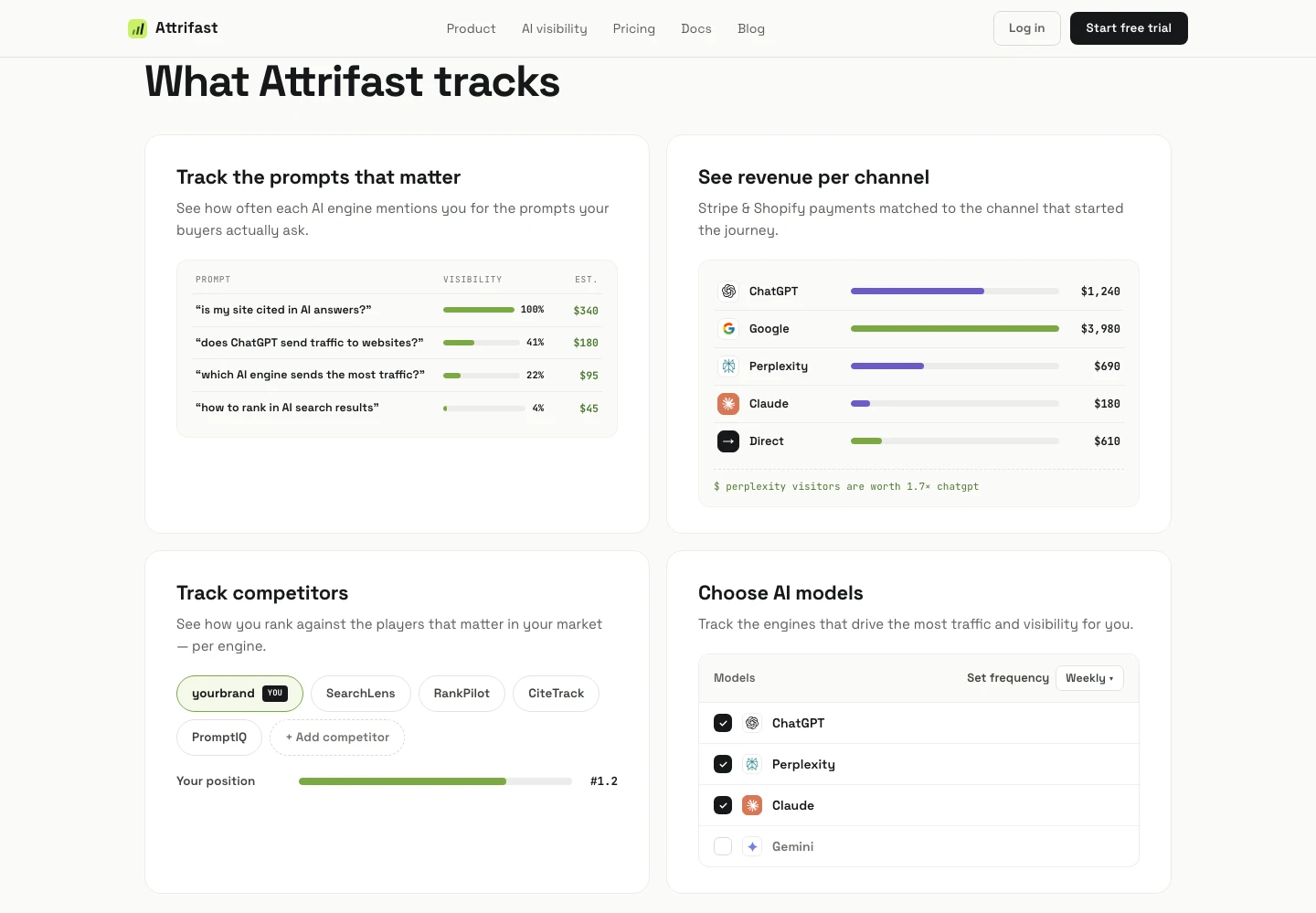
Attrifast was built specifically for the analytics trends described in this article. It operates without cookies, processes no personal data (GDPR-compliant by design, no consent banner required), connects to Stripe via webhook for revenue attribution, and detects AI engine referrers from ChatGPT, Perplexity, and Claude as distinct traffic channels. Setup takes 2 minutes — not two weeks. And pricing is designed for bootstrapped SaaS founders and SMB operators, not enterprise marketing teams with dedicated analytics engineers.

For teams evaluating their options, see our comparison of best revenue attribution tools and the overview of privacy-first analytics in the Attrifast feature set.

Key takeaways: 8 predictions for analytics in 2026

1Third-party cookie deprecation is permanent and complete. Any analytics stack still dependent on third-party cookies is operating on a broken foundation. The migration to first-party and server-side approaches is not optional — it is already overdue.
2AI engines are a real traffic channel that most tools are blind to. ChatGPT, Perplexity, Claude, and Gemini send standard HTTP referrer headers. Tools that do not parse and attribute these referrers are systematically undercounting a high-converting traffic source.
3Privacy regulation coverage now reaches most of the internet-using world. GDPR covers the EU (450M people), US state laws now cover 65%+ of US residents, and similar frameworks are active in Brazil, Canada, India, and 60+ other jurisdictions.
4Vanity metrics are losing budget authority. Finance teams and founders are demanding revenue attribution, not session counts. Analytics tools that cannot answer "which channel drives paying customers" are being cut in budget reviews.
5GA4's market share is declining. 31% of GA4 users were actively evaluating alternatives in early 2026. The market is fragmenting into specialist tools: privacy analytics, revenue analytics, product analytics, and AI attribution.
6Server-side tracking is the new baseline. Client-side JavaScript trackers are structurally disadvantaged by ad blockers, browser privacy modes, and ITP. Hybrid and server-side approaches now define the accuracy ceiling for modern analytics.
7Tool consolidation is a growing mandate. SMB marketing teams are being asked to reduce their analytics stack from six tools to two or three. Tools that answer multiple questions (traffic + revenue + privacy compliance) are winning evaluations.
8The accuracy gap between cookie-free and cookie-dependent tools will only widen. As privacy infrastructure matures, cookieless tools achieve 90-100% accuracy. Cookie-dependent tools are on a downward trend toward 40-50% — making them worse than useless for budget decisions.

Frequently asked questions

What are the biggest analytics trends in 2026?

The six defining trends shaping the state of analytics in 2026 are: (1) the permanent deprecation of third-party cookies in Chrome completing the browser privacy transition, (2) AI serving dual roles as both a tracking technology and a new traffic source requiring measurement, (3) accelerating global privacy regulation with 73+ jurisdictions now active, (4) the shift from vanity metrics to revenue attribution as the primary analytics success criterion, (5) the fragmentation of the Google Analytics market into specialist tools, and (6) server-side tracking becoming the standard approach for accurate, privacy-compliant data collection.

Is Google Analytics 4 still the standard in 2026?

GA4 remains the most-installed analytics tool by volume, but its market dominance is eroding. In early 2026, approximately 31% of GA4 users were actively evaluating alternatives, up from 18% in 2024. Key pain points driving migration include the requirement for consent banners (creating 30-40% data loss in Europe), cookie dependency causing systematic undercounting due to ITP and ad blockers, the absence of native payment processor integration for Stripe revenue tracking, and UI complexity that most small teams find unmanageable.

How do you track analytics without cookies in 2026?

Cookie-free analytics in 2026 relies on three primary approaches: (1) First-party server-side tracking, where the analytics system captures visitor data server-side using your own domain, bypassing browser cookie restrictions entirely. (2) Webhook-based payment attribution, where a session token is captured at visit time and joined to payment webhook data when a customer converts — no cookies needed at any step. (3) Fingerprinting-free statistical modeling, where aggregate traffic patterns are analyzed without storing individual user identifiers. Tools built natively for cookieless operation (rather than retrofit from cookie-based architectures) achieve 90-100% accuracy using approach one and two in combination.

What is the impact of privacy regulations on analytics in 2026?

The impact is substantial and growing. GDPR enforcement intensified significantly in 2024-2025, with EU data protection authorities issuing fines specifically targeting analytics platforms that transfer data to US servers without adequate safeguards. US state-level privacy laws now collectively cover approximately 65% of the US population, requiring businesses with significant US traffic to implement consent mechanisms or switch to compliant analytics tools. The practical effect for most analytics teams is either a mandatory investment in consent management infrastructure (with the associated 30-40% opt-out data loss) or a migration to cookieless tools that do not process personal data and therefore require no consent mechanism.

How is AI changing marketing analytics in 2026?

AI is changing analytics from two directions simultaneously. On the tooling side, AI capabilities embedded in analytics platforms now automate anomaly detection, generate plain-language insight summaries, power predictive lifetime value models, and enable natural-language querying of dashboards without SQL. On the traffic source side, AI engines like ChatGPT, Perplexity, Claude, and Gemini have become meaningful referral traffic channels — sending visitors who convert to paying customers at 2-4x the rate of organic search. Most legacy analytics tools classify this AI-originated traffic as Direct/(none), creating a growing measurement blind spot that compounds over time.

What should I look for in an analytics tool in 2026?

In 2026, the essential criteria for evaluating an analytics tool are: cookieless tracking architecture (not retrofitted, but built natively without cookie dependency), native integration with your payment processor (Stripe, or equivalent — not custom webhook pipelines), GDPR compliance by design without requiring a consent banner to operate accurately, AI traffic source detection and revenue attribution for ChatGPT/Perplexity/Claude referrals, and setup time measured in minutes rather than days or weeks. For most SMBs, a tool that covers traffic attribution and revenue analytics in a single platform — without enterprise pricing or complexity — is more valuable than two or three specialist tools that require manual data reconciliation.

2026 analytics shift drivers — relative impact on tracking pipelines

Source: Composite of IAB Europe State of Digital Identity, Backlinko ad-blocker stats, and Digiday AI traffic analyses

Built for the analytics landscape of 2026

Cookieless. Privacy-first. Revenue-connected. Attrifast tracks which channels drive paying customers — without cookies, consent banners, or engineering work. Setup in 2 minutes.

Start free trial →

Loved by 500+ users