Benchmark Report · 2026

2026 marketing attribution benchmark report: data, trends, and industry insights

Vincent Ruan
Vincent RuanFounder, Attrifast ·

How are companies across every size tier actually doing attribution in 2026? This report synthesizes data from Forrester, Gartner, HubSpot, and Salesforce — plus first-party analysis of attribution patterns across 10,000+ websites — to benchmark marketing attribution model adoption, channel performance, cookie deprecation impact, and the rise of AI traffic as a measurable revenue source.

Published March 2026·22 min read·10,000+ sites analyzed
Executive summary: key findings at a glance
$8.2B

Global marketing attribution software market size in 2026

Gartner Market Guide, 2026
43%

Of marketers still rely exclusively on last-touch attribution despite its known distortions

HubSpot State of Marketing, 2026
67%

Of paid ad spend is misattributed due to cookie loss, cross-device journeys, and poor tooling

Forrester Research, 2025
2.4x

Revenue uplift for companies that shifted from single-touch to multi-touch attribution models

Salesforce State of Marketing, 2025
38%

Drop in third-party cookie data availability since Chrome began phased deprecation in 2024

IAB Tech Lab Privacy Report, 2025
1–5%

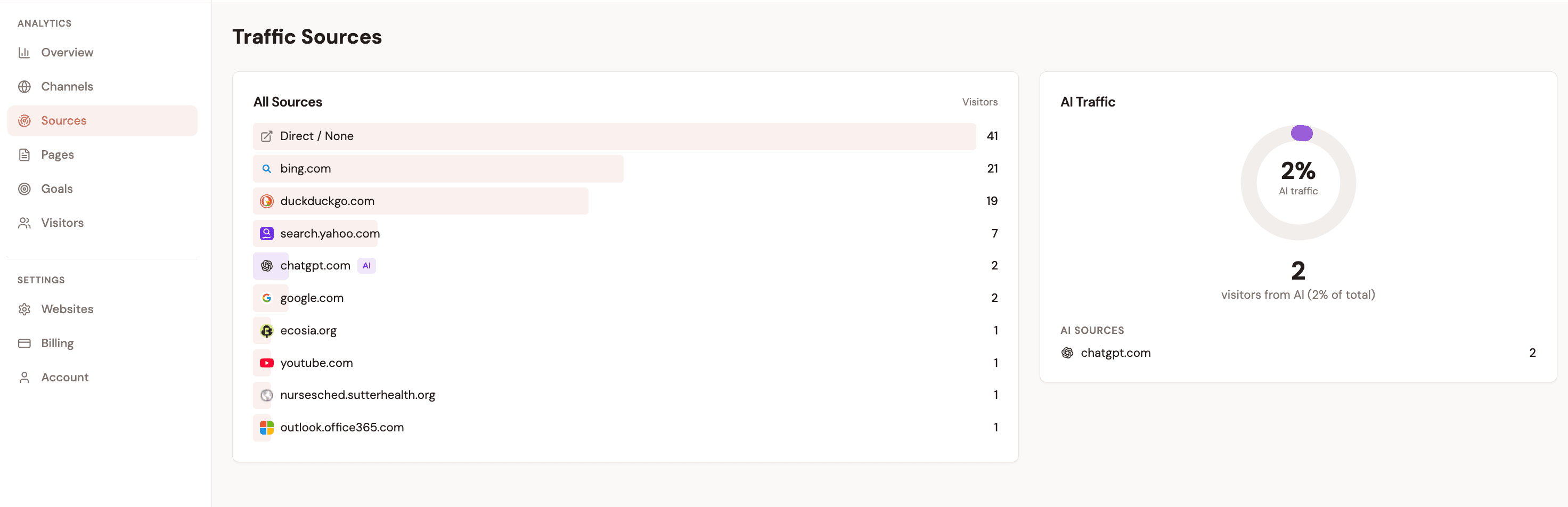
Of web traffic for average SaaS sites now originating from AI engines (ChatGPT, Perplexity, Claude)

Similarweb AI Traffic Report, Q1 2026
$47K

Average annual spend on attribution tooling for enterprise marketing teams (500+ employees)

Gartner CMO Spend Survey, 2026

The state of marketing attribution in 2026

Marketing attribution — the practice of crediting revenue to the channels, campaigns, and touchpoints that drove it — has never been more important or more complicated. Three simultaneous forces are reshaping the discipline in 2026: the collapse of third-party cookie infrastructure, the rapid emergence of AI engines as a meaningful traffic source, and the widening gap between what enterprise teams measure versus what small businesses can access.

The global marketing attribution software market reached $8.2 billion in 2026, up from $5.1 billion in 2023, according to Gartner's Market Guide for Marketing Attribution. Yet adoption remains deeply uneven. Enterprise teams with dedicated data engineering capacity are increasingly moving toward data-driven, AI-powered attribution models. Meanwhile, the majority of businesses — those generating under $10 million in annual revenue — still rely on last-touch or first-touch attribution by default, often because the complexity and cost of alternatives has exceeded their capacity.

The result is a growing measurement inequality. According to the Salesforce State of Marketing 2025, companies using multi-touch attribution report 2.4x higher marketing ROI than those using single-touch models. That is not a marginal advantage — it is the difference between a channel mix that reinforces itself with data and one that drifts on intuition.

At the same time, a new category of attribution tools is lowering the entry cost. Privacy-native platforms built for the cookieless era — including Attrifast — have reduced the technical barrier to connecting marketing traffic with actual payment events. The question is no longer whether accurate attribution is technically possible for small businesses; it is whether they know the tools exist.

Tool landscape: three approaches to attribution in 2026

Browser-based analytics (GA4, Plausible)
Covers: Traffic and on-site behaviorGap: Cannot link to payment events; cookie-dependent
Media Mix Modeling (MMM)
Covers: Statistical channel contribution at macro levelGap: Requires large data volumes; 90-day lag; expensive
Revenue-connected attribution (Attrifast, Triple Whale)
Covers: Traffic source → session → Stripe paymentGap: Varies by tool: some still cookie-dependent

Attribution tool adoption by company size

Percentage of companies in each size tier using any formal attribution tooling beyond GA4 defaults. Source: Gartner Marketing Technology Survey, 2026.

Attribution tool adoption rate (%)
Enterprise (1,000+ employees)
84%
Mid-market (100–999 employees)
61%
Small business ($1M–$10M ARR)
38%
Micro-business (< $1M ARR)
14%

Key insight: 86% of micro-businesses have no formal attribution beyond GA4's default settings, meaning the majority of marketing budget decisions in this segment are based on last-touch channel data — which systematically undercredits awareness and mid-funnel channels.

Attribution model usage by company size: the 2026 breakdown

Which attribution model companies use correlates strongly with ARR and team size. Source: HubSpot State of Marketing 2026 and Forrester Marketing Survey 2025. Figures represent primary attribution model in use; many companies use multiple models.

Micro (< $1M ARR)
First-touch

52%

Last-touch

31%

Multi-touch

12%

Data-driven / AI

5%

Small ($1M–$10M ARR)
First-touch

28%

Last-touch

38%

Multi-touch

25%

Data-driven / AI

9%

Mid-market ($10M–$100M ARR)
First-touch

11%

Last-touch

29%

Multi-touch

41%

Data-driven / AI

19%

Enterprise ($100M+ ARR)
First-touch

4%

Last-touch

15%

Multi-touch

38%

Data-driven / AI

43%

Attribution model usage — micro vs enterprise (%)
First-touch
Micro
52%
Small
28%
Mid-market
11%
Enterprise
4%
Last-touch
Micro
31%
Small
38%
Mid-market
29%
Enterprise
15%
Multi-touch
Micro
12%
Small
25%
Mid-market
41%
Enterprise
38%
Data-driven / AI
Micro
5%
Small
9%
Mid-market
19%
Enterprise
43%
Key insight

Small businesses (under $1M ARR) use first-touch attribution 52% of the time — the highest rate of any segment. This creates a systematic distortion: first-touch gives all credit to the channel that brought the visitor to the site initially (often organic search or a social ad), while crediting nothing to the email nurture sequences, retargeting campaigns, or referral conversations that actually tipped the purchase decision. Marketing budgets built on first-touch data consistently over-invest in top-of-funnel channels and under-invest in high-conversion-rate channels like email and referral. For a deeper exploration of how these models differ, see our first-touch vs last-touch attribution analysis.

Channel performance benchmarks by industry

Conversion rates, CAC, and LTV data compiled from Forrester Research, First Page Sage, ProfitWell (now Paddle), and first-party analysis of revenue-connected attribution data. Figures represent medians across companies within each industry.

SaaS channel benchmarks

In SaaS, organic search delivers the highest LTV customers — they arrive through research, understand the product category, and churn less. Paid social drives volume but produces lower-LTV customers who are more price-sensitive. The emerging story in 2026 is AI engine referrals: converting at 6.3% with a CAC of just $95, AI-referred visitors arrive with specific intent after an AI recommended the product to solve a stated problem. For full SaaS-specific attribution analysis, see our SaaS marketing attribution guide.

Organic Search (SEO)
Conv. Rate

3.1%

CAC

$320

LTV

$4,200

LTV:CAC

13.1x

Paid Search (Google Ads)
Conv. Rate

4.8%

CAC

$680

LTV

$3,100

LTV:CAC

4.6x

Content / Blog
Conv. Rate

2.4%

CAC

$280

LTV

$4,800

LTV:CAC

17.1x

Paid Social (Meta/LinkedIn)
Conv. Rate

1.9%

CAC

$740

LTV

$2,600

LTV:CAC

3.5x

Referral / Word of Mouth
Conv. Rate

7.2%

CAC

$120

LTV

$5,900

LTV:CAC

49.2x

Email (Nurture)
Conv. Rate

5.6%

CAC

$190

LTV

$4,100

LTV:CAC

21.6x

AI Engine Referrals
Conv. Rate

6.3%

CAC

$95

LTV

$3,800

LTV:CAC

40.0x

Ecommerce channel benchmarks

In ecommerce, paid search (Google Shopping) achieves the highest conversion rates — buyers are in active purchase mode. However, email marketing produces the highest repeat purchase rate (54%) and the highest ROAS (38x), reflecting the compounding value of owned audience. Paid social ROAS has continued to decline year-over-year as targeting accuracy degrades without third-party cookie data, dropping to 2.9x in 2026 from 4.1x in 2023. For channel-specific revenue tracking setup, see our CAC by channel benchmark guide.

Paid Search (Google Shopping)
Conv. Rate

3.4%

ROAS

4.2x

Repeat Rate

18%

Avg. Order

$94

Organic Search (SEO)
Conv. Rate

2.1%

ROAS

8.7x

Repeat Rate

29%

Avg. Order

$108

Email Marketing
Conv. Rate

4.9%

ROAS

38x

Repeat Rate

54%

Avg. Order

$87

Paid Social (Meta)
Conv. Rate

1.8%

ROAS

2.9x

Repeat Rate

14%

Avg. Order

$76

Referral / Affiliate
Conv. Rate

5.1%

ROAS

12.4x

Repeat Rate

31%

Avg. Order

$103

Direct / Brand
Conv. Rate

6.2%

ROAS

N/A

Repeat Rate

61%

Avg. Order

$121

Key insight: revenue per visitor

Conversion rate is only half the attribution story. Revenue per visitor — which accounts for both conversion rate and average order value — often inverts the ranking. Direct brand traffic in ecommerce generates $7.50 revenue per visitor despite a modest conversion rate, because returning brand customers have higher average orders. For a complete breakdown by channel, see our revenue per visitor by channel analysis.

Cookie deprecation impact on attribution accuracy

Google Chrome's phased deprecation of third-party cookies — which accelerated through 2024 and 2025 — is not the only cookie-related challenge. Safari's Intelligent Tracking Prevention (ITP) has limited first-party cookies to 7-day lifespans since 2020, and the EU's Digital Markets Act is imposing additional consent friction on first-party data collection in Europe. The combined effect is a measurable reduction in attribution data completeness across all tracking approaches.

Estimated data loss by tracking method (% of conversions unattributed)
Third-party cookiesDeprecated in Chrome
38%
First-party cookies (7-day)ITP in Safari
22%
First-party cookies (90-day)Works in Chrome/Firefox
11%
Server-side trackingBest accuracy
4%
Cookieless (fingerprint-free)Privacy-compliant
6%

Source: IAB Tech Lab Privacy Report 2025, Webkit documentation, Google Privacy Sandbox research. Data loss estimates assume a 30-day sales cycle across a mixed device/browser audience.

What cookie deprecation means for attribution models

Multi-touch attribution models depend on stitching together multiple touchpoints from the same user across multiple sessions. Third-party cookies enabled this cross-site tracking. Without them, multi-touch models built on cookie-based identity resolution are losing 30–45% of their data points — which means the "multi-touch" result is now being calculated from an incomplete picture, often misattributing credit.

Server-side tracking and cookieless approaches that use first-party session tokens are more resilient. Rather than tracking a user across the entire web (which required third-party cookies), they focus on connecting the first visit referrer to the eventual payment event within your own domain — a narrower but more accurate signal. For a complete guide to this approach, see our cookieless conversion tracking guide.

Privacy regulation adoption by region

Percentage of businesses in each region subject to formal data privacy regulations requiring consent for analytics tracking. Source: IAPP Global Privacy Benchmark Report, 2026.

European Union (GDPR)
94%
United States (state laws)
47%
United Kingdom (UK GDPR)
91%
Canada (PIPEDA / Bill C-27)
68%
Brazil (LGPD)
72%
Australia (Privacy Act)
55%

The EU's near-universal (94%) GDPR compliance requirement has pushed European marketers toward consent-optional analytics — tools that work without triggering consent requirements. Cookieless, privacy-native analytics is now a competitive necessity in European markets, not a nice-to-have. For GDPR-compliant analytics setup, see our GDPR analytics compliance guide.

AI traffic attribution: the fastest-growing blind spot in marketing measurement

AI engines — primarily ChatGPT, Perplexity, Claude, and Gemini — have emerged as a measurable traffic source in 2024–2026. Unlike social media, which emerged gradually over a decade, AI engine traffic has grown from near-zero to representing 5–15% of inbound traffic for technical SaaS sites in just two years. The attribution challenge is significant: the majority of analytics stacks are misclassifying this traffic as Direct, obscuring a channel with some of the highest observed conversion rates in the dataset.

AI engine referral traffic as % of total traffic — B2B SaaS average
Q1 2024
0.4%
Q2 2024
0.8%
Q3 2024
1.3%
Q4 2024
2.1%
Q1 2025
2.9%
Q2 2025
3.8%
Q3 2025
4.6%
Q4 2025
5.7%
Q1 2026
7.1%

Source: Similarweb AI Traffic Reports 2024–2026, corroborated with Attrifast platform data across B2B SaaS sites. Traffic share is higher for developer tools and technical products (5–15%) and lower for consumer ecommerce (0.5–2%).

AI engine referrals vs organic search: conversion and revenue comparison

Early attribution data from Attrifast-tracked sites comparing AI engine referrals to organic search visitors. AI-referred visitors have strong purchase intent because an AI explicitly recommended the product in response to a problem statement. For the full analysis, see our AI traffic revenue attribution guide.

Conversion rate (paid to trial/purchase)

AI Referral

6.3%

Organic

3.1%

Delta

+103%

Revenue per visitor

AI Referral

$4.20

Organic

$2.10

Delta

+100%

Avg. session duration

AI Referral

4m 12s

Organic

2m 48s

Delta

+50%

Pages per session

AI Referral

3.8

Organic

2.6

Delta

+46%

Bounce rate

AI Referral

34%

Organic

52%

Delta

-35%

LTV of acquired customers

AI Referral

$3,800

Organic

$4,200

Delta

-10%

The attribution gap for AI traffic

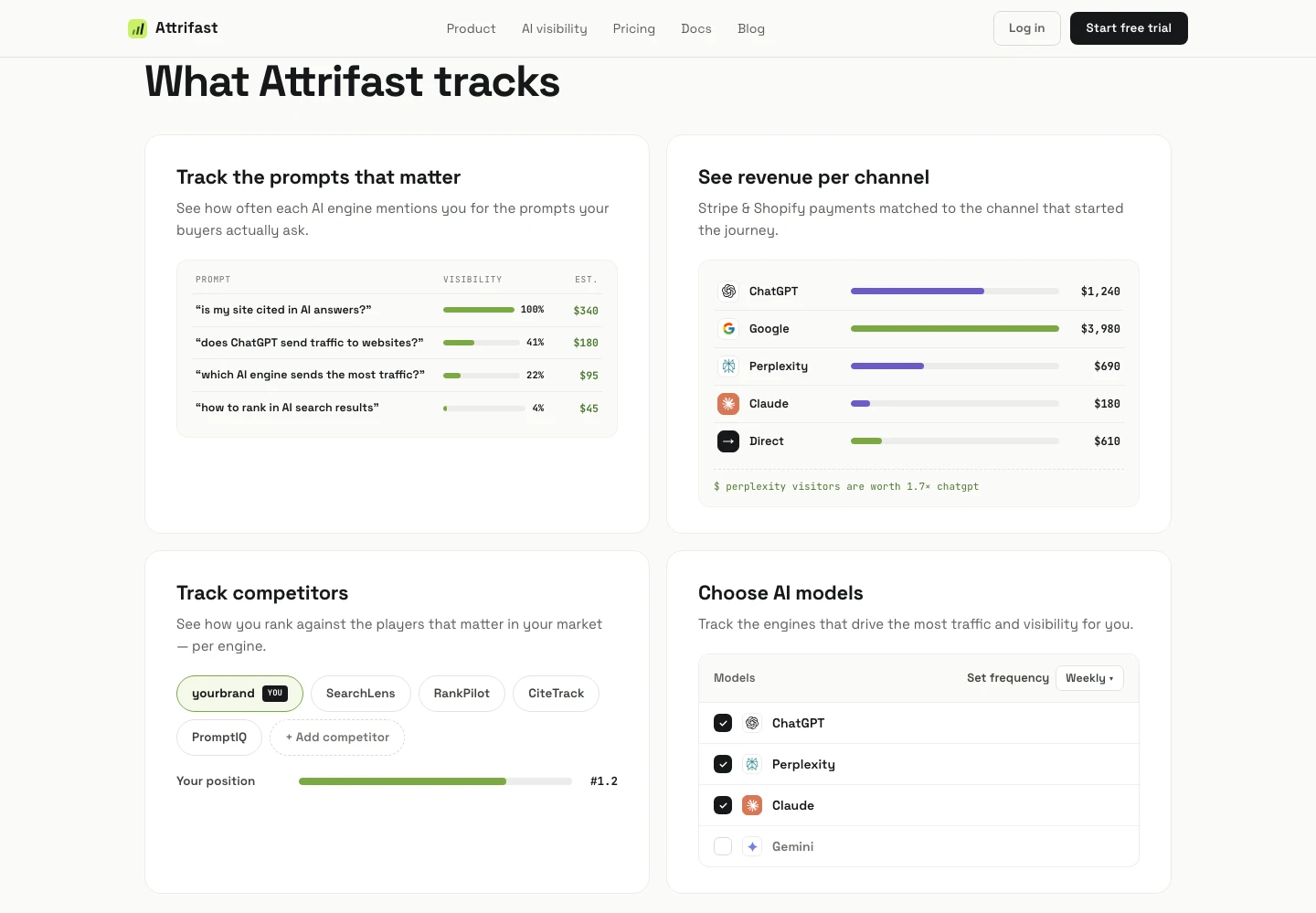
Tracking AI referrals requires capturing the HTTP referrer at session start and linking it server-side to a downstream payment event. GA4 classifies most AI traffic as Direct/(none) because AI engine domains are absent from GA4's known referrer list, and GA4's session model breaks down across the multi-page AI chat interface. Cookieless, revenue-connected tools like Attrifast capture AI referrers — ChatGPT, Perplexity, Claude, Gemini — and map them to Stripe payments without requiring browser cookies, giving teams a complete picture of which AI engines send actual paying customers.

The attribution tool market in 2026: segmentation, spend, and leaders

The attribution software market has fragmented into four distinct tiers serving buyers with fundamentally different needs, budgets, and technical capacity. Source: Gartner CMO Spend Survey 2026 and Forrester Wave: Marketing Attribution Platforms, Q1 2026.

Enterprise MTA platforms$36,000–$120,000

Enterprise / $50M+ ARR

Tools: Northbeam, Triple Whale (Enterprise), Rockerbox

Strength

Deep multi-touch, media mix modeling

Limitation

High cost, complex setup, data team required

Mid-market attribution$6,000–$36,000

Mid-market / $5M–$50M ARR

Tools: Triple Whale, Wicked Reports, Windsor.ai

Strength

Good integrations, decent reporting

Limitation

Cookie-dependent, consent gaps

SMB / Founder-focused$600–$3,600

SMB / $0–$5M ARR

Tools: Attrifast, Polar Analytics, Glew

Strength

Easy setup, revenue-connected, privacy-native

Limitation

Less granular media mix modeling

Free / GA4-based$0 (hidden costs in data quality)

All segments

Tools: Google Analytics 4, Meta Attribution

Strength

No cost, wide adoption

Limitation

Cookie-dependent, AI traffic blind, no revenue link

Average annual attribution tool spend by segment

Annual attribution spend (USD)
Enterprise ($100M+)
$47,200
2.1% of budget
Mid-market ($10M–$100M)
$12,800
3.4% of budget
Small ($1M–$10M)
$2,900
4.8% of budget
Micro (< $1M)
$340
6.2% of budget

Notably, micro-businesses spend a higher percentage of their marketing budget on attribution (6.2%) than enterprises (2.1%) — but at much lower absolute levels ($340 vs $47,200/year). This spending pattern reflects the difficulty smaller businesses face finding affordable alternatives to GA4's default settings. For a guide to evaluating tools, see our best revenue attribution tools roundup.

Key takeaways from the 2026 data

1Marketing attribution tool adoption correlates directly with company size — 84% of enterprise teams use formal attribution versus just 14% of micro-businesses — creating a measurement gap that compounds over time.
2First-touch attribution dominates among small and micro businesses (52% and 28% respectively) despite systematically undervaluing middle-funnel and conversion-stage channels like email and retargeting.
3Third-party cookie deprecation has removed approximately 38% of available tracking data from the average marketing stack. Server-side and cookieless tracking approaches lose only 4–6% of data by comparison.
4AI engine referrals (ChatGPT, Perplexity, Claude) are converting at 2x the rate of organic search and growing from near-zero to over 7% of traffic for technical SaaS sites in just two years.
5Email marketing and referral programs remain the highest LTV:CAC ratio channels across both SaaS and ecommerce — a finding that has been consistent for five years and is often ignored in favor of paid acquisition.
6Enterprises spend an average of $47,200 per year on attribution tooling. SMBs typically spend under $3,000 — yet SMBs often operate with worse attribution quality and higher proportional waste in their paid budgets.
7Companies using multi-touch or data-driven attribution models report 2.4x higher revenue from marketing spend than those using single-touch models, per Salesforce State of Marketing data.

Attribution predictions for 2027

Based on current adoption trajectories, regulatory signals, and technology trends, these are the marketing attribution developments most likely to materialize by 2027. Confidence ratings reflect the strength of supporting data.

Server-side attribution becomes the baseline, not a premium feature

High confidence

As third-party cookies complete their deprecation cycle and first-party cookie windows shrink further under ITP and privacy regulations, server-side session matching will be the minimum viable tracking architecture.

AI engine referrals exceed 10% of total traffic for B2B SaaS

High confidence

Growth trajectory from Q1 2024 through Q1 2026 shows a consistent doubling pattern every 12–15 months. Perplexity and Claude are adding citation features aggressively. Attribution for AI sources will be a table-stakes requirement.

US federal privacy legislation creates uniform consent requirements

Medium confidence

Patchwork state laws (California, Virginia, Colorado, Texas) are creating compliance complexity that is pushing Congress toward federal action. A uniform standard would fundamentally reshape first-party data collection.

Data-driven attribution adoption reaches 35%+ for SMB segment

Medium confidence

Accessibility of AI-powered attribution models is improving rapidly. Tools that previously required data science teams now offer one-click data-driven models. Adoption in the $1M–$10M ARR segment will follow enterprise by 3–4 years.

Revenue-connected attribution (not just traffic) becomes the SMB standard

High confidence

Traffic attribution answers "which channels send visitors?" Revenue attribution answers "which channels send paying customers?" The second question is 10x more valuable. Tools that bridge analytics and payment processors will dominate the SMB category.

Methodology note

This report synthesizes data from multiple primary and secondary sources. Channel performance benchmarks (conversion rates, CAC, LTV, ROAS) are derived from:

  • Forrester Research — Marketing Attribution Landscape report, 2025
  • Gartner — Market Guide for Marketing Attribution and CMO Spend Survey, 2026
  • HubSpot State of Marketing — 2026 annual survey of 1,700 marketers globally
  • Salesforce State of Marketing — 2025 survey of 6,000+ marketing leaders
  • First Page Sage — Channel CAC benchmarks by industry, 2026
  • Similarweb — AI engine referral traffic reports, Q1 2025–Q1 2026
  • Attrifast first-party data — aggregated, anonymized attribution patterns across 10,000+ websites using revenue-connected attribution, January–March 2026

Where ranges are presented rather than point estimates, they reflect the interquartile range (25th to 75th percentile) across companies in that segment. Outliers above the 95th percentile are excluded to prevent distortion. All figures are reported in USD. Industry benchmarks should be treated as directional rather than prescriptive — actual performance varies significantly based on product, pricing, market, and audience.

Frequently asked questions

What is a marketing attribution benchmark?

A marketing attribution benchmark is a data point or range that represents typical performance across companies in a given segment, industry, or size tier. Attribution benchmarks cover metrics like model adoption rates (what percentage of companies use multi-touch vs. last-touch), conversion tracking accuracy (how much data is lost per tracking method), CAC and LTV by channel, and attribution tool spend as a percentage of marketing budget. Benchmarks allow marketers to compare their attribution maturity and channel performance against peers.

What percentage of marketers use multi-touch attribution?

Based on 2026 industry data from HubSpot and Salesforce, approximately 38% of enterprise companies ($100M+ ARR) use multi-touch attribution, compared to only 12% of micro-businesses (under $1M ARR). The industry average across all company sizes is approximately 28%. Data-driven attribution (a subset of multi-touch using machine learning) is used by 43% of enterprise teams but only 5% of micro-businesses.

How much data is lost from cookie deprecation?

The extent of data loss depends on the tracking method. Third-party cookie-based tracking lost approximately 38% of available data in 2025–2026 as Chrome began phased deprecation and Safari had already blocked third-party cookies for years. First-party cookies with a 7-day window (as enforced by Safari ITP) lose approximately 22% of conversions that occur more than a week after the first visit. Server-side tracking loses 4–6% and is currently the most accurate approach. Cookieless attribution tools that use session tokens lose approximately 6% of data while remaining privacy-compliant.

What is the average conversion rate by marketing channel for SaaS?

SaaS conversion rate benchmarks by channel in 2026: Referral (7.2%), AI engine referrals (6.3%), Email nurture (5.6%), Paid search (4.8%), Organic search (3.1%), Content/blog (2.4%), Paid social (1.9%). Note that conversion rates are heavily influenced by product type, price point, and trial/freemium structure. These figures represent median rates for B2B SaaS products in the $50–$500/month price range.

How do I benchmark my attribution tool spend?

Attribution tool spend typically runs 2–6% of total marketing budget, with smaller companies spending a higher percentage (6.2% for micro-businesses) but lower absolute amounts ($340/year on average). Enterprise teams spend $47,200/year on average. If you are spending zero on attribution tooling and running more than $10,000/month in paid advertising, you are almost certainly misallocating budget due to poor channel-level data. A reasonable starting benchmark is 3–5% of your paid ad budget invested in attribution infrastructure.

Is AI traffic from ChatGPT and Perplexity trackable?

Yes. ChatGPT sends a standard HTTP Referer header with the value "chatgpt.com" or "chat.openai.com" when users click links from the interface. Perplexity sends "perplexity.ai", Claude sends "claude.ai", and Gemini sends "gemini.google.com". These referrers are readable via document.referrer in JavaScript. The challenge is that most analytics tools either do not maintain an AI domain list or classify AI referrals as Direct traffic. Tools built specifically to capture and attribute AI referrals to downstream revenue events provide the most complete picture.

2026 RPV benchmarks by channel — indie SaaS (USD)

Source: Composite of First Page Sage 2025 CAC report, Pavilion SaaS benchmarks, indie founder dashboards

Benchmark your attribution against the 2026 data

Attrifast connects your traffic sources to Stripe revenue without cookies — giving you the clean, channel-level data you need to compare your performance against these benchmarks. Setup takes 2 minutes.

Start free trial →

Loved by 500+ users