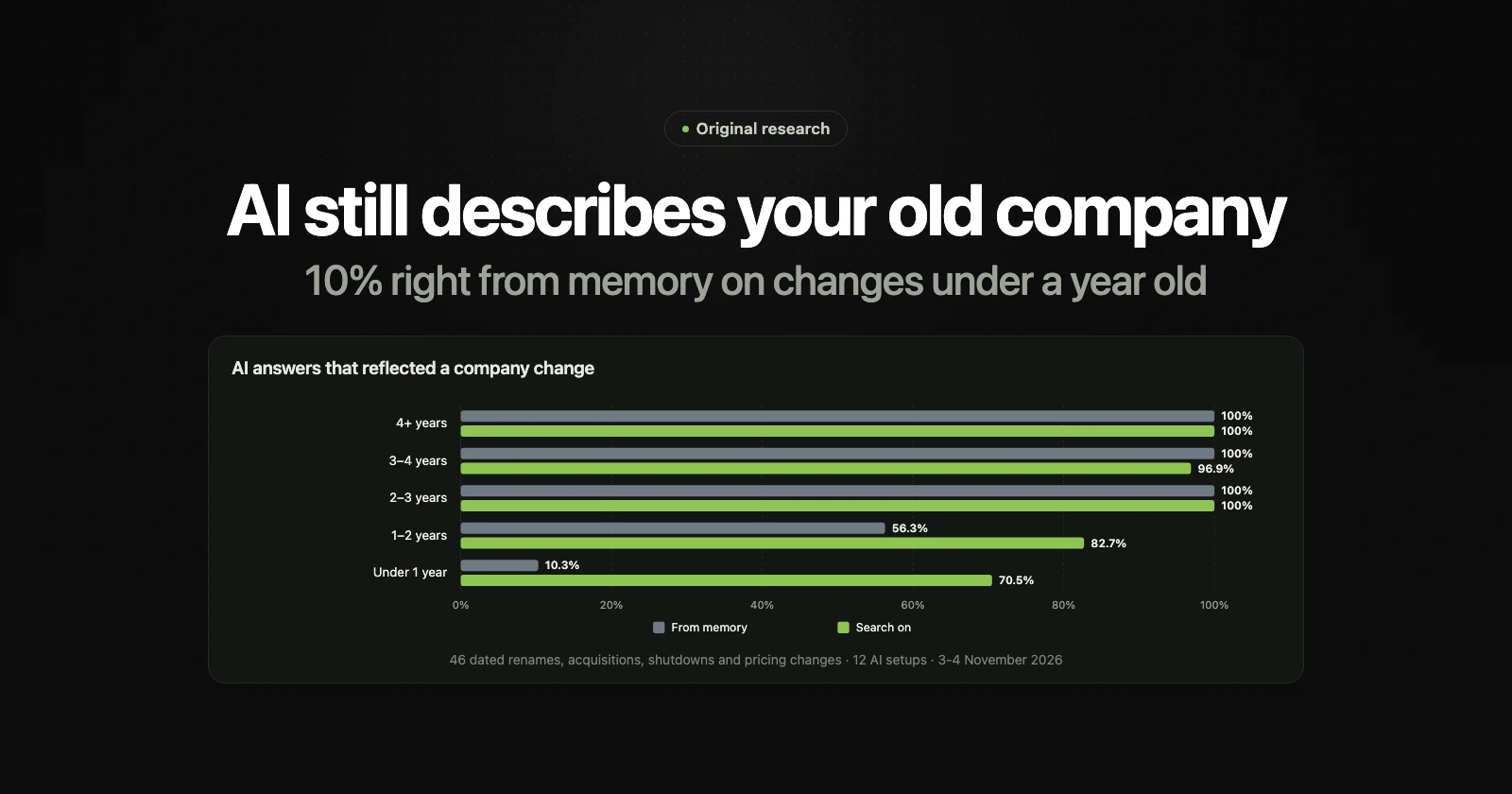
Semrush gave this problem a good name in September: the LLM positioning lag, the gap between the day you change what your company is and the day AI assistants start saying so[1]. Their examples are vivid. Hotjar still described as a standalone tool after merging into Contentsquare. Duolingo still a language app after adding math, music and chess. But they are screenshots of single prompts, and every vendor post written since gives a timeline ("6 to 18 months") without saying where the number came from.
The question a marketing team actually has after a rebrand, an acquisition or a pricing change is narrower: how long will ChatGPT keep getting us wrong, and what shortens it? That is measurable. So I measured it, on 46 changes where the right answer is a matter of public record.
This matters more each quarter. Capgemini's consumer survey found 58% of consumers had already replaced traditional search engines with generative AI tools for product and service recommendations, up from 25% in 2023[9]. If those tools describe the company you were two years ago, that is the company those buyers meet.
The short answer: two lags, on two different clocks
| Memory lag | Retrieval lag | |
|---|---|---|
| What happens | The model answers from training data, which predates your change or is dominated by older text about you | The model searches, but reads pages that still describe the old you, or decides not to search |
| Measured here | 66% of answers current from memory; 10% for changes under a year old | 94% current when a search ran; 15 of 234 searched answers still stale or partial |
| What fixes it | Time, a new model generation, and a much larger volume of text using the new name | Your own pages, your directory listings, your filings and announcements, then the third-party pages engines cite |
| How fast a fix shows | Not until the next model is trained, and not guaranteed then | Days to weeks after the pages change and get recrawled |
Everything below is the evidence for that table.
How we measured it
- 46 real, dated changes from July 2021 to September 2026, each checked against a press release, filing or the company's own announcement[13][14][17]: 13 renames, 15 acquisitions, 10 shutdowns and 8 product or pricing changes. They run from Facebook becoming Meta to Progress Software closing its Domo deal 42 days before the test[16].
- One plain question per change, phrased the way a buyer would ask it and never mentioning the change: "Who owns Semrush?", "What is Sendinblue and what is it used for?", "Is Skype a good option for free international video calls?".
- Six models answering from memory, with no tools: GPT-5.6 Terra, Claude Sonnet 5.5, Gemini 3.8 Flash and DeepSeek V4.1 Flash as current models, plus Llama 4 Maverick and GPT-4o mini, older models that still sit inside plenty of third-party chatbots and browser extensions. Each question was asked twice, minutes apart.
- Six search-enabled setups: GPT-5.6 Terra and Claude Sonnet 5.5 with their native web-search tools, once on automatic (the model decides whether to search) and once forced to search; Gemini 3.8 Flash with Google Search grounding on automatic; and Perplexity Sonar, which always searches.
- Every call carried the same one-line system message giving the current date, 3 November 2026, the way consumer chat apps do. All traffic ran through the Vercel AI Gateway on 3–4 November 2026[19].
- Grading: each answer was labelled current, partial, stale, hedged (old facts plus an explicit "this may be out of date") or other against a written rubric for that change. Two judges from different labs graded every answer, Claude Sonnet 5.5 and GPT-5.6 Terra, without seeing which model wrote it. They agreed on 96%. Gemini 3.8 Flash broke the ties, and I read every answer that was still split.
For the knowledge-cutoff analysis I used each vendor's documented date: 16 February 2026 for GPT-5.6 Terra[4], 1 October 2023 for GPT-4o mini[5], June 2026 for Claude Sonnet 5.5[6], March 2026 for Gemini 3.8 Flash (Google notes some domains stop at January 2025)[7], and August 2024 for Llama 4[8]. DeepSeek does not publish one, so it is left out of that cut.
Limits worth stating up front. These are API calls, not the consumer ChatGPT, Claude or Gemini apps, which add their own system prompts and their own rules for when to search. Eight of the 47 forced-search calls to Claude came back without searching anyway, all on short definitional or setup questions; those eight are excluded from the forced-search group. And one question per change is a probe, not a census: a model can know a fact and still not volunteer it to a question phrased this way. That is the realistic case, since buyers do not phrase questions to help you, but the numbers describe this question set and not every possible one.
From memory, AI gets a company change right two times in three
Across the four current models answering from training data alone, 66% of answers reflected the change. The rest split as the chart shows, and most of the misses were confident: the old facts stated as current, with no warning that they might be out of date.
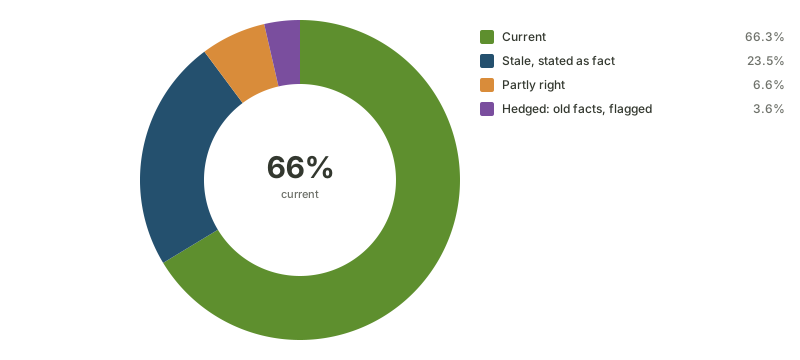
Source: Attrifast study, 3–4 November 2026 — GPT-5.6 Terra, Claude Sonnet 5.5, Gemini 3.8 Flash and DeepSeek V4.1 Flash answering 46 change questions with no tools (366 answers). Two-judge grading.
The models are not interchangeable here, and the differences are a matter of temperament as much as knowledge:
| Model, from memory | Current | Stale | Hedged | Documented cutoff |
|---|---|---|---|---|
| GPT-5.6 Terra | 64% | 30% | 0% | 16 Feb 2026 |
| Claude Sonnet 5.5 | 76% | 1% | 14% | Jun 2026 |
| Gemini 3.8 Flash | 50% | 43% | 0% | Mar 2026* |
| DeepSeek V4.1 Flash | 76% | 19% | 0% | not published |
| Llama 4 Maverick | 25% | 51% | 11% | Aug 2024 |
| GPT-4o mini | 16% | 57% | 20% | 1 Oct 2023 |
The striking line is Claude's. It was wrong outright in 1% of answers: when it did not know, it said its information might be out of date, which is the honest failure and the one a buyer can act on. GPT-5.6 Terra and Gemini 3.8 Flash never hedged once. When they missed, they stated the old facts flatly, in 30% and 43% of their answers. The two older models, still common inside other products, got about one change in five right.
How long the lag lasts: under a year, memory almost never has it
The cleanest way to answer "how long" is to sort the 46 changes by age and see where memory catches up.
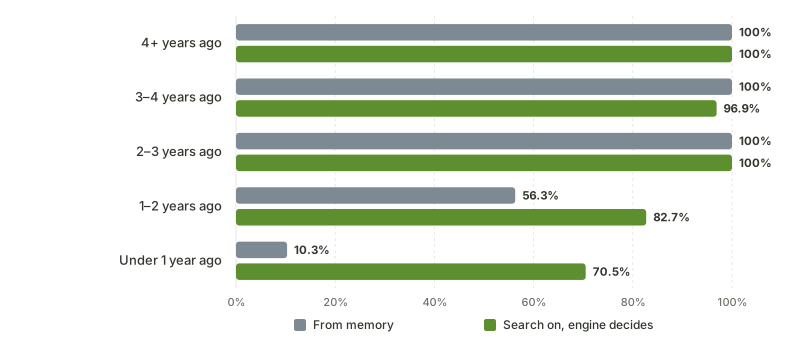
Source: Attrifast study, 3–4 November 2026 — 46 dated company changes. Memory = 4 current models with no tools. Search on = GPT-5.6, Claude Sonnet 5.5 and Gemini 3.8 Flash deciding for themselves, plus Perplexity Sonar.
| Age of the change on 3 Nov 2026 | Changes | From memory (current models) | Search on, engine decides |
|---|---|---|---|
| Under 1 year | 11 | 10% | 70% |
| 1–2 years | 13 | 56% | 83% |
| 2–3 years | 7 | 100% | 100% |
| 3–4 years | 8 | 100% | 97% |
| 4+ years | 7 | 100% | 100% |
Read the memory column as the honest answer to "how long does it take ChatGPT to update information about a company": for anything under a year old, plan on it not knowing. Between one and two years the odds are roughly a coin flip. Past two years, every answer from the four current models was current: the memory layer does catch up, it just takes longer than a rebrand plan usually allows.
The search column is the reason the lag is survivable: 70% of answers about changes less than a year old were current when the engine could search. That is the number to manage.
It is not just the training cutoff
The tempting explanation is simple: the model was trained before your change, so of course it does not know. That covers the newest changes. It does not cover the rest.
For every model with a documented cutoff, I took only the changes that happened at least six months before that cutoff, comfortably inside the window the model was trained on. 22% of those 258 answers still missed the change.
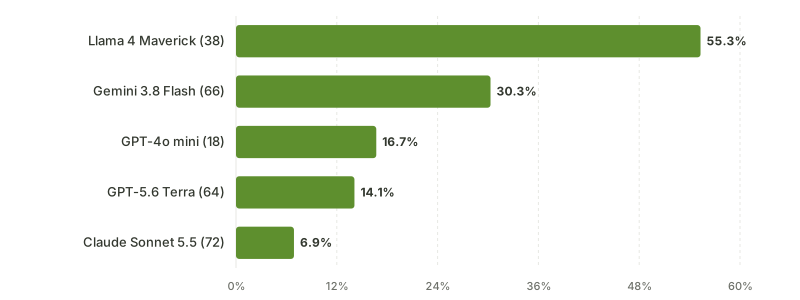
Source: Attrifast study, 3–4 November 2026 — answers about changes dated at least 6 months before each model's vendor-documented knowledge cutoff (answer counts in brackets). Gemini's card notes some domains stop at January 2025.
Some examples, all inside the model's documented window:
- GPT-5.6 Terra (cutoff 16 February 2026), asked whether Figma is publicly traded: "No. Figma is not currently a publicly traded company." Figma listed on the NYSE in July 2025, more than six months before that cutoff. Same answer on both runs.
- GPT-5.6 Terra on Skype, which Microsoft shut down nine months before the model's cutoff: "Skype can still work for free international video calls between Skype users." Asked for Warner Bros. Discovery's streaming service, it said "Max", seven months after the service went back to HBO Max.
- Gemini 3.8 Flash on Pocket, which Mozilla closed in July 2025: "Yes, Pocket is still one of the best and most reliable apps for saving articles to read later." Google's model card warns that some domains stop at January 2025, and this is what that caveat looks like from the outside[7].
- Llama 4 Maverick (cutoff August 2024) described "Twitter" with no mention of X on both runs, 13 months after the rebrand, and Sendinblue with no mention of Brevo, 15 months after.
- Claude Sonnet 5.5 missed least, 7% of its in-window answers, and never flatly: it mentioned that Contentsquare bought Hotjar in 2021, but described Hotjar as a standalone product rather than one merged into Contentsquare in 2025.
This is what the "positioning lag" actually is. A model does not learn a fact once, on a date. It learns how often the fact appears. Ten years of "Sendinblue, the email marketing platform" sit in the training data next to a few months of "Brevo". Researchers at Johns Hopkins found that a model's effective cutoff often differs from the one its makers report, for exactly this kind of reason: new web crawls contain large amounts of old content, and deduplication misses near-copies, so older versions of a fact keep their weight[2].
The practical consequence: the next model generation is the earliest realistic date for the memory layer to change, not a guaranteed one. A launch that happened six months before a model's cutoff is, as far as the model is concerned, a minority opinion.
Which kinds of change lag worst
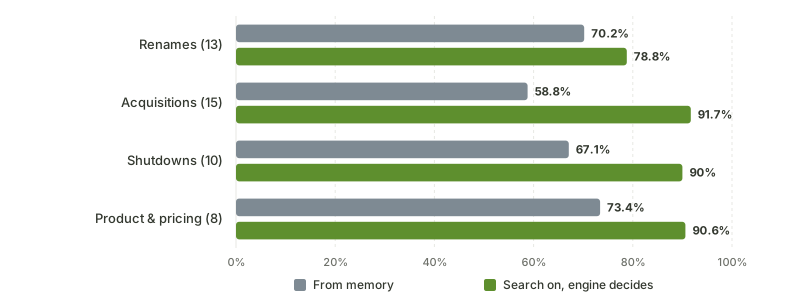
Source: Attrifast study, 3–4 November 2026 — Memory = 4 current models with no tools; search on = engine decides whether to search.
From memory, acquisitions lag worst: 59% current, against 67% to 73% for the other types. An ownership change is one line in a press release, set against years of copy describing an independent company, and it has a trap built in: a model often knows a deal was announced without knowing it closed. Acquisitions produced more "partial" answers than every other type combined, most of them some version of "Adobe has agreed to acquire Semrush" or "Palo Alto Networks is acquiring CyberArk", true when announced and incomplete now.
With search on, the order flips. Renames become the hardest: 79% current, against 92% for acquisitions and 90% for shutdowns. The search engines are not worse at finding a new name. They just do not look, for reasons the next section measures.
Search fixes most of it, when the engine bothers to search
With a search actually running, 94% of answers were current, across 234 searched answers. That is the single most important number for anyone trying to fix this, because it is the layer you can move.
The catch is the word "running". Given the tool and left to decide, the engines often answered from memory instead:
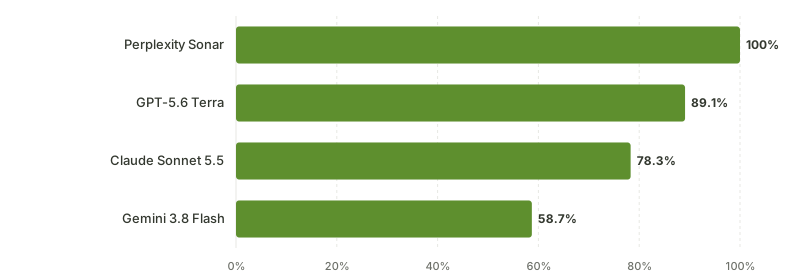
Source: Attrifast study, 3–4 November 2026 — the same 46 questions with web search available and the model deciding. Perplexity Sonar searches by design.
| Engine, search available | Searched | Current when it searched | Current when it did not |
|---|---|---|---|
| GPT-5.6 Terra | 89% | 90% | 40% |
| Claude Sonnet 5.5 | 78% | 94% | 80% |
| Gemini 3.8 Flash | 59% | 96% | 68% |
| Perplexity Sonar | 100% (by design) | 89% | n/a |
The questions they skipped were the ones that look like settled facts: "What is Integromat?", "What is Twitter?", "What is Google Bard?". Across the three engines that decide for themselves, they searched for 41% of the rename questions, against 83% to 96% of every other type. That matches what we saw when we traced ChatGPT's own sources in September: it searched for every B2B software question but for 0% of stable factual ones (full study). OpenAI says ChatGPT chooses to search based on what you ask[10], and a question about what your company is reads, to a model, like a question about something that does not change. That is exactly the question a rebrand changes.
When search still gets it wrong, the stale page is usually yours
Fifteen answers searched and still came back stale or partial. I read the sources behind each one. Fourteen could be classified (Gemini's grounding returns proxy URLs that hide the source). In nine of those, the outdated source was published by the company itself:
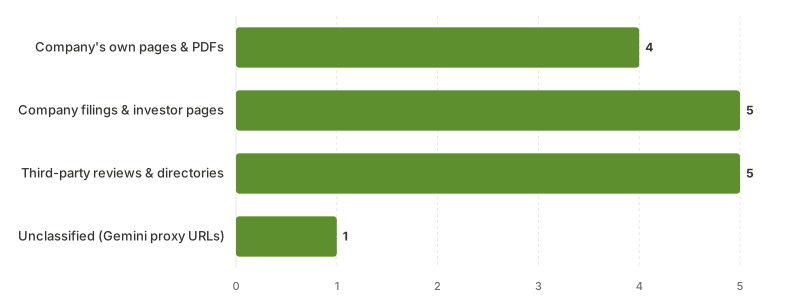
Source: Attrifast study, 3–4 November 2026 — every searched answer graded stale or partial (15), classified by where most of its cited sources came from. Gemini returns proxy URLs, so its one answer is unclassified.
- The company's own legacy pages. Asked "What does Pure Storage do?", GPT-5.6 searched and cited ten sources. Five were PDFs still hosted on purestorage.com, including a 2022 annual report and a product fact sheet. Its answer never mentioned Everpure, the name the company has used since March[15]. Asked what Affinity Designer costs, it read affinity.serif.com and the Serif forums and quoted a one-time price, a year after Canva made the app free. Asked about Google Fiber, it cited fiber.google.com ten times and called GFiber "often" the brand, not the official name since March[12].
- The company's own filings and investor pages. Three of the six search-enabled answers about Domo described an independent public company controlled by its founder. They cited proxy statements, quarterly reports and investor pages, and none of those recorded the completed sale to Progress Software[16]. Two of the Pure Storage answers leaned on SEC filings and investor pages that still carry the old name.
- Third-party coverage that outnumbers the update. Perplexity answered the Affinity question from toolradar, Capterra and Software Advice listings, every one still showing the old price. Asked whether Notion has its own email client, Claude searched both times and read the same eight launch-era reviews and tutorials from 2025. None of them mentioned that Notion had shut the app down six weeks earlier, so it described an app that no longer exists.
Research on how models weigh retrieved text explains why this is so effective at keeping you stale. In Stanford's ClashEval benchmark, leading models adopted retrieved content over their own correct prior knowledge more than 60% of the time when the two conflicted[3]. A model will believe your 2022 PDF over its own memory. The good news is the same mechanism: it will believe your updated page too.
Old models inside other products never catch up
Llama 4 Maverick and GPT-4o mini got 21% of these changes right. That sounds like an irrelevant result about obsolete models until you remember where these models run: help-desk bots, browser extensions, writing assistants, procurement tools, any product that picked a cheap model in 2024 and has not switched since.
Across the six models with documented cutoffs, 150 answers were about changes that happened after the model's cutoff. Only 5 of them were current, and those were extrapolations rather than knowledge: deals that had been announced before the cutoff (IBM and HashiCorp, Google and Wiz) and an older no-subscription option that happened to match Blue Apron's new policy. 20% hedged, which is the most you can hope for from a model that cannot know. The other 70% stated the old facts as current.
You cannot fix these. You can know they exist, and stop treating "ChatGPT now gets it right" as the end of the job.
What happened when we asked about ourselves
Attrifast repositioned in early August. Until 3 August 2026, the site described the product as "privacy-first revenue attribution", Stripe-native and cookieless. Since then it has been "an analytics platform for website traffic, customer-level revenue and AI brand visibility", because that is what the product had become. So "What is Attrifast?" went into the same run, scored separately from the 46.
From memory, no model knew us at all. DeepSeek and Llama described a pain-relief tablet, GPT-4o mini an industrial adhesive, and GPT-5.6 guessed from the name alone that it might be attribution software. Claude said plainly that it did not know rather than guess. A young brand has no memory layer to be stale in. It has a name-collision problem instead.
With search, 4 of the 6 setups described the current positioning. The two that did not were both GPT-5.6. It built its answer from our G2, Capterra, GetApp and Software Advice listings plus an installation doc, and described the revenue-attribution half of the product without the AI-visibility half. One of the Claude answers that passed still opened with "a privacy-focused analytics and revenue attribution tool", an echo of the old descriptor that survives in older posts on our own blog.
That is the whole article in one company: our homepage changed in an afternoon, while the directory profiles and older posts that engines read first kept the old version alive.
The study caught me too
One more result, because it is the clearest illustration in the dataset. My answer key listed "Notion launched its own email client, Notion Mail, in April 2025" as the current fact. Four of the six search-enabled answers disagreed, and the ones whose sources I could read cited Notion's own help center: Notion Mail shut down on 22 September 2026[11]. They were right. My own knowledge of Notion was stale by six weeks, I had written it into a rubric, and only the engines that searched caught it. I re-scored that change as a shutdown before computing anything in this article.
If the person building the test can carry a stale fact into it, so can the model answering your buyers.
The full results, change by change
"From memory" is the share of current answers from the four current models; "search on" is the share across the four engine-decides setups.
| Change | Date | From memory | Search on |
|---|---|---|---|
| Slack → Salesforce | Jul 2021 | 8 of 8 | 4 of 4 |
| Facebook → Meta | Oct 2021 | 8 of 8 | 4 of 4 |
| Mailchimp → Intuit | Nov 2021 | 8 of 8 | 4 of 4 |
| Square → Block | Dec 2021 | 8 of 8 | 4 of 4 |
| Jarvis → Jasper | Jan 2022 | 8 of 8 | 4 of 4 |
| Integromat → Make | Feb 2022 | 8 of 8 | 4 of 4 |
| Slack free plan → 90-day history | Sep 2022 | 8 of 8 | 4 of 4 |
| Heroku ends free tier | Nov 2022 | 8 of 8 | 4 of 4 |
| Evernote → Bending Spoons | Jan 2023 | 8 of 8 | 4 of 4 |
| Sendinblue → Brevo | May 2023 | 8 of 8 | 4 of 4 |
| Netflix paid sharing | May 2023 | 8 of 8 | 4 of 4 |
| Universal Analytics sunset | Jul 2023 | 8 of 8 | 3 of 4 |
| Twitter → X | Jul 2023 | 8 of 8 | 4 of 4 |
| Google Optimize shutdown | Sep 2023 | 8 of 8 | 4 of 4 |
| Spotify Premium adds audiobooks | Oct 2023 | 8 of 8 | 4 of 4 |
| Bing Chat → Copilot | Nov 2023 | 8 of 8 | 4 of 4 |
| Loom → Atlassian | Nov 2023 | 8 of 8 | 4 of 4 |
| Clearbit → HubSpot | Dec 2023 | 8 of 8 | 4 of 4 |
| Google Bard → Gemini | Feb 2024 | 8 of 8 | 4 of 4 |
| Splunk → Cisco | Mar 2024 | 8 of 8 | 4 of 4 |
| Mint shutdown | Mar 2024 | 8 of 8 | 4 of 4 |
| Google Podcasts shutdown | Jun 2024 | 8 of 8 | 4 of 4 |
| HashiCorp → IBM | Feb 2025 | 8 of 8 | 4 of 4 |
| Humane AI Pin discontinued | Feb 2025 | 6 of 8 | 4 of 4 |
| Skype shutdown | May 2025 | 4 of 8 | 4 of 4 |
| Duolingo adds chess | Jun 2025 | 5 of 8 | 4 of 4 |
| Hotjar → merged into Contentsquare | Jul 2025 | 0 of 8 | 1 of 4 |
| Pocket shutdown | Jul 2025 | 5 of 7 | 3 of 4 |
| Glitch ends project hosting | Jul 2025 | 6 of 8 | 4 of 4 |
| Max → HBO Max (again) | Jul 2025 | 4 of 8 | 3 of 4 |
| Windsurf → Cognition | Jul 2025 | 6 of 8 | 4 of 4 |
| Figma goes public | Jul 2025 | 4 of 8 | 4 of 4 |
| Blue Apron drops subscription | Aug 2025 | 0 of 8 | 4 of 4 |
| Grammarly Inc. → Superhuman | Oct 2025 | 4 of 8 | 3 of 4 |
| Affinity becomes free (Canva) | Oct 2025 | 6 of 8 | 1 of 4 |
| Vimeo → Bending Spoons | Nov 2025 | 3 of 8 | 4 of 4 |
| CyberArk → Palo Alto Networks | Feb 2026 | 1 of 7 | 4 of 4 |
| Pure Storage → Everpure | Feb 2026 | 0 of 8 | 0 of 4 |
| Wiz → Google | Mar 2026 | 4 of 8 | 4 of 4 |
| Google Fiber → GFiber | Mar 2026 | 1 of 8 | 2 of 4 |
| Freepik → Magnific | Apr 2026 | 0 of 8 | 1 of 4 |
| Semrush → Adobe | Apr 2026 | 0 of 8 | 4 of 4 |
| TV Time shutdown | Jul 2026 | 0 of 8 | 3 of 4 |
| Airtable → Bending Spoons | Sep 2026 | 0 of 8 | 4 of 4 |
| Domo → Progress Software | Sep 2026 | 0 of 8 | 2 of 4 |
| Notion Mail launched, then shut down | Sep 2026 | 0 of 8 | 3 of 4 |
How to fix outdated information about your company in ChatGPT
There is no form to fill in. OpenAI, Anthropic and Google do not take correction requests for company descriptions, and nothing you do this week changes the weights of a model that has already shipped. What you can change is what the engines retrieve, and how much of the web tells the new version of your story. The data says those are two different jobs on two different clocks, so the playbook splits the same way.
First, the retrieval layer (days to weeks)
- Audit your own legacy pages before anyone else's. The most common source behind a stale search answer in this study was the company's own site: old PDFs, fact sheets, annual reports, the previous product domain, help-center articles. Search your domain for the old name. Update the boilerplate, add a dated note, or retire the file. Do not leave a 2022 fact sheet as the best-structured description of your company.
- Write the transition sentence, and put it everywhere. "Brevo (formerly Sendinblue)". "Hotjar, now part of Contentsquare". "Pure Storage is now Everpure". It lets a model that remembers the old name connect it to the new one, and it gives a search for the old name somewhere to land. Put it in the first paragraph of your homepage, About page, press boilerplate and the old brand's landing page.
- Keep one page that answers "what happened to [old name]?" in its first two sentences, with the date. Redirecting every old URL to the new homepage is tidy and removes the bridge.
- State the change in structured data. In your Organization markup, set
nameto the new name,alternateNameto the old one[18],sameAsto the profiles that corroborate it, andparentOrganizationafter an acquisition. It is a small signal and a cheap one (schema for AI search). - Fix the directory profiles you control. G2, Capterra, GetApp, Software Advice, Crunchbase, LinkedIn, app-store listings. In our own test they were what GPT-5.6 read first.
- Announce on your own domain, dated, with both names in the headline. Wire distribution decays; your newsroom page stays and gets cited. For an acquisition, publish the completion as well as the announcement, because "agreed to acquire" is the version that otherwise survives.
- Then the third-party pages the engines actually cite. Run your questions with search on, read the sources, and work down that list: Wikipedia and Wikidata through the talk page with a reliable source, never by editing your own article; comparison posts; review sites.
Then, the memory layer (months, and mostly volume)
You cannot buy back the weight of years of old text. You can make the next training run see more of the new version:
- Volume of consistent new-name mentions: guest articles, podcast show notes, partner and integration pages, customer case studies. Each is training text that uses the right name.
- Every page you control, not only the homepage: old blog posts, changelogs, docs and PDFs are all still being crawled. Our own "privacy-focused" echo came from exactly there.
- Consistency across surfaces: if your pricing page, G2 profile and LinkedIn "About" say three different things, the model averages them.
| Type of change | Memory current (current models) | What to update first |
|---|---|---|
| Rename | 70% | Transition sentence on every owned page, old-name landing page, alternateName, directory profiles |
| Acquisition | 59% | Completion announcement on both companies' sites, investor pages, parentOrganization, Crunchbase |
| Shutdown | 67% | A shutdown notice at the old product URL, help-center article, app-store status |
| Product or pricing change | 73% | Pricing page, plan comparison tables, third-party pricing directories, old pricing PDFs |
How to check what AI says about your company, and keep checking
A single check is an anecdote. In this data the same model, asked the identical question twice minutes apart, gave a differently graded answer 10% of the time. Treat it like rank tracking: a fixed prompt set, on a schedule, on every engine your buyers use.
The prompt set I would start with after any repositioning has five shapes, because each fails differently:
| Prompt shape | Example | What it catches |
|---|---|---|
| Identity, by old name | "What is Sendinblue?" | Whether the engine bridges the old name to the new one |
| Ownership | "Who owns Loom?" | Acquisitions, and "announced but not closed" answers |
| Availability | "Is Pocket a good app for saving articles?" | Shutdowns, sunsets, discontinued plans |
| Pricing and model | "Do I need a subscription to order from Blue Apron?" | Old prices, removed free tiers, dropped subscriptions |
| Category fit | "What can you learn on Duolingo?" | Expansions the engine has not absorbed |
For each answer, log three things: whether it is current, which sources it cited, and whether the engine searched at all. The sources column is the one you will act on, because it names the page to fix. The searched column tells you whether you are fighting the memory layer or the retrieval layer.
If you are comparing tools for this, the LLM tracking tools ranking covers the field, and tracking brand mentions in AI search covers the manual method.
What this does not tell you
- API, not apps. Consumer ChatGPT, Gemini and Claude add system prompts, memory and their own search policies. The direction of every finding should carry over; the exact percentages may not.
- 46 changes, one question each. They are well-known companies. A smaller company with less written about it has a thinner memory layer, which cuts both ways: less old text to outweigh, and less chance of being known at all, as our own result shows.
- A snapshot. Two days in November 2026. The next model releases will move the memory numbers; that is rather the point.
- Grading is judgement. Two judges from different labs agreed on 96% of answers, and I resolved the rest by hand, but "partial" is a judgement call by nature. The rubric for every change, and every label, came from the same written definitions.
FAQ
Why does ChatGPT have outdated information about my company?
Two separate reasons. When it answers from memory, it is using training data written before your change, and years of older text about you outweigh months of new text. When it searches, it may read your own outdated pages, a directory profile or an old filing, or it may decide not to search at all. In our test of 46 real company changes, current models answering from memory were right 66% of the time; with a search running, 94%.
How long does it take ChatGPT to update information about a company?
From memory, longer than most teams expect. For changes under a year old, current models reflected the change in 10% of answers in our test, and for changes one to two years old, 56%. The memory layer only moves with a new model generation. With search, it can be days or weeks after the pages it reads are updated: 70% of search-enabled answers about changes under a year old were already current.
Can I ask OpenAI to correct what ChatGPT says about my business?
There is no correction form for company descriptions, and a shipped model's training data cannot be edited. What you can change is what it retrieves: your own pages first, then your directory profiles, filings and announcements, then the third-party pages it cites. When ChatGPT searches, it tends to trust what it reads, which is why stale pages on your own site are the most damaging and the quickest to fix.
What is LLM positioning lag?
The term, which Semrush used in a September 2026 article, describes the delay between a company changing what it is (a new name, owner, product line or price) and AI assistants describing it that way. Our data shows it has two parts with different timescales: a memory lag that lasts until a new model is trained on enough new text, and a retrieval lag that ends once the pages the engine reads are updated.
Why does ChatGPT still use my old brand name after a rebrand?
Because "What is [brand]?" looks to a model like a settled fact, it often answers from memory without searching, and its memory is dominated by the old name. In our test, renames were the change type search helped least: 70% current from memory, 79% with search available, because the engines searched for only 41% of rename questions. The fix is a transition sentence on every page you own ("Brevo, formerly Sendinblue"), a page that answers what happened to the old name, and alternateName in your Organization schema.
Does ChatGPT search fix outdated answers?
Mostly, when it runs. Answers that included a web search were current 94% of the time in our test. But left to decide, GPT-5.6 searched for 89% of our questions and Gemini 3.8 Flash for 59%, skipping exactly the definitional questions a rebrand changes. When search ran and still failed, the stale source was usually published by the company itself: a legacy page, an old PDF or a filing.
Which AI model is most up to date about companies?
From memory, Claude Sonnet 5.5 (76%) and DeepSeek V4.1 Flash (76%) were current most often in our test, ahead of GPT-5.6 Terra (64%) and Gemini 3.8 Flash (50%). Claude was also the only current model that warned it might be out of date instead of stating old facts as current. With search, every engine did far better, between 85% and 98% current. Older models still embedded in other products, Llama 4 and GPT-4o mini, were current only 21% of the time.
Continue the research path
- Where does ChatGPT get its information?: the September study that traced 287 ChatGPT answers back to their sources
- AI brand sentiment and what it costs: when the stale fact is a negative one
- How AI engines choose which sources to cite: the retrieval mechanics behind every fix above
- ChatGPT isn't recommending your product?: the diagnosis when you are missing rather than mis-described
- Prompt tracking, joined to revenue
Sources
Primary sources for the claims in this article. Numbered citations in the text link to the matching entry.
- [1]The LLM positioning lag: What it is and how to avoid it — Semrush (2026).
- [2]Dated Data: Tracing Knowledge Cutoffs in Large Language Models — Cheng et al., COLM 2024 (2024).
- [3]ClashEval: Quantifying the tug-of-war between an LLM's internal prior and external evidence — Wu, Wu & Zou, NeurIPS 2024 (2024).
- [4]GPT-5.6 Terra model page (knowledge cutoff) — OpenAI (2026).
- [5]GPT-4o mini model page (knowledge cutoff) — OpenAI (2024).
- [6]Models overview (reliable knowledge and training data cutoffs) — Anthropic (2026).
- [7]Gemini 3.8 Flash model card — Google DeepMind (2026).
- [8]Llama 4 model card — Meta (2025).
- [9]71% of consumers want generative AI integrated into their shopping experiences — Capgemini Research Institute (2025).
- [10]Searching the web with ChatGPT — OpenAI Help Center (2026).
- [11]Notion Mail inbox is going away: what to do next — Notion Help Center (2026).
- [12]It's official: Google Fiber is now GFiber — GFiber (2026).
- [13]Freepik is now Magnific — Magnific (2026).
- [14]Hotjar is now part of Contentsquare — Contentsquare Support (2025).
- [15]Pure Storage becomes Everpure, acquires 1touch — Techzine (2026).
- [16]Progress Software Form 10-Q for the quarter ended 31 August 2026 (Domo closing) — U.S. SEC (2026).
- [17]Airtable joins Bending Spoons — Airtable (2026).
- [18]alternateName — Schema.org (2026).
- [19]AI Gateway documentation (data collection method) — Vercel (2026).