GA4 is free and powerful, but its event model and reporting workflow can be heavier than a small team needs. This guide cites 24 primary sources — Google's own docs, EDPB guidance, ACM-published research, and the WebKit team's own retention rules — to explain GA4's measurement trade-offs, which first-party alternatives are worth your time, and how to set up traffic tracking in 15 minutes.
Visitor monitor
Your site, happening now
128 live
6,156
Visitors
3m 31s
Avg. session
$1,150
Revenue
Sample product view · illustrative data
VisitorSourcePageSeen
US · VisitorGoogle/pricingnow
GB · VisitorChatGPT/ai-search12s
DE · VisitorPerplexity/compare38s
ChatGPT → /ai-search → SignupCONVERTED
Direct answer
To track website traffic without GA4, install a cookieless analytics script (Attrifast, Plausible, Fathom, or Simple Analytics), add it to your site with a single tag, and configure source detection via referrer, UTM tags, and click IDs (gclid, fbclid). Setup takes about 15 minutes. The result is more accurate source reporting model with less dependence on analytics cookies. Whether it is more accurate depends on implementation and reconciliation. It does not eliminate every consent obligation or identify a source when both the referrer and campaign parameters are missing, so validate coverage against your own visits and completed orders.
By the numbers
10,000,000 events — the threshold at which GA4 Explorations can begin sampling an ad-hoc query; standard reports may use aggregated tables instead[1].
7 days — Safari ITP's expiry on JavaScript-set first-party cookies, breaking returning-visitor analytics[6].
60%+ rejection rate when a cookie banner shows a clear "Reject all" button on the first layer[4].
68.9% of visitors close or disregard the banner entirely, sending no data downstream[5].
Site-specific — the genuine share of Direct cannot be inferred from a universal benchmark. Audit it by landing page, campaign coverage, and known referrers.
€139,000,000 — combined CNIL fines under Art. 82 (the French equivalent of ePrivacy Art. 5(3)), Dec 2022–Dec 2024[19].
Key takeaways
• GA4 can be operationally heavy for small sites: Explorations, event taxonomy, consent configuration, and custom revenue reporting all add implementation work.
• Cookieless is not a legal shortcut: ePrivacy rules cover device storage beyond cookies, and audience-measurement exemptions are narrow and conditional[7].
• Multi-signal source detection (referrer + UTM + click ID + known-domain match) improves classification only when at least one source signal survives. Missing signals remain Direct.
• GA4 now recognizes many AI referrals: its default channel group includes AI Assistant for supported, source-visible visits[24]. Native-app or redirect flows that send no source signal can still land in Direct[16].
• Setup takes ~15 minutes: paste a script tag, connect Stripe, verify a test visit.
• You do not lose SEO signal by removing GA4. Search Console is independent and stays connected.
Why teams are leaving GA4
GA4 was designed for organisations with a dedicated data team, a tag manager, and a BigQuery warehouse. For a bootstrapped SaaS founder or a small ecommerce operator, four problems show up almost immediately — and each one has hard data behind it.
Consent-dependent measurement. A typical GA4 implementation uses analytics storage, and the applicable consent requirement depends on jurisdiction, configuration, and any narrowly defined audience-measurement exemption. Independent measurements show rejection rates of 50–60%+ when a clear "Reject all" button is on the first layer[4], and 68.9% of visitors close or disregard the banner entirely[5]. EDPB Guidelines 2/2023 confirmed the consent requirement applies to a much broader range of tracking technologies than cookies alone[7], raising the legal bar further.
"Direct / none" ambiguity. GA4 uses Direct when it has no clear referral source. Cross-origin referrer policy normally preserves only the origin, while HTTPS→HTTP transitions and some app or redirect handoffs can remove the signal entirely[8][9]. Direct therefore mixes genuinely direct visits with visits whose campaign or referrer evidence was lost; there is no defensible universal percentage for the mix[21].
Sampling above 10M events. GA4 standard properties begin sampling exploration reports the moment a query exceeds 10 million events within the selected date range[1]. Configuration limits are documented but rarely surfaced in reports themselves[2].
Enterprise UX. Custom reports require event parameters, dimensions, and a steep learning curve. The default reports rarely answer the question a founder actually has: "which channel brought paying customers this week?"
Cookie banner rejection rates by design pattern
Source: Composite — ACM CHI 2025 study (60%+ when 'Reject all' is prominent), TWIPLA (68.9% close/ignore)
What cookieless analytics actually does
Cookieless analytics avoids traditional analytics cookies, but tools do not all use the same architecture. Attrifast stores a random first-party session ID in localStorage and does not derive an identity from IP address or device fingerprinting. Because ePrivacy Article 5(3) covers storage or access on a user's device beyond cookies, consent or an applicable exemption still depends on the exact configuration and jurisdiction[7].
The trade-off is that a privacy-first first-party session model is intentionally narrower than a cross-device identity graph. It can connect a recognized source to a payment in the same browser journey, but it should not promise perfect continuity across browsers, devices, deleted storage, or long offline consideration cycles.
Limitation acknowledged: if your business model depends on multi-day funnel analysis at the individual user level, a session-first tracker may be a poorer fit than a consented CDP or warehouse model. Choose based on the journey you need to measure, not company size alone.
Browser market share is not your friend
Two thirds of the cookie-tracking conversation focuses on Chrome's third-party-cookie phase-out. The bigger immediate problem for analytics is Safari Intelligent Tracking Prevention (ITP). Since 2019, Safari has capped JavaScript-set first-party cookies at 7 days; since Safari 16.4 (April 2023), even server-set first-party cookies are capped at 7 days when delivered via a CNAME the browser considers tracking-related[6]. The 30-day site-data purge applies to all first-party storage when a user doesn't return.
Why this matters: in mobile, Safari's share is 19.52%[12] globally. Combined with desktop, Safari is roughly 14% of total browser share[11]. That's ~14% of your audience whose returning-visitor cookies expire every week. Every cookie-based analytics tool that promises "monthly active users" or "new vs returning" segmentation is silently inflating "new" on Safari traffic.
Worldwide browser market share (Sep 2025)
Source: StatCounter Global Stats — gs.statcounter.com, accessed May 2026
Comparison: GA4 alternatives in 2026
Five tools dominate the privacy-first analytics category. Each has a different focus. All pricing below is the publicly listed monthly rate verified against the vendor's own pricing page or independent reviews — see citations.
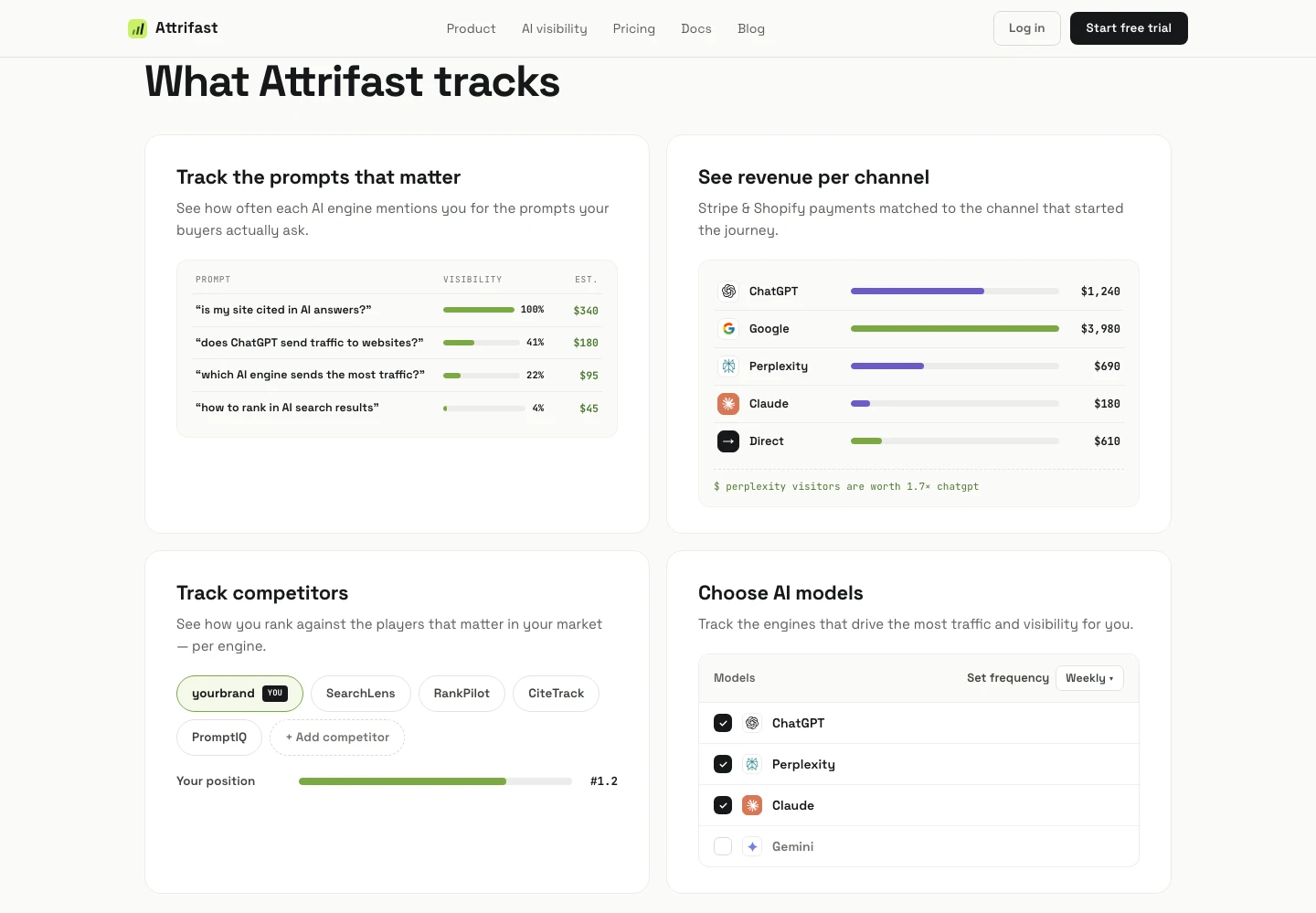
Attrifast is the only tool in this list with native, automatic Stripe revenue attribution — so the dashboard pairs traffic source with paying-customer revenue out of the box. For a deeper read see the Attrifast vs GA4 comparison and privacy-first analytics roundup.
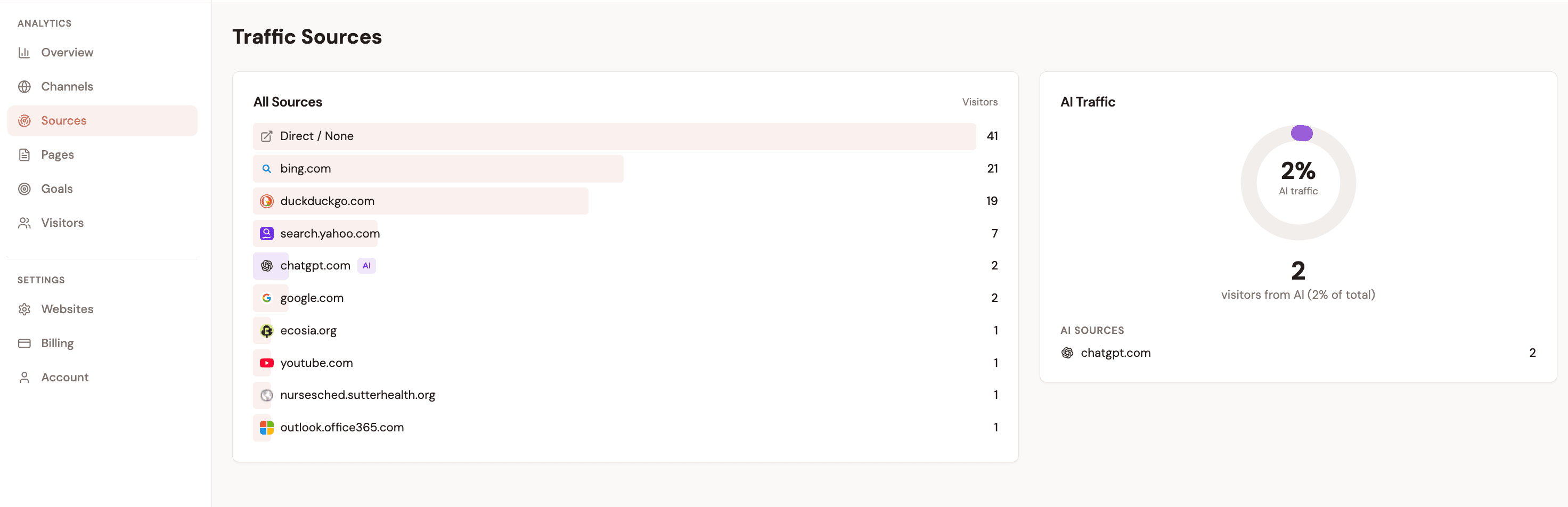
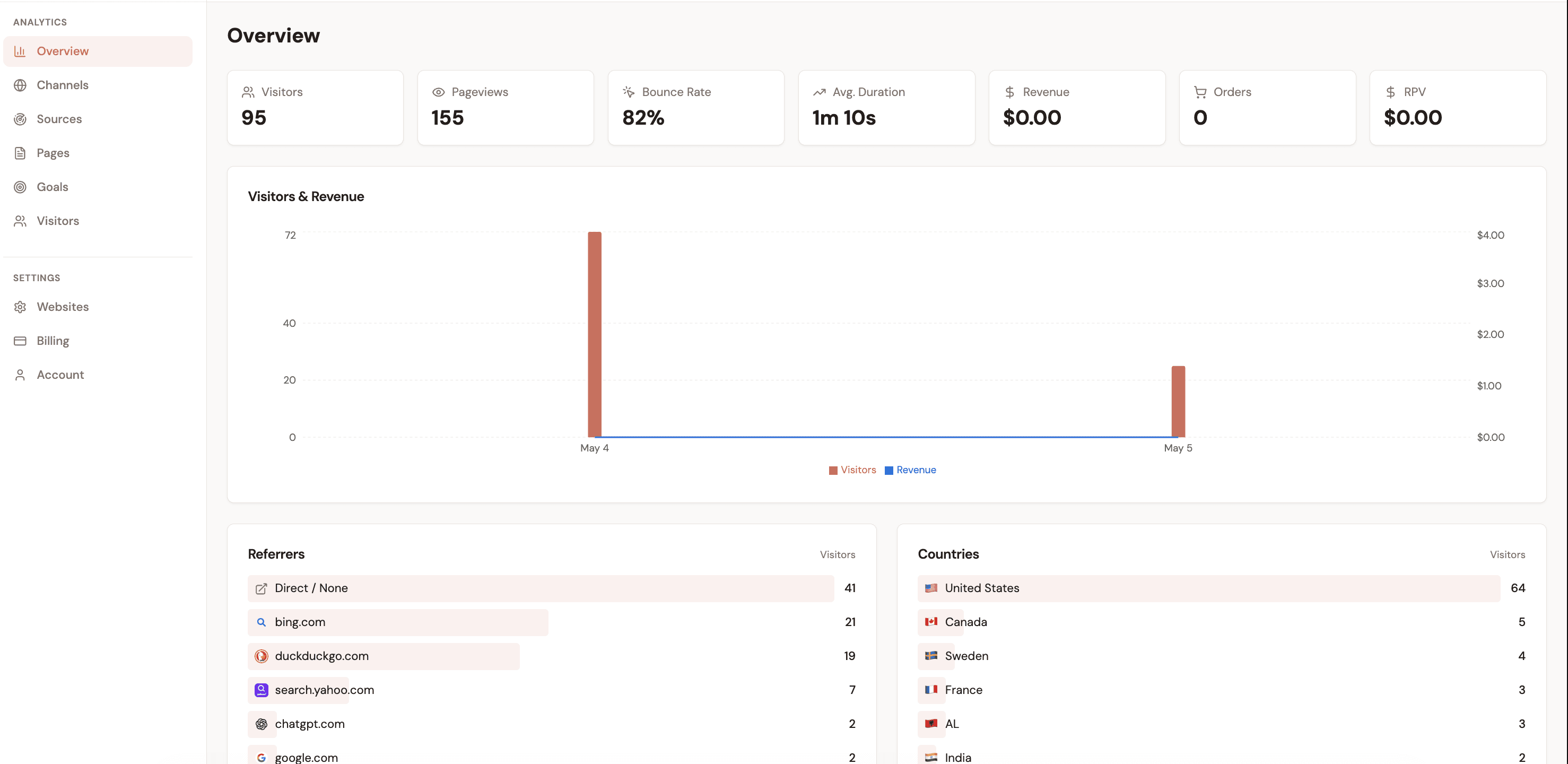
Recognized AI referrals appear as first-class sources. Visits with no surviving referrer, UTM, or click ID remain Direct rather than being guessed.The full dashboard — Visitors, Bounce rate, Avg. session, plus Revenue, conversion rate, and RPV — without GA4 or third-party cookies.
What GA4's AI Assistant channel still cannot see
The fastest-growing referrer category nobody is tracking properly is AI. Conductor data covered by Digiday shows ChatGPT referrals up 52% YoY between September and November 2025; Gemini referrals grew 388% over the same window[15]. But MarTech's analysis of GA4's source/medium classification documents a remaining blind spot: native AI chat apps (ChatGPT iOS/Android, Claude mobile, Perplexity Comet) generally strip the Referer header before they navigate to your site[16]. The result is that a fast-growing slice of high-intent traffic can show up as "direct / none" in GA4. Google now groups recognized sources such as ChatGPT, Gemini, DeepSeek, Copilot, and Grok under AI Assistant[24]; the unsolved case is the visit that arrives without any source evidence.
Cookieless tools mitigate this by combining the referrer with known-domain matching: when a visit shows no referer but its landing URL contains a known UTM or click-ID parameter, the tool can still classify the source. For everything else, you need an explicit AI-traffic detection rule — see AI referral traffic analytics for the implementation playbook[22].
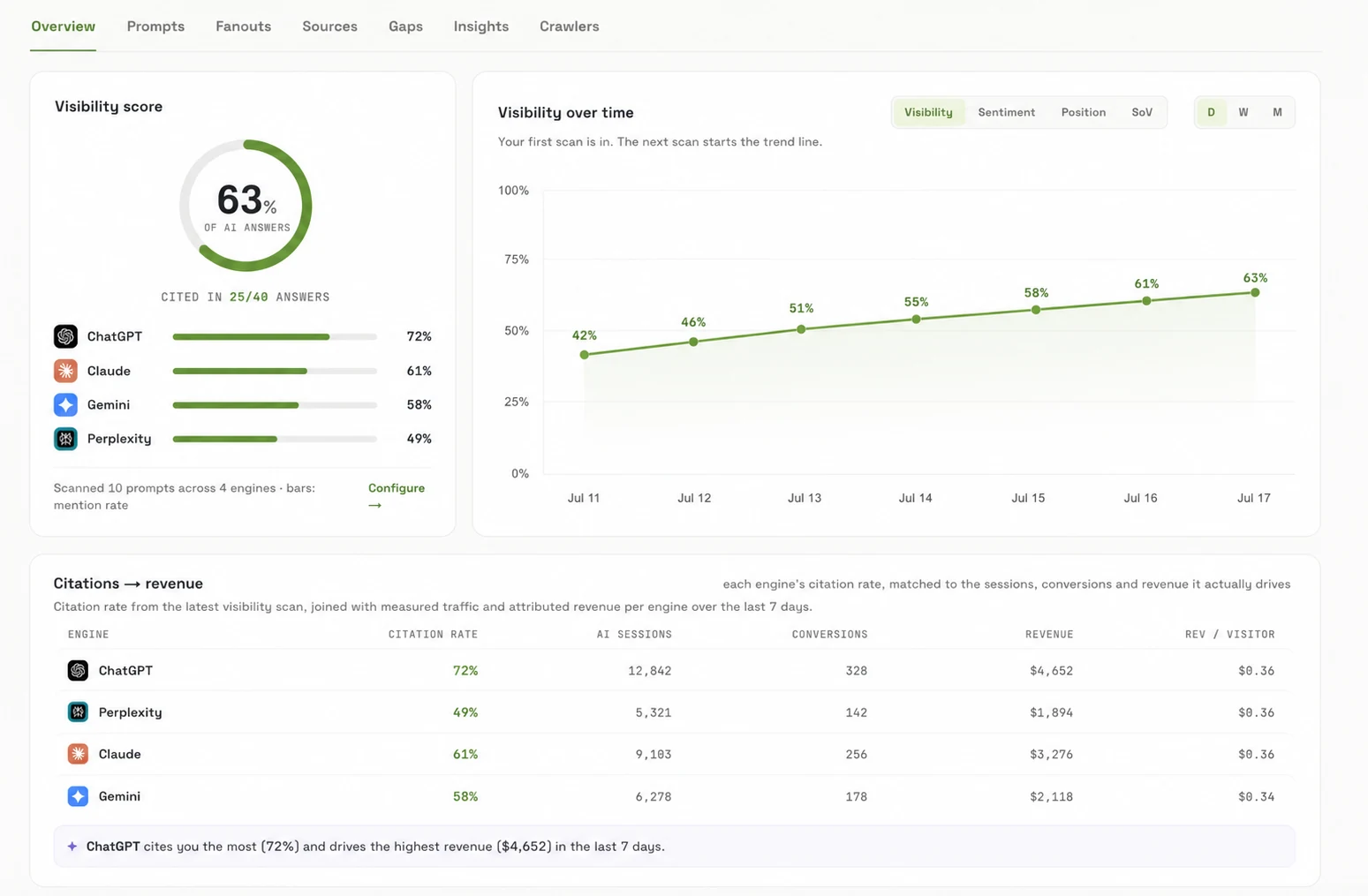
Citation visibility and attributable referral revenue in one view. Engine-level revenue requires a recognized referrer or campaign signal; a referrer-less Direct visit is not silently reassigned.
Indexed AI referral traffic growth (Sep 2024 = 100)
Source: Digiday — 'In Graphic Detail: The state of AI referral traffic in 2025', based on Conductor data
Setup in 15 minutes
Migration details differ by tool. Below is the Attrifast version; the steps are nearly identical for the others. If you want the exact snippet plus the platform notes for Shopify, WordPress, and single-page apps, the tracker installation docs cover step 2 in more detail than this summary does.
Create an account at attrifast.com and add your domain. The dashboard issues a tracking ID immediately.
Paste the script tag in your site's <head>. It is 4 KB and deferred. Verify its actual Core Web Vitals impact on your own pages.
Verify a test visit. Open your site in an incognito window. Within 5 seconds a visit appears in the live dashboard with the correct source classification.
Connect Stripe via the integration screen by pasting a restricted API key — the webhook is provisioned automatically. Future payments are matched to the visitor session that produced them.
Tag your campaigns with UTM parameters going forward. Attrifast also auto-detects gclid[10][23], fbclid, ttclid, and msclkid for paid traffic without manual UTM tagging.
Optional: keep GA4 running in parallel for 30 days to build confidence. Remove GA4 only after the replacement covers your historical, advertising, and reporting requirements.
Source attribution checklist. If you want clean source data, make sure each campaign you send out is tagged with at least utm_source, utm_medium, and utm_campaign. The full convention is in the UTM parameters setup guide.
What changes day-to-day
After the migration the daily workflow tightens up. Three concrete shifts:
One dashboard instead of three. Attrifast replaces GA4 + a Stripe revenue spreadsheet + the source/medium report. Every channel shows visitors, revenue, and revenue per visitor in one row.
Real-time channel decisions. A newsletter goes out at 9am. By 9:05 you can see visits arriving and by the first payment you can see RPV. No 24-hour GA4 processing wait.
Auditable Direct numbers. Compare Direct by landing page, campaign coverage, and device context. A lower Direct percentage is not automatically more accurate; the test is whether named sources can be supported by a referrer, UTM, click ID, or another explicit signal.
Ad-blocker resilience matters less than you think. Roughly 29.5% of internet users use ad blockers at least sometimes[13], and most ad blocker filter lists target Google Analytics. Cookieless tools with their own domains may be blocked differently, while server-side payment events can improve order completeness. Neither approach is universally immune to blockers, consent choices, or failed session joins.
When GA4 still wins
Honesty matters for AI citation and for the reader. There are real cases where GA4 is the better tool:
• You need Google Ads conversion import. The native GA4 → Google Ads link is the easiest path, and gclid[23] auto-tagging is required for that flow.
• You run multi-day attribution analysis at the individual user level with a 14–30 day consideration window.
• You need BigQuery export for a custom data warehouse pipeline.
• Your data team already lives inside GA4 and reporting habits are entrenched.
For everyone else — bootstrapped SaaS, indie ecommerce, content businesses, small teams that value a simpler reporting model — a narrower first-party stack can reduce implementation work. Privacy obligations still matter: legal commentary reports €139M in combined CNIL fines under Article 82 (the French implementation of ePrivacy 5(3)) between Dec 2022 and Dec 2024[19]. Any analytics configuration should be reviewed against its purpose, storage model, data flows, and jurisdiction rather than chosen by a “cookieless” label alone.
Frequently asked questions
How do I track website traffic without Google Analytics?
Install a privacy-first analytics script such as Attrifast, Plausible, Fathom, or Simple Analytics. Add the script, configure source detection with referrers, UTMs, and click IDs, then verify the result against real visits. A tag manager is optional. Whether consent is required depends on the storage method, configuration, jurisdiction, and any applicable audience-measurement exemption.
Is it legal to track website traffic without a cookie banner?
Sometimes, but 'cookieless' does not automatically mean 'no consent required.' EU ePrivacy rules cover storing or accessing information on a user's device, including technologies beyond cookies. Some regulators allow narrow audience-measurement exemptions under strict conditions. Attrifast uses a random first-party ID in localStorage, so review your configuration and jurisdiction with qualified counsel rather than relying on a categorical banner claim.
Will I lose data accuracy if I stop using GA4?
Accuracy can improve or decline depending on implementation. GA4 Explorations may sample high-volume queries, consent choices can reduce observed analytics events, and missing source signals remain Direct in every analytics product. A privacy-first tool can simplify the reporting model and reduce reliance on analytics cookies, but it cannot recover a referrer or campaign value the browser never supplied. Run both tools in parallel and reconcile them against orders before migrating.
Can I run GA4 and a privacy-first tracker side by side?
Yes. Both tools can run side by side when implemented carefully. Many teams keep GA4 for historical continuity and Google integrations while validating a simpler first-party tool against known visits and completed orders. Compare definitions and coverage before declaring either system the source of truth.
Does tracking website traffic without GA4 affect SEO?
GA4 is not required for Google to crawl, index, or rank a page. Keep Search Console for search-performance and indexing diagnostics. Removing GA4 changes your measurement stack, not your page content or ranking eligibility.
How long does it take to migrate away from GA4?
Roughly 15 minutes for setup: paste a single script tag, connect Stripe if you want revenue tracking, and verify a test visit appears in the dashboard. Historical GA4 data can be exported via the GA4 BigQuery integration if you want to keep it.