# Where Does Google AI Get Its Information? (2026)
> Google AI pulls from 4 distinct sources: web crawl, Knowledge Graph, live SERP citations, and Gemini training data. Each has different freshness and levers.
Author: Vincent Ruan (https://x.com/0xVinceAI)
Publisher: Attrifast — https://attrifast.com
Last updated: 2026-08-01
Canonical: https://attrifast.com/blog/where-does-google-ai-get-its-information
**TL;DR**
- Google AI is 4 sources stitched together: the live web crawl, the Knowledge Graph, real-time AI Overviews citations, and Gemini's frozen training corpus. Each has a different update cadence and a different lever.
- The live crawl + AI Overviews citations are the fast surfaces. Fresh content can be cited in roughly 24-72 hours when it ranks top-10 organic for the query (directional, not a guarantee).
- Knowledge Graph entity updates lag schema deploys by 4-12 weeks. Wikidata + Organization schema + sameAs is the standard playbook.
- Gemini's training corpus is the slow surface. Cutoffs are roughly every 6-12 months. Google-Extended in robots.txt is the opt-out lever.
- AI Overviews synthesizes at query time, not from training data. That is why corrections propagate fast for live citations and slow for Gemini chat answers.
- **Want to know which Google AI surface is actually sending you revenue? [See Attrifast's done-for-you SEO + GEO content engine](/seo) →** [Start free trial](/login)
Google AI is not one model with one memory. It is a stack of four information sources stitched together at query time. The live web crawl and search index handle freshness (hours to days). The Knowledge Graph handles entities and relationships (weeks). AI Overviews synthesizes a per-query answer from 4-7 retrieved sources (real-time). Gemini's training corpus handles background knowledge (frozen until the next model). Three of the four are influenceable today; one is locked until Google ships a new Gemini generation. Most operators only optimize for one of them and wonder why their brand shows up wrong in the other three.
## Quick Facts
| Source | Update cadence | Primary lever |
|---|---|---|
| Live web crawl + search index | Hours to days | Indexable content + crawl-budget signals |
| Knowledge Graph | Weeks (4-12 lag typical) | Organization / Person schema + Wikidata + sameAs |
| AI Overviews citations | Real-time, per query | Top-10 organic rank + Direct Answer + question H2s |
| Gemini training corpus | Every 6-12 months (model-cycle) | Google-Extended robots.txt + index well before training cutoff |
| Citations per AI Overview block | 4-7 sources | — |
| Google-Extended user agent introduced | September 2023 | — |
| AI Overviews appearance rate (Ahrefs, 146.1M SERPs, Sept 2025) | 20.5% of SERPs; Conductor measured 25.11% of 21.9M searches (Sept-Oct 2025) | — |
I have spent the last six months watching this 4-way split play out on attrifast.com and three client properties. A common confusion among operators: assuming "Google AI" means Gemini, and that influencing Gemini means waiting for the next training run. That misses the three faster surfaces. Most of the wins on AI Overviews citations and Knowledge Panel updates land inside a quarter; only the deep training-corpus answers run on annual cycles.
## Google AI is not one thing — it's 4 information sources stitched together
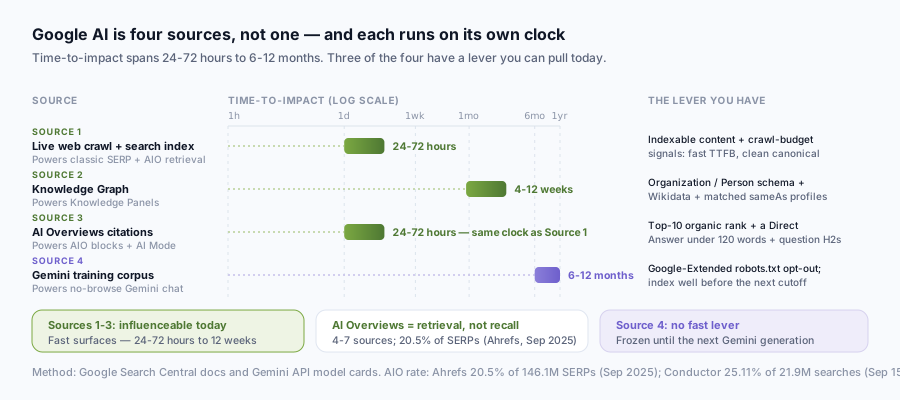
When someone asks "where does Google AI get its information?", they are usually conflating four different systems Google runs in parallel. Each surface in the Google ecosystem (classic SERP, AI Overviews, AI Mode chat, Knowledge Panels, Google Lens, the Bard-now-Gemini chatbot) draws from a different mix of the four.
The four sources, listed by update speed:
1. **Live web crawl + search index** — Googlebot crawls hundreds of billions of pages on a rolling basis, updating the canonical search index that classic blue links draw from. The crawl frequency varies roughly 1000x between high-authority news sites (hours) and long-tail blogs (weeks), per [Ahrefs Googlebot research](https://ahrefs.com/blog/googlebot/).
2. **Knowledge Graph** — A structured database of entities (people, companies, places, products, concepts) and the relationships between them. Updates from new web data, schema.org markup, Wikidata, and editorial curation. The lag from schema deploy to a visible Knowledge Panel change is roughly 4-12 weeks based on industry observation; Google does not publish a target.
3. **AI Overviews real-time citations** — When an AI Overview appears on a SERP, [Google synthesizes the answer at query time](https://blog.google/products/search/generative-ai-google-search-may-2024/) from 4-7 sources pulled from the live index. The synthesis itself uses Gemini, but the factual claims come from pages indexed today, not from training data.
4. **Gemini training corpus** — The frozen text-and-image data Gemini learned from during pre-training. Per [Google's Gemini API model cards](https://ai.google.dev/gemini-api/docs/models), the Gemini 2.5 family has a training cutoff in early 2025. Anything published after that cutoff is invisible to the model's background knowledge until the next generation ships.
```mermaid
flowchart TD
A[User query] --> B{Which Google surface?}
B -->|Classic SERP| C[Source 1: Live web crawl + index]
B -->|Knowledge Panel| D[Source 2: Knowledge Graph]
B -->|AI Overview / AI Mode| E[Source 3: Real-time citations from Source 1]
E --> F[Gemini synthesizes the prose]
F --> G[Source 4: Training corpus disambiguates + phrases]
B -->|Gemini chat with browsing off| H[Source 4 only]
```
The diagram captures something most playbooks miss: AI Overviews depends primarily on Source 1 (the live index) for facts, with Source 4 (training data) doing the prose-shaping. That is why a brand-new article can show up in an AIO citation within days but cannot show up in a no-browsing Gemini chat answer for months.
A short caveat. Google does not publish the exact composition of any of these systems. What follows is inferred from Google's published documentation, the schema.org standard, and observable behavior across our own measurement. The full training corpus composition is not publicly disclosed in detail — that is one of the things to live with when working in this niche.
## Source 1 — The live web crawl and search index

This is the oldest and largest of the four. Googlebot crawls the public web on a rolling basis and writes pages into the search index. Both classic SERP and AI Overviews retrieval rely on this index — when AIO picks 4-7 sources to cite for a query, it picks from the same index that ranks the blue links.
The crawl mechanics, per [Google's crawler documentation](https://developers.google.com/search/docs/crawling-indexing/google-common-crawlers):
| Crawler | Purpose | Respects robots.txt? |
|---|---|---|
| Googlebot | Standard search index (mobile + desktop) | Yes |
| Googlebot-News | News surfaces (faster cadence) | Yes |
| Google-Extended | Gemini training + Bard | Yes (separate user agent) |
| GoogleOther | Internal R&D | Yes |
| Google-InspectionTool | Search Console / Rich Results test | Yes |
The crawl-frequency variance is the part most operators underestimate. A site like nytimes.com or stripe.com sees Googlebot multiple times a day. A low-authority blog might see it every 2-4 weeks. The 1000x variance comes from authority signals (backlink graph, prior crawl-to-index conversion rate, server response time, and the broader [helpful-content classifier signals](https://developers.google.com/search/docs/fundamentals/creating-helpful-content)).
What this means in practice. If you publish a new article tonight, the time-to-citation in AI Overviews depends almost entirely on how often Googlebot already visits your domain. Sites that already rank well for adjacent queries get re-crawled within 24-72 hours of a new publish; sites starting from zero authority may wait weeks. That 24-72 hour figure is a directional estimate from observing our own and client publications — not a guarantee, and not a published Google SLA.
The lever for Source 1 is straightforward: ship indexable content (no `noindex`, fast TTFB, clean canonical), build the kind of links and engagement that move Googlebot to crawl you more often, and make sure structured data is present so the index understands what each page is. The [which backlinks drive revenue analysis](/blog/which-backlinks-drive-revenue) covers what kind of links actually move ranking versus what just looks impressive.
## Source 2 — The Knowledge Graph (entities, weeks to update)
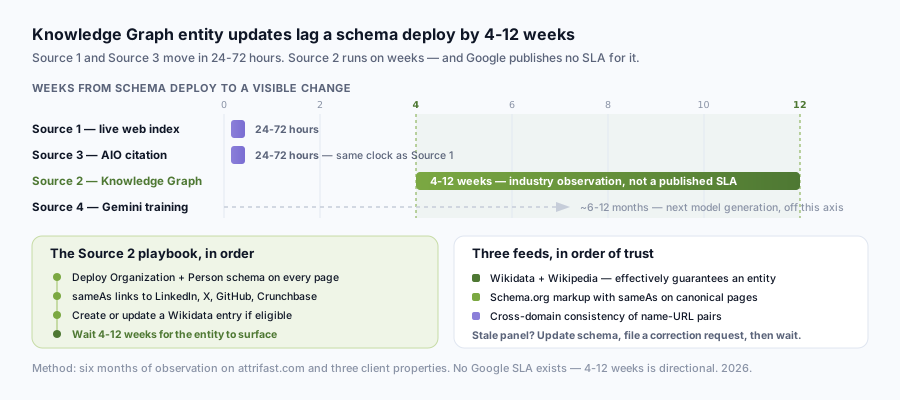
The Knowledge Graph is Google's structured entity database. When you search "attrifast" and see a panel on the right with the founder's name, the company description, and links to social profiles, that comes from the Knowledge Graph, not from the live web index.
Knowledge Graph entities come from three feeds, in roughly this order of trust:
1. **Wikidata + Wikipedia.** The single highest-trust feed. A Wikidata Q-number entry effectively guarantees a Knowledge Graph entity. Wikipedia presence amplifies it.
2. **Schema.org markup on the entity's canonical web pages.** `Organization`, `Person`, `Product`, `LocalBusiness` schema with `sameAs` links pointing at matched external profiles.
3. **Cross-domain consistency.** Name-URL pairs that match across LinkedIn, X, GitHub, Crunchbase, etc. without inconsistencies.
Per [Google's Knowledge Panel documentation](https://support.google.com/knowledgepanel/answer/9787176), Knowledge Panel verification and updates run on Google's own cadence — not a published SLA. Industry pattern across the operators I have worked with: a new Organization schema deploy with strong sameAs starts showing in Knowledge Graph entity references in roughly 4-12 weeks. Some land in days; some never land at all because the entity is too new or ambiguous. Hedge it as a directional estimate, not a guarantee.
The `sameAs` property from [schema.org](https://schema.org/sameAs) is the linchpin. It is the explicit signal that says "this entity at URL A is the same entity at URL B." Without it, Google has to infer entity-merging from text patterns. With it, the merge is declared.
A worked example for a SaaS brand:
```html
```
This is the schema bundle that gets a new brand into the Knowledge Graph fastest. The full GEO playbook with `Person` + `Article` + `FAQPage` schema lives in the [how to get cited by AI engines deep-dive](/blog/how-to-get-cited-by-ai-engines). For brands that already have a Knowledge Panel but show stale info, the fix path is different: update the schema, file a Knowledge Panel correction request via [Google's official correction flow](https://support.google.com/knowledgepanel/answer/7534842), and wait.
The Knowledge Graph is also the source that fuels disambiguation when Gemini answers a question about a named entity. If Gemini knows "Attrifast" is the SaaS founded by Vincent Ruan (via Knowledge Graph), it will phrase answers about Attrifast differently from a model that has never heard the name. That feeds back into Source 4.
## Source 3 — Live AI Overviews citations (real-time, per query)
This is the most-talked-about and most-misunderstood of the four. When an AI Overview appears at the top of a Google SERP, the 4-7 cited sources are not pulled from Gemini's training corpus. They are retrieved from the live search index in real time, at the moment the user types the query.
The flow, per [Google's documentation of generative AI in Search](https://blog.google/products/search/generative-ai-google-search-may-2024/):
1. User submits the query.
2. Google's AIO classifier decides whether the query is a good fit for a generative summary. Per [Ahrefs' 146.1-million-SERP study](https://ahrefs.com/blog/ai-overview-triggers/), this fires on 20.5% of SERPs crawled in September 2025; [Conductor](https://www.conductor.com/academy/aeo-geo-benchmarks-report/) measured 25.11% across 21.9 million Google searches sampled September 15 to October 12, 2025.
3. If yes, the retrieval layer picks 4-7 sources from the live index — almost always pages in the top-10 organic ranking for the query.
4. Gemini synthesizes a 1-3 paragraph answer from those sources, with inline citations.
5. The block renders above the classic blue links.
The key point. Source 3 is fundamentally a retrieval system on top of Source 1. The Gemini model handles the synthesis and the phrasing; the facts come from pages indexed in the last hours or days. That is why citation can update within a 24-72 hour window for fresh content on well-indexed domains. We get into the citation mechanics in more depth in [the AI Overviews ranking and citation breakdown](/blog/ai-overviews-google).
The five signals that move citation likelihood, observed across [Ahrefs](https://ahrefs.com/blog/ai-overview-citations-top-10/) and [Semrush](https://www.semrush.com/blog/ai-citations/) research on AIO:
1. Existing top-10 organic rank (Ahrefs measured 37.9% of AIO citations coming from top-10 pages across 863K SERPs, down from ~76% a year earlier)
2. Article + FAQPage + HowTo schema bundle present
3. Direct Answer paragraph under 120 words near the top of the page
4. Question-shaped H2 headers matching conversational queries
5. Entity disambiguation via Organization + Person + sameAs schema
Notice how Source 3 leans on signals from Source 1 (rank) and Source 2 (schema + sameAs). The three are not independent surfaces — they compound. A page that has all five signals is cited dramatically more often than a page with one or two.
One honest hedge that bears repeating. The 24-72 hour citation window is observed pattern across our own publications and client sites, not a Google-published metric. On a low-authority domain with weak crawl signals, the same article might take 2-3 weeks to appear in an AIO citation. The window is bounded by Source 1's crawl cadence on your specific domain, not by an AIO-specific clock.
## Source 4 — Gemini training data (frozen until next model)
Source 4 is the slowest of the four and the only one without a fast lever. Gemini's training corpus is the text and image data the model learned from during pre-training. Once a model generation ships, that corpus is frozen until Google trains a new generation.
Per [Google's Gemini API model documentation](https://ai.google.dev/gemini-api/docs/models), each Gemini generation has a published training cutoff. The Gemini 2.5 family has a cutoff in early 2025. Anything published after that cutoff is invisible to Gemini's base-model knowledge — the model literally does not know it exists — unless one of three things happens:
1. Browsing is enabled and the model retrieves the fresh content at query time (turning Source 4 questions into Source 1 questions on the fly).
2. A grounding layer like AI Overviews retrieval feeds it the fresh source at query time (Source 3 again).
3. Google trains a new generation that includes the post-cutoff content.
The training-corpus composition is not publicly disclosed in detail. What Google has published: the corpus draws from large-scale public web text, code repositories, books, and curated multimodal data. Much of the composition is inferred from observable behavior — what Gemini "knows" suggests what it was trained on, but the exact mix and weights are not in public docs.
Two levers exist, both indirect:
**Lever 4a — `Google-Extended` opt-out.** Google introduced the [`Google-Extended` user agent in September 2023](https://developers.google.com/search/docs/crawling-indexing/google-common-crawlers) specifically so publishers can opt out of Gemini training while still allowing classic Googlebot indexing. Add to `robots.txt`:
```
User-agent: Google-Extended
Disallow: /
```
This blocks training-data scraping but does not block search-index crawling. Use it only if you actively want to be invisible to Gemini's background knowledge — the more common scenario for SaaS brands is the opposite (you want Gemini to know you exist).
**Lever 4b — Index well before the next training cutoff.** This is the inverse: make sure your content is in Source 1 and Source 2 well before Google freezes the next training generation, so it gets included. Cutoffs are not announced in advance, but the pattern across Gemini generations has been roughly every 6-12 months. If you ship a major positioning change or a new product, you want the canonical pages indexed and the Knowledge Graph entity stable for at least 3-6 months before any plausible next-generation cutoff.
A specific failure mode worth naming. We shipped a significant update to Attrifast's plans and positioning on 2026-05-09. If you ask a no-browsing Gemini chat session today (2026-05-10) "what does Attrifast offer?", it will likely answer with the old positioning, because the update postdates the Gemini 2.5 training cutoff. Source 1, Source 2, and Source 3 will start reflecting the change within weeks; Source 4 will not refresh until the next Gemini generation ships. There is no fast fix for that gap. You just live with it.
For the operator-side angle on this — what Google actually knows about a person or a brand at any given moment — the [does Google know everything breakdown](/blog/does-google-know-everything) covers the full identity-surface mechanics, not just the AI half.
## The 4-source comparison table
Side-by-side, the four sources look like this:
| Dimension | Source 1: Live Index | Source 2: Knowledge Graph | Source 3: AI Overviews | Source 4: Gemini Training |
|---|---|---|---|---|
| Update cadence | Hours to days | Weeks (4-12 lag typical) | Real-time, per query | Every 6-12 months |
| Primary lever | Indexable content + crawl signals | Org/Person schema + Wikidata + sameAs | Top-10 rank + Direct Answer + schema | Google-Extended robots.txt; index pre-cutoff |
| Time-to-impact | 24-72 hours (well-indexed sites) | 4-12 weeks (industry observation) | 24-72 hours (same as Source 1) | Until next model generation ships |
| Influenceable today? | Yes | Yes | Yes | Indirectly |
| Powers which surfaces? | Classic SERP, AIO retrieval | Knowledge Panels, entity disambiguation | AIO blocks, AI Mode | Gemini chat (no-browse), background knowledge for AIO synthesis |
| Citation visibility | Yes (you see ranking) | Yes (Knowledge Panel) | Yes (inline citation) | No (synthesized, no attribution) |
The table is the practical map. Three of the four surfaces give you measurable feedback (you can watch rank, watch the Knowledge Panel, watch AIO citations). The fourth is a black box — you cannot see when Gemini's background knowledge updates because the model does not surface citations for training-derived claims.
```
Time-to-impact, log scale (hours → years)
Source 1: Live index |█▌ | ~24-72h
Source 3: AIO citation |█▌ | ~24-72h (depends on Source 1)
Source 2: Knowledge Graph | █████████ | ~4-12 weeks
Source 4: Gemini training | ████████████| ~6-12 months (next gen)
1h 1d 1wk 1mo 6mo 1yr
```
Typical observed time-to-impact for an influence action on each of the 4 Google AI sources. Source 1 and Source 3 share a clock because Source 3 is a retrieval layer on top of Source 1. Source 4 runs on Google's training cadence, which no operator can accelerate.
## Which lever to pull for which goal — a decision tree
Most operators want one of four outcomes from Google AI. Each maps to a different lever.
{/* interactive: decision-tree */}
```mermaid
flowchart TD
A[What outcome do you want?] --> B{Goal?}
B -->|Get cited in an AI Overview this quarter| C[Source 3 path]
B -->|Build a Knowledge Panel for the brand| D[Source 2 path]
B -->|Make sure Gemini knows the brand exists in the next model generation| E[Source 4 path]
B -->|Fix wrong info Gemini is currently saying about the brand| F[Hybrid path]
C --> C1[Rank top-10 organic for the target query first]
C1 --> C2[Add Article + FAQPage + HowTo JSON-LD]
C2 --> C3[Direct Answer ≤120 words near top of page]
C3 --> C4[Question-shaped H2 headers]
C4 --> C5[Expect citation in 24-72 hours after rank stabilizes]
D --> D1[Deploy Organization + Person schema on every page]
D1 --> D2[sameAs links to LinkedIn, X, GitHub, Crunchbase]
D2 --> D3[Create or update Wikidata entry if eligible]
D3 --> D4[Wait 4-12 weeks for Knowledge Graph entity to surface]
E --> E1[Ship canonical brand pages 3-6 months before next cutoff]
E1 --> E2[Get Knowledge Graph entity stable Source 2]
E2 --> E3[Earn high-trust external mentions docs forums GitHub]
E3 --> E4[Wait for next Gemini generation usually 6-12 months]
F --> F1[Update Source 1 + Source 2 with the correct info]
F1 --> F2[Earn AIO citations on related queries Source 3]
F2 --> F3[File Knowledge Panel correction if there is a Panel]
F3 --> F4[Accept Source 4 lag until next model ships]
```
The decision tree captures one thing the comparison table does not: the four paths have different prerequisites. The Source 3 path requires you to already have ranking strength on the target query. The Source 2 path requires entity-disambiguation discipline. The Source 4 path requires patience and a head-start before the next training cutoff lands. None of them is hard individually; the hard part is recognizing which one applies to your actual goal.
For a SaaS brand that has shipped a positioning change in the last 90 days, you almost certainly want the hybrid path (F). Source 1 will reflect the change in days, Source 2 in weeks, Source 3 will start citing the new positioning within the same window — and Source 4 will lag until the next Gemini generation. The lag is unfixable; the only thing that matters is making sure 1, 2, and 3 are correct so that grounded surfaces (AI Mode, AIO) tell the right story even while the no-browsing Gemini chat is stale.
## Measuring whether any of this actually moved revenue
The honest part. None of the four sources is currently measurable end-to-end inside GA4.
GA4 lumps AI Overviews citation clicks as Direct/(none) — Referer headers are stripped, no UTM parameters are appended, and the destination URL is your canonical URL. Per [our breakdown of GA4 attribution limitations](/blog/cookieless-tracking-solutions), the same gap applies to ChatGPT and Perplexity referrals, with one difference: Perplexity usually preserves the Referer, ChatGPT often does not, AI Overviews almost never does.
What you can measure today, surface by surface:
- **Source 1 visibility.** Standard SEO tooling. [Google Search Console's coverage and performance reports](https://support.google.com/webmasters/answer/7451184) tell you which pages are indexed and how they rank.
- **Source 2 visibility.** Manually inspect Knowledge Panel presence and content. Set up Brand Mention monitoring on your entity name. Wikidata and Crunchbase changes are observable.
- **Source 3 visibility.** Search Console added a "Search Appearance: AI Overview" dimension in late 2025 — it shows impressions of pages cited inside AIO blocks. Click-side is still broken (Direct/(none)) but impression-side works.
- **Source 4 visibility.** Effectively zero. You can spot-check by querying Gemini directly with browsing disabled and seeing what it knows, but there is no systematic monitoring.
The piece GA4 cannot do — joining an AI-referral click back to a Stripe payment so you know which Google AI surface actually moved revenue — is the gap that motivated the attrifast first-party tracking architecture. A 4KB cookieless script drops a first-party session ID on the landing page, scoped to your own domain so ITP and Total Cookie Protection do not touch it. A Stripe webhook handler joins the session back to a `checkout.session.completed` event server-side, which means the join works even across the days-to-weeks gap between visit and conversion. The same architecture is documented in more depth on [the revenue attribution feature page](/features/revenue-attribution).
I will not publish per-source RPV numbers yet. We have not shipped the AIO-specific detection layer on attrifast.com yet, and the SaaS analytics niche is full of fabricated case-study figures. The architecture is the part that is publishable today; the numbers are 90 days out.
## Limitations
- **No published AIO-source RPV numbers from attrifast yet.** The detection layer is on the roadmap. Treat any vendor's "we drove X% revenue from AI Overviews" claim with skepticism if they cannot show you the detection rules.
- **24-72 hour citation window and 4-12 week Knowledge Panel lag are directional estimates, not Google SLAs.** Your actual times depend on your domain authority, crawl frequency, and entity disambiguation strength. Some sites are faster; some are dramatically slower.
- **Training-corpus composition is not publicly disclosed in detail.** What this article says about Source 4 is inferred from Google's documentation and observable model behavior, not from a Google-published spec.
- **Source 4 has no fast lever.** If Gemini is repeating outdated information in a no-browsing chat session, you cannot force a refresh. You can only update Sources 1-3 and wait for the next generation.
- **The AI Overviews appearance rate is tracker-dependent, not a Google-published number.** Ahrefs 20.5% of 146.1M SERPs (September 2025), Conductor 25.11% of 21.9M searches (September-October 2025), Semrush under 16% (November 2025), Similarweb 43%+ for the US (mid-2026, sample not published). Verified against the publishers' pages on 2026-08-01. Other languages and regions also have different rollout schedules. The four-source structure applies globally, but the per-source visibility metrics in Search Console differ by locale.
- **The decision tree assumes you already have ranking strength.** If you are starting from a brand-new domain with no organic visibility, the Source 3 path takes longer than 24-72 hours — it takes however long it takes to earn top-10 rank in the first place.
## FAQ
### Where does Google AI actually get its information from?
Google AI is not a single system. It stitches together four distinct sources: (1) the live web crawl and search index that Googlebot updates hours-to-days fresh, (2) the Knowledge Graph of entities and relationships, which updates on a scale of weeks, (3) real-time AI Overviews citations synthesized at query time from top SERP results, and (4) Gemini's frozen training corpus, which only refreshes when Google ships a new model. Each source has a different freshness and a different lever for influencing what Google AI knows about you.
### Is AI Overviews drawing from Gemini's training data?
Mostly no. Per Google's published documentation on AI features in Search, AI Overviews are synthesized at query time from the same web index that powers the classic SERP. The Gemini model contributes the language synthesis and reasoning, but the factual content comes from the 4-7 cited sources retrieved fresh for each query. Training data influences how Gemini phrases the answer and what background knowledge it brings to disambiguation, but the citable facts come from the live index. This is also why citations can update within 24-72 hours of new content publication, while training-data answers are frozen until the next model generation.
### How do I get my brand into Google's Knowledge Graph?
Three signals move the needle: Organization schema with sameAs links pointing at 4+ matched identity profiles (LinkedIn, X, GitHub, Crunchbase), a Wikidata entry (which often seeds Knowledge Graph entries), and consistent name-address-phone or name-URL pairs across high-trust mentions. The lag from schema deploy to a visible Knowledge Panel update is roughly 4-12 weeks based on industry observation, not a guarantee. The full mechanics live in our get cited by AI engines deep-dive.
### Can I opt out of Gemini training data?
Yes, partially. Google introduced the Google-Extended user agent in September 2023 specifically so publishers can disallow training-data scraping while still allowing classic Googlebot indexing for search. Add `User-agent: Google-Extended` plus `Disallow: /` to your robots.txt and Gemini will not train on the disallowed paths. The catch: opting out also reduces the chance that Gemini ever learns your brand exists as background context for future answers. Most operators should opt in for visibility and accept the tradeoff.
### Why does Google AI sometimes say outdated things about my brand?
Because three of the four sources can update quickly but the fourth (Gemini training data) cannot. If Google AI is repeating a pricing claim, a feature description, or a positioning line that is no longer true, it almost certainly comes from training data that froze before your update shipped. Levers to fix it: get the corrected information into the live index (so AI Overviews can cite the fresh version), update Wikidata if there is an entry, and wait. Gemini training cutoffs are roughly every 6-12 months, so the frozen claim will refresh on the next model generation.
## Related reading from the Attrifast research stack
For a deeper dive on related ground, see [What Does Google Know About Me? (2026 Inventory)](/blog/what-does-google-know-about-me). For hands-on tools and deeper context, see [AI citation tracking](/features/ai-citation-tracking), [GEO (generative engine optimization)](/geo), and [track AI Overviews](/track-ai-overviews).
## Sources
## Sources
1. [Generative AI in Search: Let Google do the searching for you](https://blog.google/products/search/generative-ai-google-search-may-2024/) — Google, 2024
2. [Google common crawlers documentation](https://developers.google.com/search/docs/crawling-indexing/google-common-crawlers) — Google Search Central, 2024
3. [Creating helpful, reliable, people-first content](https://developers.google.com/search/docs/fundamentals/creating-helpful-content) — Google Search Central, 2024
4. [Knowledge Panel verification and updates](https://support.google.com/knowledgepanel/answer/9787176) — Google, 2024
5. [Suggest a change to a Knowledge Panel](https://support.google.com/knowledgepanel/answer/7534842) — Google, 2024
6. [Gemini API model cards](https://ai.google.dev/gemini-api/docs/models) — Google AI for Developers, 2025
7. [sameAs property documentation](https://schema.org/sameAs) — Schema.org, 2025
8. [What triggers AI Overviews? 86 factors and 146 million SERPs analyzed (20.5% of SERPs, September 2025)](https://ahrefs.com/blog/ai-overview-triggers/) — Ahrefs, 2025
9. [How Googlebot crawls the web: a complete guide](https://ahrefs.com/blog/googlebot/) — Ahrefs, 2024
10. [Update: 38% of AI Overview citations pull from the top 10](https://ahrefs.com/blog/ai-overview-citations-top-10/) — Ahrefs, 2026
11. [What Are AI Citations and How Do I Get Them?](https://www.semrush.com/blog/ai-citations/) — Semrush, 2025
12. [Search Console performance and coverage reports](https://support.google.com/webmasters/answer/7451184) — Google Search Central, 2025
13. [Webhooks and event-driven integrations](https://docs.stripe.com/webhooks) — Stripe, 2025
14. [How people read on the web](https://www.nngroup.com/articles/how-users-read-on-the-web/) — Nielsen Norman Group, 2024